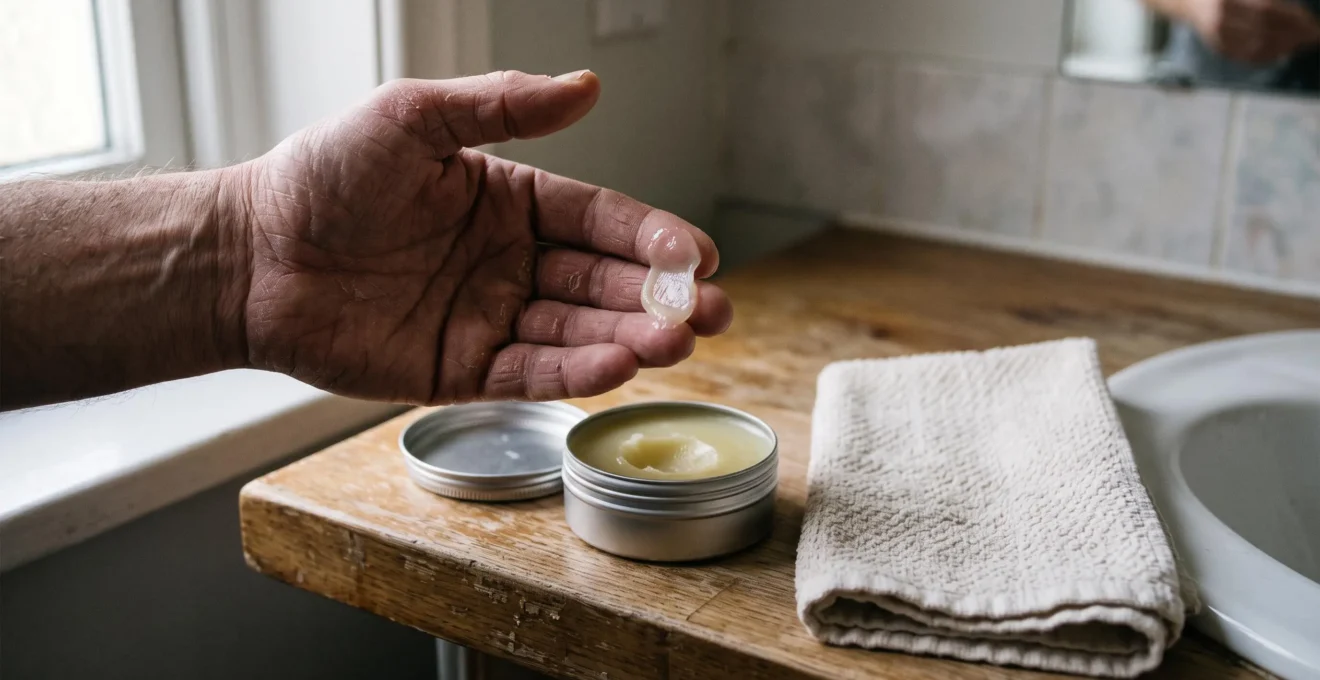
A rich CBD balm protects dry skin primarily through its texture and supporting ingredients, not through cannabidiol alone. Waxes, oils, and other occlusive components form a thin surface film that helps limit moisture evaporation and reduces direct contact with everyday environmental exposure. This makes a dense balm particularly useful on hands, knuckles, elbows, and other areas where dryness persists despite regular moisturizing.
The distinction matters because dry skin does not always need more active ingredients. Sometimes it needs a better way to retain the moisture already present. A lightweight lotion may provide comfortable hydration, while a richer balm adds a more persistent protective coating.
However, a protective film is not the same as rebuilding the skin’s natural barrier. Its benefits depend on the complete formulation, the condition of the skin, and how the product is applied. Understanding those differences makes it easier to choose an appropriate CBD texture without assuming that a stronger CBD concentration necessarily means better protection.
Rich CBD balm and dry skin: the essentials
- Occlusive ingredients such as waxes and petrolatum help limit moisture loss by forming a protective surface film; CBD itself is not the main barrier-forming ingredient.
- Dense balms are generally better suited to localized, persistently dry areas, while lighter lotions and serums are more comfortable for broad coverage.
- Apply a small amount to slightly damp, intact skin and avoid using an unfamiliar CBD balm on weeping, potentially infected, or acutely reactive areas.
- Why Is the Skin Barrier So Important in CBD Topical Formulation?
- Why Does Healthy Skin Block Many Ingredients from Penetrating Deeply?
- Why Do Thick CBD Balms Stay on the Skin Longer Than Lightweight Serums?
- How Can You Apply a Rich CBD Balm Without Leaving an Uncomfortably Heavy Layer?
- CBD Balm or Lotion: Which Texture Better Protects Very Dry Skin Areas?
- When Should You Avoid Covering Irritated Skin with a Heavy CBD Balm?
- When Is It Worth Switching from a CBD Lotion to a More Protective Balm?
- Rich CBD Balm or Lightweight Serum: Which Better Fits Your Application Area?
Why Is the Skin Barrier So Important in CBD Topical Formulation?
The skin barrier is important in CBD topical formulation because it controls both moisture loss and exposure to external substances. When its natural lipid structure is disrupted, water escapes more readily and skin becomes more vulnerable to irritation. A rich CBD balm can provide temporary external protection through its occlusive ingredients, although it does not automatically restore the skin’s biological barrier.
The outermost skin layer, called the stratum corneum, consists of flattened cells surrounded by an organized mixture of lipids. Ceramides, cholesterol, and free fatty acids are particularly important because their arrangement helps maintain the permeability barrier.
A scientific review of stratum corneum lipids and skin barrier function explains how this lipid matrix limits excessive water loss and restricts the entry of external compounds. When the matrix becomes disorganized, its protective performance can decline.
A rich balm approaches that problem from the outside. Ingredients such as petrolatum, mineral oil, plant-derived oils, butters, and waxes can leave an occlusive or emollient layer over the skin. Depending on the ingredients and their proportions, this coating helps slow transepidermal water loss, or TEWL, while softening rough surface areas.
CBD is not the ingredient principally responsible for that physical seal. Cannabidiol is a lipophilic compound incorporated into the formulation, whereas the continuous film is largely determined by the balm’s base. Nor should a temporary external coating be confused with biological restoration of ceramides and other intercellular lipids.
This distinction also explains why two products with identical CBD concentrations may behave differently. A lightweight emulsion and a dense anhydrous balm have different water contents, evaporation characteristics, spreading properties, and ingredient-release profiles.
For persistently dry skin, the relevant purchasing question is therefore not simply how many milligrams of CBD appear on the label. The type and quality of the moisturizing vehicle deserve greater attention.
A balm may improve surface comfort while it remains on the skin, but that benefit depends on choosing a compatible formula and applying it where additional occlusion is genuinely useful.
Why Does Healthy Skin Block Many Ingredients from Penetrating Deeply?
Healthy skin limits deep ingredient penetration because its outermost layer is built as a selective barrier. Tightly organized cells and intercellular lipids restrict the movement of most external molecules. CBD can interact with this barrier because it is highly lipophilic, but its presence in a balm does not guarantee meaningful delivery to deeper tissues or systemic circulation.
The stratum corneum is designed to keep water inside the body while limiting the passage of substances encountered in the environment. Its effectiveness is a protective feature, not an obstacle that every skincare formulation should attempt to overcome.
Molecular size, oil-water partitioning, solubility, and the formulation vehicle all influence topical penetration. Relatively small molecules with suitable physicochemical properties may pass through parts of the barrier more readily than large or poorly compatible molecules, but penetration is not governed by a single rule.
CBD is strongly lipophilic, making its interaction with skin lipids relevant. However, its poor water solubility and behavior within different vehicles complicate predictions about how much reaches particular skin layers.
Laboratory evidence: the CBD vehicle changes skin permeation
In a 2020 experimental investigation using human skin and diffusion cells, researchers compared CBD formulations containing the same 1% CBD concentration. The tested lipophilic ointment produced a measured CBD permeation rate of 0.34 ± 0.06 micrograms per hour per square centimetre, compared with 1.28 ± 0.33 for the hydrophilic gel.
CBD retained in the skin after 24 hours was also higher with the tested gel: 19.00 ± 5.31 micrograms per square centimetre, versus 8.30 ± 1.96 with the ointment. These laboratory results show that a denser vehicle does not necessarily deliver more CBD into the skin. They do not establish which preparation moisturizes dry skin better in everyday use.
The findings are documented in the experimental study on CBD formulation and skin permeation. They are especially relevant when evaluating promotional claims that a heavier topical product automatically provides deeper CBD action.
A compromised barrier introduces additional uncertainty. Irritated or damaged skin may be more permeable than healthy skin, potentially changing exposure to CBD and other ingredients. Increased penetration is not automatically desirable, especially when the formula contains fragrance, menthol, or sensitizing botanical components.
For consumers choosing a product for dryness, the more useful standard is observable surface performance: whether the preparation reduces the feeling of tightness, improves softness, and provides comfortable protection without irritation.
A rich balm should be judged first as a topical cosmetic formulation, with any additional CBD-specific benefits considered separately and only where adequate evidence supports them.
Why Do Thick CBD Balms Stay on the Skin Longer Than Lightweight Serums?
Thick CBD balms often remain noticeable on the skin longer because their oil-rich, frequently water-free bases leave a persistent coating. Lightweight, water-based serums contain components that can evaporate or spread into a much thinner film. A balm’s remaining surface layer can help reduce moisture evaporation, although its actual durability depends on formulation, friction, washing, and application thickness.
An anhydrous balm typically combines oils with structurants such as waxes or fatty materials. These ingredients create a semisolid texture that softens when warmed against the skin and redistributes into a continuous film.
Unlike the water portion of a serum, an oil-and-wax base does not evaporate rapidly under normal conditions. That makes its protective layer more noticeable and potentially longer lasting, particularly where skin is repeatedly exposed to dry air.
However, longer surface residence does not mean that a balm cannot rub off. Clothing, towels, handwashing, physical activity, and repeated contact with objects can remove or redistribute the film. Nor does visible persistence establish a specific duration of protection.
A serum behaves differently. Many lightweight formulas contain water, humectants, and small quantities of emulsifiers or oils. After application, some water evaporates while other components remain on or within the upper skin layers. A serum can still leave beneficial ingredients behind, but it generally creates less of the heavy, continuous surface coating associated with an occlusive balm.
For very dry areas, this difference matters because an occlusive film can slow ongoing water loss. It may also reduce direct surface contact during mild everyday friction, although it should not be treated as a physical shield against all irritants or harsh conditions.
The trade-off is that ingredients remain in contact with the skin alongside the protective base. Fragrances, essential oils, menthol, and certain terpene-rich preparations may be poorly tolerated by sensitive users. Prolonged contact can therefore be a disadvantage when the formulation itself causes irritation.
A simple cosmetic rule follows: use a persistent balm when the skin needs a localized sealing layer, but favor a lighter vehicle when comfort, coverage, and minimal residue matter more.
Once that difference is understood, application technique becomes the main way to gain the benefits of a rich texture without using more product than necessary.
How Can You Apply a Rich CBD Balm Without Leaving an Uncomfortably Heavy Layer?
Apply a rich CBD balm in a small amount, warm it between clean fingertips, and spread it gently over slightly damp skin. Begin with a thin, even layer rather than a thick coating, adding more only where dryness persists. This approach improves distribution and limits excess residue while preserving the balm’s intended surface protection.
For many anhydrous balms, gentle warmth softens the wax-and-oil structure, making the formula easier to spread. A small amount may become more translucent as it thins between the fingertips. This is a useful visual application cue, not a scientifically validated test of protective effectiveness.
Skin preparation also matters. After washing, pat the area gently so it remains slightly damp rather than dripping wet. Applying moisturizer at this stage can help retain surface moisture underneath the protective layer.
Use light strokes instead of vigorous rubbing. If the formulation initially appears pale or opaque, distribute it until the coating becomes reasonably even. Some balms remain visible because of their composition, so complete transparency is not a requirement.
This technique is particularly practical for hands, knuckles, elbows, knees, and heels. These areas are often exposed to repeated friction, washing, or environmental dryness, and a little residual coating may be acceptable.
By contrast, coating a large area of the chest, back, or other heat-prone region may feel uncomfortably greasy. In those situations, a lighter moisturizer may provide a more pleasant everyday experience.
If too much balm has been applied, gently blot the excess with a clean tissue or soft towel. Aggressively washing the area again can remove the moisturizer entirely and unnecessarily expose dry skin to another cleansing cycle.
Five-step checklist for a comfortable CBD balm application
- Inspect the target area: identify one intact, dry patch without new drainage, unusual heat, or signs of infection. Result: a clearly chosen application zone.
- Prepare the surface: wash gently when needed, then pat until slightly damp. Result: skin that is clean but not dripping wet.
- Warm a small amount: soften the balm between clean fingertips before spreading. Result: a pliable coating that moves easily.
- Apply a thin layer: distribute the balm gently and check for obvious excess. Result: reasonably even coverage without thick deposits.
- Assess the finish: blot excess if necessary and note comfort, greasiness, or irritation. Result: a simple observation to guide the next application.
The ideal amount is not a fixed universal measurement. It is the smallest practical quantity that covers the intended area comfortably, without leaving an unnecessarily thick deposit.
CBD Balm or Lotion: Which Texture Better Protects Very Dry Skin Areas?
A rich CBD balm is generally the more suitable texture for localized, persistently dry areas that benefit from an occlusive surface film. A CBD lotion is usually easier to spread across larger areas and may feel more comfortable during daily use. Neither format is universally superior: the choice depends on dryness severity, ingredient composition, skin tolerance, and application area.
Lotions typically contain a substantial water phase, allowing them to spread easily and deliver water-soluble moisturizing ingredients, including humectants. They can be useful when skin feels mildly tight or needs regular hydration without noticeable residue.
Balms typically contain higher proportions of oils, waxes, or other fatty ingredients. Their main advantage is a more substantial surface coating that helps limit water loss, particularly on localized rough or flaky patches.
The American Academy of Dermatology advice on relieving dry skin favors creams and ointments over lighter lotions for dry skin. It also recommends applying moisturizer while skin remains damp and choosing fragrance-free preparations when irritation is a concern. This general dermatological guidance is not a comparative clinical endorsement of CBD balms.
The following comparison summarizes typical formulation characteristics rather than guaranteeing that every product performs identically.
| Criterion | Rich CBD balm | CBD lotion |
|---|---|---|
| Typical composition | Oil-rich, often anhydrous, with waxes or other structurants | Water-based emulsion with humectants, oils, and emulsifiers |
| Surface feel | Dense, protective, potentially greasy | Lighter, easier to spread |
| Primary application | Localized rough or persistently dry patches | Routine moisturizing across broader areas |
| Film persistence | Often more noticeable and persistent | Usually thinner and less noticeable |
| Convenient timing | Targeted use or nighttime routine | Daytime or regular whole-area care |
| Potential limitation | May feel heavy or unsuitable for reactive skin | May provide insufficient occlusion for some very dry patches |
The most practical approach may be to combine both textures. For example, lotion can provide a lightweight moisturizing base after washing, followed by a small amount of balm on the driest intact areas. The second layer adds occlusion without requiring a heavy coating everywhere.
There is also an important distinction between very dry skin and deeply fissured or bleeding skin. A moisturizing balm may help protect intact flaky areas, but painful, open, or persistent cracks can require medical evaluation rather than routine cosmetic care.
CBD concentration alone cannot resolve this choice. An ointment containing less CBD may still offer more suitable surface protection than a higher-concentration lotion if its occlusive base better matches the skin’s needs.
The better product is the one that maintains comfort on the intended area without provoking irritation, excessive residue, or the need for unnecessary repeated application.
When Should You Avoid Covering Irritated Skin with a Heavy CBD Balm?
Avoid applying an unfamiliar heavy CBD balm to actively weeping skin, a potentially infected lesion, or an area showing a strong reaction to a skincare product. New drainage, increasing pain, unusual warmth, swelling, or pus calls for medical assessment. Ordinary dry skin may benefit from occlusion, but acutely reactive or broken skin requires a more cautious approach.
The difference between dry skin and actively inflamed skin is important. Dryness alone may cause roughness, flaking, and mild tightness. An intensely painful, newly wet, or increasingly inflamed patch raises different concerns that a cosmetic protective film cannot adequately address.
For example, eczema can produce weeping lesions when fluid escapes through damaged skin. This does not automatically mean an infection is present, but broken skin can increase susceptibility to infection.
According to the American Academy of Dermatology guidance on weeping eczema, new or increasing drainage warrants professional evaluation. Swelling, pain, pus, and fever are additional warning signs that should not be dismissed as ordinary dryness.
These precautions do not mean that inflamed skin must always be left uncovered. Clinicians may recommend appropriate ointments, dressings, or wet-wrap treatments for particular conditions. The concern is the unsupervised application of a CBD cosmetic to a lesion whose cause and treatment needs are uncertain.
Before using a balm, three simple observations can help guide the decision:
- Look: Is the skin intact and dry, or is there new fluid drainage, an open lesion, pus, or marked swelling?
- Touch gently: Is the area unusually hot, increasingly tender, or painful compared with surrounding skin?
- Review recent reactions: Did itching, redness, burning, or swelling begin after introducing a particular product?
A negative reaction may come from ingredients other than CBD. Some topical products include fragrance, essential oils, menthol, or terpene-rich mixtures that can irritate susceptible skin. An occlusive base may prolong contact with these ingredients, so a familiar, simple, fragrance-free formula is generally preferable when skin sensitivity is a concern.
If a new product causes burning, itching, or increasing redness, discontinue it. Seek professional advice when symptoms persist, worsen, or suggest infection.
For intact skin that is simply dry, however, a suitable occlusive moisturizer may remain useful. The decision depends on the skin’s current condition, not on whether all redness or barrier damage is automatically incompatible with moisturizing.
When Is It Worth Switching from a CBD Lotion to a More Protective Balm?
Switching from a CBD lotion to a richer balm is worth considering when dryness repeatedly returns despite regular moisturizing, especially on hands, feet, knuckles, or elbows. Persistent tightness, visible flaking, and roughness suggest that a more occlusive layer may be useful. The change can be targeted rather than replacing an otherwise comfortable lotion routine everywhere.
A lotion may already provide adequate hydration but leave a surface film that feels too light for a particularly exposed area. For example, hands are subjected to regular washing, contact with objects, and variations in temperature. These conditions may make moisture retention more difficult.
Cold weather, low humidity, indoor heating, and frequent cleansing can also increase the practical need for richer moisturizing products. A balm offers a way to add surface protection without assuming that the lotion itself is poorly formulated.
Several observations can indicate that an extra occlusive step deserves consideration:
- Skin becomes noticeably tight again between routine lotion applications.
- Localized flaking or roughness returns despite consistent moisturizing.
- Hands or knuckles feel particularly dry after repeated washing.
- Heels or elbows remain rough while surrounding skin feels comfortable.
- Dryness becomes more noticeable during cold or low-humidity conditions.
Rather than replacing every product immediately, try a limited comparison on intact skin. Continue the usual lotion routine and apply a small amount of compatible balm to one particularly dry area at night for several days. Observe whether the treated patch feels more comfortable or appears less flaky than similar areas receiving the usual care.
This is a personal observation method, not a controlled clinical test. Differences in skin condition, washing, friction, and application amount can affect the comparison.
The opposite response is equally informative. If the area becomes uncomfortably shiny, develops new bumps, or feels greasy and congested, the formula may be unsuitable for that location or current conditions. Reduce or stop the balm rather than increasing CBD strength to compensate.
Switching texture is not the same as escalating treatment. Persistent, painful, or worsening dryness may have causes that need professional evaluation, especially when a consistent moisturizing routine provides little relief.
A targeted adjustment usually makes more sense than coating the entire body with a heavier product, particularly when only a few exposed areas experience persistent dryness.
Key takeaways for choosing a topical texture
- Choose the product’s texture according to the location of dryness, not simply the skin type or CBD concentration stated on its label.
- Consider friction, handwashing, clothing contact, and daily comfort when deciding how persistent the protective surface film needs to be.
- Use lightweight hydration as a base when appropriate, then reserve richer occlusion for intact areas that remain noticeably dry.
Rich CBD Balm or Lightweight Serum: Which Better Fits Your Application Area?
A rich CBD balm generally fits localized, exposed, or high-friction dry areas better, while a lightweight serum is more convenient for the face, neck, and larger or hair-bearing regions. The choice depends on how much surface protection the area needs and how much residue feels comfortable. A serum and balm can also be layered selectively rather than treated as competing products.
Application area influences the performance and acceptability of every topical texture. Thick skin on the heels often tolerates richer coating than facial areas where a noticeable film may interfere with comfort or routine skincare.
The following zone-based guide provides practical starting points. Individual tolerance and the ingredients of each product still take priority.
| Application area | Typical texture preference | Practical reasoning |
|---|---|---|
| Face and neck | Lightweight serum or lotion | Usually easier to spread with less noticeable residue |
| Hands and knuckles | Rich balm for dry patches | Useful where washing and repeated contact challenge moisture retention |
| Elbows and knees | Rich balm | Suitable for localized roughness and areas exposed to friction |
| Heels | Rich balm or ointment | Provides a substantial coating over intact, thick, dry skin |
| Lips | Dedicated lip-compatible balm | Helps provide localized occlusion; suitability for lip use must be confirmed |
| Large or hair-bearing areas | Serum or lotion | Generally easier to distribute without heavy buildup |
The amount of contact an area experiences also matters. A protective layer on the hands may be partially removed after washing or repeated object handling, whereas a balm on the elbows during a quiet evening may remain less disturbed.
This creates a practical trade-off. A balm may provide a more substantial initial film but require reapplication after washing. A lighter moisturizer may feel more convenient for frequent daily use, even when its individual application leaves less occlusion.
A flexible routine can accommodate both needs. Apply a hydrating serum or lotion to a broader area, allow it to settle, then add a small amount of balm only to persistent dry patches. The serum contributes hydration or humectant ingredients, while the balm adds an external sealing layer.
There is no requirement that this layered routine include CBD in both products. The main surface-protective function depends on the moisturizing ingredients and compatibility of the formulas, not on duplicating cannabidiol exposure.
For sensitive skin, introduce products carefully rather than layering several unfamiliar formulations at once. Any new irritation should prompt reassessment of the ingredients and application area.
Before choosing a rich CBD balm, identify the exact dry area, check that the skin is suitable for routine cosmetic care, and review the occlusive ingredients. Then apply the lightest comfortable amount that provides useful coverage. The goal is not the thickest layer or highest CBD concentration, but a protective texture matched to the skin’s actual needs.
Does CBD itself create a protective skin barrier?
No. The physical protective coating of a rich CBD balm primarily comes from its occlusive and emollient base, including ingredients such as waxes, petrolatum, and oils. CBD is a separate component within the formula. Current evidence should not be interpreted as proving that CBD itself rebuilds the skin’s natural lipid barrier.
Can you use a CBD balm over a regular moisturizer?
Yes, provided the products are compatible with your skin and the area is suitable for cosmetic application. A hydrating moisturizer can be applied first, followed by a small amount of balm on localized dry patches. This combines hydration with an additional occlusive surface film without requiring a dense coating everywhere.
Does a higher CBD concentration make a balm more moisturizing?
Not necessarily. Moisture protection depends mainly on the overall formulation, including its occlusive agents, emollients, humectants, and suitability for the skin. Laboratory research shows that CBD behavior varies substantially with the vehicle, but it does not establish that increasing CBD concentration improves dry-skin hydration.
Can a rich CBD balm replace a fragrance-free ointment for very dry skin?
A CBD balm may serve as a moisturizer if its base provides suitable occlusion and its ingredients are well tolerated. However, adding CBD does not make the formula inherently more protective than a conventional fragrance-free ointment. For particularly sensitive skin, a simple formulation without unnecessary fragrance or potentially irritating additives may be the more appropriate choice.
Should a rich CBD balm be applied before or after washing your hands?
Applying moisturizer after washing, while skin is still slightly damp, is a practical way to help retain moisture. A balm applied immediately before handwashing may largely be removed during cleansing. For frequently washed hands, reapplication when needed may be more useful than applying one excessively thick layer.