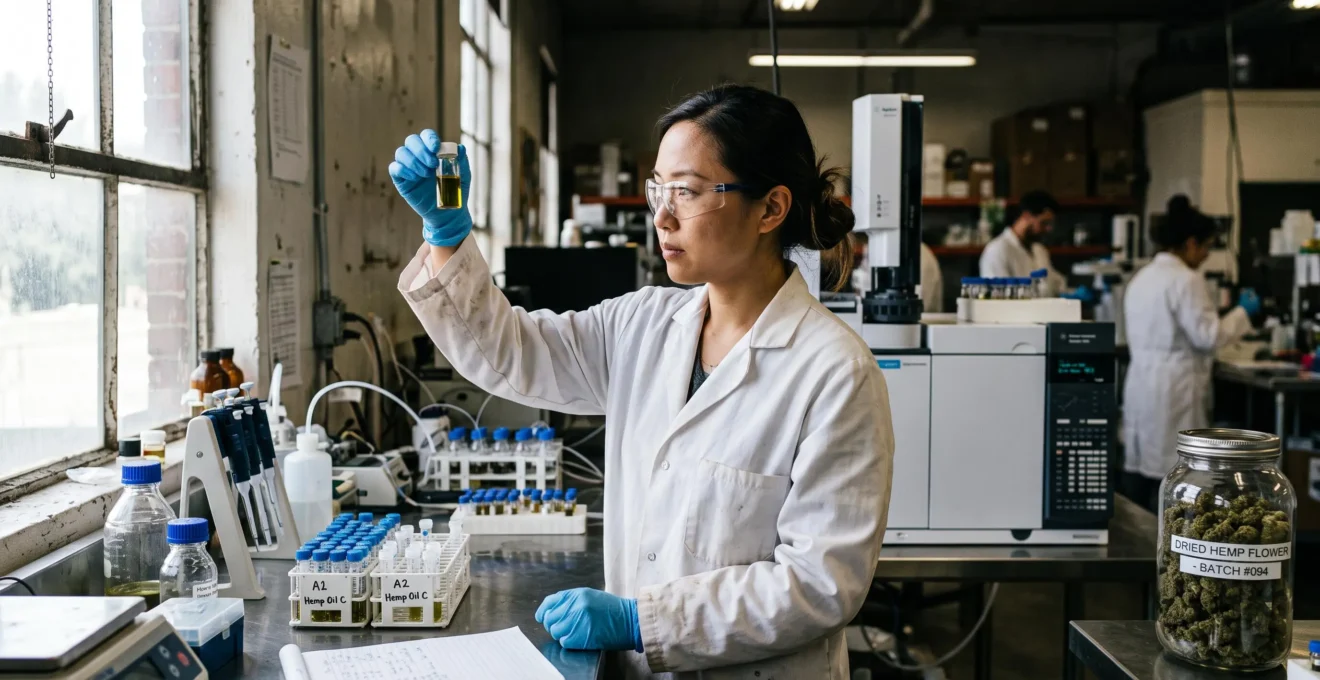
Two CBD oils can contain the same advertised amount of cannabidiol yet have substantially different botanical compositions. One may contain measurable quantities of minor cannabinoids and terpenes, while another may consist primarily of refined CBD blended into a carrier oil. Neither description, by itself, establishes superior quality or suitability.
When comparing plant-derived CBD products, the compounds that matter most are those relevant to the intended formulation: CBD and other measured cannabinoids, their acidic forms, and any additional constituents that the manufacturer specifically claims to retain. Terpenes and other botanical compounds can help distinguish extract profiles, but their presence does not automatically establish greater effectiveness.
For UK consumers, understanding these differences requires more than reading front-of-pack descriptions. A meaningful comparison depends on the extract type, manufacturing process, analytical results and quantities reported for the actual batch. It also requires separating chemical composition from claims about health benefits or legal compliance, neither of which can be established through a cannabinoid list alone.
CBD compound profiles: the essentials
- Start with measured composition. CBD, CBDA, THC, THCA and minor cannabinoids should be interpreted using their reported quantities and analytical limits.
- Look beyond extraction labels. Terpenes, refinement and processing conditions can substantially alter the finished botanical profile.
- Compare verified batches. Match laboratory reports, units, testing methods and extract descriptions before drawing conclusions.
- Why Can Two CBD Extracts from the Same Plant Have Different Compound Profiles?
- How Can You Read a CBD Specification Without Misinterpreting Its Compound List?
- Broad Botanical Extract or Refined Preparation: Which Suits a Simpler Product Profile?
- Which Assumptions About Natural CBD Compounds Can Lead to Poor Product Comparisons?
- How Can You Compare Botanical CBD Products More Reliably When Labels Use Vague Claims?
- Cannabinoid Panel or Wider Plant Profile: Which Test Tells You More About Extract Complexity?
- Why Does Extraction Method Change the Final Botanical Profile of CBD Products?
- How Can You Evaluate Full-Spectrum Extracts Beyond the Marketing Label?
Why Can Two CBD Extracts from the Same Plant Have Different Compound Profiles?
Two CBD extracts derived from the same plant variety can contain different combinations and concentrations of compounds because plant chemistry changes with cultivation, harvesting, storage and processing. Extraction conditions selectively recover particular substances, while subsequent refinement may remove others. A shared botanical origin therefore does not guarantee an identical finished chemical profile.
The first source of variation is the raw plant material. Cannabis cultivars differ in their cannabinoid-producing characteristics, often described through their chemotypes. Even within one cultivar, growing conditions, harvest timing and the particular plant material selected for extraction may influence the starting composition.
Drying and storage introduce further variables. Exposure to heat, light, oxygen and moisture can affect the stability of certain constituents. Two batches harvested from comparable plants may consequently enter extraction with different chemical profiles.
The second source of variation is manufacturing. Solvents do not recover every compound equally, and processing conditions can influence which substances remain in the final preparation. Filtration, separation and refinement add further opportunities to change the result.
An experimental study comparing hemp extraction methods examined ethanol maceration, hydrodistillation and supercritical carbon dioxide extraction using a CBD/CBG-dominant cultivar grown in three locations. The resulting extracts showed substantially different cannabinoid and terpene compositions.
In that experiment, supercritical CO2 extracts showed the greatest variety and abundance of cannabinoids among the extraction approaches investigated, whereas hydrodistilled extracts showed the greatest variety and abundance of terpenes. These findings concern the specific experimental conditions and do not establish a universal ranking of extraction methods.
When interpreting two different laboratory reports, it helps to separate plant-derived variation from process-induced variation. Differences concentrated in minor constituents may suggest selective extraction or refinement. Larger differences in dominant cannabinoids warrant checking starting material, manufacturing records and analytical methods. Neither pattern proves its cause without supporting evidence.
Botanical origin is useful background information, but the measurable finished composition is the stronger basis for comparison. That makes the specification document the logical next place to look.
How Can You Read a CBD Specification Without Misinterpreting Its Compound List?
A CBD specification is useful when it identifies the actual batch, states measurable compound concentrations, explains the units and provides enough analytical information to interpret the results. The most important distinction is between what a laboratory has quantified, what it has merely detected and what its method cannot reliably measure at very low concentrations.
Begin with the certificate of analysis, commonly abbreviated to COA. A product specification may describe intended manufacturing targets, whereas a batch-specific COA reports analytical findings for a tested sample. These documents serve different purposes and should not be treated as interchangeable.
Check the sample identification, batch number, test date and laboratory details. Ideally, the batch reference should correspond to the product being considered. A generic certificate for a different production run is weaker evidence of the composition of the bottle in question.
Next, examine the individual analytes. CBD and CBDA are distinct compounds, as are THC and THCA. A calculated total may combine relevant forms according to the laboratory’s stated calculation, so total cannabinoids and measured CBD are not interchangeable figures.
The US National Institute of Standards and Technology distinguishes individual cannabinoids and calculated totals in its Cannabis Laboratory Quality Assurance Program cannabinoid report. This laboratory comparison work reinforces the importance of analytical scope and measurement consistency, although it does not certify individual retail products.
Reporting limits also matter. « Not detected » means that the compound was not detected under the stated method and conditions. « Below the limit of quantification » means its concentration could not be reliably quantified above the specified threshold. Neither statement necessarily establishes absolute absence.
For a meaningful numerical comparison, align the measurement basis. A result expressed in milligrams per gram cannot be compared directly with milligrams per bottle or milligrams per serving. Additional information about product mass, concentration or serving size may be necessary to convert the values.
Finally, check the laboratory’s method and accreditation scope. Accreditation can provide evidence of technical competence for specified testing activities, but the laboratory’s actual accredited methods and the report’s analyte coverage still require examination.
A specification lacking quantitative results, reporting limits, analytical method or date should be treated as insufficient for a rigorous composition comparison. It may remain useful as basic product information, but it cannot support the same conclusions as a properly documented test.
Once the measured compounds are understood, the next question is whether a wider botanical matrix or a more narrowly defined preparation better matches the intended product profile.
Broad Botanical Extract or Refined Preparation: Which Suits a Simpler Product Profile?
A refined CBD preparation generally suits buyers prioritising a narrower, more clearly defined cannabinoid composition, whereas a broader botanical extract may suit those interested in retaining additional plant constituents. Neither is inherently superior. The appropriate choice depends on which compounds should be present, which should be absent and how consistently the finished formulation can deliver that profile.
Broad botanical extracts may retain combinations of cannabinoids, terpenes and other constituents recovered from the source material. The composition depends on the extraction and subsequent processing steps rather than on the term « botanical » alone.
Refined preparations undergo additional processing intended to concentrate selected substances or reduce unwanted components. An extensively purified CBD ingredient may simplify cannabinoid composition, although the completed product can still contain carrier oils, flavourings or other added ingredients.
To compare the options, separate extract complexity from the practical objective.
| Comparison criterion | Broader botanical extract | Refined CBD preparation |
|---|---|---|
| Compound range | May retain additional cannabinoids and other botanical constituents | Generally targets a narrower set of constituents |
| CBD content consistency | Requires verification through batch testing | Can facilitate more controlled formulation, subject to manufacturing quality |
| Profile complexity | More constituents may require identification and evaluation | Fewer targeted constituents may simplify interpretation |
| THC considerations | Measured THC and related compounds require particular attention | Refinement may reduce THC, but laboratory confirmation remains necessary |
| Best analytical priority | Check a wider set of quantified constituents | Check CBD purity, potency and residual unwanted substances |
A less complex cannabinoid profile does not automatically establish that the overall product is safer. Residual solvents, pesticides, toxic elements and other potential contaminants require suitable testing regardless of how refined the extract appears.
One easily overlooked consequence of refinement is that desirable and undesirable constituents may both be removed. A buyer expecting terpenes or minor cannabinoids in a purified preparation could therefore be disappointed if the refinement process has substantially reduced them.
Conversely, choosing a wider extract because it sounds more natural may introduce constituents that were never central to the buyer’s objectives.
Descriptions such as « pure CBD » and « whole-plant extract » should be interpreted carefully when they appear together. They may refer to different aspects of a formulation, but neither phrase establishes the detailed composition. The declared extract type and batch measurements provide the necessary clarification.
Visual appearance is similarly limited: darker colour or stronger aroma does not reliably establish cannabinoid richness, purity or overall quality.
Choosing by the desired compound profile is more defensible than choosing by perceived naturalness. This distinction also exposes several recurring assumptions that can distort product comparisons.
Which Assumptions About Natural CBD Compounds Can Lead to Poor Product Comparisons?
The most misleading assumptions are that natural compounds are automatically consistent, that more plant constituents indicate higher quality and that identical CBD quantities make two products equivalent. Each assumption overlooks an important variable: batch variation, actual concentrations or the surrounding chemical matrix. Reliable comparisons test these beliefs against documented composition rather than accepting them as product facts.
Assumption one: natural means consistent. Plants contain naturally variable mixtures of chemical constituents. Cultivation, harvesting and extraction can influence those mixtures, meaning a botanical product may require substantial standardisation to achieve a repeatable finished profile.
A refined preparation may offer greater control over its target CBD concentration, but that advantage depends on formulation accuracy and quality assurance. Refinement alone does not guarantee consistency.
Assumption two: a longer compound list means a better product. A laboratory may report numerous minor cannabinoids simply because its testing method measures more analytes or detects lower concentrations. Another laboratory may use a narrower reporting panel.
Consequently, the number of listed substances can reflect analytical coverage rather than meaningful differences in botanical richness.
Even when additional compounds are genuinely present, their identification does not demonstrate a useful biological effect. The concentrations, relevance, potential interactions and available evidence still need to be considered.
Assumption three: equal CBD milligrams mean equivalent products. Two hypothetical oils containing the same declared amount of CBD could differ considerably in their minor cannabinoids, carrier ingredients, terpene concentrations or residual impurities.
They may therefore have equivalent stated CBD quantities without having equivalent overall compositions. That does not, by itself, establish that their effects will differ clinically.
A fourth assumption is also worth challenging: naturally derived automatically means safe. Product quality and the suitability of CBD use cannot be inferred from botanical origin. CBD can interact with medicines, and evidence about composition should not be confused with evidence about safety or efficacy.
A simple way to examine marketing assumptions is to write down three claims influencing a purchase decision and identify the evidence each would require. « Contains only CBD » calls for a suitable cannabinoid panel; « retains terpenes » requires appropriate terpene testing; « consistent between batches » requires comparable results across production runs.
If a claim cannot be linked to relevant evidence, it should not carry decisive weight.
The next step is to apply that reasoning to labels whose terminology is less precise than the laboratory evidence needed to support them.
How Can You Compare Botanical CBD Products More Reliably When Labels Use Vague Claims?
Translate every vague CBD marketing claim into a specific question that a product document or laboratory report could answer. Then compare products using matching units, compound categories and batch references. Terms such as « natural », « clean » and « full plant » become meaningful only when they correspond to identifiable ingredients, documented processes or measurable constituents.
The word « natural », for example, does not specify how extensively an extract has been refined. « Raw » may imply limited heat treatment, but its interpretation remains uncertain unless processing information explains which steps occurred.
« Clean » is similarly ambiguous. It might refer to a refined appearance, an intended absence of certain ingredients or contaminant testing. None of those meanings should be assumed without supporting documentation.
A useful translation exercise looks like this:
- « Full plant »: Which plant-derived compounds are actually present in the finished batch, and at what concentrations?
- « Clean extract »: Which impurities or residual substances were tested, using which methods and reporting limits?
- « Naturally rich »: Which additional constituents were quantified rather than merely named?
- « Consistent quality »: Are comparable batch results available for more than one production run?
It also helps to distinguish claims about cultivation from claims about finished formulation. A named cultivar or growing practice describes the source material, not necessarily the substances remaining after extraction and refinement.
Evidence that the manufacturer grew or sourced a particular plant cannot substitute for evidence describing the contents of the finished bottle.
74%
In a 2024 US study of 202 commercially available CBD products, 74% differed from their declared CBD potency by at least 10%. This result describes the tested US sample and cannot be treated as a prevalence estimate for the UK market.
Gidal and colleagues, 2024, study of CBD product labeling accuracy and contamination.
That research illustrates why packaging claims warrant verification. It does not establish that every product is inaccurately labelled or that a particular UK manufacturer has a quality problem.
When comparing two CBD oils, put their results on the same measurement basis. Make sure that a CBD amount per serving is not being compared against an amount per container, and check whether reported totals include acidic cannabinoid forms.
Red flags include a missing batch number, compound lists without quantities, undisclosed quantification limits and apparent contradictions between the declared extract type and measured constituents. Missing data does not necessarily prove poor quality, but it limits what a comparison can establish.
Once claims have been translated into measurable questions, selecting the correct laboratory testing scope becomes the next important decision.
Cannabinoid Panel or Wider Plant Profile: Which Test Tells You More About Extract Complexity?
A cannabinoid panel is most useful for identifying and quantifying CBD and other specified cannabinoids. A wider botanical profile examines additional constituent groups, potentially including terpenes or flavonoids. The wider assessment can reveal more about extract complexity, but neither testing approach measures every plant compound. The right choice depends on the particular product claim being investigated.
Cannabinoid panels typically focus on a defined selection of analytes, such as CBD, CBDA, THC, THCA and minor cannabinoids included in the laboratory’s method.
They are especially useful for checking labelled cannabinoid content, understanding the relationship between acidic and neutral forms and investigating whether additional cannabinoids are detectable or quantifiable.
A wider botanical assessment can add information about other chemical groups. Terpene analysis, for example, can help establish whether particular volatile constituents are present in a finished extract.
Flavonoids and other botanical substances may require separate analytical methods. A laboratory’s use of the phrase « complete plant profile » should therefore be interpreted through the actual compounds and methods listed.
| Testing question | Cannabinoid panel | Wider botanical profile |
|---|---|---|
| How much CBD is present? | Directly relevant when CBD is quantified | Only if cannabinoid analysis is included |
| Are minor cannabinoids measured? | Yes, for included analytes | Depends on the analytical scope |
| Which terpenes remain? | Not established by cannabinoid results alone | Can be investigated with appropriate terpene analysis |
| How chemically diverse is the extract? | Shows diversity within the tested cannabinoid group | Can describe additional measured compound groups |
| Are all possible plant constituents known? | No | No |
A broader analysis is not automatically less precise. Precision, accuracy and detection capability depend on the method’s validation and performance for each compound and sample type.
Similarly, two laboratories may advertise comprehensive cannabinoid analysis while measuring different numbers of compounds or using different limits of quantification.
For UK consumers, a report’s usefulness also depends on whether the test addresses the actual decision. A cannabinoid panel does not establish the absence of residual solvents, pesticides or toxic elements; those questions require suitable additional tests.
Nor does a quantified cannabinoid profile establish that a finished CBD product meets every applicable UK regulatory requirement.
Laboratory results explain what was measured, but understanding why the compounds reached those concentrations requires examining the extraction process itself.
Why Does Extraction Method Change the Final Botanical Profile of CBD Products?
Extraction changes a CBD product’s botanical profile because different processes recover, preserve or transform plant compounds in different ways. Solvent properties, temperature, pressure, processing time and subsequent purification all influence the final mixture. The name of an extraction technique is therefore useful manufacturing context, but it is not proof of a particular composition or quality level.
Solvent-based extraction works through the ability of a chosen liquid to dissolve selected substances from plant material. The resulting mixture depends on solvent characteristics and extraction conditions.
Carbon dioxide extraction uses controlled conditions to recover compounds from the botanical material. The specific pressure, temperature and subsequent processing stages influence which constituents are collected.
Mechanical separation and thermal processing may produce different preparations again, depending on which plant fractions are retained and whether compounds are exposed to conditions that alter their chemistry.
One particularly important process is decarboxylation. Cannabis plants contain acidic cannabinoids, including CBDA and THCA. Heating can convert these into corresponding neutral forms, including CBD and THC.
Consequently, two extracts originating from similar material may show different proportions of CBD and CBDA because one underwent more extensive heat-related conversion.
Analytical conditions can complicate the picture. A scientific review of phytocannabinoid profiling techniques discusses differences between chromatographic approaches, including the potential conversion of acidic cannabinoids during heated analysis without appropriate precautions.
This means that a reported difference between cannabinoid forms may relate to product processing, analytical methodology or both. The report’s method should be checked before assigning a manufacturing explanation.
Additional refinement may selectively reduce certain compounds after the original extraction. Filtration, separation and other manufacturing stages mean that the final bottled composition may differ substantially from the initial crude extract.
Two products could therefore have fairly similar cannabinoid panels while possessing different terpene profiles or having undergone different manufacturing steps.
For comparison purposes, extraction information is most useful when combined with a finished-product laboratory report. A description such as « CO2 extracted » cannot, without measurements, establish how much CBD, CBDA or any particular terpene remains.
Likewise, an extraction method does not independently establish contaminant safety, clinical effectiveness or regulatory conformity.
The same principle is particularly important for products sold as full-spectrum extracts, where the marketing description may suggest a broader range of constituents than the analytical documentation actually demonstrates.
Key takeaways before evaluating a full-spectrum product
- A spectrum claim must be translated into a defined set of compounds and measurable concentrations.
- One favourable laboratory report describes a tested sample, not necessarily the consistency of future production batches.
- A reliable comparison combines extract classification, analytical scope, manufacturing context and batch-specific verification.
How Can You Evaluate Full-Spectrum Extracts Beyond the Marketing Label?
Evaluate a full-spectrum CBD extract by checking which cannabinoids and other botanical constituents are actually present, how reliably they were measured and whether the results correspond to the product’s claimed composition. The term « full-spectrum » does not substitute for laboratory evidence, and its meaning should not be assumed to be identical across products or jurisdictions.
Start by identifying the manufacturer’s intended meaning of full-spectrum. The description should clarify which compound groups the formulation aims to retain, rather than merely suggesting that it represents every substance originally present in the plant.
Next, obtain a cannabinoid panel for the relevant batch. Check CBD, any reported acidic forms, THC-related results and the other cannabinoids included in the test.
Quantified minor cannabinoids provide stronger evidence of a reported compound profile than an unqualified list of botanical names. However, measured diversity does not by itself establish that the concentrations are clinically meaningful.
If the manufacturer specifically claims terpene richness or wider botanical retention, look for analytical results addressing those substances. A cannabinoid-only panel cannot confirm that claim.
Then compare the observed results with the stated extract type. A product marketed as full-spectrum yet supported only by a limited CBD measurement lacks enough information to establish its claimed spectrum.
Consistency over time provides an additional assessment. Several comparable batch reports can show whether measured concentrations remain within documented manufacturing specifications, allowing for expected botanical variation.
Reports across different batches should use comparable methods, units and analytical scopes before apparent changes are interpreted as genuine manufacturing variation.
Five checks to complete before comparing full-spectrum CBD extracts
- Match the batch. Locate the bottle’s batch identifier and record the corresponding laboratory report number or sample reference.
- Build a compound table. Record CBD, relevant acidic forms, THC-related results and quantified minor cannabinoids, including their units.
- Check analytical limits. Note the testing method and detection or quantification limits, producing a list of results that cannot establish absence or precise concentration.
- Verify the spectrum claim. Compare the manufacturer’s claimed constituents against the tested analytes and any available terpene results; mark unsupported claims separately.
- Record comparability. Check the report date, extract type, manufacturing information and any previous batch results, then identify which products can genuinely be compared on equivalent terms.
A completed comparison sheet should distinguish confirmed measurements from unverified marketing claims. It should also separate botanical composition from contaminant control and regulatory status.
In the UK, this distinction is particularly important because cannabinoid composition, controlled-cannabinoid requirements and novel-food considerations are separate issues. A full-spectrum label or a COA alone does not establish that a product is lawfully marketable, authorised as a food, or suitable for a particular consumer. Applicable official requirements need to be checked independently.
The US commercial-product analysis discussed earlier provides a useful caution: among products evaluated for extract-type labelling not meeting the study’s criteria, 26% did not meet the study’s criteria for their stated category. This result concerns the analysed sample and classification method, not a universal definition or a finding about every UK full-spectrum product.
Finally, avoid using the phrase « entourage effect » as proof that additional plant compounds improve outcomes. The presence of several constituents does not establish clinical synergy or superior effectiveness without relevant human evidence.
For a practical next step, select two products and complete the five checks using their actual batch reports. If the necessary information is missing, record the gap instead of assuming that a more detailed label represents a better extract.
Does a higher terpene concentration mean a CBD product is more effective?
No. A higher measured terpene concentration establishes a compositional difference, not necessarily a meaningful difference in effectiveness. Evaluating biological effects requires evidence concerning the particular compounds, concentrations, formulation and intended outcome.
Can a CBD product contain CBDA as well as CBD?
Yes. CBDA is an acidic cannabinoid that can occur alongside CBD. Processing conditions, particularly heat exposure, can influence their relative proportions. A suitable analytical method can distinguish them and report their individual concentrations.
Does a laboratory report showing no detectable THC prove that a CBD product contains none?
No. A non-detect result is conditional on the method, compounds tested and detection limits. It does not necessarily establish absolute absence. UK legal compliance also cannot be determined from a single THC result without considering the relevant product and regulatory requirements.
Is an older certificate of analysis still useful when comparing CBD oils?
An older certificate may describe the composition of the batch originally tested. Its relevance to a currently available product depends on whether the product belongs to that batch and whether storage or other conditions could have affected its composition. A report from an unrelated batch should not be treated as current batch-specific evidence.
Can a cannabinoid panel confirm that a CBD oil is free from contaminants?
No. A cannabinoid panel measures the cannabinoids included in its analytical scope. Evaluating residual solvents, pesticides, toxic elements or microbiological contamination requires appropriate additional tests. A satisfactory cannabinoid profile is only one aspect of product quality assessment.