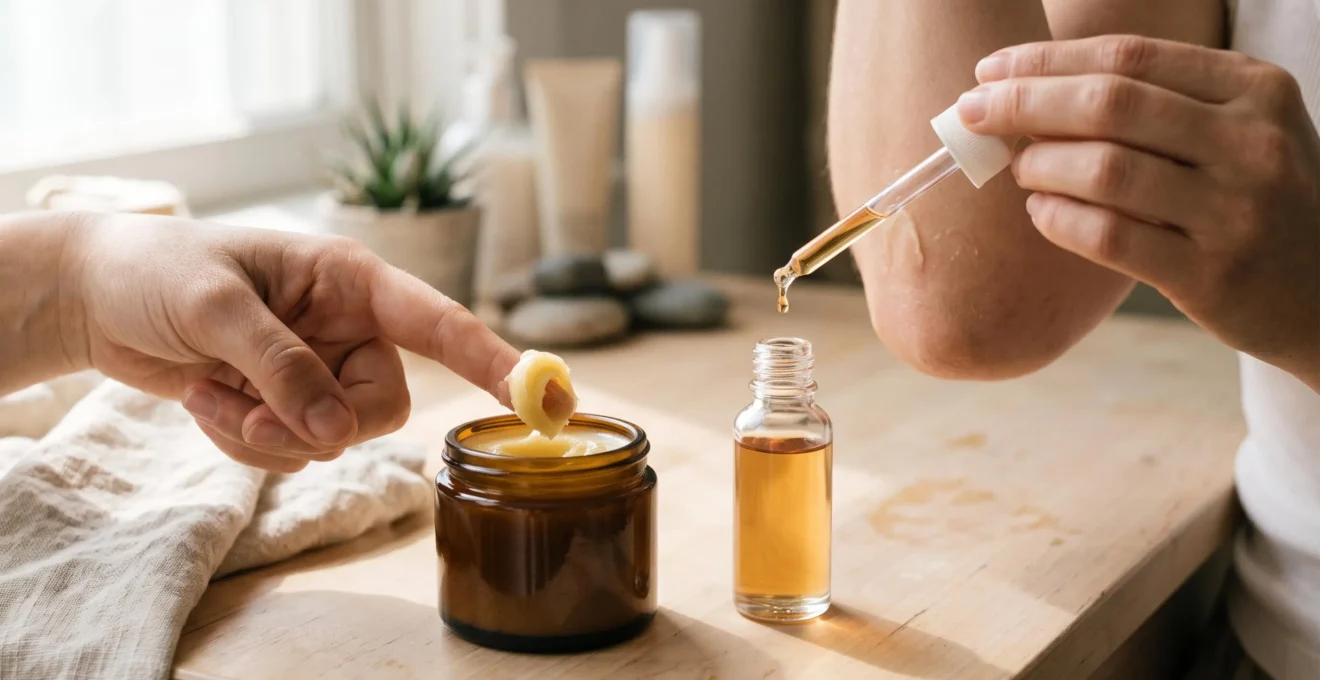
A CBD topical blend is more than cannabidiol mixed into a moisturiser. Its cannabinoid extract, botanical ingredients and delivery base work together to determine how it spreads, feels, remains on the skin and fits into a skincare routine. A rich wax-based balm, for example, may suit dry elbows better than a fast-spreading serum, even when both products list similar CBD concentrations.
The most suitable formula depends on the application area, skin barrier condition, sensitivity to fragrances and intended skincare function. A complex botanical blend is not automatically more effective than a minimalist cream, and a higher CBD concentration does not necessarily make a product better suited to a particular use.
Scientific evidence also warrants caution. Research into topical CBD suggests potential dermatological applications, but clinical studies remain limited. Choosing a formula therefore requires separating established cosmetic functions, such as moisturising and occlusion, from CBD-specific benefits that have not yet been consistently demonstrated in humans.
CBD topical blends: the essentials
- Choose texture by application area: rich balms for localised dry zones, lightweight serums for broader coverage and layering.
- Compare ingredient lists, cannabinoid types and batch-specific laboratory documentation instead of relying on marketing names.
- For sensitive or compromised skin, favour simpler, fragrance-free formulas with fewer potentially irritating botanical ingredients.
- Why Do CBD Topical Blends Use Such Different Textures and Ingredient Bases?
- How Can You Compare CBD Topical Blends Without Relying on Marketing Names?
- Rich CBD Balm or Lightweight Serum: Which Better Fits Your Application Area?
- When Can a Complex CBD Topical Blend Become Too Complicated for Sensitive Skin?
- When Should You Switch from a Multi-Ingredient CBD Blend to a Simpler Formula?
- Single Plant Extract or Botanical Blend: Which Offers the Simpler CBD Skincare Formula?
- Essential-Oil Blend or Fragrance-Free CBD Cream: Which Better Suits Sensitive Skin?
- Why Is the Skin Barrier So Important in CBD Topical Formulation?
Why Do CBD Topical Blends Use Such Different Textures and Ingredient Bases?
CBD topical blends use different textures because their ingredient bases serve different application and skin-conditioning purposes. Wax-rich balms create a persistent protective film, while water-based serums and emulsions generally spread more easily and feel lighter. These differences influence moisturisation, residue, layering and potential CBD delivery, although texture alone does not establish how effectively CBD reaches the skin.
Three formulation components determine much of a CBD topical’s character: its cannabinoid extract, supporting botanicals and carrier system.
- Cannabinoid spectrum: CBD isolate contains cannabidiol as the selected cannabinoid ingredient. Broad-spectrum extracts contain additional cannabis-derived constituents but are generally formulated without detectable THC, depending on specifications and testing. Full-spectrum extracts retain a broader range of plant constituents and may contain THC.
- Botanical co-ingredients: Menthol can create a cooling sensation, while lavender and tea tree ingredients contribute aromatic compounds. Arnica may be included in targeted botanical formulas, although its presence does not establish a proven CBD-related benefit.
- Carrier and base: Waxes, oils, gels and emulsions determine the product’s viscosity, spreadability, evaporation, skin feel and occlusive properties.
In an oil-and-wax balm, the fatty base typically forms a persistent surface layer that helps reduce moisture loss. A serum may instead use water, humectants and solubilising or emulsifying agents to deliver a lightweight finish. However, some serums are oil-based, and some creams are highly occlusive. The ingredient system matters more than the category name.
Ingredients should also be separated by purpose. Glycerin, squalane, ceramides and petrolatum may contribute to hydration or barrier support, depending on the formulation. Fragrance, menthol and aromatic essential oils primarily modify the sensory experience, even when they are presented as botanical actives.
A 2024 scientific review of CBD in cosmetic dermatology discusses promising skin-related properties but identifies limited clinical evidence and continuing challenges with topical delivery. Most conventional cosmetic topicals are designed for local application, yet CBD penetration and retention depend on the complete formulation and cannot be predicted from texture alone.
The next step is to translate these formulation differences into a repeatable comparison method, rather than treating product names as evidence of performance.
How Can You Compare CBD Topical Blends Without Relying on Marketing Names?
Compare CBD topicals by checking their stated CBD quantity, extract type, complete ingredient list, carrier system, fragrance components and available laboratory results. Labels such as balm, salve, serum and cream describe broad product formats, but do not reliably establish absorption, ingredient quality or effectiveness. A structured comparison makes the formulation’s actual differences easier to identify.
Start with CBD quantity. Look for the total milligrams of cannabidiol and the package size, then calculate concentration where sufficient information is available. For example, a hypothetical 600 mg CBD product in a 30 mL package contains a nominal 20 mg/mL. This calculation describes labelled concentration, not the amount absorbed by the skin.
Next, examine the ingredient declaration. Ingredients are generally listed in descending order of weight, subject to applicable labelling rules and exceptions for lower-concentration ingredients. This can indicate whether a formula is predominantly oil-based, water-based or wax-rich.
However, finding CBD after a preservative or fragrance ingredient does not automatically mean it is ineffective. Some ingredients are functional at low concentrations, and an ingredient list cannot independently establish cannabinoid dose, delivery or clinical outcomes.
Use the following comparison grid to record factual differences between products.
| Criterion | Product A: Rich balm | Product B: Lightweight serum |
|---|---|---|
| CBD extract | Check isolate, broad-spectrum or full-spectrum | Check isolate, broad-spectrum or full-spectrum |
| Base system | Typically oils and waxes | Typically water-based, gel-like or lightweight oils |
| Added botanicals | Record extracts and essential oils | Record extracts and essential oils |
| Fragrance exposure | Check fragrance and aromatic ingredients | Check fragrance and aromatic ingredients |
| Application fit | Localised areas; persistent finish | Broader areas; easier layering |
| Independent verification | Batch-matched certificate of analysis | Batch-matched certificate of analysis |
This is a hypothetical format comparison, not a claim that every balm or serum has these characteristics. A product’s actual ingredient declaration should take precedence over typical category features.
Laboratory documentation adds an important quality-control check. A certificate of analysis should identify the tested batch, report measured cannabinoid content and, where testing is provided, address relevant contaminants such as heavy metals, pesticides and residual solvents.
The FDA information on CBD product safety and quality explains why cannabinoid-content accuracy and contamination deserve attention. An independent report can provide useful evidence about a tested sample, but it cannot guarantee that the finished product will be effective or suitable for every user.
Five checks before selecting a CBD topical
- Record the intended application area and desired finish. Produce a one-sentence product-use profile.
- Copy the stated CBD quantity, package size and extract type. Create a comparable CBD-content record.
- Identify the carrier base, botanical additions and fragrance ingredients. Produce an ingredient comparison for the shortlisted products.
- Check the certificate of analysis against the product batch and reported cannabinoid results. Record whether verification is available and matches.
- Compare texture suitability, ingredient complexity and verified information. Create a short rationale for choosing or rejecting each option.
Once the product’s composition is understood, the most useful differentiator is often where and how it will be applied.
Rich CBD Balm or Lightweight Serum: Which Better Fits Your Application Area?
A rich CBD balm generally fits small, dry or high-friction areas where a persistent protective layer is desirable. A lightweight serum often fits larger areas, facial routines or situations requiring easy layering. The better choice depends on spreadability, residue, skin tolerance and whether the goal is surface protection or a lighter cosmetic finish.
Consider elbows, heels, knees and hands. These areas may experience dryness, friction or repeated washing, making a film-forming product useful. A wax-rich balm can remain perceptible after application and reduce moisture loss through its occlusive ingredients.
By contrast, a facial serum or lightweight emulsion may spread with less rubbing and sit more comfortably beneath another moisturiser. This does not establish that a serum delivers CBD into the skin more effectively, only that its texture can simplify application and layering.
| Application need | Rich balm | Lightweight serum |
|---|---|---|
| Dry elbows or heels | Useful for a persistent protective film | May feel insufficiently protective on its own |
| Facial skincare | May feel heavy depending on the formula | Often easier to layer beneath moisturiser |
| Hands after washing | Useful for targeted dry patches | May provide a less greasy feel |
| Large application area | Can be slower to distribute | Often spreads more readily |
| Under clothing | May transfer or leave residue | Often offers a lighter finish |
Application frequency and cost per use also deserve attention. A concentrated balm may require only a small amount for a restricted area, while a serum may be distributed more liberally across a larger surface. However, the quantity required depends on formulation, intended coverage and manufacturer directions; a serum does not inherently require more frequent application.
One product does not have to serve every area. A person might prefer a light serum for routine facial use and a fragrance-free balm for particularly dry elbows. This two-format approach is reasonable when both products are individually tolerated, without assuming that combining them improves CBD’s biological effects.
Texture becomes less decisive, however, when skin is reactive. In that situation, the number and type of additional ingredients can matter more than whether the product is thick or lightweight.
When Can a Complex CBD Topical Blend Become Too Complicated for Sensitive Skin?
A CBD blend can become unsuitable for sensitive skin when its combination of botanical extracts, essential oils, fragrance compounds and other additives introduces ingredients the skin does not tolerate. More ingredients create additional potential exposures, although they do not guarantee irritation. The priority is identifying avoidable triggers rather than assuming botanical complexity always improves skincare performance.
Essential oils deserve particular attention. Tea tree, citrus and other aromatic oils contain numerous chemical constituents, some of which can cause allergic contact dermatitis. Menthol may produce a desired cooling sensation but can also be uncomfortable on irritated skin.
The DermNet reference on allergic contact dermatitis to essential oils explains that allergic responses may appear after a delay, commonly within 24–72 hours of exposure. Symptoms can include redness, itching and scaling.
Ingredient order provides useful context, but it is not a reliable individual allergy-risk score. A fragrance allergen may trigger a sensitised person even at a relatively low concentration. Conversely, the presence of several well-tolerated ingredients does not automatically make a product unsuitable.
A cautious home-use test can help identify whether the finished product appears tolerable before applying it more widely. The American Academy of Dermatology recommends applying a new skincare product to a small area, such as the underside of the arm or elbow bend, twice daily for seven to ten days, using the usual application amount.
Watch for itching, redness, swelling, stinging or other unexpected reactions. If irritation develops, wash the product off and discontinue it. Severe, persistent or unclear symptoms warrant professional assessment. Home testing does not diagnose an allergy or establish that a product will never cause one.
Importantly, a reaction to a CBD cream is not automatically a reaction to cannabidiol. The responsible ingredient could be a fragrance component, preservative, carrier or other botanical constituent. Formal dermatological patch testing may be necessary to identify a specific allergen.
When a complex blend repeatedly causes discomfort, the next decision is whether to remove individual additives or simplify the formulation more substantially.
When Should You Switch from a Multi-Ingredient CBD Blend to a Simpler Formula?
Consider switching to a simpler CBD formula when a product repeatedly causes redness, itching, stinging or other unwanted reactions, particularly after additional botanicals or fragrance ingredients have been introduced. Stop using a product that causes a reaction rather than continuing to test it. Once the skin has settled, a simpler formulation can make future ingredient tolerance easier to evaluate.
Three practical signals justify reassessing the current blend: discomfort associated with application, a change in skin tolerance after introducing a more complex product, or continuing uncertainty about which ingredient is contributing to unwanted effects.
Persistent symptoms should not be treated as a reason to conduct repeated unsupervised product experiments. If irritation continues after discontinuation, or if the cause remains unclear, seek advice from a qualified healthcare professional.
For product simplification, separate the cannabinoid extract from the surrounding ingredients. A full-spectrum product with several botanicals represents more potential variables than a minimal CBD-isolate formula, but broad-spectrum or full-spectrum status does not by itself establish irritation risk.
A useful comparison sequence is:
- Discontinue the product associated with the reaction and allow the skin to recover.
- Review the ingredient list for fragrance, essential oils and recently introduced components.
- If a CBD topical remains appropriate, consider a fragrance-free formula with fewer additional botanicals, potentially using CBD isolate in a minimal base.
- Evaluate one new formula at a time, using cautious small-area testing before broader application.
- Record changes in comfort and visible skin response rather than assuming that any improvement must come from CBD.
This is a practical method of reducing formulation variables, not a clinically validated treatment protocol. Switching from full-spectrum to broad-spectrum and then isolate is not an established medical necessity. A broad-spectrum formula with minimal additives could be better tolerated than an isolate product containing multiple fragrance ingredients.
Simplification also involves a trade-off. Removing botanical additives may remove a preferred cooling sensation, fragrance or cosmetic characteristic. Evidence remains insufficient to assume that these additions create superior CBD skincare results through synergy.
Once a simple formula is tolerated, complexity can be reintroduced selectively if there is a clear reason. For example, compare one additional botanical ingredient at a time rather than immediately returning to a multi-extract product. Avoid deliberately reintroducing known allergens.
This approach raises another important question: whether a single plant extract is actually simpler than a botanical blend, especially when the cannabinoid extract itself contains multiple compounds.
Single Plant Extract or Botanical Blend: Which Offers the Simpler CBD Skincare Formula?
A minimal CBD-isolate formula generally offers the simplest cannabinoid profile, while a full-plant extract contains additional cannabis-derived constituents. A botanical blend introduces a separate layer of complexity through other plant ingredients. For ingredient tracking and sensitive skincare, simplicity depends on both the cannabinoid extract and the complete cosmetic formula, not merely the number of plants advertised.
It helps to distinguish two kinds of complexity.
Cannabinoid complexity concerns whether the product contains CBD isolate or a broader extract with other cannabis constituents. Botanical complexity concerns the additional extracts, aromatic oils and other plant-derived ingredients included alongside the cannabinoid material.
For example, consider two hypothetical formulations. Product A contains CBD isolate, a basic emollient system and a preservative appropriate for its formulation. Product B contains full-spectrum hemp extract, lavender oil, tea tree oil, arnica extract and multiple carrier ingredients.
Product A would generally be easier to analyse because fewer ingredients could explain a new reaction. However, its simpler composition would not prove that CBD is responsible for any improvement in skin comfort; the emollient base may account for much of the moisturising effect.
Product B may offer a more distinctive sensory experience, but attributing a result to one component would be difficult. Claims of an entourage effect or botanical synergy should not be treated as established evidence that the finished cosmetic blend outperforms isolate.
For a person trying a topical CBD product for the first time, a minimal formula can be a useful starting point. It also makes sense for someone who keeps a skincare diary, changes products cautiously or wants to avoid unnecessary fragrance exposure.
Yet minimal does not mean automatically gentle. Even a short ingredient list may contain a substance to which someone is allergic or intolerant. Likewise, a carefully formulated multi-ingredient cream can be well tolerated.
Among the optional ingredients, fragrance deserves particular scrutiny because it can provide an enjoyable sensory effect without being necessary for routine skin moisturisation.
Essential-Oil Blend or Fragrance-Free CBD Cream: Which Better Suits Sensitive Skin?
A fragrance-free CBD cream is generally the more cautious starting point for sensitive, reactive or eczema-prone skin because it avoids deliberately added fragrance ingredients. Essential-oil blends may provide appealing aromas or cooling sensations, but their aromatic constituents can trigger irritation or contact allergy. Neither choice guarantees tolerance, and the entire ingredient list remains important.
Essential oils are often described as natural, but their origin does not establish that they are gentle. Plant-derived aromatic compounds can be biologically active, chemically complex and allergenic.
Tea tree and certain citrus-derived essential oils are relevant examples of potential contact allergens. Fragrance-related irritation or allergy can also arise from ingredients not prominently described as perfume on the front label.
A fragrance-free claim ordinarily indicates that fragrance has not been deliberately added for scent, but it does not guarantee the absence of all potentially aromatic or irritating botanical compounds. An unscented product may also contain ingredients intended to mask an underlying odour.
| Decision factor | Essential-oil blend | Fragrance-free cream |
|---|---|---|
| Sensory experience | May provide distinctive scent or cooling sensations | Generally prioritises a neutral experience |
| Aromatic compound exposure | Introduces additional volatile constituents | Avoids added fragrance when accurately labelled |
| Reactive skin | Requires particular caution | Usually the more conservative starting option |
| Barrier support | Depends on the complete base | Depends on the complete base |
| Overall tolerance | Individual and formulation-dependent | Individual and formulation-dependent |
For intact, resilient skin, a scented blend may be acceptable if no irritation occurs. But when the skin is already stinging, inflamed or prone to eczema, avoiding unnecessary aromatic ingredients is a more sensible approach.
Fragrance-free should not distract from other important formulation details. A cream still needs an appropriate preservative system where required, compatible emulsifiers and a base that suits the application area. The absence of perfume cannot compensate for a poorly tolerated formula.
The condition of the skin barrier ultimately determines how much caution is needed, which is why it should be assessed before comparing CBD concentration, botanical sophistication or cosmetic texture.
Key takeaways before choosing a formula
- Assess skin comfort and barrier condition before choosing the richest or most complex CBD topical.
- Prioritise an appropriate moisturising base and fewer unnecessary aromatic ingredients when the skin is reactive.
- Judge a product by its complete composition and observed tolerance, not by a promise of superior cannabinoid delivery.
Why Is the Skin Barrier So Important in CBD Topical Formulation?
The skin barrier matters because it regulates moisture loss and limits the entry of external substances. Its condition affects how a topical product feels, how well moisturising ingredients perform and how readily certain substances may enter the skin. A compromised barrier can increase sensitivity to formulation components, making ingredient simplicity and barrier-compatible textures especially important.
The outermost skin layer, known as the stratum corneum, consists of flattened cells embedded in an organised lipid structure. This arrangement helps retain water while restricting unwanted environmental exposure.
When that barrier functions well, the skin generally tolerates routine cosmetic contact more comfortably. When disrupted by dryness, excessive cleansing, friction or an inflammatory skin condition, sensations such as tightness, flaking and stinging may become more noticeable.
Barrier damage may also alter penetration of certain topical ingredients, including potential irritants. However, the degree of absorption varies with the substance and formulation. It should not be assumed that damaged skin uniformly increases CBD delivery or makes a product more effective.
Before selecting a CBD topical, consider these signs:
- Tightness: Does the skin feel uncomfortable after washing or during the day?
- Flaking: Are there persistent dry patches or visible surface changes?
- Stinging: Do ordinary skincare products cause burning or discomfort?
- New reactivity: Have previously tolerated products started causing unwanted sensations?
These signs are useful reasons to reassess a routine, but they do not independently diagnose barrier damage or a specific skin disorder.
For dry but otherwise comfortable areas, an occlusive balm containing appropriate emollients may help reduce moisture loss. For skin requiring lighter daily coverage, a fragrance-free moisturising emulsion may feel preferable. Ingredients such as glycerin, ceramides and petrolatum can provide recognised cosmetic barrier-supporting functions independently of CBD.
For actively inflamed, cracked, weeping or otherwise compromised skin, avoid assuming that a CBD botanical blend is an appropriate treatment. Persistent or significant symptoms warrant professional evaluation, and CBD cosmetics should not replace evidence-based management of diagnosed conditions.
The barrier perspective unifies the main choices: a texture determines the feel and surface protection; the carrier influences ingredient contact and delivery; botanicals modify the exposure profile; and fragrance adds potential sensory benefits alongside possible irritation risks.
CBD may have interesting biological properties, but the currently limited clinical evidence does not justify assuming that it repairs a compromised barrier more effectively than established moisturising ingredients.
For a practical next step, assess the skin’s current condition, shortlist a small number of suitable formulas, verify their ingredients and laboratory information, then introduce only a product the skin tolerates. This produces a more defensible choice than selecting the strongest or most elaborate CBD blend.
Does a higher CBD concentration mean a topical works better?
Not necessarily. Labelled CBD concentration indicates how much cannabidiol is present relative to product quantity, but it does not establish how much reaches the intended skin layers or produces a measurable benefit. The carrier system, other ingredients, application method and available clinical evidence also matter.
Can a CBD balm and serum be used in the same skincare routine?
They can serve different cosmetic purposes when both are tolerated. A lightweight serum may be appropriate for broader application, while a balm can provide an additional occlusive layer on localised dry areas. Using both does not establish enhanced CBD absorption or improved clinical effectiveness.
Does broad-spectrum CBD automatically suit sensitive skin better than full-spectrum CBD?
No. Broad-spectrum and full-spectrum describe differences in cannabinoid composition, not verified categories of skin tolerance. Fragrance, preservatives, botanical additives and the base may be more relevant to an individual’s reaction. A minimal CBD-isolate product can reduce variables, but it is not guaranteed to be non-irritating.
Can a certificate of analysis prove that a CBD skincare product is safe?
No. A credible, batch-specific laboratory report can provide useful information about cannabinoid content and tested contaminants. It does not establish the absence of every possible contaminant, predict an individual’s allergic response or demonstrate that the finished product has clinical skincare benefits.
What should happen if a CBD cream causes redness or itching?
Discontinue the product and gently wash it off. Do not repeatedly apply it to determine whether the reaction will disappear. If symptoms are severe, persistent or recurring, seek professional advice. The reaction may involve CBD or another formula ingredient, and appropriate dermatological assessment may be needed to identify the cause.