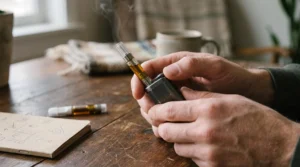
Temperature regulation matters in CBD vape devices because heating conditions influence how liquid becomes an inhalable aerosol, how consistently the heating element operates, and whether the formulation undergoes unwanted thermal changes. Excessive heat can compromise flavor, increase irritation, accelerate coil deterioration, and alter the chemical composition of the aerosol.
However, the temperature selected on a device is not necessarily the temperature experienced by the liquid. Coil resistance, battery output, airflow, wick saturation, and puff duration all influence the actual heating environment. Even an unchanged setting can produce different results as a cartridge empties or its heating element deteriorates.
Understanding these interactions helps adult users distinguish a temperature-setting problem from a failing cartridge and recognize when continued operation is inappropriate. It also prevents a common misconception: producing more visible vapor does not necessarily mean delivering CBD more efficiently. Temperature control can improve hardware predictability, but it cannot establish that inhaling CBD aerosol is safe.
CBD Vape Temperature Regulation: Key Facts
- Coil temperature depends on power, resistance, liquid supply, airflow, and puffing behavior—not simply the displayed setting.
- Burned flavors, unusual heat, persistent irritation, and cartridge deterioration are reasons to stop and inspect the equipment.
- Compatible hardware, conservative manufacturer-approved settings, and cartridge maintenance support more consistent aerosol production without guaranteeing safe exposure.
- Why Can Excessive Heat Change the Taste and Performance of CBD Vape Liquid?
- How Can You Adjust Vape Temperature Gradually Without Chasing Maximum Output?
- Fixed or Adjustable Temperature: Which CBD Vape Device Is Easier to Manage?
- Which Signs Suggest a CBD Vape Device Is Running Too Hot?
- When Should You Check the Coil or Cartridge Before Changing Vape Temperature Again?
- Why Does Heating Temperature Change the Character of CBD Vape Aerosol?
- When Should You Replace a CBD Vape Cartridge Instead of Trying to Reuse It?
- What Makes CBD Vape Aerosol Consistent Enough for Controlled Inhalation?
Why Can Excessive Heat Change the Taste and Performance of CBD Vape Liquid?
Excessive heat can change CBD vape liquid because its ingredients do not all respond to temperature in the same way. Flavoring compounds, terpenes, carrier liquids, and cannabidiol can undergo different physical and chemical changes. Consequently, unpleasant taste, increased aerosol production, and reduced formulation stability may appear independently rather than indicating one identical problem.
A CBD vape liquid is a mixture rather than a single substance with one evaporation or decomposition temperature. Depending on its formulation, it may contain cannabidiol, propylene glycol, vegetable glycerin, terpenes, or additional flavoring compounds. Heating can change the relative amounts of these constituents transferred into the aerosol, while sufficiently severe conditions may cause chemical degradation.
This distinction matters because flavor deterioration is not a reliable measurement of CBD degradation. A liquid may develop unpleasant aromatic notes without establishing how much CBD remains chemically unchanged. Conversely, a seemingly acceptable flavor does not prove that the aerosol contains no thermal decomposition products.
The Scientific Reports study on CBD thermal conversion investigated cannabidiol pyrolysis under controlled laboratory conditions. At investigated temperatures of 250–500 °C, researchers identified transformation products including delta-9-THC, delta-8-THC, cannabinol, and cannabichromene. These findings demonstrate temperature-dependent CBD chemistry, but they do not establish equivalent conversion rates during normal use of commercial cartridges.
Two operating problems also deserve separation. Actual thermal degradation can produce harsh or burned-tasting material. By contrast, increased aerosol volume can change the perceived flavor intensity or concentration per unit of aerosol without proving that CBD has chemically decomposed. Neither effect allows reliable conclusions about absorbed CBD dose from taste alone.
Repeated overheating or insufficient liquid delivery may leave dark deposits around the coil or wick. Once these deposits develop, lowering the setting cannot be assumed to restore the original material or flavor. A more forceful throat sensation is similarly not evidence of improved CBD absorption; irritation and aerosol characteristics depend on several interacting factors.
When flavor or aerosol behavior changes unexpectedly, checking the cartridge and operating conditions is more informative than interpreting a stronger sensation as better performance. The next consideration is how adjustable hardware should be managed without assuming that higher output offers an advantage.
How Can You Adjust Vape Temperature Gradually Without Chasing Maximum Output?
Adjustable CBD vape devices are best managed conservatively, starting within the manufacturer’s approved operating range and avoiding unnecessary increases in power or temperature. A displayed temperature may represent a control target rather than the actual coil temperature. Changes in airflow, wick saturation, resistance, and remaining liquid can therefore affect aerosol behavior even when the selected setting remains unchanged.
For compatible adjustable devices, the practical principle is to use the lowest manufacturer-supported setting that provides normal operation rather than immediately selecting maximum output. If the manufacturer permits adjustments, changes should remain within the cartridge’s specified electrical and thermal limits. Any harsh flavor, abnormal heat, or unexpected behavior warrants stopping rather than repeatedly testing higher settings.
It is important to identify what the device actually controls. A variable-voltage battery adjusts electrical potential, while a wattage-controlled device regulates electrical power. Genuine temperature-control systems estimate or regulate heating-element temperature using compatible hardware. These technologies are not interchangeable.
For a simple resistive heating element, power depends on both voltage and resistance. A voltage adjustment therefore has different consequences across cartridges with different coil resistances. A temperature displayed on a screen also cannot be assumed to represent an accurate, uniform temperature throughout the coil and wick.
Liquid viscosity and supply to the heating element add further variability. Thick formulations or restricted wicking may replenish liquid more slowly than it is aerosolized. As the reservoir approaches empty, reduced wetting can contribute to local overheating, although the precise behavior depends on cartridge design.
Higher output is not necessarily more economical. It may increase liquid consumption and aerosol production per puff, yet neither effect establishes a proportional increase in CBD absorption. The volume inhaled, aerosol composition, deposition, and individual factors all complicate the relationship.
Measured Coil Temperatures Depend on Liquid Supply
In an experimental investigation of top-coil electronic cigarettes, researchers tested 13 replaceable coil heads across different voltage, resistance, and liquid-wetting conditions.
With propylene glycol as the test liquid, measured temperatures ranged from 110–185 °C under full-wet conditions, 145–334 °C under wet-through-wick conditions, and 322–1008 °C under dry conditions. These are laboratory observations from a particular device architecture, not recommended CBD vaping temperatures or universal operating limits.
These measurements, described in PLOS ONE research on e-cigarette coil temperatures, show why sufficient liquid delivery is as important as the electrical setting. They also explain why changing a setting cannot compensate for an inadequately supplied heating element.
Once the difference between electrical settings and actual heating is understood, choosing between fixed-output and adjustable hardware becomes easier. The more suitable option depends on the cartridge system and the level of control the user can reliably manage.
Fixed or Adjustable Temperature: Which CBD Vape Device Is Easier to Manage?
Fixed-output CBD vape devices are generally easier to manage because users do not need to select voltage, wattage, or temperature settings. Adjustable devices offer greater flexibility across compatible cartridges but require an understanding of operating limits. Neither design is automatically safer: cartridge compatibility, quality of thermal control, and adequate liquid supply remain essential.
Prefilled pods, integrated pens, and some disposable systems are designed around predefined electrical characteristics. Their principal advantage is simplicity. When a battery and cartridge are engineered as a matched system, the user has fewer settings to misconfigure.
Nevertheless, fixed-output does not mean fixed coil temperature. Two fixed-output batteries can deliver different electrical conditions, and their behavior also depends on the resistance and construction of the attached cartridge. Even a matched system may heat differently as liquid delivery or battery behavior changes.
Variable-voltage or wattage-controlled devices provide more flexibility, particularly where manufacturers explicitly support multiple compatible cartridge types. However, this flexibility creates additional opportunities for mismatch. A battery capable of delivering more power than a cartridge is designed to tolerate may create undesirable heating conditions.
The following comparison describes typical management trade-offs rather than guaranteed performance across every product.
| Criterion | Fixed-output device | Adjustable device |
|---|---|---|
| Daily operation | Fewer user settings to manage | Requires attention to selected operating mode |
| Cartridge flexibility | Often optimized for a particular pod or cartridge | Potentially supports several approved cartridge types |
| Heating control | Preset electrical behavior; actual coil heat still varies | Selectable output or temperature control, depending on design |
| Main user error | Using unsupported cartridges or ignoring fault symptoms | Combining incompatible components or exceeding recommended settings |
| Best management fit | Users prioritizing simplicity | Users who understand manufacturer specifications and compatibility |
Compatibility is more consequential than the number of available settings. A cartridge’s resistance, connector design, liquid formulation, and approved power range should match the battery. A common physical connection does not automatically establish electrical compatibility.
There is also an important difference between a device labeled “adjustable” and one featuring verified temperature regulation. Selecting a voltage is not equivalent to directly measuring the liquid or guaranteeing that a coil remains below a specified temperature.
Whichever system is selected, recognizing signs of overheating remains necessary because no setting or device category eliminates mechanical faults, inadequate wicking, or formulation-related risks.
Which Signs Suggest a CBD Vape Device Is Running Too Hot?
A CBD vape device may be overheating when it produces an unexpectedly burned or metallic taste, unusually hot or irritating aerosol, rapid liquid darkening, abnormal bubbling, or excessive cartridge heat. Leakage and sudden changes in vapor output may also indicate operating problems. These signs warrant stopping use, although none identifies overheating with certainty.
Warning signs become easier to interpret when separated into sensory, visual, and hardware-related observations.
- Immediate sensory warnings: burned flavor, metallic notes, unexpectedly hot aerosol, or noticeable throat irritation.
- Visual changes: unusually vigorous bubbling, rapid discoloration, dark residues, or an unexpected shift in aerosol appearance.
- Hardware warnings: excessive heat at the cartridge or battery, repeated leakage, unusual noises, or unstable electrical operation.
A burned taste can develop when the heating element consumes liquid faster than the wick supplies it, creating partially dry or dry operating conditions. In other cases, persistent abnormal flavor may reflect existing deposits, an aged coil, or deterioration of the liquid itself.
Leakage is another ambiguous signal. Heating generally reduces liquid viscosity, potentially facilitating movement through seals or airflow passages. However, damaged seals, incorrect assembly, orientation, and cartridge defects can also cause leaks. Leakage alone should not be treated as proof of overheating.
An exceptionally dense aerosol cloud followed by a rapid reduction in flavor or vapor output may indicate uneven liquid supply. Yet cloud density depends heavily on the formulation and airflow. A white, visible cloud cannot independently diagnose a dry wick or establish the amount of CBD delivered.
In experimental research published in Addiction, inadequate liquid supply was associated with dry-puff conditions and substantially increased aldehyde emissions in the affected atomizer. The observed increase under those experimental conditions was 30–250 times relative to the investigated non-dry-puff conditions. These findings do not establish a universal emissions ratio for CBD cartridges.
The Addiction research on dry puffs and aldehyde emissions supports treating abnormal taste as a practical warning rather than ignoring it in pursuit of higher output. Importantly, the absence of a burned taste does not prove that aerosol emissions are harmless.
A temporary temperature increase and an already deteriorated cartridge may produce overlapping symptoms. If a device feels excessively hot, it should be switched off where possible and allowed to cool without further inhalation. Persistent burned taste, leakage, discoloration, or electrical abnormalities require inspection or replacement rather than repeated test puffs.
A hot, swelling, hissing, or otherwise visibly damaged battery presents a separate safety concern. Stop using or charging the device and follow appropriate battery-safety procedures rather than attempting to correct the problem through vape settings.
Because several warning signs can originate in the cartridge rather than the temperature setting, checking the heating element and liquid supply is the next logical step before making further adjustments.
When Should You Check the Coil or Cartridge Before Changing Vape Temperature Again?
Check the coil or cartridge whenever normal settings produce persistent burned flavor, reduced aerosol, unexpected heat, leakage, or visible deterioration. These symptoms may indicate insufficient liquid, a blocked wick, deposits, or a worn heating element. Changing temperature without inspecting the hardware can conceal the original problem and encourage operation beyond the cartridge’s intended limits.
The first distinction is between a device that has simply been operated outside its recommended range and one whose consumable components have deteriorated. Lowering power does not repair burned wicking material, remove established deposits, or reverse chemical changes in damaged liquid.
Over time, residues can accumulate around the heating surface, changing heat transfer and liquid contact. Users may interpret reduced vapor as a need for higher power, but that response can worsen thermal stress if liquid supply is already inadequate.
Cartridge type determines the appropriate maintenance response. Some refillable systems have manufacturer-approved replaceable coil heads. In those systems, changing a worn coil may restore expected hardware behavior, assuming the liquid and remaining components are sound. Sealed prefilled cartridges typically have no user-serviceable coil; opening them may damage seals and create contamination or leakage risks.
A visual inspection should take place only after the device has been switched off, disconnected where appropriate, and allowed to cool. Users should not dismantle sealed cells, energize exposed coils, or attempt to clean internal components with improvised tools.
Five-Point Coil and Cartridge Inspection Checklist
- Confirm the device is cool and inactive. Record whether the battery and cartridge have returned to normal handling temperature without unusual heat or battery damage.
- Check the remaining liquid. Note whether the visible fill level is within the manufacturer’s permitted operating range.
- Inspect accessible components. Record visible dark deposits, cracks, leakage, or changes in liquid appearance without opening sealed parts.
- Verify compatibility and service life. Compare the cartridge model, coil specifications, and replacement instructions with manufacturer documentation; note any mismatch.
- Make a documented decision. Record whether the equipment appears serviceable, requires an approved replacement component, or should be retired because warning signs persist.
The inspection produces a straightforward outcome: continue only where normal operation and compatibility can be established according to the manufacturer’s instructions. A persistent fault should not be investigated by repeatedly inhaling from the device, including at minimum settings.
Once hardware condition and liquid supply are understood, the remaining differences in vapor character can be considered more accurately. These involve aerosol physics as well as the chemical composition of the liquid.
Why Does Heating Temperature Change the Character of CBD Vape Aerosol?
Heating temperature changes CBD vape aerosol because it affects liquid evaporation, condensation, and the conditions under which airborne droplets form. Higher energy input can change aerosol mass, temperature, particle characteristics, and flavor perception. However, these outcomes also depend on airflow, puff duration, formulation, and device design; higher temperature does not automatically mean greater CBD delivery.
Vape aerosol is not simply invisible CBD gas or pure water vapor. Heating produces vaporized constituents that can condense into suspended droplets as the airflow cools. The resulting aerosol is influenced by the carrier liquids, dissolved ingredients, heating surface, and surrounding air.
Particle size is particularly complex. It changes with vapor generation, condensation, dilution, and other processes. A moderate heating condition may feel smoother than an aggressive one, but it is not scientifically justified to assume that every lower-temperature setting always produces smaller particles.
Research reported in Atmospheric Environment investigated relationships between coil temperature, puffing behavior, and aerosol characteristics in nicotine-free electronic cigarettes. The tested systems showed increased peak coil temperatures and aerosol particle diameter with longer puff duration and lower puff flow rate. This evidence concerns specific non-CBD formulations and does not establish CBD absorption efficiency.
Visible aerosol density is not a measure of CBD bioavailability. A thicker cloud may reflect greater production of carrier-liquid droplets. Its appearance cannot establish the chemical dose inhaled, deposited in the respiratory tract, or absorbed into the bloodstream.
Puff duration introduces another source of variation. Long activations can allow greater heating, while short intervals between activations may limit cooling and liquid replenishment. Therefore, a constant setting does not guarantee that aerosol composition or temperature stays identical across an entire session.
Flavor perception can also vary with operating conditions. More volatile aroma constituents may be released differently as heating changes, while excessive thermal stress can produce harsh or altered notes. A perceived roasted flavor is not automatically evidence of harmless flavor development; it may also indicate undesirable degradation.
These relationships explain why the goal of thermal management is predictable operation within specified hardware limits—not maximizing cloud density or identifying a universal temperature that makes every CBD formulation equally suitable for inhalation.
Because aerosol behavior can change as components age, consistency eventually depends on knowing when a cartridge has reached the end of its usable life rather than trying to compensate through power adjustments.
When Should You Replace a CBD Vape Cartridge Instead of Trying to Reuse It?
Replace a CBD vape cartridge when burned flavor persists, visible deposits accumulate, liquid becomes unusually dark or thick, vapor output deteriorates, or the housing leaks or becomes damaged. The cartridge may be functionally exhausted even when liquid remains. Lowering the heating setting cannot reliably restore degraded liquid, damaged wicking material, or a worn-out coil.
Remaining liquid volume is only one indicator of cartridge life. The heating element, wick, seals, electrical contacts, and formulation must remain suitable for their intended operation. A cartridge with a depleted or damaged coil may perform poorly despite containing a visible amount of liquid.
Several observable conditions justify replacement or discontinuation:
- Persistent burned or metallic flavor under otherwise normal, manufacturer-approved conditions.
- Unusual darkening, thickening, separation, or visible contamination of the liquid.
- Substantial loss of expected aerosol output that is not explained by a normal operating condition.
- Cracks, persistent leakage, damaged connectors, or other structural defects.
- Expiration, maximum-use limits, or replacement instructions specified by the manufacturer.
Liquid that has undergone thermal deterioration cannot be restored to its original composition simply by cooling the cartridge. Similarly, a coil with damaged wicking material may continue producing abnormal aerosol even after power is reduced.
A common temptation is to continue operating a cartridge until no visible liquid remains. This can be counterproductive when the remaining liquid no longer reaches the heating element efficiently. Attempting to extract the final amount can increase the likelihood of insufficiently wetted operation.
Single-use cartridges should not be treated as refillable systems. Reopening, cleaning, or refilling a sealed cartridge can alter its seals, internal liquid pathway, and intended thermal behavior. A physical ability to open a component does not establish that reuse is supported by its manufacturer.
For refillable systems with approved replacement coils, maintenance should follow the manufacturer’s documented procedures. Components that are not intended to be serviced should not be repaired through improvised heating, solvents, or invasive cleaning.
Used cartridges may also require specific disposal practices because of residual liquid, electrical components, or integrated batteries. Follow applicable local disposal requirements and manufacturer guidance rather than placing battery-containing devices in ordinary household waste.
Replacing compromised components removes one major source of unpredictable heating. For intact equipment, the final consideration is how temperature control, cartridge condition, and consistent operating conditions work together.
Key Takeaways Before Your Next Session
- Establish hardware compatibility before evaluating any heating setting; a stable display cannot compensate for an unsuitable cartridge.
- Use unexpected taste, heat, or liquid changes as maintenance signals rather than reasons to increase power.
- Evaluate aerosol consistency through equipment condition and repeatable operating conditions, not by cloud size or throat sensation alone.
What Makes CBD Vape Aerosol Consistent Enough for Controlled Inhalation?
Consistent CBD vape aerosol requires three interacting conditions: stable thermal operation, a cartridge that supplies liquid properly, and comparable puffing behavior. Even when these are maintained, inhaled CBD dose and aerosol composition can vary. Consistency therefore describes improved technical repeatability, not a guarantee of precise dosing, predictable absorption, or safety.
The first factor is the heating system. An appropriate manufacturer-approved setting, compatible battery, stable electrical connections, and functioning heating element reduce avoidable variation. A temperature-control feature may help on supported hardware, but its display alone does not verify the temperature of every part of the liquid.
The second factor is the cartridge. Liquid delivery, wick saturation, remaining volume, and coil condition all influence how consistently the heating surface produces aerosol. If a cartridge becomes contaminated, restricted, or worn, an unchanged electrical setting may no longer generate comparable results.
The third factor is puffing behavior. Duration, airflow, and the time between activations affect the heating and cooling cycle. Repeated long puffs or closely spaced activations may change the thermal environment, even without any adjustment to the device itself.
For users managing compatible adjustable equipment, a practical baseline is to document the approved cartridge and battery combination, follow its recommended settings, and avoid operating beyond specified limits. After any cartridge change, the appropriate starting point is the manufacturer’s guidance—not a temperature copied from an unrelated device.
Allowing equipment to cool according to its operating instructions helps avoid repeated heating before the liquid-delivery system has recovered. However, a cooling interval is not a substitute for replacing damaged components, and no universal interval can be recommended for every design.
Storage conditions also influence how a cartridge behaves over time. Excessive ambient heat and direct sunlight can affect formulation stability and physical properties, potentially changing liquid viscosity or accelerating deterioration. Cartridges should be stored according to product instructions, protected from avoidable heat exposure, and kept upright where recommended by the manufacturer.
Most importantly, consistent aerosol is not equivalent to controlled medical dosing. The mass of aerosol produced and the amount of CBD absorbed are different quantities. Without validated device-specific testing, visible output and subjective effects cannot provide an accurate measurement of inhaled CBD exposure.
Thermal regulation should consequently be treated as one element of equipment management. It can help maintain predictable operating behavior, but it does not eliminate possible inhalation-related risks or establish a universally safe temperature.
Before using or continuing to use a CBD vape device, verify cartridge compatibility, inspect the equipment, and follow its documented operating and replacement limits. If overheating symptoms, persistent irritation, or hardware faults develop, discontinue use rather than pursuing greater output through further adjustments.
Is there one ideal temperature for every CBD vape cartridge?
No. Heating conditions depend on the cartridge construction, electrical characteristics, liquid formulation, and heating-control technology. Published laboratory temperature measurements are not universal recommendations. Follow the specific manufacturer’s operating range, and do not assume any setting guarantees safe inhalation.
Does a higher voltage always mean a higher coil temperature?
No. Higher voltage can increase power delivered to a resistive coil, but actual temperature also depends on resistance, liquid supply, airflow, and heat losses. Different devices and cartridges can therefore reach different temperatures at the same nominal voltage.
Can a CBD cartridge overheat without producing a burned taste?
Yes. Taste is an imperfect warning indicator. The absence of a harsh or burned flavor cannot establish that the heating process is chemically stable or that undesirable emissions are absent. Device condition and manufacturer operating limits remain important even when flavor appears normal.
Does temperature control make CBD vaping safe?
No. Temperature regulation can reduce some avoidable operating variations, but it does not eliminate exposure to aerosol constituents, contaminants, or thermal transformation products. The cited laboratory research does not identify a universally safe CBD vaping temperature or establish long-term inhalation safety.
Can CBD dose be estimated from the amount of visible vapor?
Not reliably. Visible aerosol depends on formulation, airflow, condensation, and hardware operation. Aerosol volume alone does not establish its CBD concentration, the amount deposited in the respiratory tract, or the quantity absorbed into the body. Accurate dose estimation would require appropriate validated measurements.