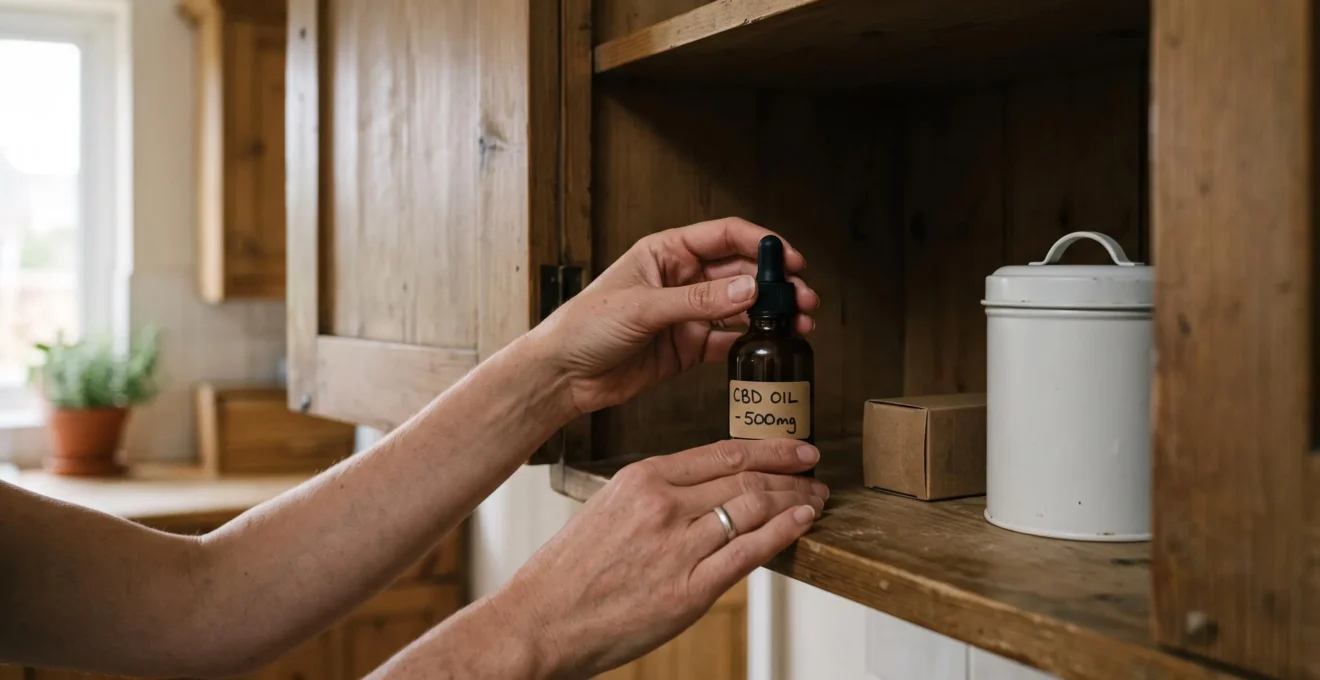
A CBD extract can change chemically long before its printed best-before date. Light, temperature, oxygen and the formulation itself influence whether the cannabinoids and other botanical compounds present at production remain consistent during distribution and everyday use. An apparently intact bottle does not necessarily contain an unchanged extract.
Protecting extract integrity therefore begins before storage. Extraction conditions determine which constituents enter the formulation, while the carrier oil and container influence their subsequent exposure to environmental stress. Once the bottle reaches the consumer, opening frequency, dropper hygiene and storage location introduce further variables.
Laboratory stability studies help explain these processes, although results from isolated CBD in one carrier oil cannot automatically predict the behaviour of every full-spectrum product. The practical objective is to limit avoidable chemical change throughout the product’s life, rather than assume that an amber bottle or an expiry date independently guarantees stability.
CBD extract integrity: the essential principles
- Control environmental exposure: light, elevated temperature and oxygen can contribute to compositional changes, with effects depending on the formulation.
- Evaluate the entire package: amber glass provides light protection, but closures, seals and appropriate packaging materials also matter.
- Adapt storage to actual use: keep containers tightly closed in a stable, cool, dark location, prevent dropper contamination and follow manufacturer-specific instructions.
- Why Can Heat, Light and Air Gradually Change a Botanical Extract?
- How Can You Evaluate Whether CBD Packaging Supports Long-Term Extract Stability?
- Unopened or Frequently Opened CBD Oil: Which Faces More Stability Challenges?
- Which Everyday Storage Mistakes Can Undermine CBD Extract Integrity?
- What Should You Prioritise When Storing a CBD Extract for Several Months?
- How Can You Reduce UV Exposure to CBD Oil Without Special Storage Equipment?
- Low-Temperature or Intensive Extraction: Which Better Preserves a Complex Botanical Profile?
- Why Are Amber Glass Vials Commonly Used for CBD Oils and Botanical Extracts?
Why Can Heat, Light and Air Gradually Change a Botanical Extract?
Heat, light and air can alter a botanical extract through different chemical pathways. Temperature can encourage cannabinoid transformations, light can promote photochemical degradation, and oxygen can contribute to oxidation of susceptible constituents. These changes accumulate during storage, potentially modifying cannabinoid concentration, aromatic composition or carrier-oil quality before obvious visible deterioration occurs.
The distinction between these mechanisms matters because degradation is not a single process. Different constituents respond differently to the same storage environment.
- Thermal transformations: heat can promote decarboxylation of cannabinoid acids and, under suitable conditions, other chemical changes including isomerisation or degradation. Their extent depends on the compounds present, temperature and exposure duration.
- Photochemical degradation: exposure to light can initiate reactions that alter cannabinoid content and visible appearance. The effect depends on wavelength, intensity, packaging and formulation.
- Oxidation: atmospheric oxygen can participate in reactions involving cannabinoids, volatile terpenes and susceptible carrier-oil lipids. Some oils may develop oxidation products associated with rancidity.
These pathways can occur together rather than independently. For example, elevated temperature may intensify the effects of light exposure, while oxygen availability can influence subsequent chemical reactions.
A 2026 study on CBD oil discoloration and storage stability investigated CBD isolate dissolved in medium-chain triglyceride (MCT) oil under different temperature, light and air-exposure conditions. Clear vials exposed to light experienced the greatest overall CBD loss and colour change. Air exposure accelerated discoloration, although its independent effect on CBD loss was comparatively limited under the tested conditions.
5.51% versus 12.93%
After approximately six months, CBD concentration declined by 5.51% in dark-control samples and 12.93% in amber vials exposed to light. These experimental results concern a specific 3% CBD isolate formulation in MCT oil, not a universal prediction for commercial extracts.
Ryu and colleagues, Industrial Crops and Products, 2026.
Chemical degradation can affect potency without producing an obvious sensory warning. Conversely, changes in colour or smell do not establish the identity, concentration or toxicity of degradation products. Loss of declared cannabinoid content and potential safety concerns from oxidised constituents are separate questions requiring different analytical evidence.
Once oxidation or other irreversible reactions have occurred, returning a bottle to suitable conditions does not restore its original composition. Controlling exposure is preventive, not restorative.
Manufacturing also establishes the starting point. Extraction conditions influence the cannabinoid and terpene profile, while the presence of residual processing compounds, plant waxes or other constituents may affect the formulation’s behaviour. Their specific effects must be assessed rather than assumed from an extraction label.
The first practical barrier against these processes is the container itself, but its protective performance depends on more than the colour of the bottle.
How Can You Evaluate Whether CBD Packaging Supports Long-Term Extract Stability?
Evaluate CBD packaging by examining the bottle material, light protection, closure integrity, dropper assembly and manufacturer’s stability information. A container that blocks ultraviolet light may still permit oxygen exchange through its cap. Reliable packaging therefore combines compatible materials, an effective seal and evidence that the complete system protects the specific formulation during its intended storage period.
Glass generally offers a strong barrier against gas permeation through the container wall, whereas plastic materials differ considerably in permeability and chemical compatibility. Plastic is not automatically unsuitable, but its interaction with a particular extract should be evaluated.
The FDA guidance on pharmaceutical container-closure systems explains the roles of packaging materials, closures, light protection and compatibility testing. This is pharmaceutical packaging guidance, not a requirement automatically applicable to every commercial CBD wellness product.
When comparing products, separate protection from light from protection against oxygen and moisture. The following criteria help identify what a package can reasonably achieve.
| Packaging feature | What to examine | Why it matters |
|---|---|---|
| Bottle material | Glass or plastic type and formulation compatibility | Influences gas permeation and potential material interactions |
| Light barrier | Amber or opaque container and secondary carton | Reduces exposure to damaging wavelengths |
| Closure seal | Cap fit, gasket condition and evidence of leakage | Helps limit external air and moisture ingress |
| Dropper assembly | Material compatibility and secure attachment | Reduces potential contamination and closure problems |
| Bottle capacity | Volume relative to expected usage | Influences the growing air space as contents are consumed |
| Product information | Batch code, date marking, storage directions and COA access | Supports traceability and evaluation of the manufacturer’s quality practices |
Batch identification, a certificate of analysis (COA) reference and storage instructions are useful transparency signals. However, their presence does not independently prove that stability testing was performed throughout the product’s claimed shelf life. A COA showing cannabinoid content at release is also different from a longitudinal stability study.
Bottle size introduces another variable. As oil is consumed, the headspace above the liquid increases. A larger partially emptied bottle may retain more air than a suitably sized smaller container, although the resulting impact depends on sealing, opening frequency and formulation.
It is not possible to infer an acceptable headspace volume from bottle dimensions alone. Nor is transferring oil automatically preferable to retaining the original container, which may have been selected and tested by the manufacturer.
For occasional users, smaller original retail sizes may be more practical than purchasing a large bottle that remains partly filled for many months.
Even an appropriately selected container faces different challenges after its seal is first broken, making everyday handling the next important consideration.
Unopened or Frequently Opened CBD Oil: Which Faces More Stability Challenges?
Frequently opened CBD oil generally faces more opportunities for air exchange, moisture introduction and dropper contamination than an equivalent unopened product. An unopened bottle still undergoes time-dependent changes influenced by temperature and light. However, each opening adds handling variables that may affect stability, making usage frequency and hygiene relevant alongside the printed best-before date.
The difference is not that an unopened bottle remains chemically unchanged. Rather, a properly sealed container maintains a more controlled environment, assuming the original packaging is suitable and storage recommendations are followed.
After opening, the liquid can interact with air during dosing. A dropper that contacts fingers, the mouth or an unclean surface can introduce additional contamination pathways.
A 2021 CBD stability study in Pharmaceutics examined CBD powder and CBD dissolved in sunflower oil under controlled storage conditions. The oil solution proved less stable than the powder, and substantial degradation occurred under severe conditions involving elevated temperature, humidity and open containers.
Under open-vial conditions of 40°C and 75% relative humidity, approximately complete CBD degradation was reported after 270 days. This was an accelerated experimental stress condition, not a general expiry timeline or a simulation of normal dropper-bottle use.
| Factor | Unopened bottle | Frequently opened bottle |
|---|---|---|
| Oxygen exposure | Influenced by the original headspace and packaging seal | Additional air exchange during opening and handling |
| Moisture exposure | Dependent on packaging protection | Additional opportunities during dosing |
| Contamination | Primarily associated with manufacturing and packaging integrity | Additional risk from dropper and hand contact |
| Storage duration | Assessed against the manufacturer’s unopened shelf-life conditions | May require a separate after-opening recommendation |
| Main handling priority | Maintain the specified storage environment | Close promptly and protect the applicator |
A printed best-before date generally assumes the product remains under the manufacturer’s specified storage conditions and, unless otherwise indicated, unopened. Once opened, the usable period may differ, but there is no evidence-based universal rule that opening reduces CBD oil shelf life by a fixed number of weeks or months.
For daily users, minimising unnecessary open-air time and maintaining dropper hygiene are practical priorities. For occasional users, preventing prolonged storage in unsuitable locations may be especially important.
Keep the dropper from touching the mouth or skin, return it directly to the bottle and secure the cap after dosing. These are precautionary hygiene practices, not experimentally quantified CBD shelf-life extensions.
The most effective routine addresses both handling and the surrounding storage environment, where several common household locations create avoidable exposure.
Which Everyday Storage Mistakes Can Undermine CBD Extract Integrity?
Common storage mistakes include leaving CBD oil near windows, keeping it in a warm vehicle, storing it in humid bathrooms or repeatedly exposing it to temperature changes. These conditions can increase chemical stress or create opportunities for contamination. Refrigeration is not automatically the best remedy, because formulation, condensation risk and manufacturer instructions must also be considered.
A bathroom cabinet may appear dark enough, but frequent changes in temperature and humidity make it less predictable than a stable interior cupboard. Moisture outside a properly sealed bottle does not necessarily enter the formulation, yet repeated handling in a damp environment can increase exposure opportunities.
Car storage is particularly unsuitable for extended periods because interior temperatures can vary substantially. A bottle left in a parked vehicle may experience intense heating followed by cooling, even when shielded from direct sunlight.
Temperature cycling can cause expansion and contraction of materials and contents. Depending on container construction, these changes may contribute to sealing problems. Nevertheless, the available CBD stability studies do not establish that fluctuations are universally more damaging than sustained exposure to a moderately elevated temperature.
It is useful to distinguish consequences rather than treat every storage mistake as equally serious.
- Potential potency changes: prolonged light exposure and elevated temperature may contribute to measurable cannabinoid loss.
- Potential quality or safety concerns: contamination and oxidation of susceptible formulation components warrant attention, although an observed chemical change does not automatically demonstrate toxicity.
- Physical changes: cooling can increase viscosity or produce cloudiness in some formulations without necessarily proving cannabinoid degradation.
- Packaging-related concerns: leaks, damaged closures or repeated moisture exposure can undermine the protective function of a container.
Refrigeration may be useful when supported by product-specific instructions, particularly where ambient storage conditions are consistently warm. Laboratory results showing improved stability at low temperatures do not, by themselves, establish that every household CBD product should be refrigerated.
Cold storage may cause thickening, and repeatedly moving a bottle between cold and warm conditions can introduce condensation concerns, particularly when the container is opened before reaching an appropriate handling temperature. Manufacturer instructions should determine the preferred approach.
A stable indoor cupboard away from heat sources is usually a more straightforward starting point than alternating between multiple storage locations.
For storage extending over several months, the same principles can be organised into a hierarchy that prioritises the measures with the clearest practical value.
What Should You Prioritise When Storing a CBD Extract for Several Months?
For several months of CBD extract storage, prioritise a consistently cool, dark location, an intact airtight closure and the manufacturer’s stated storage conditions. Refrigeration may be considered when specifically recommended or appropriate for the formulation. Reduce unnecessary opening, record the opening date and inspect the product before use, without treating visual appearance as proof of chemical stability.
The order of priorities matters. An expensive storage accessory offers little benefit if the bottle is routinely left open or exposed to sunlight. Similarly, a carefully sealed container does not eliminate reactions that may occur at elevated temperatures.
For a product used regularly over several months, maintaining a predictable daily routine is often more practical than trying to achieve laboratory storage conditions at home.
Long-term stockpiling raises different concerns. Unopened products still experience time-dependent changes, and the manufacturer’s supported shelf life remains more relevant than assumptions about indefinite stability.
Purchasing quantities that can reasonably be used within the stated period reduces the need to manage ageing stock. Rotating products according to their labelled dates is preferable to assuming that an unopened bottle remains suitable indefinitely.
Reducing headspace in a partially emptied bottle is a reasonable consideration, but transferring oil at home also introduces potential contamination, material-compatibility and handling risks. A smaller container should therefore be used only when it is appropriate for the formulation and transfer can be performed hygienically, preferably following supplier guidance. Retaining the original package is generally the simpler option when such information is unavailable.
Five checks before putting CBD oil into extended storage
- Verify the storage instructions: locate the manufacturer’s recommended conditions and record them in a short storage note.
- Select a stable location: identify one cool, shaded cupboard away from heat sources and record where the bottle will be kept.
- Inspect the closure: check the cap and dropper for damage, leakage or residue, leaving a visibly clean and properly closed container.
- Record product identification: note the batch number, labelled date and first-opening date in a simple product log.
- Review the remaining quantity: estimate whether it can be used within the manufacturer’s recommended period and note whether replacement or smaller future purchases would be preferable.
Before retrieving a bottle that has been stored for months, check for unusual odours, unexpected separation, marked changes in colour, damaged seals or altered consistency. Such changes may justify avoiding use and contacting the manufacturer.
However, sensory observations have important limitations. The 2026 MCT-based CBD experiment found a relationship between yellowing and declining CBD concentration, but visible changes could not directly quantify cannabinoid loss or identify the degradation products.
A product that looks unchanged may still have a different composition from its original certificate of analysis. Laboratory testing, rather than appearance alone, is necessary to establish its actual cannabinoid profile.
For products handled every day, one particularly useful improvement is reducing light exposure during the brief periods when the bottle is removed from storage.
How Can You Reduce UV Exposure to CBD Oil Without Special Storage Equipment?
You can reduce CBD oil’s ultraviolet exposure without specialised equipment by storing it in an interior cupboard or drawer, keeping its original cardboard carton, or using an opaque secondary container. Limit the time the bottle spends in daylight and return it to storage immediately after use. These habits reduce cumulative light exposure without requiring perfect darkness.
Light-related degradation depends on the wavelengths reaching the formulation, their intensity and the duration of exposure. Repeated brief exposures can therefore contribute to total exposure over time, although their chemical consequences depend on the product.
An amber bottle helps limit some wavelengths, but it is not a complete light shield. Keeping that bottle inside its original carton offers an additional physical barrier when the carton is opaque.
For ordinary household storage, several simple arrangements are available:
- Use an interior cupboard or drawer away from direct daylight and heat sources.
- Keep the bottle in its original cardboard packaging between uses.
- Place the closed bottle inside a suitable opaque canister when its original packaging is unavailable.
- For travel, use an opaque protective covering or case while also preventing breakage and excessive heating.
Direct sunlight is not the only relevant consideration. Daylight reaching a room through windows can include transmitted ultraviolet wavelengths, although ordinary window glass filters much of the shorter-wavelength UV spectrum. Certain artificial light sources may also contribute to photochemical exposure, depending on their emission characteristics.
Consequently, storing a bottle away from windows is a more reliable habit than relying exclusively on the absence of direct sunlight.
For daily use, the highest-frequency exposure opportunity is often the dosing routine itself. Instead of leaving the bottle on a windowsill or countertop for convenience, take it from its cupboard, dispense the product away from strong light and return it promptly.
Reducing exposure is more important than achieving absolute darkness. Every avoidable period of illumination removed from the routine reduces the cumulative opportunity for light-driven reactions.
Once photochemical changes have occurred, subsequent darkness cannot reverse them. The purpose of these precautions is to prevent additional exposure, not regenerate degraded constituents.
While storage determines what happens after purchase, the extract’s initial botanical composition is established earlier, through decisions made during manufacturing.
Low-Temperature or Intensive Extraction: Which Better Preserves a Complex Botanical Profile?
Low-temperature extraction can favour retention or selective recovery of volatile botanical constituents under suitable conditions, while more intensive extraction may target greater cannabinoid recovery or concentration. Neither approach is universally superior. Preserving a complex profile depends on the raw material, solvent, temperature, processing time, fractionation and subsequent formulation—not simply whether an extraction method is described as gentle or intensive.
Different extraction methods are designed around different performance objectives. Maximising the amount of cannabinoids recovered from plant material is not necessarily equivalent to preserving the broadest possible distribution of terpenes and minor constituents.
A scientific review of cannabis extraction techniques published by the Royal Society of Chemistry discusses how operating conditions influence compound selectivity and extraction yield.
Among the research reviewed, lower-temperature supercritical carbon dioxide extraction without a co-solvent favoured terpene recovery in a particular experimental context. The addition of ethanol as a co-solvent helped maximise cannabinoid extraction under the conditions examined.
These findings illustrate a trade-off between targeted recovery and botanical breadth, but they do not establish that lower temperatures always preserve more of every compound.
| Evaluation criterion | Lower-temperature approach | More intensive approach |
|---|---|---|
| Primary optimisation | May favour selected volatile constituents | May favour cannabinoid recovery or processing efficiency |
| Terpene profile | Can support recovery under suitable conditions | Depends on processing parameters and possible fractionation |
| Cannabinoid content | Not necessarily maximised | May be increased through selective processing |
| Finished composition | Depends on subsequent formulation and handling | Depends on subsequent formulation and handling |
| Storage implications | Susceptibility depends on retained constituents | Susceptibility depends on the resulting formulation |
The distinction becomes important for terpene-rich products. Many terpenes are volatile and chemically susceptible to environmental conditions, so protecting an aromatic profile may require attention beyond the measured CBD concentration.
However, a full-spectrum label does not establish a predictable degradation rate. Different formulations contain different compounds, concentrations and carrier oils; their comparative stability requires product-specific testing.
Consumers and product professionals can evaluate manufacturing claims by asking which extraction method was used, whether processing conditions are disclosed and whether the COA identifies minor cannabinoids or relevant terpenes.
A certificate showing only CBD concentration can verify certain aspects of cannabinoid content at the time of testing, but it cannot demonstrate preservation of the full botanical profile or independently reveal the extraction conditions.
Likewise, a broad analytical profile is not sufficient on its own to establish microbiological quality, contaminant control or long-term stability. These are additional dimensions of product quality.
Once that composition is established, packaging must protect it during distribution and storage, explaining the frequent use of amber glass in botanical extract products.
Key takeaways before choosing a bottle
- Light protection is a measurable packaging function, but it is distinct from limiting oxygen or moisture entry.
- Glass material, bottle colour and cap construction work together; no single feature establishes the shelf life of a CBD formulation.
- Packaging claims are more meaningful when supported by compatibility information, batch traceability and relevant stability testing.
Why Are Amber Glass Vials Commonly Used for CBD Oils and Botanical Extracts?
Amber glass vials are widely used for CBD oils and botanical extracts because coloured glass can reduce the transmission of light wavelengths associated with photochemical degradation. Glass also provides a strong barrier against gas permeation through the container wall. These characteristics make amber glass a practical packaging choice, although actual stability also depends on the closure, formulation and storage conditions.
The colour is functional rather than purely decorative. Amber glass absorbs or filters portions of incident light, including relevant ultraviolet wavelengths, reducing the amount reaching the extract.
The degree of protection depends on glass composition, thickness and wavelength. Amber colour alone does not prove that a specific bottle satisfies a defined light-transmission requirement.
Glass also differs from many plastics in its resistance to gas permeation. However, the dropper cap, liner and other closure components may still permit leakage or exchange if they are not appropriately designed and fitted.
Amber glass protects against certain light exposures, not every cause of degradation. The complete packaging system remains important.
In the 2026 MCT-based CBD stability experiment described earlier, amber vials exposed to light provided less protection than samples stored in darkness. The result demonstrates why light-filtering containers should not be treated as substitutes for appropriate storage conditions.
Amber glass has a long history of use for light-sensitive pharmaceutical and botanical preparations, reflecting established packaging practices. Historical prevalence, however, is not evidence that every modern CBD formulation will remain stable for a particular duration.
Glass has practical drawbacks. It is heavier than many plastic alternatives and can break during transport or handling. The suitability of a particular format therefore also depends on user requirements and the integrity of its closure assembly.
For CBD products, packaging selection should be considered alongside the manufacturer’s storage instructions and the conditions under which stability claims were established.
Before choosing or storing an extract, compare the available batch information, packaging characteristics and expected usage period, then establish a consistent storage routine suited to that specific product.
Can CBD oil lose cannabinoid content without changing colour?
Yes. Visible appearance is not a reliable quantitative measure of CBD content. Laboratory research has found associations between discoloration and cannabinoid loss under certain conditions, but these relationships do not establish a universal visual test. A product may experience compositional changes without an obvious change in colour, while discoloration alone cannot identify which chemical reactions have occurred.
Does a certificate of analysis guarantee that CBD oil will remain stable?
No. A COA generally reports analytical findings for a particular sample or batch at a specified point in time. Long-term stability requires evidence covering relevant storage conditions and changes over time. A release certificate listing cannabinoid concentrations does not independently guarantee that those concentrations will remain unchanged until the product’s labelled date.
Is cloudy CBD oil necessarily degraded?
Not necessarily. Changes in temperature can affect the appearance or viscosity of certain oil formulations, and cloudiness alone does not establish cannabinoid degradation. However, unexpected changes may also indicate formulation instability or contamination. If cloudiness persists, is accompanied by an unusual odour or differs from the manufacturer’s description, seek product-specific advice before use.
Can an expired CBD extract be made stable again by refrigeration?
No. Refrigeration may slow some subsequent chemical reactions, depending on the formulation, but it cannot reverse degradation that has already occurred or re-establish an expired product’s original composition. Refrigeration also does not validate the safety of a product stored beyond its supported shelf life. Follow the manufacturer’s date and storage guidance rather than attempting to restore an ageing extract.
Why can two CBD oils stored under identical conditions behave differently?
CBD oils may differ in cannabinoid concentration, terpene content, carrier oil, processing history, packaging and other formulation characteristics. These variables can influence which degradation pathways occur and how quickly changes become measurable. Findings for CBD isolate in MCT oil or sunflower oil therefore cannot be applied automatically to every broad-spectrum or full-spectrum preparation.