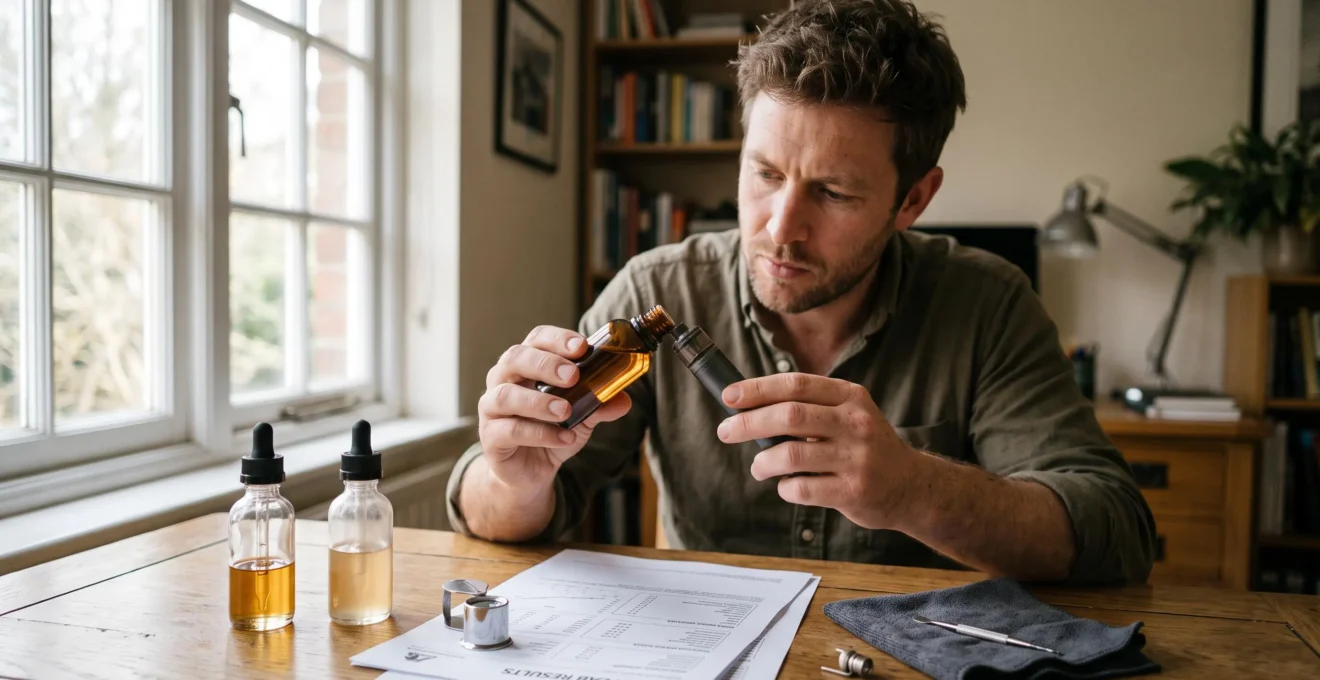
A CBD vape liquid is compatible with a particular device when its carrier formulation, flow characteristics and thermal behaviour fall within the operating conditions supported by that device. The relevant variables include the propylene glycol (PG) and vegetable glycerin (VG) balance, cannabinoid formulation, wick design, coil resistance and available heating power.
Physical compatibility is only one part of the assessment. A liquid must also be explicitly formulated for inhalation, have identifiable ingredients and provide enough batch information to evaluate its composition. A bottle that fits a refill opening, or a cartridge that screws into a battery, is not necessarily appropriate for the heating system.
For adults in the UK comparing CBD products, the most useful starting point is therefore the combination of the manufacturer’s specifications and a batch-matched certificate of analysis (COA). Neither device compatibility nor laboratory testing establishes that inhaling a CBD aerosol is harmless. Vaping carries potential respiratory risks, and the long-term effects of inhaling many CBD formulations remain insufficiently characterised.
CBD vape liquid compatibility at a glance
- Match liquid flow to the wick: PG/VG composition, cartridge openings and coil design determine whether the liquid can replenish the heating surface adequately.
- Verify what the bottle contains: check CBD concentration, carrier ingredients, intended use, batch identification and supporting laboratory results.
- Respect the device’s operating limits: a compatible connection does not guarantee suitable electrical power, heating behaviour or consistent aerosol production.
- Why Can a CBD Vape Liquid Be Too Thick or Too Thin for Some Devices?
- How Can You Read a CBD Vape Liquid Label Before Filling a Compatible Device?
- Flavoured or Unflavoured CBD Vape Liquid: Which Has the Simpler Formulation?
- Which CBD Vape Liquid Label Gaps Should Make You Avoid Using the Product?
- When Should You Change CBD Vape Liquid Rather Than Keep Adjusting the Device?
- How Can You Check Whether a CBD Cartridge Matches Your Vape Device Before Use?
- Why Can Excessive Heat Change the Taste and Performance of CBD Vape Liquid?
- What Makes CBD Vape Aerosol Consistent Enough for Controlled Inhalation?
Why Can a CBD Vape Liquid Be Too Thick or Too Thin for Some Devices?
A CBD vape liquid can be too thick when its viscosity prevents the wick from supplying the heating coil quickly enough. It can be too thin when the cartridge’s liquid-control system allows excessive flow, potentially causing flooding or leaks. Compatibility depends on the formulation and the atomiser’s construction, not simply on the device brand or bottle size.
Viscosity describes a liquid’s resistance to flowing. In conventional PG/VG formulations, PG generally flows more readily, while VG is more viscous. The actual behaviour also depends on temperature, CBD concentration and any other ingredients. Concentrated cannabinoid preparations and wax-containing extracts may behave differently from ordinary PG/VG e-liquids.
The wick supplies liquid to the coil through capillary action. If evaporation at the heated surface exceeds replenishment, portions of the wick can become insufficiently saturated. This creates conditions associated with dry hits, excessive local heating and an unpleasant burnt taste.
Conversely, a relatively thin formulation in a cartridge designed to retain more viscous liquid may pass through its intake system too freely. The result can be gurgling, flooding or leakage, although seals, cartridge damage and filling errors can produce similar symptoms.
The Scientific Reports study on electronic-cigarette wick evaporation examined how PG/VG composition, electrical power and wick porosity interact. Its modelling and experimental work showed that these variables jointly influence evaporation and thermal efficiency. The findings do not establish universal PG/VG ratios for CBD devices.
Liquid density should not be confused with viscosity or wicking speed. A liquid may appear sufficiently fluid in its bottle but still replenish a particular coil too slowly because the wick material, intake geometry or heating conditions are unsuitable.
Thicker formulations also have different heat-transfer and evaporation characteristics. Increasing power is not a reliable correction: more heat can worsen local wick drying when liquid supply is already insufficient.
A preliminary visual inspection can identify obvious abnormalities. A liquid that moves very slowly, resembles syrup or separates into visible layers deserves further investigation. However, a pour test cannot establish actual viscosity, device suitability or inhalation safety.
Do not add PG, VG, oils or other thinning agents to correct an apparent mismatch. Doing so changes the intended formulation and may introduce substances whose behaviour when heated has not been adequately evaluated.
The next compatibility decision begins with the label: a plausible-looking liquid is not enough unless its stated composition can be checked against the device’s requirements.
How Can You Read a CBD Vape Liquid Label Before Filling a Compatible Device?
Read a CBD vape liquid label by identifying its CBD concentration, carrier ingredients, PG/VG ratio, intended use, nicotine content and batch number. Then compare those details with the device manufacturer’s liquid requirements and the product’s certificate of analysis. A label that omits essential composition information cannot reliably establish compatibility, regardless of its marketing claims.
Begin with cannabinoid quantity. A bottle might declare CBD in milligrams per container, but that does not directly state concentration. For example, a hypothetical bottle containing 500 mg of CBD in 10 ml would contain a nominal 50 mg/ml. This calculation describes liquid concentration, not the amount inhaled or absorbed during a puff.
Next, identify the carrier system. PG-rich liquids are often associated with smaller, lower-output devices, while more VG-rich formulations are commonly used in hardware designed for greater liquid throughput. These are general formulation tendencies, not interchangeable manufacturer specifications. Coil construction and approved operating conditions remain decisive.
Check whether the ingredients include MCT oil, vitamin E acetate, additional thinning agents or unexplained extracts. Do not assume an ingredient suitable for oral consumption is appropriate for inhalation. The FDA and CDC have specifically advised against adding vitamin E acetate or unintended substances to vaping products.
Terms such as full-spectrum, broad-spectrum and CBD isolate describe cannabinoid composition claims. They do not establish a liquid’s viscosity or prove that its terpene content is compatible with a specific heating system. Likewise, descriptors such as premium or organic-style do not supply meaningful technical specifications.
A batch-specific COA can provide evidence of measured cannabinoid content and, depending on the testing performed, results for residual solvents, heavy metals or pesticides. It should identify the tested sample and methods clearly enough to determine whether it relates to the bottle being considered.
74%
In a study of 202 US CBD products purchased in 2021, including 34 vape products, 149 products differed from their labelled CBD potency by at least 10%. This result describes the full sample, not vape products alone, and should not be treated as a current UK market estimate.
2024 Frontiers in Pharmacology study on CBD labeling accuracy
The study illustrates why a front-label potency claim is not sufficient evidence of actual contents. It does not mean that a satisfactory COA guarantees safe inhalation or compatibility with every device.
Five checks to complete before filling
- Record the CBD concentration. Note the declared total CBD in mg, bottle volume in ml and the resulting nominal mg/ml concentration.
- Identify the carrier formulation. Write down the PG/VG ratio and every disclosed oil, solvent or additional diluent; mark unidentified ingredients as unresolved.
- Confirm intended use. Locate an explicit vaping designation and compare the liquid with the manufacturer’s stated device requirements.
- Verify the product batch. Match the bottle’s batch identifier to the COA and record which cannabinoids and contaminants were actually tested.
- Document the compatibility decision. Record the device model, cartridge or coil specification and any missing information; do not fill when critical details remain unverified.
After the basic ingredients have been verified, flavouring becomes the next variable to assess because it can change both the complexity of the formulation and its response to heating.
Flavoured or Unflavoured CBD Vape Liquid: Which Has the Simpler Formulation?
Unflavoured CBD vape liquid generally has the simpler formulation because it may contain only the cannabinoid preparation and its carrier system. Flavoured products introduce additional substances, such as flavouring compounds or terpenes, which require separate evaluation. A shorter ingredient list can make composition easier to understand, but it does not establish that a liquid is safe to inhale.
The main advantage of an unflavoured formulation is fewer ingredient interactions to investigate. There may be fewer potential sources of flavour instability, residue formation or unexpected changes when the liquid is heated. However, unflavoured products can still contain unsuitable solvents, degraded cannabinoids or undisclosed substances.
Flavourings can mask CBD’s naturally bitter or plant-like taste. This may make a product more palatable, but flavour acceptability is not a measure of aerosol safety.
Different flavour compounds respond differently to heat. Some can undergo chemical transformation under vaping-relevant conditions, while sweetened formulations may leave deposits on heating surfaces. Residue accumulation can interfere with heat transfer and liquid supply, although the rate of coil deterioration depends on the complete formulation and hardware.
Importantly, a substance described as food-grade has not necessarily been evaluated for inhalation after heating. Oral exposure and respiratory exposure involve different routes and conditions. Flavour suppliers and finished-product manufacturers should therefore be able to explain the ingredient’s intended use rather than relying solely on food-related classifications.
When comparing flavoured and unflavoured liquids, assess ingredient disclosure before taste preferences. A clearly documented flavoured formulation may be easier to evaluate than an unflavoured bottle with an unidentified carrier.
| Assessment criterion | Unflavoured liquid | Flavoured liquid |
|---|---|---|
| Ingredient complexity | Potentially fewer ingredients | Additional flavour compounds or terpenes |
| Thermal behaviour | Still depends on carriers and CBD preparation | Also depends on flavour chemistry |
| Coil deposits | Possible, depending on formulation | Additional ingredients may contribute to deposits |
| Evidence needed | Full composition and batch testing | Full composition, batch testing and flavouring assessment |
| Inhalation safety | Not guaranteed | Not guaranteed |
For someone prioritising a straightforward compatibility assessment, an unflavoured product with a fully disclosed carrier system can reduce the number of variables. That benefit disappears if the manufacturer cannot identify what the liquid contains.
Whichever option is preferred, missing formulation information should not be treated as a minor packaging inconvenience. Some omissions prevent a meaningful compatibility assessment altogether.
Which CBD Vape Liquid Label Gaps Should Make You Avoid Using the Product?
A CBD vape liquid should not be used when its intended route of administration, principal carrier ingredients or product identity cannot be established. Missing batch identification, unverifiable potency claims and the absence of manufacturer information are also substantial warning signs. These gaps prevent informed assessment of composition, traceability or device compatibility, even when the product looks normal.
The most important distinction is between products intended for oral administration and those specifically formulated for vaping. CBD oils and tinctures may contain MCT oil or other lipid-based carriers intended for swallowing or sublingual use. They should not be transferred into a vaping device.
Labelling should make the intended use clear. A statement that something contains CBD, is natural or is suitable for adults does not establish that it has been formulated for aerosol generation.
Several omissions merit particular attention:
- Undisclosed carrier composition: the product does not identify the liquid base or relevant additives.
- Insufficient potency information: the CBD quantity or bottle volume is missing, preventing calculation of nominal concentration.
- No identifiable batch: there is no reliable way to connect the bottle to a particular test result.
- Unverifiable laboratory claims: a COA is absent, unrelated to the batch or too incomplete to support the claims made.
- No responsible manufacturer contact: missing information cannot be clarified or traced.
- Unclear intended use: the formulation might be an oral oil, food preparation or another product not intended for inhalation.
These warning signs concern missing evidence, not proof that every poorly labelled bottle contains a harmful substance. The appropriate response is nevertheless to avoid using a product whose critical characteristics cannot be verified.
The FDA information on vaping-associated lung injuries describes investigations into the 2019–2020 EVALI outbreak and the strong association with vitamin E acetate, principally in THC-containing vaping products. The FDA and CDC advised that vitamin E acetate should not be added to vaping products and warned against adding substances not intended by manufacturers.
That historical investigation does not establish that MCT oil caused EVALI, nor does it provide safety certification for modern CBD liquids. It reinforces the importance of distinguishing formulation ingredients and intended routes of exposure.
When a label is incomplete, check the manufacturer’s published technical information and compare the batch number with any available COA. Ask for specific missing details in writing. A refusal to disclose basic formulation information, or an answer consisting only of marketing claims, leaves the compatibility question unresolved.
Even a properly identified liquid can become unsuitable through degradation, storage problems or a persistent mismatch with a particular coil. The next step is to distinguish these causes before making further device adjustments.
When Should You Change CBD Vape Liquid Rather Than Keep Adjusting the Device?
Change or stop using a CBD vape liquid when persistent dry hits, leaking, gurgling or abnormal taste remain after the device has been checked against the manufacturer’s instructions. Replace the liquid immediately if it shows unexplained separation, contamination or significant deterioration. Repeatedly increasing power or modifying the formulation is not a safe substitute for resolving a compatibility problem.
Three common failure patterns need different responses: inappropriate liquid flow, liquid deterioration and coil wear. Treating them as the same problem often leads to unnecessary adjustments without identifying the actual cause.
Start by checking the hardware. A worn coil or damaged seal can produce burnt flavours, leaks and inconsistent performance even when the liquid was originally suitable. If the manufacturer identifies the coil as replaceable, follow its replacement and preparation instructions before concluding that the formulation is responsible.
If the hardware is in good condition but problems occur only with one specific liquid, examine the liquid’s stated viscosity range and carrier composition. Repeated dry hits may indicate inadequate replenishment; persistent flooding may reflect excessive liquid flow or a sealing problem.
Consider the following hypothetical comparison: the same properly maintained refillable device operates normally with an approved liquid but repeatedly gurgles with a different formulation. That observation is consistent with a possible flow mismatch. It does not, by itself, prove that viscosity is the cause, since fill level, seals and manufacturing defects also require consideration.
Liquid deterioration is a separate reason to stop using the product. Check the manufacturer’s shelf-life and storage instructions, particularly after prolonged opening, heat exposure or direct sunlight. Changes in smell, unexpected cloudiness, particles or persistent phase separation warrant caution.
A colour change alone is not conclusive evidence of contamination or a specific chemical reaction. Similarly, a liquid that has no obvious visible changes is not necessarily unchanged at a chemical level.
Cost should not drive the decision to continue using an unsuitable product. Keeping an expensive bottle in service by forcing higher wattage or altering the carrier mixture can increase uncertainty about both hardware performance and aerosol composition.
When problems persist, stop use and consult the manufacturer’s technical guidance rather than repeatedly experimenting with settings. A liquid that is not approved for the device should not be made to fit by improvisation.
For cartridge systems, another distinction matters: the electrical and mechanical connection must be checked separately from the liquid inside the cartridge.
How Can You Check Whether a CBD Cartridge Matches Your Vape Device Before Use?
A CBD cartridge matches a vape device only when its connection type, electrical requirements and intended liquid formulation are supported by that device. A cartridge may physically attach to a battery yet still require a different voltage, power range or control system. Compatibility should be confirmed from manufacturer specifications before use, rather than inferred from appearance or threading alone.
Connection type is the first layer. Many cartridges use a 510-threaded connector, while other systems use magnetic contacts or proprietary pod fittings. A shared connection standard can help establish mechanical fit, but it does not guarantee that every connected cartridge is electrically suitable.
The second layer is coil resistance and power delivery. Resistance, commonly expressed in ohms (Ω), influences electrical current and heating power in conjunction with the battery’s output and regulation system.
A cartridge designed for one operating range may perform poorly with a battery that supplies inadequate power. Conversely, unsuitable or poorly regulated output can contribute to excessive heating. The relevant comparison is the cartridge manufacturer’s approved operating range against the battery’s supported output—not resistance alone.
The third layer is the cartridge’s liquid-management design. Intake openings, wick materials and the intended formulation influence how quickly liquid reaches the heating element. A cartridge intended for a concentrated cannabinoid preparation may have different requirements from a conventional refillable PG/VG pod.
Before connecting a cartridge, use the following information to identify potential mismatches:
- Connection: verify the exact connector or pod system stated by both manufacturers.
- Electrical specification: confirm coil resistance and approved voltage or power range where provided.
- Liquid system: establish whether the cartridge is pre-filled, refillable or restricted to a particular formulation.
- Manufacturer support: check for explicit compatibility guidance and relevant operating restrictions.
A pre-filled cartridge introduces an additional limitation: consumers cannot independently select its internal carrier formulation. The product datasheet, ingredient disclosure and batch-specific COA therefore become particularly important. With a refillable cartridge, the liquid can be evaluated separately, but only within the manufacturer’s stated filling requirements.
Never force a threaded or magnetic connection. If the cartridge does not seat correctly, has damaged contacts or lacks clear electrical specifications, do not attempt to make it work through adapters or improvised modifications without explicit manufacturer support.
Once those requirements align, heat management becomes the next concern, because correct electrical pairing does not prevent changes in aerosol chemistry when operating conditions are excessive.
Why Can Excessive Heat Change the Taste and Performance of CBD Vape Liquid?
Excessive heat can alter CBD vape liquid by accelerating chemical reactions in cannabinoids, carrier ingredients and flavouring compounds. It may also increase residue formation and interfere with liquid delivery to the coil. Harsh or burnt flavours and darkening around the heating element are warning signs of abnormal operation, although they do not identify which chemicals are being produced.
Vaping involves more than evaporation of an unchanged liquid. When ingredients encounter a hot surface, some may undergo oxidation, decomposition or other reactions. The extent depends on local temperature, oxygen availability, formulation and how long the ingredients remain exposed to heat.
CBD and terpenes are chemically distinct substances, and they should not be assigned a single universal degradation temperature. Coil temperatures also vary within a device, making any one displayed wattage an incomplete description of what the liquid experiences.
Experimental research in Scientific Reports examined the heating of selected monoterpenes, specifically alpha-pinene and terpinolene, under conditions intended to mimic vaping-coil temperatures. The researchers identified thermal reaction pathways, including oxidation, rearrangement, cleavage and dehydration. Temperature and air availability influenced the reaction products.
These results show that certain terpene constituents are thermally reactive. They do not establish that every CBD flavouring behaves identically or provide a universal safe temperature for CBD vaping.
Prolonged heating can also affect hardware performance. Deposits associated with heated formulations may accumulate on coil surfaces, altering heat transfer or obstructing liquid movement. Reduced replenishment can then contribute to further local overheating.
Warning signs include an unexpectedly sharp or burnt taste, repeated harshness, abnormal dark residue and substantial changes in vapour production. A peppery sensation or changing perceived effect is not a reliable thermometer or measurement of CBD delivery.
Two devices operating at the same displayed wattage can behave differently because of coil material, surface area, airflow, wick saturation and power regulation. Staying within the manufacturer’s operating range is necessary, but it does not establish that the resulting aerosol is free of harmful compounds.
When overheating is suspected, stop using the device and check the hardware and formulation against the manufacturer’s specifications. Repeatedly tolerating a burnt taste is not an appropriate way to assess compatibility.
Temperature control, however, is only one part of consistent aerosol production. Liquid stability and the rate at which the wick is replenished also determine whether the same device behaves similarly during repeated use.
Key takeaways before assessing aerosol consistency
- A liquid must remain physically stable and reach the coil at a rate appropriate for the cartridge’s design.
- Electrical compatibility and steady heating are separate requirements; neither can be inferred from mechanical fit alone.
- Repeatable aerosol appearance is useful for spotting changes in performance, but cannot verify CBD dose or inhalation safety.
What Makes CBD Vape Aerosol Consistent Enough for Controlled Inhalation?
Consistent CBD vape aerosol requires a stable liquid formulation, repeatable heating conditions and sufficient liquid delivery to the coil. These conditions can support more predictable device performance, but they do not guarantee a controlled or accurately measured inhaled CBD dose. Aerosol appearance, puff duration and laboratory liquid concentration cannot independently establish how much CBD reaches the lungs.
Liquid stability is the first requirement. The carrier system should remain sufficiently uniform during storage and use, without unexplained separation, precipitation or viscosity changes. Otherwise, the material reaching the coil may not have the same composition throughout the cartridge.
Thermal stability is the second requirement. The heating system must operate within its intended electrical range while the wick remains adequately supplied. Changes in resistance, airflow, coil deposits or battery behaviour may alter aerosol generation despite an unchanged bottle of liquid.
The third requirement is replenishment. In wick-based systems, liquid must reach the heating surface quickly enough to replace what is evaporated. Frequent or prolonged puffs can increase demand relative to liquid supply and potentially contribute to local drying.
These relationships explain why apparently identical liquids can behave differently in separate devices. Cartridge construction and operating conditions influence aerosol generation as much as the formulation itself.
Some practical observations can help identify changes in performance:
- Whether draw resistance remains similar during normal operation.
- Whether flavour or harshness changes unexpectedly.
- Whether vapour production becomes unusually irregular.
- Whether leaks, gurgling or burnt-tasting puffs develop.
- Whether the cartridge shows abnormal residue, separation or deterioration.
These are operational indicators, not validated measurements of aerosol composition. Similar-looking puffs can contain different quantities of CBD, and a consistent taste does not exclude unwanted thermal reaction products.
Liquid concentration is also not equivalent to delivered dose. The actual quantity generated and inhaled depends on aerosol output, puff behaviour, device characteristics and chemical transformations. The amount absorbed by the body introduces further uncertainty.
Consequently, claims about precise CBD delivery per puff require product-specific evidence rather than calculations based solely on the bottle label. The available research on generic electronic-cigarette evaporation supports the importance of interactions between liquid composition, wick structure and heating power; it does not validate controlled CBD dosing across commercial devices.
For adults reviewing a device-liquid pairing, consistency is best understood as the outcome of several successful compatibility checks. It is not a substitute for ingredient transparency, appropriate device specifications or an assessment of inhalation-related risks.
Before using any CBD vaping product, establish the manufacturer’s intended liquid and hardware combination, verify the ingredient and batch information, and avoid use when essential compatibility or safety information is missing. Anyone considering inhaled CBD for a health condition should seek appropriate medical advice rather than relying on device performance as evidence of a controlled therapeutic dose.
Can CBD vape liquid be mixed with an ordinary nicotine e-liquid?
Mixing products changes their intended cannabinoid and nicotine concentrations, carrier composition and potentially their thermal behaviour. Compatibility and inhalation safety cannot be established simply because both are labelled as vape liquids. Do not mix formulations unless the manufacturers explicitly support the combination and provide adequate specifications.
Does a higher CBD concentration require a more powerful vape device?
Not necessarily. CBD concentration alone does not determine viscosity, evaporation behaviour or appropriate electrical power. The carrier ingredients, physical form of the CBD preparation and atomiser design matter. Follow the device and liquid manufacturers’ stated requirements rather than increasing power solely because the labelled CBD concentration is higher.
Can a clear, uniform CBD vape liquid still be incompatible with a device?
Yes. A visually uniform liquid can still have unsuitable viscosity, unidentified ingredients or thermal characteristics outside the device’s intended operating conditions. Appearance is useful for detecting some obvious problems, but cannot replace ingredient disclosure, device specifications or relevant laboratory testing.
Does a certificate of analysis prove a CBD vape liquid is safe to inhale?
No. A COA reports the results of particular tests on identified samples. It may verify cannabinoid concentrations or screen for specified contaminants, but it does not automatically assess every possible inhalation hazard or the chemicals formed during heating. The tested batch, analytical methods and scope of testing must all be considered.
Is CBD vape liquid compatibility the same as compliance with UK product requirements?
No. Technical compatibility concerns how a particular formulation interacts with the device, while UK product requirements can involve cannabinoid content, product classification, safety, labelling and applicable restrictions. The source material used for this article does not establish the current legal status of an individual CBD product. Device suitability should never be interpreted as evidence that a product is legally compliant or authorised for medicinal use.