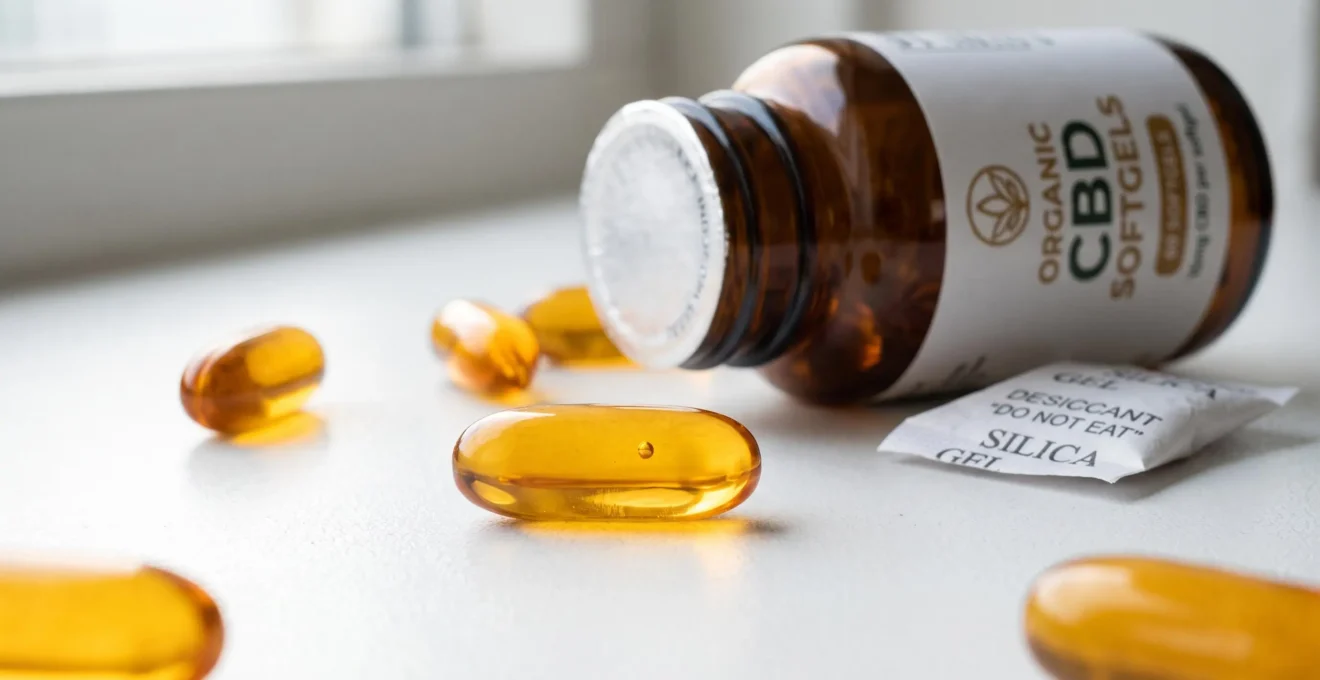
CBD oil contains compounds whose stability depends on their surrounding environment. Oxygen can trigger oxidation, light can initiate chemical changes, and excessive heat or humidity can compromise the formulation and its container. Encapsulation helps limit these exposures by enclosing a measured quantity of oil within a continuous, flexible shell.
A CBD softgel is more than a convenient alternative to a dropper. Its gelatin-based shell physically contains the oil, reduces direct contact with the surroundings and supports consistent unit dosing. However, the shell is not an impermeable shield. Its protective performance depends on its composition, the ingredients inside, the packaging and the conditions encountered during storage.
Understanding these distinctions matters because changes can begin before a capsule looks damaged. A softgel may remain visually intact while chemical reactions gradually affect its contents. Choosing suitable packaging, recognizing warning signs and storing capsules correctly are therefore essential complements to encapsulation itself.
CBD softgel protection: the essentials
- Encapsulation reduces direct environmental exposure, but gelatin shells do not completely block oxygen, moisture or light.
- Barrier packaging, appropriate temperature and humidity, and prompt resealing help preserve both the capsule shell and its oil-based contents.
- Visible defects can signal deterioration, although a normal appearance cannot guarantee that CBD potency or formulation quality remains unchanged.
- Why Do Sensitive CBD Ingredients Need Protection from Air, Moisture and Light?
- How Can You Keep CBD Capsules Protected After Opening the Original Container?
- Blister Pack or Bottle: Which Better Protects Sensitive CBD Capsules During Storage?
- Which Packaging Problems Can Expose CBD Capsules Before You Use Them?
- When Does Storage Protection Matter Most for CBD Capsules Used Occasionally?
- Why Can Warm, Humid Storage Speed Up CBD Capsule Degradation?
- Why Can a Gelatin Capsule Protect CBD Oil Before Dissolving in the Digestive Tract?
- What Causes Early Degradation in CBD Capsules and Softgels?
Why Do Sensitive CBD Ingredients Need Protection from Air, Moisture and Light?
CBD ingredients need protection because oxygen, moisture and light can affect different parts of a softgel formulation through distinct mechanisms. Oxygen can oxidize susceptible molecules, moisture can alter the gelatin shell and interact with formulation components, and light can promote photochemical reactions. Encapsulation helps reduce exposure, while suitable outer packaging strengthens that protection.
Oxidation occurs when susceptible compounds react with oxygen or other oxidizing agents. CBD can undergo oxidative degradation, while unsaturated fats in certain carrier oils may oxidize through their own reaction pathways. These changes can affect chemical composition, smell and formulation quality.
An experimental study on cannabidiol stability published in Journal of Chromatography B investigated the influence of temperature, solvents, oxidative conditions and light. The researchers reported substantial CBD sensitivity under their experimental oxidizing conditions. These measurements concerned CBD solutions, however, and cannot be interpreted as degradation rates inside commercial softgels.
Moisture exposure introduces a different problem. Water can migrate into or out of gelatin shells, changing their mechanical properties. Hydrolysis may also affect susceptible formulation ingredients when sufficient water and suitable reaction conditions are present. Nevertheless, moisture-induced CBD hydrolysis inside oil-filled softgels has not been established by the supplied research.
Photodegradation refers to chemical changes initiated by absorbed light. UV and certain visible wavelengths may contribute to photochemical reactions in susceptible ingredients. The CBD stability experiment identified light sensitivity, with an apparently oxidative photolytic mechanism.
CBD is not the only ingredient worth protecting. Depending on the formulation, softgels may contain terpenes, flavonoids, antioxidants and carrier oils such as MCT or hemp seed oil. These ingredients have different chemical vulnerabilities. For example, oils containing more oxidation-prone unsaturated fatty acids may develop undesirable oxidation products independently of measurable changes in CBD concentration.
Once a compound has chemically degraded, simply returning the container to better storage conditions does not restore the original molecules. Degradation prevention is therefore more effective than attempting to correct damage afterward.
The softgel shell provides physical containment and can reduce direct environmental contact. Yet gelatin-based shells have formulation-dependent permeability, and translucent capsules do not necessarily block light. An opaque outer container and effective closure remain important parts of the protective system.
Once the original container is opened, the effectiveness of that combined protection increasingly depends on everyday handling and storage habits.
How Can You Keep CBD Capsules Protected After Opening the Original Container?
CBD capsules are best protected after opening by keeping them in their original packaging, closing the container promptly and following the manufacturer’s storage instructions. A cool, dry location away from direct sunlight and household heat sources reduces avoidable environmental stress. Regular inspection can identify physical deterioration, although appearance alone cannot confirm chemical stability.
Each time a bottle opens, its internal atmosphere can exchange with the surrounding air. Humidity may enter, oxygen is replenished, and the capsules may encounter additional light. Promptly replacing the cap limits the duration of this exposure.
For moisture-sensitive packaging systems, a desiccant can help control humidity inside the container. Keep an original desiccant packet in place when the product instructions indicate that it should remain there. Do not open the packet, and do not assume that desiccants also remove oxygen. Cotton inserts serve different packaging purposes and should be handled according to the manufacturer’s directions.
Transferring oil-filled softgels into an ordinary pill organizer may reduce the protection provided by the original container. The organizer might not have equivalent moisture, oxygen or light-barrier properties. If a separate organizer is necessary, its suitability for the product should be verified rather than assumed.
The bathroom is a particularly unsuitable location because showers can create repeated humidity fluctuations. Kitchen storage presents similar concerns near stovetops, sinks, dishwashers and other appliances.
The FDA guidance on medicine expiration and storage explains that unsuitable conditions, including damp bathroom cabinets, can reduce the effectiveness of medicines before their labeled expiration dates. Although this guidance is not a CBD-softgel-specific stability study, its general storage principles are relevant.
Inspect capsules periodically for sticking, deformation, leakage, unexpected discoloration or an unusual rancid smell. These observations warrant caution, but none reliably identifies a specific degradation product or measures remaining CBD potency.
When capsules show unexpected deterioration, stop using the affected product and contact the manufacturer or supplier for guidance. Do not attempt to clean, dry, cool or otherwise restore damaged softgels.
Five steps for checking and storing opened CBD softgels
- Check the label: identify the manufacturer’s storage conditions and record any special instructions.
- Inspect the closure: confirm that the bottle cap closes securely after each use, leaving no visible gap.
- Verify the storage location: choose a cabinet away from windows, sinks and heat-producing appliances.
- Preserve the packaging system: check whether the original desiccant must remain inside and avoid unnecessary transfers.
- Record potential warning signs: note unusual sticking, leakage, odor or shell changes, together with the batch and expiration information if a quality complaint is needed.
These handling practices also reveal an important packaging distinction: opening one capsule compartment is not necessarily equivalent to opening a container holding the entire supply.
Blister Pack or Bottle: Which Better Protects Sensitive CBD Capsules During Storage?
Neither blister packs nor bottles are universally better for CBD softgel storage. A properly designed blister can isolate individual capsules so that removing one dose does not expose the others. A well-sealed bottle can also provide effective protection, particularly when its materials and closure are suitable. Actual barrier performance matters more than packaging format alone.
Blister packaging separates capsules into individual cavities. In an intact, high-barrier blister, the remaining units stay enclosed when another capsule is removed. This can be useful when doses are taken infrequently and the product must remain stored for an extended period.
Bottles provide a shared storage environment. Once opened, all remaining capsules can encounter the air and humidity entering the container. However, the degree of exposure depends on opening duration, closure quality, container properties and any moisture-control components.
Packaging materials create an important qualification. Some blister films permit more moisture or oxygen transmission than high-barrier alternatives. Similarly, bottle materials, cap liners, induction seals and desiccants can provide different levels of environmental protection. An induction seal protects an unopened bottle but no longer provides its original barrier once removed.
A scientific review on moisture-protective pharmaceutical packaging explains that package selection depends on moisture transmission, initial product moisture, sorption behavior and desiccant systems. Its framework supports comparing packaging performance rather than assuming one format is superior. The publication primarily addresses solid oral pharmaceuticals, not commercial CBD softgels.
The practical differences can be summarized without assigning universal performance rankings.
| Criterion | Blister pack | Bottle |
|---|---|---|
| Exposure during use | Unopened individual cavities remain separately enclosed. | Remaining capsules share the environment whenever the bottle opens. |
| Moisture protection | Depends on cavity and lidding materials, seals and their integrity. | Depends on bottle material, closure, seal condition and possible desiccant. |
| Light protection | Opaque foil or secondary packaging may reduce exposure. | Opaque or appropriately light-protective containers may reduce exposure. |
| Occasional use | Individual compartments can limit repeated exposure of unused capsules. | Prompt resealing and suitable storage become especially important. |
| Damage inspection | Inspect cavities and foil seals for punctures or separation. | Inspect the cap, original seal, container and capsule condition. |
For daily users, a properly designed bottle may provide a practical balance of accessibility and protection. For occasional users, high-barrier blister packaging can offer the advantage of individual isolation. Neither recommendation replaces product-specific stability information.
Minimizing empty headspace in a bottle may be relevant to oxygen-management strategies, but the supplied sources do not establish that a bottle with less headspace necessarily preserves CBD softgels longer. Likewise, transferring capsules into a smaller container should not be assumed to improve stability.
Regardless of format, the protective system can fail before the product reaches home, making an initial packaging inspection worthwhile.
Which Packaging Problems Can Expose CBD Capsules Before You Use Them?
CBD capsules can encounter environmental exposure before use when bottle seals are damaged, blister cavities are punctured, closures are loose or individual softgel shells have been compromised. Manufacturing, shipping, handling and retailer storage can all affect package integrity. Checking the container and capsules upon delivery helps identify obvious defects before the product is consumed.
A broken or partially detached induction seal can indicate that an unopened bottle no longer has its intended original closure protection. Similarly, a cap that does not engage properly may allow unwanted exchange with the surrounding environment.
Blister packs require a different inspection. A punctured cavity, torn foil backing or separated seal can compromise the isolation of the enclosed capsule. Damage around one compartment does not automatically establish that every other compartment has failed, but the affected packaging should be assessed carefully.
The softgel itself forms another protective boundary. Excessive pressure or unfavorable transport temperatures can contribute to shell deformation, cracking or leakage, depending on the formulation. Freezing and subsequent thawing may also create mechanical stresses, although the supplied evidence does not establish a universal freezing-damage threshold for CBD softgels.
Some defects are difficult to detect. Minor seal imperfections or microscopic shell damage may permit gradual environmental exchange without producing visible oil leakage. Conversely, an intact-looking capsule does not demonstrate that its chemical composition has remained unchanged.
During unboxing, inspect the following product features:
- Outer packaging and seals: look for punctures, loose closures, detached seals or evidence of leakage.
- Batch and expiration information: check that the relevant product identifiers are present and legible.
- Shell uniformity: compare capsules for unusual deformation, cracks or differences in appearance.
- Capsule separation: note whether multiple softgels are unexpectedly stuck together.
- Odor and contents: check for unusual smells or visible leakage without intentionally puncturing an intact capsule.
These checks are screening measures, not laboratory tests. Sticking may indicate changes in shell condition, while an unusual odor can raise concerns about the formulation. Neither observation establishes precisely when damage occurred or which chemical pathway caused it.
For suspicious products, retain the original packaging and batch details, document the observed defect and request guidance from the supplier or manufacturer before use.
Once packaging integrity is confirmed, the period over which the remaining capsules will be used becomes another important factor in selecting suitable protection.
When Does Storage Protection Matter Most for CBD Capsules Used Occasionally?
Storage protection deserves particular attention when CBD capsules are consumed occasionally because the same package may remain in use for a longer period. Repeated bottle openings and extended storage create additional opportunities for environmental exposure. Individual blister compartments or smaller quantities may therefore be practical choices, provided their protective properties are suitable.
Consider two hypothetical consumers who purchase the same bottle containing the same formulation. One uses the capsules regularly and finishes the bottle relatively quickly. The other uses only occasional doses and retains the opened bottle for much longer.
The second consumer has a longer period during which heat, light and humidity can affect the remaining product. The bottle may also experience multiple opening and closing cycles. However, the actual degradation rate cannot be calculated from opening frequency alone; it depends on the formulation, barrier properties and environmental conditions.
Hypothetical example: regular use versus occasional use
Two consumers store identical CBD softgel bottles under the same recommended conditions. The regular user finishes the product while the occasional user retains capsules for a longer period.
The occasional user has a longer overall storage interval and potentially more cumulative exposure from repeated openings. This illustrates a plausible exposure difference, not a measured loss of CBD potency or a prediction that either bottle will deteriorate.
For infrequent use, a smaller pack may be more sensible than purchasing a large quantity simply because the per-capsule price is lower. High-barrier blister packaging can also preserve the separation of unused doses.
This is a purchasing consideration rather than a demonstrated economic rule. The supplied scientific evidence does not quantify how much CBD softgel quality or monetary value is lost in large bottles compared with smaller packages.
Occasional users should also consider travel and seasonal conditions. Capsules left in cars, luggage exposed to direct sun or poorly controlled temporary accommodation may encounter substantially different conditions from those in a stable home cabinet.
Keeping a bottle in a vehicle for convenience is particularly difficult to reconcile with controlled storage because cabin temperatures can vary considerably. A protective shell does not remove the risks associated with environmental extremes.
The effect of prolonged storage becomes easier to understand when examining how warmth and moisture influence the shell and its contents through different mechanisms.
Why Can Warm, Humid Storage Speed Up CBD Capsule Degradation?
Warm, humid environments can accelerate CBD softgel deterioration because heat influences chemical reaction rates while moisture changes the physical behavior of gelatin shells. Together, these conditions may increase sticking, deformation and ingredient migration. Chemical degradation can also occur without visible damage, making controlled storage conditions important even when capsules appear normal.
Heat generally increases the rate of many chemical reactions. In CBD formulations, temperature can influence the speed of oxidation and other degradation processes, although the magnitude depends on the ingredients and surrounding conditions.
The experimental CBD stability research described earlier identified temperature as an important factor in cannabidiol stability in solution. It reported an activation energy of 92.19 kJ/mol under the investigated conditions. This is a laboratory kinetic result, not a universal rate constant or shelf-life prediction for oil-filled capsules.
92.19 kJ/mol
Reported activation energy associated with CBD stability in the experimental solution study. It illustrates temperature dependence but cannot be used alone to predict commercial softgel shelf life.
Original experimental research published in Journal of Chromatography B, 2020.
Humidity primarily affects the capsule shell. Gelatin contains water, and its mechanical properties depend on moisture balance. Plasticizers such as glycerin influence flexibility, moisture sensitivity and permeability.
A scientific review of soft gelatin capsule formulation and stability, published in Advanced Healthcare Materials, describes how shell composition, humidity, temperature and interactions between the shell and fill affect performance. Increased moisture can alter shell behavior and contribute to adhesion, while excessively dry conditions can promote brittleness in susceptible formulations.
Moisture can also migrate between the surrounding environment, the shell and the fill. Whether this leads to significant chemical degradation depends on the particular formulation. It would be inaccurate to assume that humidity automatically causes CBD hydrolysis in every oil-filled softgel.
Common storage locations that deserve attention include:
- Bathrooms, where showers create humidity fluctuations.
- Windowsills, where sunlight can increase temperature and light exposure.
- Cabinets above cooking appliances, where localized heating occurs.
- Cars and luggage, where temperature conditions can be difficult to control.
Repeated temperature changes may also affect shell dimensions and material behavior, depending on the formulation and severity of the changes. Their practical significance requires product-specific evaluation rather than a universal household threshold.
Visible deterioration can include softening, sticking, deformation, brittleness or leakage. Chemical changes such as oxidation may precede these signs or occur without them.
These shell properties are also central to encapsulation’s second function: retaining the measured oil fill before the capsule releases it in the digestive tract.
Why Can a Gelatin Capsule Protect CBD Oil Before Dissolving in the Digestive Tract?
A gelatin softgel protects CBD oil by holding a measured quantity of liquid inside a continuous shell until the capsule begins to disintegrate or dissolve after ingestion. This separates the fill from direct environmental contact during storage and makes swallowing easier. The timing of release and degree of protection depend on shell formulation and gastrointestinal conditions.
Softgels generally contain a liquid or semisolid formulation enclosed within a gelatin-based shell. The shell commonly incorporates a plasticizer, such as glycerin, to achieve the flexibility required for manufacture, handling and swallowing.
During storage, the shell provides physical containment. It reduces the possibility of direct contact between the fill and the outside environment but does not necessarily provide a completely hermetic barrier against oxygen or water vapor throughout its shelf life.
Encapsulation also supports unit-dose consistency. During manufacturing, a specified volume or mass of fill is introduced into each capsule. Proper manufacturing controls can help maintain consistent amounts between units, although actual CBD content and dose uniformity must be established through appropriate quality testing.
Loose oils can also be dosed accurately when measured correctly. The advantage of a manufactured softgel is that consumers do not need to measure liquid manually for each administration.
After swallowing, conventional gelatin softgels are designed to release their contents through hydration, softening, dissolution or rupture of the shell under gastrointestinal conditions.
Release is not necessarily precisely timed. Shell composition, cross-linking, storage history and digestive conditions can all influence disintegration and dissolution behavior. Conventional gelatin softgels should not be described as delayed-release or enteric-protective products unless specifically designed and tested for those functions.
Likewise, the available evidence does not establish that ordinary gelatin encapsulation protects CBD against gastric acidity more effectively than free CBD oil or improves cannabinoid bioavailability. Those outcomes require formulation-specific testing.
From a sensory perspective, an intact softgel can reduce the experience of tasting an oil formulation because the liquid is swallowed inside the shell rather than placed directly in the mouth. This may appeal to people who dislike the taste or texture of tinctures.
The capsule also contains the oil during swallowing, although claims that it prevents contact with the teeth or esophagus under all conditions are not established by the supplied research.
One important trade-off remains: the gelatin shell must stay sufficiently stable during storage while still functioning appropriately during use. Excessive humidity, heat or chemical interactions may change that balance.
When either the formulation or its protective barriers deteriorate prematurely, the cause may originate at several different points in the product’s life cycle.
Key takeaways before assessing degradation
- A stable-looking shell does not confirm that the enclosed CBD and carrier oil have retained their original chemical composition.
- Packaging defects, environmental stress and formulation vulnerabilities may produce overlapping warning signs rather than one uniquely identifiable symptom.
- Product quality should be assessed against its labeling, storage history, packaging integrity and available manufacturer information, not appearance alone.
What Causes Early Degradation in CBD Capsules and Softgels?
Early degradation in CBD capsules can result from formulation instability, inadequate packaging, unfavorable transport conditions, poor retail storage or unsuitable storage at home. These factors may affect either the oil fill or the gelatin shell, sometimes simultaneously. Identifying the likely source requires examining the product’s history and visible condition without assuming that symptoms establish a specific chemical cause.
Formulation characteristics are the starting point. Carrier oils differ in oxidative susceptibility, and the use, compatibility and effectiveness of antioxidants depend on the complete formulation. Even when CBD itself remains relatively stable, other ingredients may undergo changes that affect overall product quality.
The capsule shell adds another layer of complexity. Its gelatin composition, plasticizer content, water balance and interactions with the fill determine important physical properties. An inadequate shell-fill combination can contribute to undesirable migration or changes during storage.
Packaging and distribution conditions matter as well. Inadequate material barriers, damaged seals or prolonged exposure to unfavorable temperatures can undermine protection before a customer opens the product. Retail display near direct light or heat sources may introduce additional stress.
Home storage is the final stage. Repeated opening, humid rooms, travel conditions and storage beyond the recommended period can increase the opportunity for deterioration.
The following diagnostic guide distinguishes observable concerns from conclusions that require further testing.
| Observation | Possible explanation | Appropriate interpretation |
|---|---|---|
| Rancid or unusual odor | Possible degradation of an oil-based ingredient. | Oxidation may be involved, but odor alone cannot confirm its cause or extent. |
| Capsules sticking together | Shell moisture changes, warmth or formulation-related adhesion. | Indicates a possible physical stability problem requiring assessment. |
| Brittle or cracked shells | Potential moisture imbalance, mechanical stress or formulation instability. | Compromised shells should not be treated as reliably protective. |
| Leakage | Shell damage, sealing failure or physical deterioration. | Stop using affected capsules and seek supplier guidance. |
| Unexpected cloudiness or discoloration | Possible physical or chemical changes in the fill or shell. | Not sufficient to attribute deterioration specifically to light, heat or CBD oxidation. |
| No visible changes | The product may be physically intact. | Appearance does not establish retained potency or chemical stability. |
Expiration dating must also be interpreted correctly. A date generally assumes the product has been stored according to its specified conditions. Exposure to damaging conditions can compromise quality before that date, while a normal appearance does not justify extending use beyond the labeled period.
Manufacturer-specific evidence is important because the supplied research does not validate shelf-life dates for individual commercial CBD products. Consumers should follow labeled expiry instructions rather than assuming that an apparently well-preserved capsule remains suitable after expiration.
When a possible quality issue is identified, the most useful next step is to document the batch, expiration date, packaging condition, observed change and known storage history. The manufacturer or supplier can then assess whether the concern requires a product-specific investigation.
Ultimately, effective encapsulation involves several connected protections: a compatible formulation, an appropriately designed shell, suitable outer packaging and storage conditions that preserve the system until use. Failure at one stage can reduce the advantages provided by the others.
Before purchasing or continuing to use CBD softgels, check the manufacturer’s storage instructions, examine packaging integrity and avoid capsules showing unexpected deterioration. These practical checks cannot replace stability testing, but they help identify preventable risks to product quality.
Are CBD softgel capsules completely airtight?
No. Although a continuous gelatin shell physically encloses the oil, its permeability to oxygen and moisture depends on shell composition, plasticizers, manufacturing conditions and storage. An intact softgel should not be assumed to provide an indefinitely airtight or moisture-proof barrier.
Do transparent CBD softgels protect their contents from sunlight?
Not necessarily. A transparent or translucent shell allows some light transmission, and CBD has demonstrated light sensitivity in experimental solution studies. Suitable light-protective packaging and storage away from direct sunlight remain important.
Should CBD softgels always be refrigerated?
No universal refrigeration requirement is established by the supplied evidence. Although lower temperatures improved CBD stability under certain laboratory conditions, those results do not establish optimal storage for finished softgels. Refrigeration may change shell moisture balance or create condensation concerns during handling. Follow the manufacturer’s specific instructions.
Can laboratory testing confirm whether stored CBD capsules have degraded?
Appropriate analytical testing can measure CBD content and investigate selected degradation products, while separate physical tests can assess shell integrity and performance. The interpretation depends on validated methods, specifications and the particular formulation. Visual inspection alone cannot provide equivalent confirmation.
Does encapsulation make CBD softgels more effective than CBD oil drops?
Encapsulation provides practical advantages such as physical containment, predetermined unit doses and reduced exposure to the oil’s taste. However, these features do not demonstrate superior absorption, bioavailability or therapeutic effectiveness. Such comparisons require direct studies of the finished formulations.