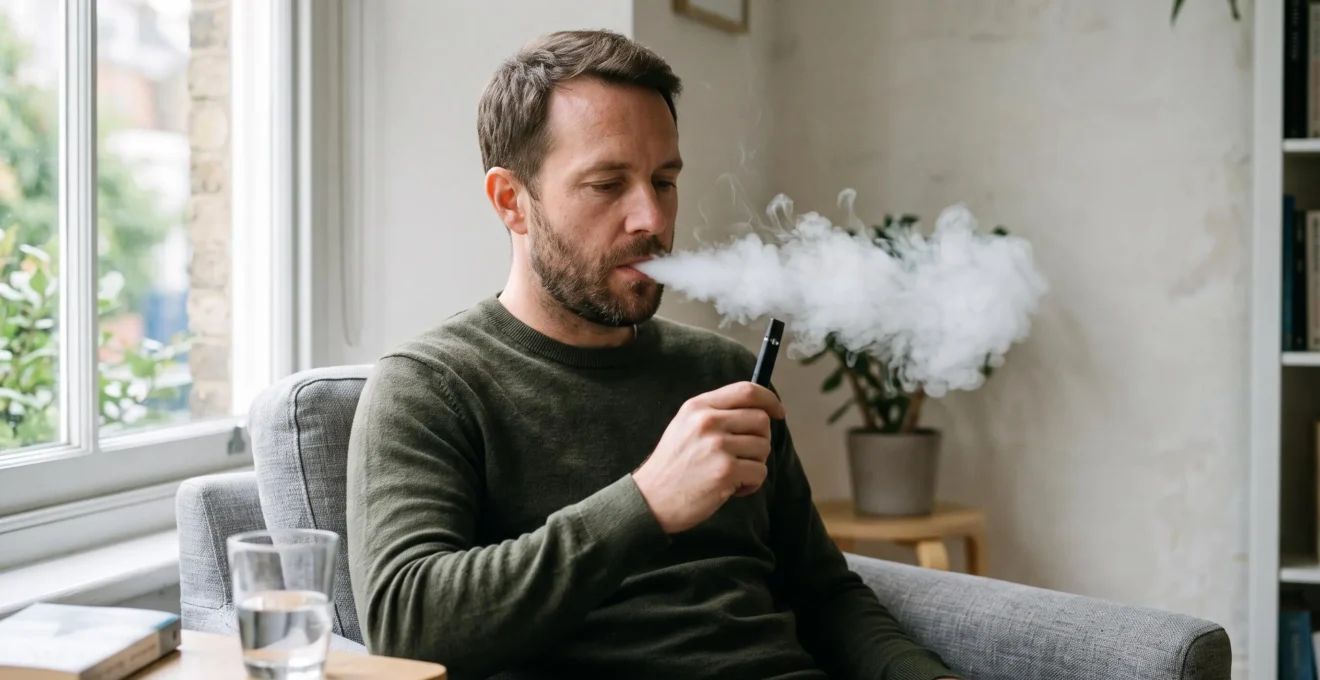
CBD vape aerosol consistency depends on a balance between electrical power, heating-element temperature, liquid supply and airflow. When these factors remain relatively stable, a device is more likely to generate aerosol with similar physical characteristics across successive puffs. When they fluctuate, aerosol quantity, composition and sensory properties can change, even without adjusting the device.
The visible cloud is only part of the picture. What is commonly called CBD vapour is an aerosol containing suspended droplets and potentially other substances formed during heating. Its appearance cannot establish how much CBD it contains, whether thermal degradation has occurred or how much material reaches the lungs.
For adults examining device performance, the relevant question is therefore not how to produce the largest cloud. It is whether the liquid reaches the heating element reliably, the device operates within its specified limits and observable changes reveal a developing fault.
Understanding those relationships helps distinguish ordinary variation from conditions that warrant stopping use or inspecting the equipment. Consistent aerosol generation is an engineering characteristic, not proof of inhalation safety or a reproducible CBD dose.
CBD aerosol consistency: the essential points
- Stable aerosol generation depends on the interaction between coil heating, liquid saturation, electrical power and airflow—not wattage alone.
- Higher visible aerosol output does not establish better consistency or safety. Excessive heating can increase unwanted chemical emissions.
- Coil condition, unusual heat, changes in aerosol character and inhalation behaviour all influence exposure, but none independently verifies the amount of CBD absorbed.
- Why Does Heating Temperature Change the Character of CBD Vape Aerosol?
- How Can You Identify Consistent CBD Vapour Without Maximising Device Power?
- Lower or Higher Vape Power: How Does Each Change CBD Aerosol Production?
- Which Vapour Changes Suggest a CBD Vape Is Heating the Liquid Incorrectly?
- When Should a Change in CBD Vapour Quality Prompt a Hardware Check?
- Which Signs Suggest a CBD Vape Device Is Running Too Hot?
- How Does Inhaled CBD Aerosol Travel from the Mouth to the Alveoli?
- How Do Pulmonary Alveoli Interact with Inhaled CBD Aerosol?
Why Does Heating Temperature Change the Character of CBD Vape Aerosol?
Heating temperature changes CBD vape aerosol because it controls how quickly liquid constituents evaporate and subsequently form suspended droplets as the vapour cools and mixes with incoming air. Different heating conditions can alter aerosol mass and chemical composition. Temperature instability may therefore produce noticeably different puffs even when the same liquid and device are used.
A CBD vape ordinarily contains a liquid reservoir, a wick or other liquid-delivery system, a heating element and an airflow pathway. Electrical energy heats the atomiser, while liquid reaching the heated surface evaporates. As those vapours move through the device and cool, some condense into the droplets that form the visible aerosol.
Temperature affects this process, but it does not act alone. Liquid composition, airflow and cooling conditions also influence droplet formation. Consequently, a change in cloud density cannot be attributed to heating temperature without additional measurements.
Battery power and actual coil temperature are different variables. Power describes the rate at which electrical energy is supplied, whereas coil temperature reflects the balance between energy input and heat removal. Coil resistance, wick saturation, airflow and puff duration can all change that balance.
A PLOS ONE study on e-cigarette coil temperatures demonstrated the importance of liquid supply. Researchers examining an older top-coil device found that measured temperatures changed substantially between dry, partially wetted and fully wetted heating conditions.
110–185°C versus 322–1008°C
Measured coil-temperature ranges under fully wetted and dry conditions, respectively, in a laboratory study of 13 replaceable coil heads using propylene glycol. These figures describe a specific experimental device, not recommended CBD vaping temperatures.
Chen et al., PLOS ONE, 2018.
Insufficient heating may produce relatively little aerosol because the liquid is not being vaporised at the required rate. At the opposite extreme, inadequate liquid supply can leave parts of the heating element unusually hot, increasing the possibility of thermal decomposition.
The useful concept is an operating window rather than one universally ideal temperature. Each compatible combination of liquid, heating element and device design has operating conditions within which aerosol formation is more controllable. Manufacturers may specify an electrical range, but this does not establish a universally safe aerosol temperature.
Understanding temperature as the outcome of several interacting variables provides the basis for evaluating aerosol consistency without assuming that greater electrical power is the solution.
How Can You Identify Consistent CBD Vapour Without Maximising Device Power?
Consistent CBD vapour is more plausibly indicated by relatively stable aerosol output, similar sensory characteristics and the absence of recurring device irregularities under comparable conditions. These observations can reveal changes in performance without increasing power. However, visual density, flavour and smoothness are only practical indicators; they cannot confirm consistent chemical composition, CBD delivery or respiratory safety.
Three observable features can help identify developing inconsistencies:
- Comparable sensory character: unexpected changes in taste, throat sensation or warmth may indicate altered heating or liquid condition.
- Similar visible output: pronounced changes in aerosol volume under otherwise comparable conditions may suggest variation in liquid supply, electrical delivery or airflow.
- Normal device behaviour: new gurgling, irregular popping, leaking or interrupted activation may indicate a mechanical or liquid-management problem.
These observations are not validated diagnostic tests. A device can generate similarly sized clouds while its emissions change, and some potentially harmful aerosol constituents are not perceptible through taste or smell.
Increasing power to compensate for weak aerosol is particularly unreliable. It may temporarily increase evaporation, but it can also raise the heating demand beyond the wick’s ability to replenish liquid. Once liquid supply becomes inadequate, local hot spots may develop even though the electrical setting has not changed.
A practical reproducibility assessment is based on comparison rather than optimisation. If an adult user notices a change during ordinary use, comparing previously observed behaviour under similar conditions—without extending, intensifying or increasing inhalation—may help identify whether the change is persistent.
Relevant conditions include battery charge, liquid level, time since the previous activation and device temperature. A difference after repeated closely spaced puffs may reflect temporary wick depletion or accumulated heat rather than inadequate rated power.
Liquid viscosity introduces another variable. More viscous formulations can move through some wick structures differently from thinner ones. CBD concentration or the presence of isolate does not, by itself, determine compatibility: the complete formulation and manufacturer specifications matter.
Repeated weak output should not be treated as an instruction to raise wattage. A poorly saturated wick, incompatible liquid or deteriorating atomiser may be responsible.
Because subjective observations cannot reveal aerosol chemistry, the next distinction is how lower and higher electrical power change both production and potential degradation.
Lower or Higher Vape Power: How Does Each Change CBD Aerosol Production?
Lower vape power generally supplies heat more slowly, while higher power can accelerate liquid evaporation and increase aerosol production when the device has sufficient liquid supply. Neither setting guarantees consistent output. Higher power increases thermal demand and may amplify emissions under unsuitable conditions, while excessively low power can produce limited or irregular aerosol formation.
Electrical power must be interpreted relative to a particular atomiser. A wattage that is appropriate for one coil design may be outside the specified operating range of another. The same applies when changing coil resistance, airflow configuration or liquid formulation.
The practical differences are best understood as tendencies rather than guaranteed outcomes.
| Criterion | Lower power within the specified range | Higher power within the specified range |
|---|---|---|
| Liquid evaporation | Generally slower, with lower heating demand | Generally faster, provided liquid supply remains adequate |
| Visible aerosol | Often lighter or less abundant | Often denser or more abundant |
| Thermal management | Lower instantaneous energy input | Greater demand on liquid replenishment and heat dissipation |
| Liquid consumption | Potentially slower under comparable usage conditions | Potentially faster under comparable usage conditions |
| Consistency | Not assured; inadequate aerosol generation remains possible | Not assured; wick limitations and overheating may become more consequential |
| Chemical exposure | Cannot be judged safe from low power alone | Potential for greater thermal emissions, especially outside specified limits |
An experimental study on vape power and carbonyl emissions examined adjustable electronic cigarettes and found that carbonyl emissions increased with increasing power under the conditions tested. Increases became particularly pronounced when power exceeded manufacturers’ recommended ranges.
Up to approximately 20 times
The increase in carbonyl emissions observed in specific experimental configurations when applied power exceeded the manufacturer’s recommended upper level by 5 W, relative to that upper level. This is not a universal multiplier or a CBD-specific exposure estimate.
Zelinkova and Wenzl, Tobacco Induced Diseases, 2020.
The distinction between aerosol density and control is important. A dense cloud can contain more aerosol material without demonstrating uniform droplets, chemical stability or consistent CBD delivery.
Higher power can also increase electrical energy consumption during activation. Effects on battery runtime, coil longevity and replacement frequency depend on device construction, liquid properties and use patterns; they should not be presented as fixed outcomes.
For devices with replaceable coils, the manufacturer’s rated power range may be printed on the coil or supplied in product documentation. It establishes a compatibility boundary, not a safety certification. No evidence in the supplied studies validates the lower or middle third of every recommended range as an optimal operating region for CBD.
Devices without adjustable power require attention to their specified compatible liquids and components rather than attempts to modify electrical output.
Changes in output become more meaningful when considered alongside taste, device behaviour and liquid condition, especially when a previously predictable device begins behaving differently.
Which Vapour Changes Suggest a CBD Vape Is Heating the Liquid Incorrectly?
Changes that may suggest incorrect CBD liquid heating include a persistent burnt or metallic taste, unusually harsh aerosol, a sudden reduction in output, abnormal liquid discoloration and recurring leakage or gurgling. Each has several possible causes, so no single symptom proves overheating. The combination, timing and persistence of changes are more informative than cloud appearance alone.
Heating-related problems can arise through excessive local temperature, insufficient energy transfer or irregular liquid contact with the coil. These mechanisms may occur separately or together.
Excessive local heating becomes more plausible when aerosol turns abruptly harsh or develops a persistent scorched character, particularly after liquid depletion or repeated rapid activations. A dry or poorly saturated region of the wick can receive heat without the cooling effect of enough incoming liquid.
Conversely, very weak output despite normal power availability may suggest interrupted liquid delivery, an electrical connection problem or inadequate heating. A raw-liquid sensation or droplets reaching the mouth can also indicate flooding or condensation, rather than simply a coil that is too cold.
Uneven heating complicates these categories. Deposits on a coil, local wick drying or irregular airflow can produce different thermal conditions across a single heating element. The resulting aerosol may therefore be inconsistent even when the power setting appears appropriate.
Some apparent hardware problems originate in the liquid. Exposure to heat, light or prolonged storage may affect a formulation’s appearance or properties. Darkening alone does not identify the chemical change involved, and a normal colour does not establish that the liquid remains suitable for inhalation.
Leaking, spitting and gurgling require separate consideration because they can reflect seals, condensation, overfilling or incompatibility between the liquid and cartridge design. Increasing heating power to eliminate these symptoms is not a reliable corrective measure.
A symptom-based assessment should therefore distinguish changes suggesting excess heat from those suggesting insufficient aerosol production, while acknowledging that the same symptom can have multiple explanations.
Where a problem persists, the next step is to assess the equipment systematically instead of assuming that the complete device has failed.
When Should a Change in CBD Vapour Quality Prompt a Hardware Check?
A hardware check is warranted when CBD vape aerosol production changes persistently, the device becomes unusually warm, flavour deteriorates, leakage develops or normal output does not return after routine manufacturer-approved checks. Battery and liquid conditions should be considered before attributing the fault to the coil. Persistent electrical, thermal or mechanical abnormalities justify stopping use rather than repeatedly testing the device.
Atomisers and wicks are consumable components in many vape designs. Deposits, material ageing and repeated heating cycles can progressively affect liquid delivery and heat distribution. Gradual deterioration is therefore not necessarily evidence of a defective product, although the rate of change varies.
A useful assessment begins with simple, non-invasive observations:
- Check whether the battery reports adequate charge and whether the device displays a fault indicator.
- Inspect the liquid level and look for leakage, visible contamination or an unexpected change in the formulation.
- Review the coil or cartridge’s age and whether it is the correct component for the device.
- Examine accessible electrical contacts and airflow openings for visible contamination or obstruction, following the manufacturer’s instructions.
- Determine whether an approved maintenance or component-replacement procedure is available, or whether professional support is needed.
A progressive change over several days can point towards component ageing, but it may also reflect altered liquid condition or usage patterns. Similarly, unexpectedly reduced battery runtime can have several causes, including battery deterioration and changes in power demand.
Five checks to document before deciding on hardware replacement
- Record the observed change: write down whether output, taste, warmth or leakage has changed, producing a short symptom description.
- Check the power status: note the battery indication and any warning displayed, producing a record of the device’s reported state.
- Inspect the liquid and reservoir: note fill level, visible leakage and unusual appearance, producing a basic condition report.
- Verify component compatibility: compare the fitted coil or cartridge with the manufacturer’s specifications, producing a compatibility confirmation or identifying a mismatch.
- Choose a safe next action: document whether approved cleaning, consumable replacement or manufacturer support is appropriate; stop using equipment showing unresolved electrical or overheating symptoms.
Inspection should remain within the device’s documented maintenance procedures. Do not open sealed batteries, repair damaged electrical cells, bypass protections or dismantle components that the manufacturer identifies as non-serviceable.
Replacement is sometimes necessary, but installing new hardware with the same incompatible liquid or using the same unsuitable operating conditions can reproduce the problem.
Among the warning signs requiring particular attention, abnormal heat deserves its own assessment because it may indicate both aerosol-formation problems and equipment hazards.
Which Signs Suggest a CBD Vape Device Is Running Too Hot?
A CBD vape device may be running too hot if its casing becomes unusually warm, the aerosol turns sharply harsh, a persistent burnt taste appears or the liquid darkens unexpectedly during use. These warning signs can accompany overheating but are not precise temperature measurements. A device that becomes painfully hot, leaks from a damaged battery or behaves abnormally should be switched off and left unused.
Some warmth near an atomiser is expected because aerosol generation requires heat. The concern is a significant departure from the device’s usual behaviour, particularly when warmth persists, intensifies or affects the battery enclosure.
Rapid successive activations can contribute to heat accumulation. If the heating element has insufficient time to cool or the wick cannot replenish liquid adequately, its thermal conditions may differ from those observed during less frequent operation.
Airflow restrictions can also change heat removal. However, increasing airflow or reducing electrical power should not be treated as a way to make a malfunctioning or excessively hot device safe.
Heat can change more than the sensory character of the aerosol. Laboratory analysis of cannabinoid-containing formulations has identified chemical products formed during thermal aerosol generation.
Research published in Chemical Research in Toxicology examined CBD and other cannabinoids in propylene glycol and vegetable glycerin formulations. The researchers detected carbonyl compounds and cannabinoid-derived oxidation products under their experimental conditions.
The research on the chemical composition of cannabinoid vaping aerosols provides direct evidence that the chemistry of heated cannabinoid formulations cannot be inferred simply from how much visible aerosol a device produces.
Laboratory evidence: aerosol formation and cannabinoid degradation
Robertson and colleagues investigated aerosols generated from formulations containing natural and synthetic cannabinoids, including CBD, using a commercial fourth-generation vaping device. Their analytical measurements compared aerosol chemistry across the tested formulations.
Under the specified experimental conditions, adding cannabinoids increased aerosol and carbonyl formation relative to the solvent-only formulation. The researchers also identified cannabinoid-derived reaction products. These findings establish potential chemical changes during heating, not the exposure profile or long-term health consequences of every commercial CBD vape.
The immediate response to suspected overheating is to stop activation and allow the equipment to cool in a safe location, following manufacturer guidance. If the device is only experiencing an ordinary warmth increase from closely spaced puffs, avoiding repeated activation may prevent further accumulation. Any subsequent maintenance or adjustment should occur only after the equipment has cooled and its condition has been assessed.
Where the model supports adjustment, operating within its stated power limits and maintaining unobstructed airflow are basic compatibility considerations. Persistent overheating, battery swelling, smoke or signs of electrical damage require discontinuing use rather than attempting to correct the issue through settings.
Visible aerosol consistency cannot rule out chemical degradation. That limitation becomes especially important when considering what an inhaled aerosol may deposit inside the respiratory tract.
Even when a device appears to be functioning consistently, the inhaled aerosol does not travel as a uniform cloud through the lungs. Its subsequent behaviour depends on particle properties and breathing physiology.
How Does Inhaled CBD Aerosol Travel from the Mouth to the Alveoli?
Inhaled CBD aerosol enters through the mouth, passes through the throat and conducting airways, and may reach smaller bronchioles and alveolar regions. Some particles deposit along the route, while others can remain airborne and be exhaled. The distribution depends on aerosol particle characteristics, breathing patterns and airway anatomy, so visible cloud size cannot reveal where CBD-containing material deposits.
Aerosol movement through the respiratory tract involves several physical processes. Larger droplets may deposit by inertial impaction when airflow changes direction. Smaller particles can deposit through gravitational settling or diffusion, depending on their aerodynamic size and the conditions inside the airways.
Particle diameter is not necessarily fixed between the atomiser and the lungs. Dilution, cooling, evaporation, condensation and interaction with respiratory humidity can alter aerosol characteristics as the inhaled material travels.
The mouth and throat therefore represent more than a passageway. They are potential deposition sites, meaning some aerosol material may not reach deeper lung regions.
Two commonly discussed inhalation patterns illustrate the importance of breathing behaviour:
- Mouth-to-lung inhalation: aerosol is initially drawn into the mouth before being inhaled further. Its residence time and mixing conditions can influence subsequent deposition.
- Direct-lung inhalation: aerosol is inhaled towards the lungs without the same intentional mouth-holding phase. Different flow rates and inhaled volumes may influence its regional distribution.
Neither technique has been established as universally preferable or safe for CBD aerosol. Differences in regional deposition do not automatically indicate greater therapeutic effect, better dose control or lower health risk.
The scientific review Respiratory Tract Deposition of E-Cigarette Particles, published in Comprehensive Physiology in 2022, describes how particle properties, inhalation conditions and respiratory anatomy affect where electronic cigarette aerosol deposits.
Across the studies discussed in that review, reported mass median aerodynamic particle diameters ranged from 0.2 to 1.2 micrometres, with an additional ultrafine population also described. The differences reflect varying equipment, aerosols and measurement methods rather than a single standard particle size.
Deposition models further indicate that a substantial portion of inhaled aerosol may be exhaled or deposit in different respiratory regions. Importantly, particle deposition is not equivalent to CBD absorption. A deposited droplet may contain multiple constituents, and the subsequent movement of individual chemicals depends on additional processes.
Claims assigning a fixed inhaled CBD bioavailability percentage to all vape devices therefore overlook important uncertainties. Liquid composition, aerosol generation, inhalation conditions and individual physiology all affect exposure.
The alveoli form one important destination for inhaled particles, but evaluating their role requires distinguishing physical deposition from chemical transfer into the bloodstream.
Key takeaways before considering alveolar exposure
- Particle deposition can occur in the mouth, throat, conducting airways and alveolar regions; there is no single deposition destination for every aerosol droplet.
- Breathing pattern and particle behaviour introduce variability after the aerosol has already left the device, independently of coil performance.
- Aerosol deposition, CBD dissolution and transfer into circulation are distinct processes. Reproducible visible output does not establish a reproducible absorbed dose.
How Do Pulmonary Alveoli Interact with Inhaled CBD Aerosol?
Pulmonary alveoli are microscopic air spaces where oxygen and carbon dioxide exchange occurs across thin respiratory barriers. Some inhaled aerosol particles can deposit in the alveolar region, where their constituents may interact with the lining fluid and surrounding tissue. Whether deposited CBD subsequently enters circulation depends on dissolution, transport and clearance processes; deposition alone does not establish absorption.
The lungs contain branching airways that terminate in alveolar structures specialised for gas exchange. Their extensive surface area and close association with pulmonary capillaries make them relevant to the uptake of certain inhaled substances.
However, an aerosol droplet is not simply transferred intact into the bloodstream. Material deposited in the respiratory tract may dissolve into surface fluids, interact with lung cells, undergo local processing or be removed through clearance mechanisms.
Some chemical constituents may cross respiratory barriers, but their behaviour depends on properties such as solubility, formulation and the surrounding physiological environment. Absorption is also not necessarily restricted to substances deposited directly in alveoli.
Aerosol size affects the likelihood of deposition in different lung regions. Nevertheless, the relationship is not a simple rule in which every smaller particle reaches the alveoli and every larger particle is trapped in the throat. Very small particles may deposit through diffusion, while deposition of larger particles depends on airflow and airway geometry.
Experimental and modelling research on electronic cigarette particles supports the importance of regional deposition, but the resulting figures should not be interpreted as measurements of CBD entering the bloodstream.
Three sources of variability remain particularly relevant:
- Generation variability: differences in liquid supply, temperature and aerosol chemistry can alter the material leaving the device.
- Transport variability: particle size, dilution and breathing behaviour influence the material reaching different respiratory regions.
- Biological variability: deposition, dissolution, absorption and clearance influence the fate of individual aerosol constituents after inhalation.
These stages explain why even a physically repeatable aerosol cannot be equated with a reproducible systemic CBD dose. Achieving that level of certainty would require validated measurements of emitted CBD, inhaled exposure and biological uptake under defined conditions.
There is also a broader safety limitation. Long-term pulmonary effects of inhaling CBD-containing formulations, including flavoured aerosols and thermal decomposition products, remain insufficiently characterised. A product designed for oral use is not automatically suitable for inhalation, and a stable-looking aerosol is not evidence that its constituents are safe for lung exposure.
Inhaled aerosol may also provoke respiratory symptoms. New or persistent coughing, wheezing, chest discomfort or shortness of breath should not be dismissed as ordinary device-performance variation. Discontinuing exposure and seeking medical advice is appropriate; severe breathing difficulty or chest pain warrants urgent assessment.
The technical objective of consistent aerosol formation is therefore limited but meaningful: reducing avoidable variation in heating and liquid delivery can make device performance more predictable. It does not remove uncertainties associated with aerosol chemistry or pulmonary exposure.
For an adult assessing a CBD vape, the practical next step is to verify manufacturer compatibility information, recognise abnormal heating or aerosol changes, and discontinue use when a fault cannot be resolved through approved maintenance. Predictable equipment behaviour is worth distinguishing from proven inhalation safety: the two are not equivalent.
Does a thicker CBD vapour cloud mean more CBD is being inhaled?
Not necessarily. A denser visible cloud may indicate more aerosol material, but its CBD concentration and chemical composition are not established by appearance. The amount reaching different respiratory regions also depends on particle characteristics and inhalation behaviour. Measuring emitted CBD requires analytical testing rather than visual comparison.
Can two CBD vape devices produce different aerosols at the same wattage?
Yes. Identical electrical power does not guarantee identical coil temperature or aerosol formation. Coil resistance and geometry, wick saturation, liquid composition and airflow all influence heating conditions. Devices operating at the same displayed wattage may consequently produce aerosols with different physical and chemical characteristics.
Is a colourless or odourless CBD aerosol necessarily safe?
No. Appearance and smell cannot establish the absence of harmful substances. Laboratory research has identified carbonyl compounds and cannabinoid-derived products in heated aerosol formulations. Chemical exposure depends on formulation and operating conditions, and long-term safety cannot be determined through sensory inspection.
Does a stable coil resistance reading guarantee stable aerosol production?
No. An apparently stable resistance reading provides only limited information about the electrical characteristics of the heating element. It does not confirm uniform temperature, adequate wick saturation or consistent aerosol chemistry. Local heating differences can occur even without an obvious change in the displayed resistance.
Can CBD e-liquid be used in any standard vaping device?
No. Compatibility depends on the formulation, cartridge or tank construction, wick system and manufacturer’s specifications. CBD products intended for oral administration, particularly oil-based preparations, should not be assumed suitable for inhalation. Even a manufacturer-described inhalable formulation should not be considered harmless simply because it is compatible with a particular device.