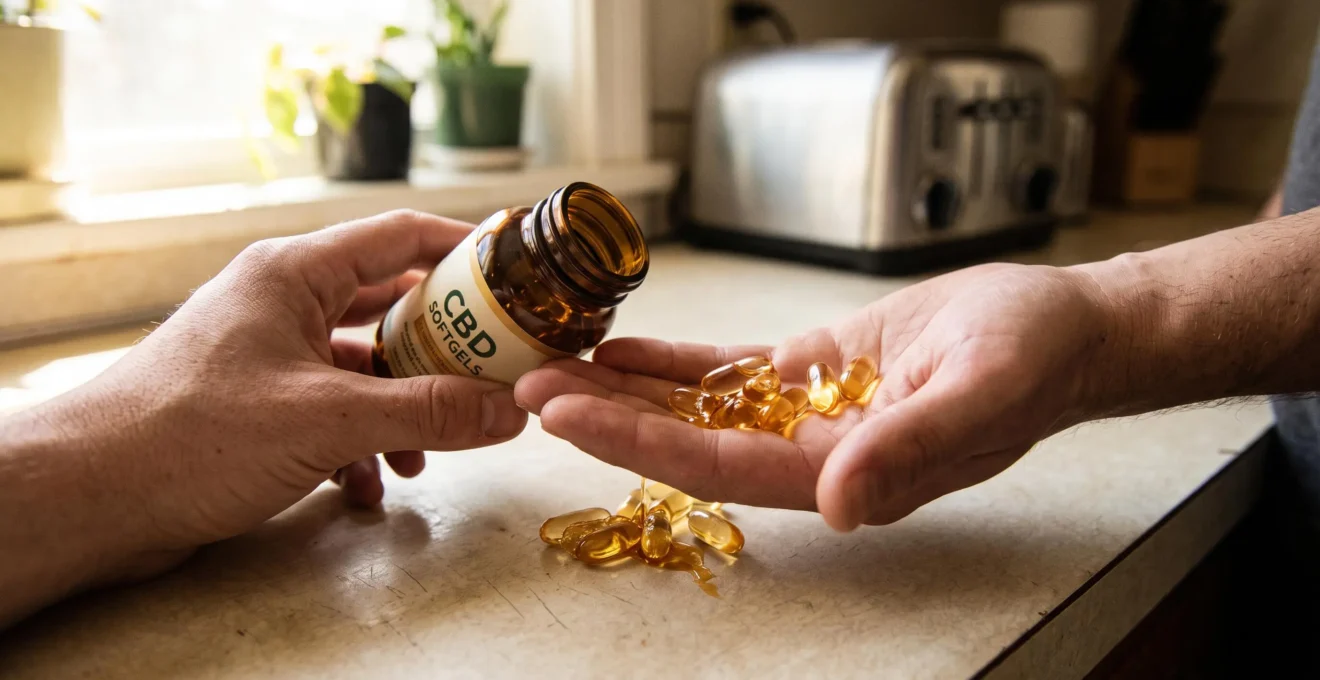
CBD capsules can deteriorate before their expected expiration date when storage conditions affect the cannabinoid formulation, its carrier oil or the capsule shell. Excessive heat, moisture, light and prolonged exposure to air can change how a softgel looks, feels and performs. Some changes are readily visible; others require laboratory testing to detect.
A sticky capsule does not necessarily mean its CBD has chemically degraded. Likewise, a smooth, intact softgel is not proof that its original cannabinoid content remains unchanged. The outer shell and the ingredients inside follow different deterioration pathways, making both formulation and storage history important.
Reducing premature deterioration starts with choosing an appropriate container, limiting environmental exposure and recognizing when a product should no longer be used. Manufacturer instructions and any stated period after opening remain the first reference points. Practical inspection can supplement those instructions, but it cannot establish potency or microbiological safety.
CBD capsule stability: the essentials
- Heat, light and oxygen can affect CBD and carrier oils, while humidity can soften or otherwise alter gelatin shells.
- Store capsules in their original, tightly closed container in a cool, dry, dark location unless the manufacturer specifies otherwise.
- Discard leaking, ruptured, unusually sticky or foul-smelling capsules. A normal appearance does not guarantee chemical stability.
- Why Can Warm, Humid Storage Speed Up CBD Capsule Degradation?
- How Can You Store CBD Capsules to Reduce Premature Deterioration?
- Visible Damage or Chemical Change: Which Signs of Capsule Degradation Can You Detect?
- Which Changes in a CBD Softgel Should Make You Avoid Using It?
- When Should You Replace CBD Capsules That Have Been Opened for a Long Time?
- Why Do Sensitive CBD Ingredients Need Protection from Air, Moisture and Light?
- Which Storage Mistakes Can Damage CBD Gelatin Capsules Before Use?
- How Does Encapsulation Protect Sensitive Compounds Inside CBD Softgels?
Why Can Warm, Humid Storage Speed Up CBD Capsule Degradation?
Warm, humid storage can accelerate CBD capsule deterioration because it affects both the filling and the shell. Heat can promote chemical changes in cannabinoids and carrier oils, while humidity alters the physical properties of gelatin. Together, these conditions increase the likelihood of sticking, deformation and formulation instability, although the extent depends on the ingredients and packaging.
Two processes should be distinguished. Inside the softgel, CBD and susceptible carrier oils may undergo chemical deterioration, including oxidation. Lipid oxidation can produce compounds associated with rancid odors and altered oil quality. Outside the filling, heat and moisture affect the gelatin network, changing shell flexibility, adhesion and mechanical strength. A sticky shell is evidence of a physical change, not a direct measurement of CBD degradation.
Humidity presents a particular challenge because gelatin interacts with environmental moisture. When the shell absorbs additional water, it can become softer and more adhesive. Moisture can also move between the shell, filling and surroundings, depending on the formulation. Excessive moisture and compromised capsule integrity may contribute to microbiological stability problems, but ordinary household humidity does not establish that CBD itself has undergone hydrolysis or that microorganisms are present.
A scientific review of soft gelatin capsule shell stability identifies temperature, humidity, shell composition and interactions with the filling as important determinants of capsule performance. It also describes sticking, fragility and changes in gelatin behavior under unfavorable conditions.
Room temperature is not a single storage environment. A consistently temperate cupboard differs from a kitchen shelf exposed to cooking heat or a bathroom with recurring steam. Repeated heating and cooling can also change local humidity and encourage condensation under certain conditions. Whether fluctuations are more damaging than constant warmth depends on their magnitude, duration and the formulation.
Light adds another pathway. UV and sufficiently intense visible light can contribute to photochemical deterioration, while sunlight can warm the container itself. A dark bottle left on a sunny windowsill may therefore still experience substantial thermal stress.
The practical implication is to control the capsule’s surroundings before visible damage appears. A stable, cool and dry location limits several deterioration pathways simultaneously, but it cannot reverse damage that has already occurred.
How Can You Store CBD Capsules to Reduce Premature Deterioration?
Store CBD capsules in their original, tightly closed container in a cool, dry location protected from direct sunlight and nearby heat sources. An amber or opaque bottle can reduce light exposure, while a well-fitting closure limits contact with humid air. Follow the product’s labeled storage requirements, especially when they specify conditions different from ordinary room-temperature storage.
Container choice matters because protection depends on more than glass color. Amber packaging reduces transmission of certain wavelengths, but it does not block every form of light or prevent temperature changes. An airtight closure and packaging materials compatible with the formulation help protect the capsules from their surroundings.
A bedroom cupboard or dry pantry shelf away from appliances is generally preferable to a bathroom cabinet, sunny counter or space above an oven. Keeping the bottle in its original packaging also preserves its batch identification, expiration information and manufacturer instructions.
The refrigeration question requires some judgment. Lower temperatures can slow certain chemical deterioration processes, making refrigeration potentially useful for some formulations in hot climates or during extended storage. However, refrigeration is not universally appropriate for finished CBD softgels. Cold conditions may produce temporary oil cloudiness, while opening a chilled bottle in humid air can encourage condensation. Refrigerate only when the product’s instructions support it.
Where refrigeration is appropriate, keep the bottle sealed while it gradually returns to room temperature before opening. This helps reduce the risk of humid air entering and condensing on cold capsules. Avoid repeated transfers between warm and cold conditions.
Opened bottles deserve additional attention. Every opening exchanges some of the air inside the container with its surroundings, potentially introducing moisture. Remove only the intended dose with clean, dry hands and close the cap promptly. Opening several bottles at once unnecessarily increases the number of products exposed during storage.
For travel, avoid leaving capsules in parked vehicles, gloveboxes or bags exposed to direct heat. A protective pouch or insulated carrier may help reduce short-term temperature exposure, but insulation alone cannot maintain a controlled temperature indefinitely. Keep the original labeled container available whenever practical.
Effective storage combines appropriate packaging, stable environmental conditions and careful handling. Even a well-formulated softgel can deteriorate prematurely if it is repeatedly exposed to heat, moisture or direct light.
Visible Damage or Chemical Change: Which Signs of Capsule Degradation Can You Detect?
Visible signs of CBD capsule deterioration include sticky or fused shells, cracks, leakage, unusual softening, brittleness and changes in color or clarity. Unpleasant odors can also indicate altered carrier-oil quality. However, CBD degradation and some oxidation reactions may occur without obvious sensory changes, so appearance alone cannot confirm the capsule’s remaining potency or safety.
The distinction is between physical damage that can be observed and chemical changes that generally require analytical testing. A deformed shell may indicate an unsuitable storage environment, whereas an intact shell provides only limited information about the condition of the ingredients inside.
A practical inspection begins with the container. Check for leaks, excessive condensation, obvious contamination or a damaged closure. Next, examine the capsules without deliberately rupturing them. Look for unusual adhesion, cracks, changes in firmness or liquid escaping from the shell.
For capsules that are naturally translucent, compare the filling with its original appearance when that reference is known. Unexpected darkening or increased cloudiness may justify further investigation. A distinctly rancid or unfamiliar odor is another warning sign, but odor testing should not involve tasting the contents of a questionable capsule.
These observations require interpretation. Some oil-based formulations may become cloudy at lower temperatures or develop crystals or sediment because of ingredient solubility and composition. Such changes do not automatically establish rancidity or contamination. Conversely, discoloration associated with chemical deterioration can occur under certain storage conditions. Neither conclusion should be made from color alone.
Laboratory methods are needed to determine cannabinoid concentration reliably and to investigate oxidation or microbial contamination. A certificate of analysis prepared when a product was manufactured does not necessarily describe its condition after prolonged or unsuitable storage.
Expiration information and storage history therefore remain important alongside sensory inspection. When the original appearance is unknown or a change cannot be explained confidently, the manufacturer may be able to clarify whether it is expected for that formulation.
Home inspection is best used to identify reasons for caution, not to certify that a product remains chemically unchanged. That difference becomes particularly important when deciding whether a questionable softgel should still be consumed.
Which Changes in a CBD Softgel Should Make You Avoid Using It?
Avoid using CBD softgels that are leaking, ruptured, visibly contaminated, unusually sticky, fused together or producing a strong rancid odor. Significant unexplained changes in shell texture or color also warrant caution. Minor cloudiness alone does not always indicate spoilage, but a normal-looking capsule should not override an expired date, known storage damage or manufacturer warnings.
The most important distinction is between changes that compromise capsule integrity and variations that may be formulation-related. A leaking shell no longer provides its intended physical separation between the filling and the environment. Moisture, oxygen and contaminants may gain greater access, making continued storage less predictable.
The following grid provides a conservative consumer decision framework rather than a laboratory determination of product safety.
| Observed condition | What it may indicate | Practical response |
|---|---|---|
| Rupture or oil leakage | Loss of capsule integrity and possible contamination | Do not use the affected capsules; assess the entire bottle. |
| Strong rancid or unusual odor | Possible oxidative deterioration of the oil filling | Avoid use and consider replacing the product. |
| Visible mold or suspected contamination | Possible microbiological quality problem | Do not use the product. |
| Shells fused together or markedly sticky | Moisture-related or thermal changes to gelatin | Avoid use and investigate storage conditions. |
| Cracked, brittle or abnormally soft shells | Altered shell properties | Avoid using damaged capsules. |
| Minor cloudiness without other changes | Possible temperature-related or formulation-related variation | Check manufacturer guidance before deciding. |
| Normal appearance but expired date | Quality no longer assured for the stated shelf-life period | Replace the expired product. |
Rancid carrier oil deserves particular attention. Oxidation of susceptible oils can produce hydroperoxides, aldehydes and other compounds that alter sensory and chemical quality. Some lipid oxidation products raise toxicological concerns, but an unpleasant odor cannot quantify exposure or establish the health risk of any individual capsule.
Not all carrier oils deteriorate at the same rate. Their fatty-acid composition, antioxidant content, processing and storage conditions matter. A scientific review of vegetable oil oxidation describes these mechanisms and the resulting quality changes, although it does not establish a specific safety threshold for CBD softgels.
If several capsules in one bottle show comparable defects, treat the batch cautiously rather than assuming that undamaged-looking capsules are unaffected. If the problem is unexpected, retain the packaging details for a manufacturer inquiry, but avoid consuming suspect capsules while seeking clarification.
Discarding a clearly damaged softgel is a straightforward precaution. More ambiguous cases require considering how long the bottle has been open and what conditions it has experienced during that period.
When Should You Replace CBD Capsules That Have Been Opened for a Long Time?
Replace an opened bottle of CBD capsules when it has exceeded a manufacturer-specified period after opening, passed its expiration date, developed signs of damage or experienced storage conditions that make its quality doubtful. There is no reliable universal number of months applicable to every CBD softgel formulation. Opening frequency, packaging, humidity and temperature all influence the decision.
The printed expiration date is an important starting point, but it should be interpreted correctly. Shelf-life information commonly depends on a product remaining in its specified packaging under recommended conditions. Whether the labeled period also applies after opening depends on the manufacturer’s stability assessment and instructions.
Opening a bottle changes the exposure environment. Repeated access can introduce fresh air and humidity, while transferring capsules to another container may remove some of the original packaging protection. This does not establish that every opened bottle has a specific shorter shelf life, but it makes storage history particularly relevant.
A practical approach is to record the first opening date and note any unusual exposure, such as a hot journey, prolonged sunlight or a cap left open. Reassess the bottle periodically and consult the product label for instructions specific to the formulation.
Five-step CBD capsule storage and replacement check
- Record the opening date. Write the date on the container or in a storage log, creating a clear reference for future checks.
- Verify the label. Identify the expiration date and any after-opening or temperature instructions, recording them alongside the opening date.
- Inspect the storage location. Check for sunlight, appliance heat, humidity and temperature fluctuations, then document any exposure that needs correcting.
- Examine the capsules. Check for leakage, adhesion, cracking, abnormal texture and unusual odor, noting whether any warning signs are present.
- Make and record a decision. Keep the product only when its labeled conditions remain satisfied and no concerns are identified; otherwise replace it or seek manufacturer guidance before use.
Consider two hypothetical bottles. One was opened recently, promptly resealed after each use and kept in a dry cupboard. The other was opened an unknown number of months ago and repeatedly carried through hot, humid environments. Even if both look normal, the second has a less reassuring storage history.
For future purchases, consider the quantity you are realistically likely to use within the manufacturer’s stated shelf life. Buying smaller quantities can reduce unnecessary long-term storage, particularly when capsules are used infrequently.
Tracking how a product has been handled is more useful than assigning it an unsupported expiration interval. Understanding why these exposures matter also helps explain the value of protective packaging and formulation choices.
Why Do Sensitive CBD Ingredients Need Protection from Air, Moisture and Light?
CBD formulations need protection from air, moisture and light because these environmental factors can affect chemical stability and capsule integrity through different mechanisms. Oxygen and light can contribute to cannabinoid or carrier-oil deterioration, while moisture changes gelatin properties and can create formulation stability concerns. The degree of vulnerability depends on the specific extract, oil, shell and packaging system.
Oxygen supports oxidative reactions in susceptible ingredients. Carrier oils containing readily oxidized fatty acids may develop hydroperoxides and secondary oxidation compounds during storage. CBD can also undergo chemical changes under unfavorable conditions, although the relationship between oxygen exposure, color changes and actual CBD loss is formulation-dependent.
Light introduces a separate concern. Photochemical reactions can change cannabinoid-containing formulations, especially when products are exposed to strong light over extended periods. The extent depends on wavelength, exposure duration, temperature and the surrounding formulation. Light may also accelerate oil oxidation or indirectly contribute to deterioration by warming the container.
Moisture primarily affects the shell and the physical environment of the filling. Gelatin absorbs and releases water, and moisture can migrate between different parts of the softgel system. Depending on the materials and manufacturing conditions, this may influence shell flexibility, sticking, disintegration and microbiological stability. It should not be assumed that ordinary moisture exposure directly hydrolyzes CBD inside every oil-filled capsule.
Formulation choices change the overall risk. Full-spectrum extracts contain additional constituents, and products incorporating terpenes or different carrier oils may have distinct stability profiles. The presence of antioxidants, the composition of the oil and interactions between the shell and filling can also influence how deterioration develops.
Protecting the filling and protecting the shell are related but separate tasks. A formulation designed to resist oxidation may still be enclosed in a moisture-sensitive gelatin shell. Conversely, a mechanically intact shell cannot guarantee that the oil inside has retained its original chemical composition.
This explains why effective packaging uses complementary protections rather than relying on a single feature. Light-resistant containers, compatible closure systems and moisture management each address different vulnerabilities.
These mechanisms also explain why seemingly harmless household habits can undermine capsule stability. The next step is identifying the storage mistakes that expose products to avoidable stress.
Which Storage Mistakes Can Damage CBD Gelatin Capsules Before Use?
Common storage mistakes include keeping CBD capsules in humid bathrooms, near hot kitchen appliances, on sunny windowsills or in vehicles exposed to extreme temperatures. Leaving containers open and transferring capsules to poorly sealed organizers can also reduce protection. Some damage may occur before purchase if storage or shipping conditions expose products to excessive heat or moisture.
Bathroom cabinets may appear convenient, but showers and baths can cause recurring humidity changes. Gelatin responds to moisture, making this environment less suitable than a consistently dry cupboard.
Kitchen storage presents different risks. A shelf near an oven, dishwasher or other heat-producing appliance may experience temperature changes even when the room generally feels comfortable. Direct sunlight combines light exposure with possible heating, so a windowsill is unsuitable even when the bottle itself is amber-colored.
Leaving the cap open while preparing a dose increases unnecessary exposure to ambient air and moisture. Transferring capsules into an unsealed or transparent pill organizer can introduce similar concerns, particularly during extended storage. A short-term organizer may be convenient, but its barrier properties should not be assumed equivalent to the original container.
Refrigeration and freezing can also be mishandled. Opening a cold bottle in humid air may encourage condensation, while some formulations can undergo changes in shell or filling properties at low temperatures. Freezing should not be treated as a universal preservation method without product-specific instructions.
The MedlinePlus recommendations for storing medicines advise keeping products away from heat, air, light and moisture, generally in their original containers. They also caution against bathroom storage and leaving medicines in vehicle glove compartments. These are general medicine-storage recommendations rather than CBD-specific stability test results.
Quality can be affected before capsules reach the consumer. Prolonged exposure to hot warehouses, unsuitable retail displays or warm delivery vehicles may undermine favorable formulation and packaging characteristics. Buyers cannot usually reconstruct an entire shipping history, but they can examine the package on arrival, check for visible defects and ask the seller about storage procedures when concerns arise.
A brief household self-audit can reveal avoidable risks:
- Does the storage area become warm, sunny or humid at any point?
- Is the original container kept properly closed between uses?
- Have the capsules been exposed to unusual heat during transport?
- Are capsules being transferred into packaging with uncertain protective properties?
- Do the shells or filling look, feel or smell different from when purchased?
A good storage routine reduces avoidable exposure after purchase. Its effectiveness also depends on the degree of protection already provided by the capsule’s construction and formulation.
Key takeaways before considering encapsulation
- The softgel shell is part of the stability system, but its moisture sensitivity must be managed alongside the chemical stability of the filling.
- Carrier-oil composition, shell materials and manufacturing conditions affect how well a product withstands normal storage.
- Protective formulation and packaging reduce environmental exposure; they do not make a capsule immune to poor storage conditions.
How Does Encapsulation Protect Sensitive Compounds Inside CBD Softgels?
Encapsulation helps protect CBD formulations by surrounding a measured oil filling with a continuous shell that separates it from direct environmental contact. The shell can reduce exposure and leakage, while pigmented shells and external packaging may provide additional light protection. However, gelatin is not a perfect barrier, and encapsulation slows certain deterioration processes rather than preventing them completely.
A CBD softgel typically combines an oil-based filling with a flexible outer shell. This design provides convenient dosing while physically containing ingredients that might otherwise be exposed whenever a liquid bottle is opened. The shell can limit direct contact with the surroundings, although oxygen and water-vapor permeability depend on its composition, thickness and condition.
Light protection is similarly conditional. A transparent softgel offers different protection from an opaque or pigmented one. Even when the shell is colored, the outer container remains important because it can provide another barrier against light and environmental damage.
Shell formulation influences long-term performance. Gelatin, water and plasticizers contribute to flexibility and mechanical strength. Their proportions, manufacturing conditions and interactions with the filling determine how the finished capsule responds to temperature and humidity. Changes in shell moisture may lead to sticking or brittleness, while some interactions can affect disintegration characteristics.
The formulation inside the capsule also matters. Carrier oils differ in oxidative stability according to their composition. Medium-chain triglyceride oils and more unsaturated oils should not be assumed to respond identically to storage conditions. Antioxidants may help manage oxidation when appropriately selected and validated for a specific formulation.
Manufacturing controls can further reduce initial exposure to oxygen and moisture. Suitable filling conditions, controlled processing environments and appropriately designed packaging may contribute to stability. Nitrogen flushing, where used and validated, can reduce oxygen exposure during relevant manufacturing or packaging stages. It is not proof of a particular shelf life by itself.
Once a shell cracks or leaks, the physical separation it provides is compromised. Even before visible damage occurs, long-term chemical and physical changes may continue at rates influenced by the entire product system.
Encapsulation is therefore a protective technology, not a guarantee of permanent stability. Reliable shelf-life claims require evidence for the actual finished formulation, packaging and intended storage conditions rather than assumptions based solely on the presence of a gelatin shell.
The most useful next action is to check the instructions on the current bottle, confirm that its storage location remains appropriate and inspect any capsules that have experienced questionable conditions. Where manufacturer guidance and visible evidence do not resolve a concern, replacing the product is safer than assuming an intact shell guarantees quality.
Can CBD capsules lose potency without changing appearance?
Yes. Chemical changes in CBD may occur without readily detectable visual or sensory differences. Appearance can reveal certain physical problems, but it cannot establish cannabinoid concentration. Reliable potency assessment requires appropriate laboratory analysis.
Does a sticky CBD softgel always mean the CBD inside has degraded?
No. Stickiness primarily indicates a change in shell properties, often associated with moisture, temperature or formulation interactions. It does not directly measure CBD degradation. However, marked or unexpected stickiness is a reason to avoid using the affected capsules because shell integrity and overall product quality may be compromised.
Can cloudy CBD softgel oil become clear again at room temperature?
Some oil formulations can develop reversible cloudiness or crystallization at lower temperatures. Whether clarity returns depends on the ingredients and the cause of the change. Do not heat capsules deliberately to test them. Consult the manufacturer if the appearance differs unexpectedly from the original product.
Does an unopened CBD bottle guarantee fresh capsules?
No. A sealed bottle generally provides better protection against repeated environmental exposure than an opened one, but heat, light and unsuitable storage conditions may still affect its contents. Packaging integrity, manufacturer instructions, expiration dates and previous transport or storage conditions remain relevant.
Can a damaged CBD softgel be opened and its oil consumed separately?
That is not advisable. When the shell is damaged, the filling may have experienced environmental exposure or contamination, and its condition cannot be established by appearance alone. Opening the capsule does not restore its original quality or verify the dose. A leaking or ruptured softgel should be discarded rather than consumed.