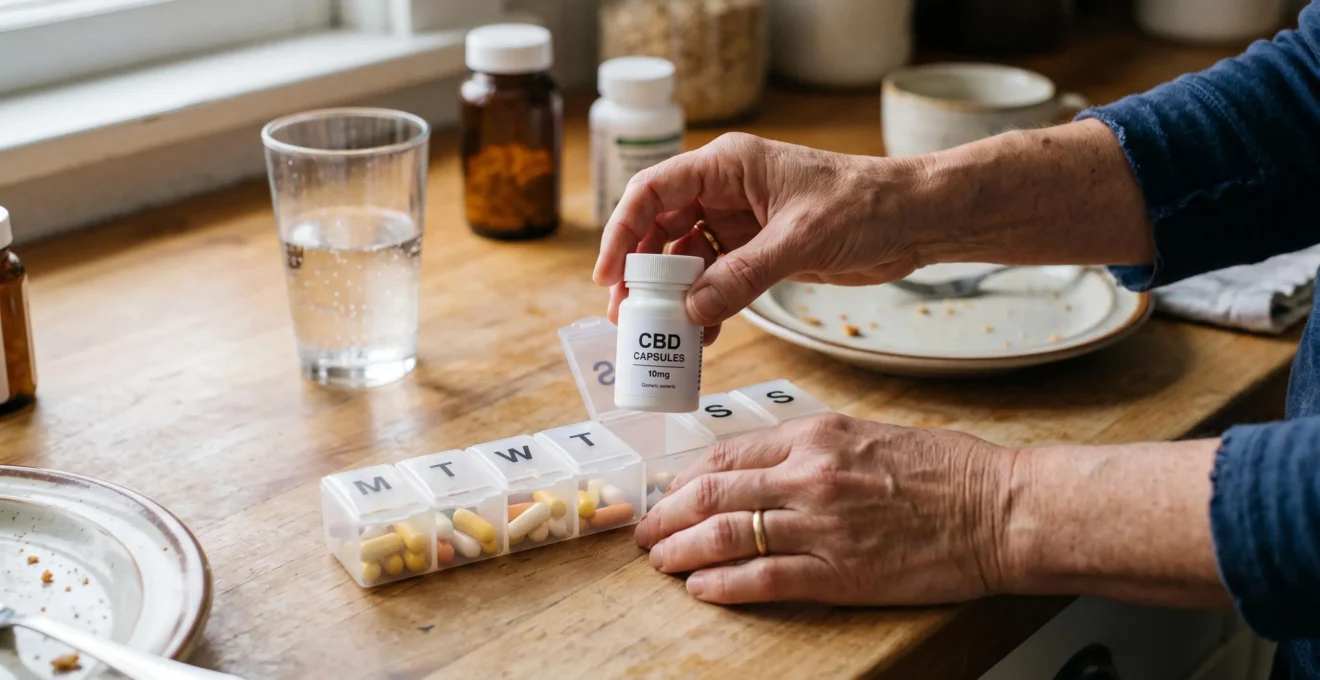
CBD capsules can be included in an existing supplement routine, but they should not automatically follow the same instructions as vitamins, minerals or other nutritional products. Their regulatory status, potential interactions and sensitivity to food can introduce considerations that an ordinary supplement schedule does not address.
For adults already managing several daily products, the practical challenge is maintaining clarity. A morning organiser might contain a multivitamin, a mineral supplement and an herbal extract, each with its own directions. Adding a CBD capsule without checking those instructions can make it difficult to identify which product belongs to which schedule or whether professional advice is needed.
A more organised approach starts with three habits: keeping the CBD label accessible, documenting when each product is intended to be taken and reviewing possible interactions before adding anything new. This does not establish that combining CBD with other supplements is safe; it provides a clearer framework for evaluating and managing a routine.
CBD Capsules and Daily Supplements: Key Points
- Keep CBD capsules identifiable and retain their original instructions rather than treating them as interchangeable with other capsules.
- Organise products according to their individual labels, including food-related instructions, instead of automatically taking everything together.
- Check medication use, liver-related concerns and other potentially interacting products before considering CBD as an addition.
- Why Can Mixing CBD Capsules with Other Supplements Cause Routine Confusion?
- How Can You Organise CBD and Daily Supplements Without Losing Label Information?
- CBD Capsules or Oil: Which Fits Better with an Existing Supplement Routine?
- Why Should CBD Not Automatically Be Treated Like Every Other Daily Supplement?
- When Should a Multi-Supplement Routine Prompt Extra Care Before Adding CBD?
- Gelatin or Plant-Based Capsule Shell: Which Better Matches Your Dietary Preference?
- When Should Medication Use Make General CBD Metabolism Information Insufficient?
- How Do Hepatic Pathways Fit into the Processing of Oral CBD Products?
Why Can Mixing CBD Capsules with Other Supplements Cause Routine Confusion?
Mixing CBD capsules with ordinary supplements can create confusion because similar-looking products may have different regulatory classifications, administration instructions and interaction risks. A CBD capsule might resemble a vitamin or herbal capsule, but its appearance does not indicate that the same dosing habits, food requirements or safety assumptions apply.
Capsule format creates a misleading sense of uniformity. A weekly organiser can accommodate different products in identical compartments, encouraging the assumption that everything inside follows one shared schedule. In reality, each label may specify different conditions, and some products may require additional professional assessment before use.
Three situations deserve particular attention:
- Assuming shared absorption rules: CBD exposure can change substantially with food, especially high-fat meals. This does not establish a specific interaction with fat-soluble vitamins, but it means their schedules should not automatically be treated as equivalent.
- Overlapping intended effects: Someone considering CBD for relaxation or sleep may already take products promoted for similar purposes. Such combinations deserve scrutiny rather than an assumption of harmless additive benefits.
- Extending one label instruction to every capsule: A direction such as “take with food” on one bottle does not override the instructions on other products in the same organiser.
A useful distinction is one shelf, two rulebooks. Vitamins and minerals are generally used to meet nutritional needs, whereas consumer CBD is frequently marketed around effects such as calm, sleep or recovery. Such marketing does not establish effectiveness, and the distinction matters because CBD is not regulated as an ordinary nutrient in every jurisdiction.
The U.S. Food and Drug Administration identifies medication interactions, potential liver injury, product-quality inconsistencies and insufficient evidence about combinations with herbal supplements among its concerns. Its information on CBD safety and regulatory restrictions provides important context for why familiar supplement habits may be inadequate.
When different capsules are transferred into an unlabelled weekly compartment, their original instructions become harder to retrieve at the moment of administration. This is a practical traceability concern, not a demonstrated rate of administration errors.
The organisational goal is therefore not to make every capsule follow one timetable. It is to maintain a timetable that respects the differences between products.
How Can You Organise CBD and Daily Supplements Without Losing Label Information?
Organise CBD and daily supplements by keeping their original labels accessible, recording each product’s instructions and grouping only those products whose schedules are compatible. A separate CBD reminder or storage location can preserve its identity without requiring every capsule to share a weekly organiser or an identical administration time.
Begin with a simple timing map. Write down every product currently used, including its name, labelled amount per serving, administration directions and relevant warnings. Note instructions such as morning, evening, with food or on an empty stomach.
Next, review whether the directions are genuinely compatible. Grouping products by time is an administrative convenience, not proof that they are safe to combine. Products with interaction warnings or uncertain directions should remain separate from any automatic grouping until those questions are resolved.
CBD deserves particular attention because the amount reaching the bloodstream after oral administration can depend on food. In a small clinical study involving eight adults with refractory epilepsy, total exposure to purified CBD capsules was approximately four times higher after a high-fat meal than under fasting conditions. The clinical study on food and CBD capsule absorption examined a specific formulation and an experimental high-fat meal, not every commercial CBD capsule or ordinary breakfast.
Approximately 4×
Higher total CBD exposure after a high-fat meal than during fasting in a small study of eight adults taking purified oral CBD capsules. This is a pharmacokinetic finding, not evidence of improved effectiveness or a recommended meal plan.
Birnbaum and colleagues, Epilepsia, 2019.
The practical implication is to avoid arbitrary changes between fasting and fed administration. Check the directions for the particular CBD product and seek professional guidance where appropriate rather than assuming that taking it with more fat is necessarily better.
Consider a hypothetical routine containing a multivitamin, a mineral product and a CBD capsule. Instead of placing all three in one morning compartment, the person records each label’s instructions independently. Any conflicting directions or interaction concerns become visible before the schedule is finalised.
Five Steps to Build a Traceable Supplement Routine
- Inventory every supplement, CBD product and medication currently used. Create a complete product list with names and labelled amounts.
- Read each original label and record its two most important administration instructions. Produce a one-page instruction sheet kept near the products.
- Mark food requirements, time-of-day directions and warning statements. Create a timing map showing possible compatible groups and unresolved questions.
- Keep CBD in its original labelled container and assign it a separate reminder or identifiable storage position. Check that its label remains available during administration.
- Review the completed list with a pharmacist or clinician when medication, liver concerns or possible interactions are involved. Record the outcome before changing the routine.
As a low-tech verification habit, read the most important label directions aloud when reviewing a new product, then write them on a note stored with the bottle. This can help prevent instructions being lost as the routine grows.
Once administration instructions are organised, the next question is whether capsules themselves are the most manageable CBD format.
CBD Capsules or Oil: Which Fits Better with an Existing Supplement Routine?
CBD capsules may fit an established supplement routine more simply because each capsule contains a pre-measured amount and requires no measuring equipment. CBD oil offers greater flexibility in measuring amounts, depending on its formulation and dispenser, but adds administration steps. Neither format is automatically safer or more suitable for every individual.
For someone already managing several daily tablets, capsules offer an operational advantage: the labelled amount per capsule is fixed. There is no need to count drops or measure liquid before each use. However, a fixed amount also means less flexibility, and a capsule’s actual CBD content still depends on manufacturing quality and label accuracy.
CBD oil creates a different workflow. The user may need to check the concentration, measure a specified volume and follow instructions about swallowing or holding the product in the mouth. Not every CBD oil is intended for sublingual administration, and a flexible dispenser does not guarantee accurate measurement.
The following comparison focuses on routine management rather than treatment outcomes.
| Routine consideration | CBD capsules | CBD oil |
|---|---|---|
| Amount per administration | Pre-measured per capsule | Measured from the labelled concentration and dispenser |
| Administration steps | Swallow according to directions | Measure the liquid and follow route-specific instructions |
| Adjustment flexibility | Restricted to available capsule strengths | May allow smaller adjustments when accurately measured |
| Recordkeeping | Track capsule count and labelled strength | Track volume, concentration and administration method |
| Routine consideration | Simple format, but easy to confuse with other capsules | More distinct format, but additional measuring steps |
Some sublingual formulations may have different absorption characteristics from swallowed capsules, but onset depends on the actual formulation, administration technique and other factors. It would be misleading to promise that consumer CBD oil always acts faster.
For people whose main priority is predictable recordkeeping, capsules may be easier to document. Someone requiring a particular liquid formulation or more flexible measurements may find oil more practical, provided the product is appropriate and professional advice has addressed any safety concerns.
Using both formats adds complexity. If both are present, their CBD contents must be considered together rather than counted as unrelated supplements. Switching between them should not be treated as an equivalent-for-equivalent substitution without appropriate guidance.
Regardless of format, CBD’s distinctive regulatory and metabolic considerations remain relevant. Choosing a convenient container does not turn CBD into an ordinary vitamin.
Why Should CBD Not Automatically Be Treated Like Every Other Daily Supplement?
CBD should not automatically be treated like an ordinary daily supplement because its regulatory status, evidence base and interaction profile differ from those of conventional vitamins and minerals. Although CBD is plant-derived, it can influence drug-metabolising processes and has documented safety concerns that a familiar capsule shape does not communicate.
Regulatory differences are particularly important across English-speaking markets. In the United States, federal FDA rules prohibit marketing CBD as a dietary supplement under the framework described in its consumer guidance. Other countries use different regulatory approaches, so a product described as a supplement in one market should not be assumed to have the same classification elsewhere.
In the United Kingdom, the Food Standards Agency treats CBD used in food as a novel food subject to authorisation requirements. Its advice on CBD safety and health claims recommends that healthy adults limit CBD consumption from food products to 10 mg per day. This is precautionary advice, not a guaranteed safe threshold or a medicinal dosage recommendation.
The same UK guidance identifies people taking medication, pregnant or breastfeeding people, those trying to conceive and children among groups advised to avoid CBD. These recommendations apply within the stated UK consumer-food context and should not be generalised into identical legal or clinical rules for every country.
10 mg per day
The UK Food Standards Agency’s precautionary recommended maximum for healthy adults consuming CBD in food products. It does not establish a risk-free amount or apply as a dosage recommendation for prescription cannabidiol medicines.
Food Standards Agency, 22 June 2026.
Biologically, CBD is different from nutrients used to correct an inadequate dietary intake. It undergoes metabolism, including through liver enzymes, and can affect the processing of certain medicines. Vitamins, minerals and herbs also have their own safety and interaction considerations, so the distinction is not that conventional supplements are universally harmless.
Natural origin does not imply metabolic inactivity. The fact that CBD comes from a plant does not establish that it can be combined freely with herbal extracts or taken under the same assumptions as a multivitamin.
CBD can appear within a person’s overall product schedule, but it still requires independent evaluation. That distinction becomes especially important as the number of products increases.
When Should a Multi-Supplement Routine Prompt Extra Care Before Adding CBD?
A multi-supplement routine warrants extra care before adding CBD when it includes several herbal extracts, products with interaction warnings, medicines, liver-related health concerns or frequent changes in intake. The number of bottles alone does not determine risk; the specific ingredients, amounts, health circumstances and potential interactions are more important.
Start by reviewing what the routine already contains. A person taking three clearly identified nutritional supplements may face a different set of considerations from someone using multiple concentrated botanical extracts alongside prescription medication. Counting products is useful for organisation, but it cannot replace an ingredient-level assessment.
A preliminary self-assessment should establish:
- How many products are taken each day, and whether any contain overlapping ingredients.
- Whether a product label mentions liver function, metabolism, interactions or additional monitoring.
- Whether the current schedule groups everything into one administration period without checking individual directions.
- Whether an herbal extract or other product is already used for sleep, relaxation or similar purposes.
- Whether any label instructs users to consult a healthcare professional under circumstances relevant to them.
The idea of a crowded metabolic window can help explain why a complex product list deserves scrutiny, but it is not an established clinical category or a validated measure of interaction risk. Taking several products together does not necessarily mean that the liver’s processing pathways are overloaded.
More importantly, separating administration times cannot be assumed to prevent metabolic interactions. If one substance affects an enzyme involved in processing another, that effect may persist beyond the time when either product was swallowed. Scheduling is helpful for following instructions and improving traceability, not for neutralising an unidentified interaction.
Extra caution is appropriate for people using high-dose botanical extracts, managing liver-related conditions or repeatedly modifying product amounts in response to perceived effects. In such situations, an assessment by a qualified professional is more useful than an increasingly elaborate timetable.
From a recordkeeping perspective, changing one variable at a time can make a routine easier to interpret. Keeping a dated log of product changes and notable observations may help a clinician assess a concern. It cannot by itself prove which product caused an effect or establish that the combination is safe.
Once ingredient and interaction questions have been addressed, practical product details such as capsule-shell material can also be considered without confusing dietary preferences with clinical safety.
Gelatin or Plant-Based Capsule Shell: Which Better Matches Your Dietary Preference?
Gelatin capsule shells are animal-derived, while plant-based shells commonly use cellulose derivatives and may better suit vegetarian, vegan or certain religious dietary preferences. The right choice depends on the full ingredient list and the individual’s requirements. Shell material alone does not establish differences in CBD effectiveness, absorption or product safety.
Gelatin is commonly produced from animal collagen. Its suitability may therefore depend on the animal source and how the material is processed. A general gelatin label is not sufficient to confirm compliance with a particular religious dietary standard.
Plant-based alternatives frequently contain hydroxypropyl methylcellulose, also known as HPMC or hypromellose. These capsules can avoid animal-derived gelatin, although the complete formulation must still be checked for other ingredients that might not match a dietary preference.
The most reliable identification method is to review the ingredients rather than depend on front-of-pack descriptions. Labels may explicitly identify “gelatin,” “hypromellose” or “hydroxypropyl methylcellulose.” Terms such as “plant-based” or “vegan-friendly” are useful initial indications but should be checked against the actual composition.
Storage deserves attention regardless of the shell type. Heat, moisture and inappropriate storage can compromise capsule quality, but sensitivity varies by formulation, packaging and manufacturing conditions. It is not reliable to assume that every plant-based shell is more vulnerable to humidity than every gelatin alternative.
Keeping capsules in their original container makes it easier to follow product-specific storage directions and check expiry information. This also supports the broader routine-management goal of preserving labels and maintaining product identification.
A person already using plant-based vitamin capsules may prefer CBD capsules with similar shell materials for consistency. That is a dietary or administrative preference, not evidence that matching capsule shells improves safety or makes two products compatible.
Shell selection resolves a question about ingredients and personal preferences. It does not resolve the more consequential issue of how CBD may interact with medicines.
When Should Medication Use Make General CBD Metabolism Information Insufficient?
General CBD metabolism information is insufficient when someone takes prescription medication, has a condition affecting liver function or uses medicines requiring careful monitoring. CBD can influence the enzymes responsible for processing certain drugs, and the significance of an interaction depends on the specific medicine, individual circumstances and cannabidiol exposure.
The correct response is not simply to insert a longer gap between scheduled doses. Enzyme-mediated interactions may continue beyond the administration period, so taking CBD a few hours before or after another medicine does not guarantee that the interaction has been avoided.
Particular attention is needed when medications have narrow therapeutic margins, require blood testing or have known interactions involving liver enzymes. A leaflet mentioning grapefruit can be a useful reason to ask about possible shared metabolic pathways, although grapefruit and CBD are not interchangeable indicators of interaction risk.
The FDA-approved cannabidiol medicine EPIDIOLEX provides documented examples of how clinically relevant this issue can be. Its official prescribing information on CBD metabolism and interactions describes enzyme-related interactions, potential liver-enzyme elevations, monitoring considerations and the importance of consistent administration relative to meals.
These pharmaceutical findings cannot be transferred unchanged to every consumer CBD product. EPIDIOLEX is a regulated prescription formulation with specific clinical indications, dosing requirements and monitoring instructions.
For a useful professional review, bring the actual CBD product label and a complete list of prescription medicines, over-the-counter products and supplements. The list should identify amounts, frequency and relevant medical circumstances. This provides more actionable information than asking whether CBD is generally compatible with medication.
In the United Kingdom, the Food Standards Agency advises people taking medication to avoid consumer CBD food products. Elsewhere, applicable guidance and individual clinical recommendations may differ. Anyone using prescribed treatment should consult their pharmacist or prescribing clinician before considering CBD and should not independently stop or change their medication.
The reason timing alone cannot resolve these concerns becomes clearer by examining what happens after an oral CBD capsule is swallowed.
Key Takeaways Before Considering CBD Metabolism
- Food can substantially change exposure to oral CBD, making product-specific administration instructions more important than an arbitrary daily timetable.
- A documented medication or liver-related concern calls for professional review, not simply rearranging the order of capsules.
- Prescription cannabidiol research helps explain metabolic mechanisms, but its precise findings cannot automatically be applied to every consumer formulation.
How Do Hepatic Pathways Fit into the Processing of Oral CBD Products?
After an oral CBD capsule is swallowed, cannabidiol passes through the digestive system and undergoes metabolism involving the liver. Enzymes involved in processing CBD also handle certain medications, helping explain why CBD exposure and drug interactions cannot be managed by supplement scheduling alone. Food, formulation and individual health circumstances can further influence this process.
Oral CBD first needs to be released from its formulation and absorbed through the gastrointestinal tract. Some absorbed CBD is processed before reaching the wider circulation, a process associated with first-pass metabolism. This contributes to variability between the amount swallowed and the amount of unchanged CBD reaching the bloodstream.
Several liver enzyme systems participate in cannabidiol metabolism. Pharmaceutical research identifies cytochrome P450 pathways, including CYP3A4 and CYP2C19, as clinically relevant, alongside additional metabolic mechanisms. Depending on the substances involved, CBD may influence the processing of other medicines, and other medicines may influence CBD exposure.
This does not mean that every supplement shares a clinically significant pathway with CBD. Nor does it establish that taking several products at the same time necessarily overwhelms the liver. Metabolic interaction risk depends on the specific substances and their effects, not merely the number of capsules in a daily organiser.
The role of food illustrates a separate but related consideration. Because CBD is a lipophilic compound, its absorption can vary with meal conditions. Studies involving purified oral CBD demonstrate that high-fat meals can markedly increase systemic exposure. This supports paying attention to meal consistency, but it does not establish an optimal meal, schedule or amount for every consumer CBD product.
It is important to distinguish absorption from interaction prevention. Adjusting administration time may help someone follow individual label directions, yet it cannot reliably eliminate interactions mediated by enzymes. The earlier concept of a crowded metabolic window should therefore remain an organisational prompt to review products, not a physiological rule for choosing safe administration intervals.
There are also limits to the available evidence. Much of the detailed information about cannabidiol metabolism, enzyme effects and liver monitoring comes from pharmaceutical formulations studied under controlled conditions. Consumer capsules can differ in CBD content, additional ingredients, manufacturing consistency and intended use. Research concerning combinations with common herbal supplements remains incomplete.
These uncertainties reinforce the value of independent labels, documented product inventories and professional evaluation where necessary.
Before incorporating CBD into an existing routine, prepare a complete product list, retain the original CBD label and have potential medication or liver-related concerns reviewed by a qualified healthcare professional. An organised routine is useful only when the products themselves are appropriate for the individual.
Can CBD capsules be kept in the same storage area as vitamins?
They can be stored in the same general area when their individual storage requirements permit, but CBD should remain identifiable in its original labelled packaging. A separate position or reminder can prevent confusion with similar-looking capsules. Shared storage does not establish that the products are safe to take together.
Does taking CBD with breakfast always improve its absorption?
No. Controlled research on purified CBD capsules found substantially higher exposure after a high-fat meal than during fasting, but the findings do not establish that every breakfast produces the same effect. Follow the specific product’s directions and seek professional guidance where necessary. Higher absorption is not automatically a better outcome.
Should CBD oil and CBD capsules be counted separately in a supplement inventory?
They should appear as separate products in the inventory so their formulations and instructions remain identifiable. However, their CBD contents must also be considered together when evaluating overall exposure. Taking two formats does not make their cannabidiol amounts independent or remove potential interaction concerns.
Can a weekly pill organiser replace the instructions on a CBD bottle?
No. A pill organiser may indicate when a compartment is intended to be used, but it does not reliably preserve product strength, ingredient information, warnings, storage directions or expiry details. Keeping the original container accessible maintains the information needed to review administration and safety.
Is a CBD capsule safer to combine with supplements simply because it contains a small amount of CBD?
A smaller labelled amount does not guarantee the absence of interactions or other risks. Suitability depends on the product’s actual composition, other medicines or supplements, medical circumstances and applicable consumer guidance. In particular, people taking medication should not infer safety from the amount printed on a CBD label without appropriate professional advice.