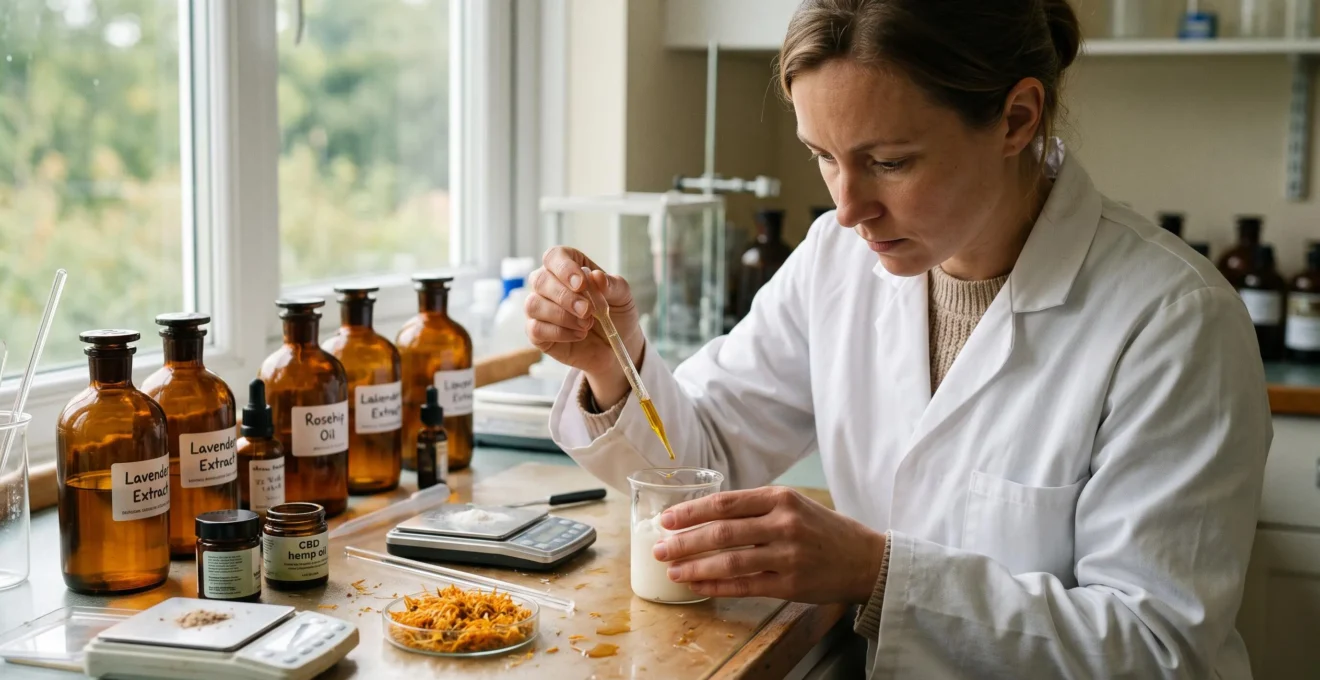
Active plant extracts fit into modern CBD topical formulations as complementary ingredients within a carefully designed cosmetic base. They may contribute antioxidant compounds, skin-conditioning properties, fragrance or sensory characteristics, depending on their botanical origin, extraction method and concentration. Their usefulness, however, depends on the complete formulation rather than the presence of a recognizable plant name.
A CBD cream containing calendula, for example, combines several distinct components: cannabidiol, a botanical preparation, water or oils, emulsifiers, humectants, emollients and preservatives where necessary. Each has a different purpose. Some maintain product stability and skin comfort, while others are included for more specific cosmetic functions.
For consumers comparing botanical creams, serums and balms, this creates an important distinction between an appealing ingredient list and a coherent formulation. A product with numerous extracts is not automatically more effective than one built around a smaller selection. Understanding extract quality, ingredient order, potential allergens and the delivery vehicle makes comparisons more meaningful.
What matters most in CBD botanical skincare
- Botanical identity alone does not establish an extract’s chemical composition, concentration or performance.
- The functional base determines texture, moisturizing properties and how CBD interacts with the skin.
- A focused botanical blend with transparent ingredients may be easier to evaluate than a lengthy list of poorly characterized extracts.
- Why Can the Same Named Plant Extract Differ Between Two CBD Skincare Products?
- How Can You Identify the Main Plant Extracts in a CBD Cosmetic Ingredient List?
- Single Plant Extract or Botanical Blend: Which Offers the Simpler CBD Skincare Formula?
- Does More Plant Extracts Automatically Mean a Better CBD Cosmetic?
- When Should the Position of a Plant Extract on the Ingredient List Matter?
- How Can You Spot Essential Oils in a CBD Skincare Ingredient List?
- How Can You Compare CBD Topical Blends Without Relying on Marketing Names?
- Which Specialised CBD Topical Blend Best Fits Different Skincare Needs?
Why Can the Same Named Plant Extract Differ Between Two CBD Skincare Products?
Two CBD skincare products can list the same plant extract yet contain botanical preparations with substantially different chemical profiles. Plant species, harvested plant parts, growing conditions, extraction solvents and manufacturing methods all influence the resulting material. The shared ingredient name therefore does not establish equivalent concentrations of botanical constituents or comparable skincare performance.
Consider Calendula Officinalis Flower Extract. One supplier may produce a water-and-glycerin preparation, while another uses an oil-based extraction process. These approaches can recover different proportions of water-soluble and oil-soluble compounds. Even when both preparations are associated with calendula, their composition and suitability for a particular CBD cream may differ.
Extraction ratios provide another layer of information. A declared 5:1 plant-to-extract ratio describes a relationship between botanical starting material and resulting extract under a specified manufacturing definition. It does not mean that the finished CBD cosmetic contains five times more beneficial compounds than a product using a 1:1 preparation.
The scientific analysis of plant-to-extract ratios and botanical extract standardization explains why extraction conditions, plant material and additional ingredients influence the characterization of botanical preparations.
Standardized extracts are controlled against defined specifications, potentially including measurable chemical markers. Non-standardized extracts may still follow quality controls, but they are not necessarily adjusted to a specified marker concentration. Standardization can improve consistency between batches without proving superior skincare outcomes.
The ingredient supplier introduces another variable. Two manufacturers can purchase extracts with matching ingredient declarations from different suppliers whose sourcing, identity testing, processing and quality specifications differ.
When assessing a botanical claim, combine three pieces of information:
- INCI identity: Which botanical ingredient is declared, and is the plant part identifiable?
- Ingredient position: Does the extract appear among the predominant ingredients or in the lower-concentration portion of the declaration?
- Technical specifications: Does the manufacturer disclose an extraction ratio, carrier, standardization marker or actual inclusion percentage?
These details help assess transparency, although neither an extraction ratio nor ingredient position independently reveals the quantity of active botanical compounds in the finished cream.
Once extract identity and production are considered separately, the next challenge is recognizing which botanical ingredients are actually present on a cosmetic label.
How Can You Identify the Main Plant Extracts in a CBD Cosmetic Ingredient List?
To identify plant extracts in a CBD cosmetic, look for botanical names in the ingredient declaration, determine which plant part or preparation is specified, and examine their position among the other ingredients. This three-step approach identifies potential botanical contributors, but it cannot establish their exact concentrations or biological effectiveness without additional manufacturer information.
Cosmetic ingredient declarations often follow the International Nomenclature of Cosmetic Ingredients (INCI). Botanical ingredients commonly use Latin-derived species names followed by terms describing plant parts or preparation types.
- Recognize the botanical name. Examples include Calendula Officinalis, Aloe Barbadensis and Camellia Sinensis. These names help distinguish plant identity from a product’s marketing terminology.
- Read the ingredient descriptor. Flower Extract, Leaf Extract and Root Extract may identify an extracted plant part, while Leaf Oil, Seed Oil or Flower Oil can describe oils with different chemical properties. Ash is not interchangeable with Extract and should not automatically be interpreted as an extract.
- Assess the surrounding ingredients. Compare the extract’s position with water, oils, glycerin, emulsifiers, thickeners and preservatives to understand its approximate place in the formulation.
For example, an illustrative CBD cream might list Aqua, Caprylic/Capric Triglyceride, Glycerin, Cetearyl Alcohol, an emulsifier, Calendula Officinalis Flower Extract and preservatives. This arrangement suggests that the main base ingredients contribute substantially to the product’s structure. It does not reveal the calendula extract’s exact percentage.
Phenoxyethanol is sometimes used as an informal reference point because its permitted concentration is restricted in several cosmetic markets. However, its presence is not a universal 1% dividing line. The preservative may be used below its maximum permitted concentration, and lower-concentration ingredients need not follow strict descending order.
Three additional details can complicate label interpretation. First, a trademarked botanical complex may be prominently displayed on the front packaging while its constituent ingredients appear individually in the declaration. Second, a botanical oil and an extract from the same plant can appear as separate ingredients because they represent different preparations. Third, some commercial blends contain carriers or solvents that must be considered when interpreting the finished formulation.
An extract appearing early may contribute materially to the formula’s composition, but high inclusion does not prove a major biological effect. Conversely, some constituents can perform a cosmetic function at relatively low concentrations.
Having identified the botanical components, consumers can evaluate whether a single-extract approach or a carefully selected mixture better matches their needs.
Single Plant Extract or Botanical Blend: Which Offers the Simpler CBD Skincare Formula?
A CBD formula containing one botanical extract is generally simpler to interpret than a blend containing several. Fewer botanical ingredients make sourcing, tolerance assessment and ingredient attribution more straightforward. A well-designed botanical blend may serve several complementary cosmetic purposes, but greater complexity requires clearer formulation logic and does not automatically produce better results.
A single-extract formula might combine CBD with calendula in a conventional moisturizing base. This arrangement allows a relatively focused evaluation of the additional botanical ingredient, although the complete formula still contains other substances that can influence tolerance and performance.
A botanical blend could instead combine an extract selected for antioxidant characteristics with another selected for skin-conditioning or comfort-related properties. The combination is reasonable when each ingredient serves a defined purpose, is compatible with the base and is included at a suitable level.
Such combinations are sometimes described as synergistic. However, complementary intended functions are not proof of synergy. Demonstrating that two extracts perform better together than separately requires evidence on the particular combination and its intended outcome.
The distinction becomes especially relevant when the total amount allocated to botanical extracts is fixed. Adding more extracts can reduce the proportion available to each one, unless their concentrations or the overall formula are adjusted.
The practical differences are easier to see side by side.
| Evaluation criterion | Single plant extract | Botanical blend |
|---|---|---|
| Ingredient traceability | Usually easier to investigate | Requires information on several extracts |
| Formulation objectives | Focused botanical contribution | Potentially several complementary functions |
| Concentration transparency | Fewer botanical quantities to establish | Individual inclusion levels may be harder to determine |
| Tolerance assessment | Fewer botanical variables | More possible ingredient sensitivities |
| Best practical use | Minimalist routines and ingredient screening | Multiple skincare priorities with a justified combination |
For reactive or allergy-prone skin, minimizing unnecessary botanical complexity is a reasonable starting point. For someone seeking both moisturizing comfort and antioxidant-oriented ingredients, a compact blend may be appropriate if its composition is transparent.
A meaningful blend therefore has a purpose beyond its plant count: each extract should contribute to a defined formulation objective rather than simply expanding the marketing description.
Neither approach guarantees an outcome. The more useful question is whether each additional extract improves the formulation’s suitability for its intended cosmetic purpose.
Does More Plant Extracts Automatically Mean a Better CBD Cosmetic?
No. A CBD cosmetic containing more plant extracts is not automatically better formulated or more effective. Ingredient number reveals little about concentration, compatibility, stability or demonstrated performance. A formula containing two or three carefully selected botanicals may be more coherent than one featuring many extracts at unspecified levels, although either approach requires evaluation of the complete product.
Consider a hypothetical formulation in which the total botanical-extract allocation remains unchanged. If that allocation is distributed across fifteen extracts instead of three, the average amount per extract decreases when divided equally. This mathematical illustration does not establish that the larger blend is less effective, but it shows why ingredient count cannot substitute for concentration information.
Botanical complexity can also introduce practical formulation challenges. Additional raw materials may bring different solvents, electrolytes, colors, odors and constituents that interact with the product’s base. Stability testing becomes important for verifying that the finished cream, serum or balm remains physically and chemically suitable throughout its intended use.
More ingredients can also mean more potential sensitivity variables. This does not establish that complex botanical products are inherently unsafe. It means that identifying a problematic ingredient may become more difficult when a formula contains many botanical materials, fragrance substances and other potential sensitizers.
Consumers should evaluate the base before focusing on a long extract list. Glycerin and other humectants can help attract or retain water, emollients contribute to skin softness, and occlusive ingredients help reduce moisture loss. These are meaningful functions even when the ingredients are familiar or inexpensive.
A botanical extract does not compensate automatically for a poorly designed vehicle, unsuitable preservation or an unpleasant texture.
Counting extracts listed after the preservative system can be a useful prompt for further questions, but it is not a validated measure of quality. Some extracts function at low inclusion levels, and ingredient order cannot reveal their precise amounts.
A more informative assessment considers whether the formula contains an appropriate moisturizing base, a manageable number of botanicals and sufficiently clear product information to explain their intended roles.
Because concentration helps determine what an ingredient can contribute, the next step is understanding how far ingredient-list position can support that assessment.
When Should the Position of a Plant Extract on the Ingredient List Matter?
The position of a plant extract matters most when comparing its relative prominence among a cosmetic’s main ingredients. In markets using descending-order declarations, earlier placement generally suggests a larger proportion of the formula. However, ordering exceptions for low-concentration ingredients prevent consumers from reconstructing exact percentages or ranking every botanical extract reliably.
Under United States cosmetic labeling rules, ingredients are generally declared in descending order of predominance. Ingredients present at 1% or less may be listed without strictly following that order, while color additives have separate provisions.
The FDA summary of cosmetic ingredient labeling requirements establishes this framework for US cosmetics. Other English-speaking markets have their own labeling and regulatory requirements, so the US rules should not automatically be treated as universal.
Suppose an illustrative cream lists a botanical extract immediately after several major emollients. That position may suggest greater formula prominence than an extract placed near the end of another product’s declaration. Yet this comparison becomes uncertain when either ingredient falls into the category permitted to appear outside strict descending order.
Likewise, the appearance of an extract after phenoxyethanol does not establish that it is below 1%. Without knowing the preservative’s actual percentage and how the lower-concentration ingredients were ordered, such an inference would be unreliable.
Formula type changes the interpretation further. In an oil-rich CBD balm, a botanical oil appearing among the main ingredients may help define the vehicle itself. In a predominantly aqueous gel, an extract appearing after water and humectants may serve a different structural or cosmetic purpose.
Ingredient prominence and ingredient effectiveness are separate questions. A substance used at a low concentration may still have a technological or cosmetic function, while a high-percentage ingredient may primarily provide bulk, texture or skin-conditioning support.
Another distinction concerns legally designated drug active ingredients. In the United States, products regulated as both cosmetics and drugs have specific labeling rules that differ from ordinary cosmetic declarations. This should not be confused with the marketing use of the term « active botanical, » which does not generally exempt plant extracts from cosmetic ingredient-order requirements.
For a comparison that genuinely depends on concentration, an explicit formulation percentage or relevant manufacturer documentation is more informative than label position alone.
Once concentration clues have been interpreted cautiously, another ingredient category deserves attention: essential oils and their potential fragrance allergens.
How Can You Spot Essential Oils in a CBD Skincare Ingredient List?
Essential oils in CBD skincare can often be identified through botanical ingredient names ending in terms such as Oil or Flower Oil, although these endings do not always indicate an essential oil. Fragrance constituents including limonene, linalool, citral and geraniol provide additional clues, but their presence does not prove which essential oil was used or at what concentration.
Essential oils are concentrated mixtures of volatile plant constituents. In cosmetic formulations, they may contribute fragrance and sensory characteristics, while some are selected for additional intended functions. Such claims need to be evaluated for the particular ingredient and finished product.
Examples of botanical names worth investigating include Lavandula Angustifolia Oil and Melaleuca Alternifolia Leaf Oil. However, names ending in Seed Oil frequently describe fixed plant oils rather than volatile essential oils. A fixed oil such as sunflower seed oil serves a different formulation purpose from a typical aromatic essential oil.
The distinction matters for CBD products intended for easily irritated skin. A fragrant balm may provide an appealing sensory experience while exposing the user to substances that can cause contact allergy in susceptible individuals.
The DermNet clinical information on limonene and linalool contact allergy explains that these fragrance constituents can oxidize, forming hydroperoxides associated with allergic contact dermatitis.
Finding limonene or linalool on a label does not mean a particular essential oil is present. Fragrance substances can originate from different materials, and their declaration is governed by applicable labeling requirements.
For consumers, the most useful approach is to examine the essential-oil ingredient itself, look for separately declared fragrance allergens and consider personal sensitivity history. Position near the end of the declaration does not prove that an oil is merely a trace fragrance rather than a functional ingredient.
People with known fragrance allergies should prioritize avoiding identified allergens. Someone seeking a minimalist CBD moisturizer may also prefer a fragrance-free formula, recognizing that fragrance-free does not guarantee the absence of all potential irritants.
Fragrance screening completes an important part of ingredient assessment, but selecting between specialized products also requires looking beyond their marketed identities.
How Can You Compare CBD Topical Blends Without Relying on Marketing Names?
Compare CBD topical blends by examining their declared CBD content, botanical ingredients, functional base, fragrance components and available technical documentation rather than product names. Terms such as calming, botanical complex and recovery describe positioning, not standardized composition. A structured comparison reveals whether differently marketed products genuinely differ in ingredients, concentrations, texture or intended cosmetic functions.
A cream described as a calming botanical complex might contain CBD, calendula and a conventional moisturizing base. Another advertised as an intensive botanical recovery balm could use some of the same extracts but substantially different proportions of oils, waxes and other base ingredients.
These differences can matter more to a consumer than the names themselves. The most appropriate product depends on its complete formulation and the skin’s needs.
CBD concentration deserves particular attention. A stated CBD amount can support comparison if the package size and measurement basis are clear. For instance, an amount expressed per container cannot be directly compared with a percentage by weight without sufficient information about the contents.
Beyond concentration, the delivery vehicle matters. An experimental study titled Topical Administration of Cannabidiol: Influence of Vehicle-Related Aspects on Skin Permeation Process investigated CBD behavior in different liquid and semisolid formulations using laboratory skin-permeation methods.
The researchers found that vehicle composition influenced CBD permeation and retention under the tested conditions. Their findings demonstrate the importance of formulation design but do not establish that one general category of consumer skincare, such as all gels or all balms, is clinically superior.
A useful comparison framework therefore includes the following criteria.
| Criterion | What to examine | Why it matters |
|---|---|---|
| CBD information | Declared amount, concentration basis and product size | Supports meaningful CBD content comparisons |
| Botanical extracts | Identity, number and documented intended functions | Shows whether the combination has a coherent purpose |
| Functional base | Oil, balm, emulsion or gel; humectants and emollients | Influences texture, moisturizing behavior and ingredient delivery |
| Accompanying ingredients | Preservatives, antioxidants, fragrances and other supporting substances | Helps assess stability, compatibility and personal suitability |
| Potential irritants | Fragrance allergens and personally problematic ingredients | Supports tolerance-based screening |
| Product documentation | Ingredient specifications, CBD testing and substantiated claims | Clarifies information absent from marketing descriptions |
Manufacturer documentation can be particularly useful when a product highlights a proprietary extract blend. An ingredient declaration identifies relevant ingredients, while a specification or certificate of analysis may supply additional details about raw materials or finished-product quality.
Such documents should be interpreted within their actual scope. A CBD test result does not automatically verify every botanical component, and a raw-material certificate does not establish the finished cosmetic’s clinical effectiveness.
Five practical checks before choosing a CBD botanical product
- Copy the complete ingredient declaration for each shortlisted product into a comparison note. Deliverable: two or more complete ingredient lists.
- Highlight every identifiable botanical extract and note its plant part where specified. Deliverable: a botanical ingredient inventory for each formula.
- Record the declared CBD amount, package quantity and measurement unit. Deliverable: a comparison of CBD information, with any missing conversion details marked.
- Identify the base ingredients, essential oils and declared fragrance allergens. Deliverable: a short list of texture characteristics and potential tolerance concerns.
- Check whether the manufacturer provides relevant ingredient specifications, test results or explanation of the blend. Deliverable: a final comparison table separating verified facts from undisclosed information.
Marketing names can still help locate product categories, but they should be treated as starting descriptions rather than evidence. The ingredient declaration and supporting documentation provide a more dependable foundation for assessment.
With those distinctions established, selection becomes a question of matching the vehicle and botanical complexity to an individual’s primary skincare priorities.
Key takeaways for choosing a CBD botanical formula
- Start with the desired skincare function and texture rather than the number of highlighted plant extracts.
- Favor ingredient transparency when comparing formulations with similar cosmetic purposes.
- Account for fragrance tolerance and the complete moisturizing base before choosing a specialized botanical blend.
Which Specialised CBD Topical Blend Best Fits Different Skincare Needs?
The most suitable specialized CBD topical blend depends on skin type, the main cosmetic objective and ingredient tolerance. Dry skin may benefit from a richer emollient and occlusive base, while sensitive skin often warrants a simpler, fragrance-free formula. Combination skin may prefer a lighter emulsion or gel, provided the overall ingredient profile is appropriate.
CBD is only one component of these products. A moisturizing cream’s functional base can make an immediate contribution to skin comfort, while botanical extracts may provide additional properties depending on their composition and supporting evidence.
For dry skin, oils, emollients and occlusive ingredients can help support softness and reduce water loss. Lipid-compatible botanical preparations may be easier to incorporate into oil-rich systems, although this does not mean they are automatically more effective.
For sensitive or reactive skin, selecting fewer unnecessary fragrance components can simplify tolerance assessment. A long list of botanical ingredients is not inherently unsuitable, but each additional constituent introduces another variable worth examining.
Combination skin often benefits from considering application feel and hydration balance. A lightweight emulsion or gel may offer a more comfortable texture than a heavy balm. Botanical extracts described as astringent should be judged cautiously, because the term does not guarantee improved oil balance or suitability for sensitive areas.
| Skincare need | Formulation characteristics to prioritize | Considerations |
|---|---|---|
| Dry skin | Emollient-rich cream or balm, appropriate occlusive ingredients and compatible botanical preparations | Assess moisturizing ingredients rather than assuming botanical oils alone provide complete hydration |
| Sensitive or reactive skin | Shorter ingredient profile, fragrance-free options and a suitable barrier-supporting base | Check known allergens and avoid interpreting natural origin as proof of tolerance |
| Combination skin | Lightweight lotion, gel or gel-emulsion with appropriate humectants | Prioritize comfortable texture and avoid unsupported oil-control claims |
| Skin seeking moisturizing comfort | Balanced humectants, emollients and a coherent selection of skin-conditioning extracts | Evaluate the complete formula rather than relying on the CBD or botanical claim alone |
| Preference for minimalist skincare | Clearly identified ingredients, fewer optional botanicals and limited fragrance complexity | Simple does not automatically mean safer or more effective, but may make evaluation easier |
The vehicle also influences how ingredients behave on the skin. In experimental CBD permeation research, tested formulation bases produced different delivery characteristics. However, higher measured CBD permeation is not equivalent to demonstrated improvement in skin hydration, comfort or other clinical outcomes.
The desired result therefore determines what evidence is relevant. If the priority is moisturizing dry skin, the humectant, emollient and occlusive system deserves close attention. If the priority is avoiding a known contact allergen, ingredient screening takes precedence over botanical marketing claims.
Three questions provide a practical final decision framework:
- What is the primary skincare need? Identify whether hydration, softness, comfort or a particular texture is most important.
- How much botanical complexity is acceptable? Consider whether a focused formula or a documented multifunctional blend better fits personal preferences and tolerance.
- Which ingredients should be avoided? Review known allergens, fragrance sensitivities and previous reactions before making a selection.
A product that answers these questions clearly is easier to evaluate than one relying mainly on a broad wellness description. No CBD botanical formulation can be judged solely by its ingredient count, and CBD-related therapeutic claims require evidence and regulatory consideration beyond ordinary cosmetic positioning.
For the next product comparison, place two complete ingredient lists side by side, identify the functional bases and key botanicals, then choose the formula whose documented characteristics best match the intended skincare need and personal tolerance.
Can a CBD cream contain botanical extracts without added fragrance?
Yes. Botanical extracts are not necessarily added for fragrance. They may be selected for skin-conditioning or other intended cosmetic functions. A formula can contain plant extracts while omitting added perfume and aromatic essential oils. However, fragrance-free labeling does not establish that every ingredient is non-allergenic or entirely odorless.
Does a standardized botanical extract guarantee better skin results?
No. Standardization can improve consistency in specified botanical characteristics across raw-material batches. It does not independently demonstrate that a CBD cream containing the extract produces better moisturizing, soothing or other skincare outcomes. Finished-product formulation and appropriate performance evidence remain important.
Can botanical extracts affect the color or smell of a CBD skincare product?
Yes. Botanical preparations may contribute pigments, aromatic constituents or other sensory characteristics depending on their chemical composition and manufacturing process. Differences in a product’s appearance or odor do not necessarily indicate a higher concentration of useful botanical compounds. Unexpected changes during storage should be assessed against the manufacturer’s product guidance.
Is a certificate of analysis enough to establish the quality of a CBD botanical cream?
Not by itself. A certificate of analysis documents particular tests and specifications for a defined material or product. Its value depends on what was tested, which batch it covers and which acceptance criteria were used. Testing CBD content, for example, does not automatically demonstrate botanical-extract potency, product stability or clinical skincare performance.
Does a plant extract need to penetrate deeply into the skin to be useful?
No. The required location of action depends on the ingredient’s intended cosmetic function. Some substances contribute to surface conditioning, texture or moisture retention without needing deep penetration. CBD delivery studies can help explain the influence of formulation vehicles, but skin penetration measurements alone do not establish a finished cosmetic’s effectiveness for a particular skincare need.