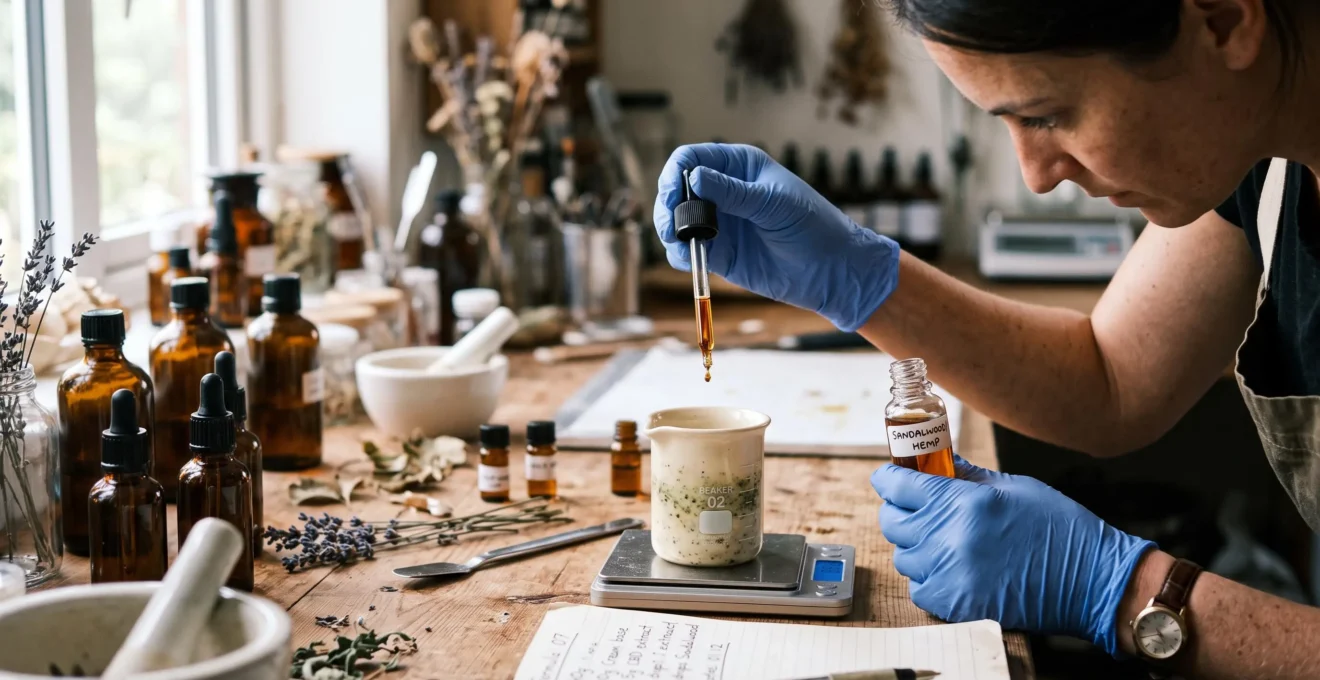
Essential oils can transform a CBD cream, balm or serum from a relatively neutral skincare product into a distinctly aromatic formulation. Lavender, peppermint, eucalyptus and other botanical oils contribute volatile fragrance compounds that influence how a product smells during application and how its scent develops on the skin.
That sensory contribution is separate from the presence or concentration of cannabidiol (CBD). An intensely scented balm is not necessarily stronger in CBD, and a fragrance-free cream is not necessarily less sophisticated. These products simply take different approaches to fragrance and overall formulation.
Essential oils also deserve careful consideration because natural fragrance compounds can irritate the skin or trigger allergic contact dermatitis in susceptible individuals. Their suitability depends on the particular oil, its concentration, the finished formula, the application area and personal sensitivity.
Understanding the aromatic ingredients, reading the full ingredient list and considering how frequently a product will be used can make the choice between scented and fragrance-free CBD skincare more informed.
Essential oils in CBD skincare: the essentials
- Concentrated aromatic compounds can noticeably alter a CBD topical’s scent even when included in relatively small amounts.
- Ingredient labels reveal botanical oils and fragrance components, but usually cannot establish their exact concentrations or CBD potency.
- Fragrance-free formulations are often preferable for fragrance-reactive skin, although no ingredient list guarantees universal tolerance.
- Why Can a Small Amount of Essential Oil Strongly Change a CBD Topical’s Aroma?
- How Can You Spot Essential Oils in a CBD Skincare Ingredient List?
- Essential-Oil Blend or Fragrance-Free CBD Cream: Which Better Suits Sensitive Skin?
- Why Can Highly Concentrated Essential Oils Be Unsuitable for Direct Skin Application?
- When Should You Choose a CBD Topical with Fewer Essential Oils?
- How Can You Identify the Main Plant Extracts in a CBD Cosmetic Ingredient List?
- When Can a Complex CBD Topical Blend Become Too Complicated for Sensitive Skin?
- Which Specialised CBD Topical Blend Best Fits Different Skincare Needs?
Why Can a Small Amount of Essential Oil Strongly Change a CBD Topical’s Aroma?
A small amount of essential oil can substantially change the aroma of a CBD topical because essential oils contain concentrated, volatile fragrance compounds. These compounds evaporate from the formulation and reach the nose during application. Their distinctive aromas may become noticeable even when essential oils represent only a minor part of the finished product.
Unlike carrier oils, which primarily contribute to texture and spreadability, essential oils are generally included for their characteristic aromatic profiles. Peppermint can introduce a recognisable mint note, lavender a floral-herbal character, and eucalyptus a sharp, fresh impression. The degree to which an ingredient dominates depends on its composition, dosage and the surrounding formula, rather than a fixed percentage applicable to every essential oil.
CBD topicals also have an underlying scent. Hemp-derived extracts can retain aromatic plant constituents, including terpenes, depending on how they are manufactured and refined. Other components, such as botanical butters and vegetable oils, contribute their own background odours.
Consequently, the finished aroma reflects several overlapping scent sources. A lavender essential oil might soften a hemp-like background, but it may not completely eliminate it. Similarly, an extract with relatively little residual aroma can leave the added fragrance more prominent.
Aroma can also change as the product is spread across warm skin and its volatile constituents disperse. What smells subtle inside a closed jar may appear stronger during application.
These sensory observations should never be interpreted as evidence of CBD concentration. Fragrance intensity is not a potency test. CBD content must be assessed through reliable product information, not by smelling the formula.
Once this distinction is clear, the next question is how to recognise which aromatic substances the manufacturer has chosen.
How Can You Spot Essential Oils in a CBD Skincare Ingredient List?
Essential oils can often be identified in a CBD skincare ingredient list by looking for botanical names associated with aromatic plant oils, such as Lavandula Angustifolia Oil or Mentha Piperita Oil. Fragrance terms and separately declared fragrance allergens provide additional clues, although they do not always reveal the complete aromatic composition of a product.
Cosmetic labels frequently use standardised ingredient names rather than familiar descriptions such as “lavender essential oil.” The botanical name identifies the plant, while accompanying terminology distinguishes an oil, extract or other material. For instance, a lavender flower extract is not necessarily identical to lavender essential oil.
Useful label clues include:
- Botanical oil names: names such as Lavandula Angustifolia Oil and Eucalyptus Globulus Leaf Oil may identify aromatic plant oils.
- Parfum or Fragrance: these terms indicate a fragrance composition that may contain natural aromatic materials, synthetic substances or both.
- Limonene and Linalool: these are individual fragrance substances found in certain essential oils, but their appearance does not prove that a particular whole essential oil was added. They may also have other origins.
- Plant extracts: terms such as Extract do not, by themselves, establish that the material is a concentrated essential oil.
Ingredient order offers some additional context. Under US cosmetic labelling rules, ingredients generally appear in descending order of predominance. However, ingredients present at concentrations of 1% or less may be declared without strict descending ordering among themselves. Colour additives have separate exceptions. These distinctions are explained in the FDA summary of cosmetic labeling requirements.
Therefore, an essential oil near the bottom of an ingredient list is not necessarily present at an insignificant concentration for fragrance purposes. Nor can comparing two nearby ingredients establish which one contributes more to the finished scent. Labelling requirements also vary across English-speaking markets.
If the packaging provides only selected ingredients, consult the manufacturer’s full ingredient disclosure. A brand’s website may offer more detail, but promotional descriptions should not be confused with the complete regulatory ingredient declaration.
When the aromatic composition remains unclear, ask whether the fragrance contains essential oils or specific substances already known to cause personal reactions. A meaningful answer should identify the relevant ingredient information rather than simply describe the fragrance as natural.
Recognising the ingredients is the first step; deciding whether those ingredients suit an individual’s skin is a separate assessment.
Essential-Oil Blend or Fragrance-Free CBD Cream: Which Better Suits Sensitive Skin?
A fragrance-free CBD cream is generally the more cautious starting point for someone who knows their skin reacts to fragrance. An essential-oil blend may suit someone who tolerates scented cosmetics and values their aroma. The decision should also reflect where the cream will be applied and how frequently it will be used.
The principal trade-off is between sensory character and avoidable fragrance exposure. Scented products can make application more enjoyable through distinctive botanical aromas. Fragrance-free products omit deliberately added perfume ingredients, reducing one potential source of irritation or allergy without guaranteeing that the overall formula will be tolerated.
Three personal considerations are especially useful:
- Fragrance history: previous itching, redness or dermatitis associated with perfumes or scented skincare argues for a more cautious choice.
- Application area: facial skin, particularly around sensitive regions, may merit a simpler formula than an occasional body massage product.
- Frequency: a product applied repeatedly becomes a recurring source of exposure to all its ingredients, including fragrance substances.
Natural origin does not make an essential oil automatically gentle. According to DermNet’s clinical overview of essential oil contact dermatitis, essential oils can cause delayed allergic contact reactions, while high concentrations may also contribute to irritant dermatitis.
This distinction matters because a product can feel comfortable immediately after application but still be associated with a delayed reaction. Conversely, an unpleasant sensation soon after application does not automatically establish an allergy. Individual symptoms and their causes may require clinical assessment.
The following comparison provides a practical starting point rather than a universal ranking.
| Consideration | Essential-oil blend | Fragrance-free formula |
|---|---|---|
| Sensory experience | Distinctive botanical aroma | No intentionally added perfume; may retain a natural ingredient odour |
| Fragrance sensitivity | Additional aromatic substances to evaluate | Generally preferable when fragrance is a known trigger |
| Facial application | Requires careful assessment of ingredients and tolerance | Often a more straightforward starting point |
| Regular use | Repeated exposure to the fragrance composition | Avoids deliberately added fragrance but not all potential irritants |
Before regular use, test the finished product on a small area. The American Academy of Dermatology’s skincare product testing instructions recommend applying a new skincare product to a test area twice daily for seven to ten days, rather than relying on a single brief application.
If redness, itching or swelling develops, wash off the product and stop using it. A home trial does not replace dermatologist-led testing for suspected contact allergy, nor does a reaction-free trial guarantee permanent tolerance.
For skin with a history of fragrance reactions, ingredient transparency and cautious testing are more valuable than assurances that a product uses purely botanical perfume.
Why Can Highly Concentrated Essential Oils Be Unsuitable for Direct Skin Application?
Highly concentrated essential oils may be unsuitable for direct skin application because undiluted exposure delivers a much greater amount of aromatic substances than a properly formulated cosmetic typically contains. Depending on the oil and the individual, this can contribute to irritation or sensitisation. Certain essential oils also present additional concerns under specific sunlight exposure conditions.
A finished CBD cream, balm or serum is a formulation containing multiple components. Essential oils, when included, are dispersed or dissolved within an appropriate system alongside emollients, carriers and other ingredients. Their suitability depends on the entire formulation and intended use, not merely on the presence of a dilution step.
By contrast, applying a concentrated essential oil directly to the skin removes the exposure controls provided by the finished cosmetic formulation. An oil that can be used appropriately at a suitable concentration is not necessarily suitable for use undiluted.
The possible consequences include stinging, redness, itching and irritant dermatitis. Allergic contact dermatitis involves a different mechanism and can emerge after sensitisation. DermNet specifically cautions against applying undiluted essential oils directly to the skin because of their sensitising potential.
Some aromatic oils deserve additional consideration because they contain compounds capable of interacting with ultraviolet radiation. For example, a published clinical report on bergamot oil phototoxicity describes two patients who experienced bullous phototoxic skin reactions after exposure to bergamot aromatherapy oil and ultraviolet light.
Those clinical cases illustrate a specific exposure hazard, not a finding that every citrus essential oil or every finished cosmetic containing bergamot is phototoxic. Composition, concentration, processing and ultraviolet exposure all matter.
Layering several strongly fragranced products on the same area can also increase total exposure to overlapping aromatic constituents. A scented cleanser, botanical serum and fragrant balm may contain some of the same fragrance compounds, even when their ingredient lists look different.
This does not mean that combining two scented cosmetics necessarily causes a reaction. It means that each product should be evaluated as part of the full routine rather than in isolation.
Anyone with reactive skin may benefit from reducing unnecessary aromatic exposure instead of adding concentrated essential oils to a product that was already formulated for topical use.
When Should You Choose a CBD Topical with Fewer Essential Oils?
A CBD topical with fewer essential oils is often a sensible choice when skin is easily irritated, fragrance sensitivity is suspected, or the product will be applied frequently. Simpler aromatic formulations are also worth considering for facial skincare and during periods of skin discomfort. Reducing fragrance ingredients limits unnecessary aromatic exposure without guaranteeing that the product will be suitable for everyone.
Minimal fragrance exposure can be particularly relevant when the skin barrier is already compromised. Skin that feels unusually dry, uncomfortable or reactive may be less tolerant of additional cosmetic ingredients. A strongly fragranced CBD balm is not necessarily appropriate simply because it contains botanical materials associated with soothing sensory experiences.
Four situations favour a more restrained formulation:
- Reactive skin: previous discomfort after scented skincare suggests choosing a product without added fragrance.
- Facial application: products used near delicate facial areas benefit from careful ingredient selection, especially when the skin already reacts easily.
- Daily routines: frequent application makes the overall exposure pattern more relevant than a single pleasant application.
- Temporarily compromised skin: irritation, excessive dryness or a disrupted skin barrier provides a reason to avoid introducing unnecessary aromatic ingredients until the skin has recovered.
An ingredient list also has a practical interpretation advantage. When fewer substances are involved, identifying a possible reaction trigger may become easier. This is sometimes described informally as an ingredient budget: every additional ingredient should have a useful formulation purpose.
However, a shorter ingredient list is not automatically safer. A simple product containing a personally problematic ingredient may be less suitable than a more complex formula composed of tolerated substances. Concentration and exposure conditions remain important.
For a quick comparison, examine the complete ingredient lists of two CBD creams and identify the declared essential oils, perfume terms and individual fragrance substances. Count the distinct aromatic entries, but do not treat the count as a scientifically validated allergy score.
A product with one declared aromatic oil may still have a strong scent, while one with several aromatic ingredients may be formulated at low concentrations. Ingredient count is therefore a screening tool, not a substitute for concentration data or personal tolerance.
The next useful step is to read beyond the fragrance section and understand how the plant oils, extracts and CBD itself fit into the complete cosmetic formula.
How Can You Identify the Main Plant Extracts in a CBD Cosmetic Ingredient List?
The main plant-derived ingredients in a CBD cosmetic can be identified by separating the ingredient list into carrier oils, botanical extracts, isolated compounds and aromatic substances. Their names often reveal their general formulation roles, although the label alone rarely establishes precise concentrations, extraction methods or the complete chemical composition of each material.
Start with the base of the product. Carrier oils and butters can contribute emollience, texture and spreadability. Examples include Helianthus Annuus Seed Oil, commonly associated with sunflower seed oil, and Butyrospermum Parkii Butter, the ingredient name used for shea butter.
Next, look for plant extracts and CBD-related ingredients. Cannabidiol identifies CBD as an ingredient, while Cannabis Sativa Seed Oil refers to hemp seed oil. These are not interchangeable names. Hemp seed oil does not establish the presence of an added concentration of CBD.
Other botanical extracts may appear under names combining a plant’s scientific designation with the relevant plant part and the word Extract. They should not automatically be interpreted as essential oils, since extraction processes and resulting compositions can differ considerably.
Finally, identify the aromatic layer: essential oils, perfume compositions and individually declared fragrance substances. This separates ingredients contributing primarily to the product’s scent from those forming the cosmetic base or providing other formulation functions.
A straightforward three-step routine is useful:
- Identify the base ingredients, including oils, butters, water and texture-forming components.
- Identify the CBD and botanical extracts, noting their declared ingredient names without assuming their concentrations.
- Identify the aromatic ingredients, including essential oils, perfume and listed fragrance substances.
Consider a hypothetical CBD cream listing water, sunflower seed oil, shea butter, cannabidiol, lavender oil and linalool. The first ingredients suggest a moisturising base, cannabidiol identifies CBD, and the last two entries indicate aromatic constituents. However, this simplified example does not disclose CBD potency, the concentration of lavender oil or whether linalool was added separately.
CBD’s position on an ingredient list can offer limited contextual information. Under the US rules discussed earlier, ingredients above the low-concentration exception are generally ordered by predominance, but the position of CBD cannot establish a precise amount. Ingredient statements also cannot replace documented analytical information when the actual CBD content matters.
Where a brand advertises a specific CBD amount, check whether it refers to the entire container or a defined quantity of product. If the distinction is unclear, request the relevant formulation or testing information rather than estimating it from the ingredient order.
Five checks before choosing a CBD topical
- Record the complete ingredient list. Save a photograph or copy of the product’s full declaration for comparison.
- Identify the formula’s base. Mark the principal carrier oils, butters or water-based components and note the resulting formulation profile.
- Locate CBD and plant extracts. Highlight Cannabidiol and the declared botanical extracts, creating a short list of identifiable ingredients.
- Mark the fragrance-related entries. Count the separately declared essential oils, perfume terms and fragrance substances, producing a simple aromatic ingredient inventory.
- Record unresolved questions. Write down missing CBD quantity information, unclear fragrance composition or known personal triggers to verify with the manufacturer before purchasing.
Once the different ingredient roles have been identified, it becomes easier to recognise when an elaborate botanical blend adds meaningful sensory character and when it introduces complexity that may be unnecessary.
When Can a Complex CBD Topical Blend Become Too Complicated for Sensitive Skin?
A complex CBD topical blend can become difficult to assess for sensitive skin when it combines numerous essential oils, fragrance components and botanical extracts. Each ingredient introduces another possible source of individual intolerance, but a long list does not prove that reactions will occur. The relevant considerations are ingredient identity, concentration, combined exposure and personal sensitivity.
Botanical blends are often marketed around the variety of plants they contain. A cream might combine lavender, rosemary, peppermint and several additional extracts to create a distinctive aromatic experience. Such combinations may be appealing, but the number of botanical ingredients does not establish superior skincare performance.
For sensitive skin, complexity creates two practical challenges. First, several ingredients may contribute overlapping fragrance compounds, potentially increasing exposure to particular substances. Second, if a reaction occurs, it can be difficult to determine which ingredient or combination is responsible.
Essential oils themselves are chemically complex mixtures. Different oils can share constituents such as linalool or limonene, so counting botanical names alone does not reveal the total amount of a particular fragrance substance.
Combined exposure matters more than ingredient count alone. A single concentrated aromatic ingredient could be less suitable for an individual than several appropriately formulated substances. Conversely, multiple botanical materials can make an already fragrance-heavy routine more difficult to assess.
A useful complexity check is to examine the aromatic portion of the ingredient declaration. If a formula lists numerous essential oils alongside perfume and several fragrance constituents, consider whether that additional scent complexity is necessary for the intended application.
There is no validated universal maximum number of essential oils that makes a CBD cream suitable for sensitive skin. A formula containing more than a handful of aromatic entries can be treated as a prompt for closer scrutiny, not as proof that the product is unsafe.
Frequency also influences the decision. A strongly scented balm intended for occasional massage creates a different exposure pattern from a facial serum applied repeatedly. However, occasional use does not eliminate allergy risk, and a known trigger should not be deliberately reintroduced simply by reducing application frequency.
Marketing language deserves similar scrutiny. Expressions such as botanical complex, herbal infusion and multi-plant formula describe product positioning but do not establish better tolerance or greater efficacy. What matters is whether each ingredient contributes something relevant to the user’s needs.
For someone who repeatedly reacts to skincare products, switching between elaborate botanical blends may make identifying the trigger more difficult. A simpler routine, together with professional dermatological advice when needed, provides a more controlled basis for evaluation.
The most appropriate product is therefore not necessarily the one containing the greatest number of plant ingredients, but the one whose composition and intended use best match the skin’s tolerance.
Key takeaways before choosing a formulation
- Choose the aromatic profile according to the intended experience, rather than using fragrance strength as a measure of CBD content or product quality.
- Prioritise the complete ingredient declaration and personal fragrance history over claims about naturalness or botanical richness.
- Match formulation complexity to application area and frequency, using a simpler fragrance profile when skin tolerance is uncertain.
Which Specialised CBD Topical Blend Best Fits Different Skincare Needs?
The most suitable specialised CBD topical depends on the intended application, preferred sensory experience and individual skin tolerance. Cooling aromatic blends may appeal after exercise, warming spice-based formulas may suit massage-style routines, and fragrance-free creams are generally a more cautious starting point for sensitive facial skin. None of these profiles establishes superior CBD potency or guaranteed skincare benefits.
Cooling formulations often contain peppermint-derived aromatics or menthol-type ingredients. These can create a cooling sensation that complements a post-exercise application ritual. This sensory effect should not be confused with evidence that CBD itself produces the cooling sensation or that the formulation treats exercise-related injuries.
Warming aromatic blends may feature spice-associated fragrance notes or botanical ingredients selected for a massage-oriented sensory profile. Depending on the composition, such ingredients can create an impression of warmth or provide a characteristic fragrance. A warming sensation does not necessarily indicate improved circulation or therapeutic effectiveness.
For facial skincare, a minimal unscented or genuinely fragrance-free formulation may be more appropriate, particularly when the product is intended for frequent application. The base formulation, compatibility with the rest of the routine and known ingredient sensitivities deserve greater consideration than decorative botanical claims.
These different profiles can be compared according to their intended experience.
| Product profile | Potentially suitable use | Main consideration |
|---|---|---|
| Cooling aromatic blend | Post-exercise body application | Menthol and other aromatic substances may cause discomfort on sensitive skin |
| Warm spice or botanical blend | Massage-oriented routines | Fragrance complexity and individual tolerance should be assessed |
| Lightly scented botanical cream | Everyday body moisturising for fragrance-tolerant users | Repeated exposure to fragrance ingredients |
| Fragrance-free CBD cream or serum | Facial skincare and fragrance-sensitive routines | Other formulation ingredients may still cause reactions |
The intended moment of use can help narrow the choice. Someone seeking an occasional aromatic massage product may reasonably prioritise scent and texture. Someone choosing a product for regular facial application may instead prefer minimal fragrance exposure and a familiar, well-tolerated base.
Neither approach makes the product inherently more effective because it contains CBD. Cosmetic suitability must be assessed independently from unsupported therapeutic claims. The presence of cannabidiol does not automatically establish that a formulation can treat inflammation, pain, eczema or another medical condition.
Before choosing, review four final questions:
- Aromatic load: which essential oils, perfume ingredients and fragrance substances are declared?
- Sensitivity history: have similar ingredients previously caused itching, irritation or allergic reactions?
- Application pattern: will the product be used on the face or body, occasionally or regularly?
- Expected experience: is the priority a cooling sensation, an aromatic massage routine or straightforward fragrance-free skincare?
When the answers point in different directions, tolerance should take precedence over fragrance preference. A pleasant-smelling product is of limited practical value if its ingredients do not suit the intended application area.
It is also worth distinguishing fragrance-free from unscented. An unscented cosmetic may contain substances intended to mask the natural odour of other ingredients, whereas fragrance-free indicates the absence of intentionally added fragrance. Ingredient disclosures remain important in both cases.
When choosing a CBD cream, balm or serum, start with the complete ingredient list, identify the aromatic ingredients and match the formula to your skin’s needs. If sensitivity is uncertain, favour a simpler option and introduce the finished product cautiously rather than relying on its fragrance, botanical claims or CBD content alone.
Can a CBD cream smell botanical without containing essential oils?
Yes. Hemp-derived extracts, vegetable oils, butters and other plant ingredients can contribute natural odours without the addition of essential oils. A fragrance-free CBD cream may therefore have a noticeable plant-like smell. This does not necessarily mean that a perfume ingredient has been added, although the full ingredient declaration should be checked to understand the composition.
Does a CBD product labelled natural or organic contain fewer fragrance allergens?
Not necessarily. Natural and organic claims do not establish that a product contains fewer fragrance allergens or that its essential oils are suitable for sensitive skin. Botanical fragrance substances can cause allergic contact dermatitis in susceptible individuals. The specific ingredients and their exposure conditions are more informative than broad descriptions of ingredient origin.
Can essential oils change the shelf life of a CBD cream?
Essential oils contain compounds that can change chemically during storage, including through oxidation. Their stability can influence the aromatic characteristics of a finished formulation. However, the presence of essential oils alone does not establish whether a CBD cream has a longer or shorter shelf life. Product stability depends on the full formulation, packaging, storage conditions and appropriate testing.
Can you add your own essential oil to an unscented CBD balm?
Adding concentrated essential oil to a finished CBD balm is not advisable without appropriate formulation expertise. Doing so changes the composition and exposure conditions of a product that was designed with a particular ingredient balance. It may also affect uniformity, skin tolerance and product stability. Choosing an appropriately formulated scented product is preferable to modifying an existing cosmetic with undiluted essential oil.
Should you stop using a CBD topical if redness or itching appears?
Yes. If redness, itching, swelling or another suspected skin reaction occurs, stop using the product and gently wash it off. A reaction may involve fragrance substances or another component of the formulation; symptoms alone cannot reliably identify the responsible ingredient. Seek medical advice for severe, persistent or recurring reactions, and consider dermatologist-led patch testing when contact allergy is suspected.