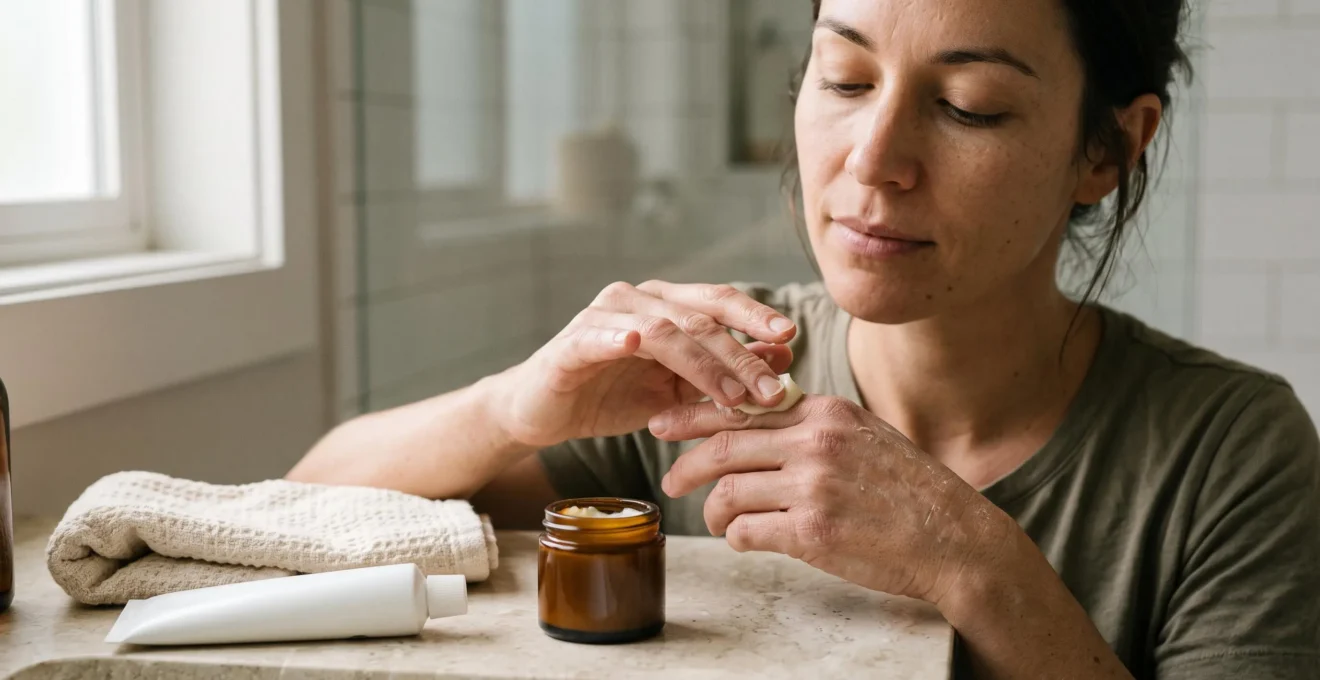
The skin barrier determines two essential aspects of topical skincare: how effectively skin retains moisture and how readily externally applied ingredients can enter its outer layers. For CBD cosmetics, this protective boundary is especially important because cannabidiol interacts with the skin’s lipid-rich structures, making formulation composition a major factor in its distribution.
Healthy skin is not designed to absorb everything placed on its surface. Its outermost layer, the stratum corneum, restricts environmental substances while helping prevent excessive water loss. CBD may accumulate in superficial skin tissue, but its presence in the outer layers does not automatically mean it reaches deeper tissues or the bloodstream.
This distinction changes how CBD balms, lotions and other topical formats should be evaluated. A product’s texture, the condition of the skin barrier and the accompanying ingredients can influence both comfort and delivery. Understanding these variables helps consumers select cosmetics that support dry skin without treating increased penetration as an objective at any cost.
CBD Topicals and the Skin Barrier: Essential Points
- The stratum corneum limits ingredient penetration while protecting skin against excessive moisture loss.
- CBD delivery depends on its physicochemical properties and the formulation vehicle, not simply the concentration printed on the label.
- Gentle cleansing, appropriate moisturisation and barrier recovery are generally more sensible skincare priorities than aggressive exfoliation.
- Why Does Healthy Skin Block Many Ingredients from Penetrating Deeply?
- How Can You Prepare Dry Skin for a CBD Topical Without Over-Exfoliating?
- Healthy or Compromised Skin Barrier: Why Should Topical Product Choice Differ?
- Does More Exfoliation Help CBD Topicals Penetrate Better?
- When Should Skin-Barrier Recovery Come Before Adding a New CBD Cosmetic?
- Why Is the Stratum Corneum Such an Effective Barrier to Topical Ingredients?
- CBD Balm or Lotion: Which Texture Better Protects Very Dry Skin Areas?
- How Does the Stratum Corneum Limit the Penetration of CBD Topicals?
Why Does Healthy Skin Block Many Ingredients from Penetrating Deeply?
Healthy skin blocks many externally applied ingredients because its outermost cells are surrounded by a highly organised lipid matrix that restricts molecular movement. This barrier is selective rather than completely impermeable. Some substances can enter superficial skin layers, but reaching deeper tissue depends on their molecular characteristics, the formulation and the condition of the skin.
The stratum corneum consists of flattened cells called corneocytes embedded within layers of lipids. These lipids include ceramides, cholesterol and free fatty acids. Together, they create a continuous structure that makes passive movement through the skin difficult for many ingredients.
The scientific review of stratum corneum lipids and barrier function describes how the composition and organisation of these lipids support the skin’s ability to resist external substances and excessive water loss.
Ingredient penetration and systemic absorption are not equivalent. A substance may enter the stratum corneum or remain within epidermal tissue without passing into the bloodstream. For CBD cosmetics, detecting cannabidiol in the skin therefore does not demonstrate systemic exposure or effects in deeper tissues.
Importantly, the barrier is not an obstacle that skincare should automatically overcome. It is a biological defence that limits environmental exposure, helps reduce water loss and contributes to the skin’s protection against microorganisms and irritants.
A weakened barrier may permit greater entry of some ingredients, but that change comes with an important trade-off: reduced protection and potentially greater transepidermal water loss. Dryness, sensitivity and irritation can become more prominent even when permeability increases.
The practical objective is not to force every topical ingredient deeper. It is to maintain a functional barrier while selecting a formulation suited to the intended cosmetic use. That begins with preparing dry skin gently.
How Can You Prepare Dry Skin for a CBD Topical Without Over-Exfoliating?
Dry skin can be prepared for a CBD topical by cleansing gently, preserving its natural lipids and supporting hydration before application. Using a moisturising product while skin is still slightly damp can help reduce moisture loss. Aggressive scrubbing or repeated exfoliation is unnecessary and may leave the skin more sensitive to the new formulation.
Hydration influences the physical properties of the stratum corneum. When its outer cells absorb water, the tissue becomes more flexible and some molecules may move through it differently. However, the general relationship between hydration and permeability does not establish that applying a particular CBD cream to damp skin increases CBD delivery.
The clearer benefit is improved moisture management. The American Academy of Dermatology recommendations for relieving dry skin support gentle cleansing and applying moisturiser while the skin is still damp.
A straightforward preparation routine involves several steps:
- Wash the area with lukewarm water and a gentle cleanser suitable for dry or sensitive skin.
- Pat the skin lightly rather than rubbing it with a towel.
- Apply an appropriate moisturising product while the skin retains some surface moisture, following the product instructions.
- Introduce the CBD cosmetic separately, using its recommended application method and avoiding excessive layering of new ingredients.
Applying a new CBD product immediately after strong exfoliating acids, retinoids or vigorous mechanical scrubbing can make irritation harder to interpret. If a reaction occurs, identifying the responsible product becomes difficult.
Watch for signs of excessive exfoliation: tightness after cleansing, unusual flaking, redness or stinging from previously tolerated moisturisers. These symptoms can indicate irritation or disrupted barrier function, although they do not establish a diagnosis.
If skin begins to sting or becomes unusually reactive, simplifying the routine is more appropriate than increasing product application. The next decision depends on whether the barrier is comfortably intact or already compromised.
Healthy or Compromised Skin Barrier: Why Should Topical Product Choice Differ?
Healthy and compromised skin require different topical product priorities because barrier damage can alter both permeability and ingredient tolerance. Intact skin generally restricts external substances effectively, allowing consumers to focus on suitable texture and moisturising performance. Compromised skin may react more readily to fragrances, solvents, preservatives and other formulation components, making simplicity and tolerability more important than CBD concentration.
With a functioning barrier, consumers can compare products according to skin feel, coverage, moisturising ingredients and convenience. A suitable CBD cosmetic should still be assessed as a complete formulation rather than judged solely by its active ingredient.
When the barrier is disrupted, the situation changes. Increased permeability does not selectively benefit cannabidiol: other ingredients in the same product may also interact more readily with sensitive skin.
This is why the excipient list matters as much as the active ingredient. A concentrated CBD preparation containing potentially irritating additives is not necessarily preferable to a simpler product, particularly when skin feels tight, inflamed or uncomfortable.
The comparison below outlines practical differences without assuming that CBD itself repairs a compromised barrier.
| Decision factor | Healthy skin barrier | Compromised skin barrier |
|---|---|---|
| Primary priority | Suitable texture, comfort and cosmetic preferences | Barrier support and reduction of potential irritants |
| Ingredient selection | Evaluate the full formulation and intended use | Prefer simple, fragrance-free moisturising care |
| Permeability | Generally more restricted | May increase unpredictably |
| Application strategy | Follow label instructions and assess tolerance | Delay new cosmetics until irritation has settled |
| Testing | Small-area testing before wider use | Seek professional advice for damaged or inflamed areas |
Applying more product is not a reliable way to compensate for a damaged barrier. Increased permeability may change exposure to multiple ingredients without providing greater cosmetic benefit.
For a new skincare product, small-area home testing is useful once the skin is intact. A reaction-free test on the arm, however, cannot guarantee tolerance on more sensitive or previously damaged areas.
When irritation is active, recovery should guide product decisions. This also challenges a common assumption: removing more of the outer skin layer does not necessarily improve a CBD skincare routine.
Does More Exfoliation Help CBD Topicals Penetrate Better?
Exfoliation can temporarily alter skin permeability by removing some of the outer corneocytes, but there is no well-established evidence that increasing exfoliation improves the performance of CBD cosmetics. Aggressive or repeated exfoliation can also weaken barrier function, increase moisture loss and provoke irritation. Greater ingredient penetration is therefore not automatically a beneficial skincare outcome.
The outer skin cells removed during exfoliation are part of the same protective structure that limits water escape. Removing excessive amounts can interfere with the organisation of the stratum corneum and expose the skin to additional irritation.
This creates a trade-off. A disruption that makes the barrier more permeable may also make it less effective at retaining moisture. For someone applying a CBD cosmetic because their skin feels dry, that trade-off can work against the original skincare objective.
Permeability is not the same as effectiveness. Even if an exfoliating method increased the amount of CBD entering superficial tissue, that result would not establish improved moisturisation, better tolerance or a clinically meaningful benefit.
Gentle, occasional exfoliation may be appropriate for some people with intact skin, particularly when visible surface buildup is a cosmetic concern. It should not be treated as a routine prerequisite for CBD application.
Furthermore, different exfoliation methods are not interchangeable. A mild exfoliating product used occasionally and aggressive scrubbing applied repeatedly can produce very different effects on skin comfort.
The available CBD vehicle research in the supplied evidence focuses on formulation-dependent retention and permeation, not the effectiveness or safety of deliberately exfoliating skin to increase CBD entry.
For dry or sensitive skin, gentle cleansing and moisturising products generally provide a more appropriate starting point than physically or chemically stripping the surface.
When skin is already irritated by exfoliation, the sensible next step is to restore comfort before introducing another cosmetic ingredient. This makes product timing just as relevant as product composition.
When Should Skin-Barrier Recovery Come Before Adding a New CBD Cosmetic?
Skin-barrier recovery should come before introducing a CBD cosmetic when skin is stinging, unusually tight, visibly irritated or reacting to products it previously tolerated. Introducing a multi-ingredient formulation during this period may worsen discomfort and make reactions difficult to interpret. A simpler routine should restore reasonable skin comfort before a new product is tested.
When skin is already reactive, adding a cosmetic introduces several variables simultaneously: CBD, its carrier, preservatives and potentially fragrance or other ingredients. If the area becomes uncomfortable, the cause may be difficult to identify.
A practical recovery-focused routine starts with gentle cleansing and a straightforward fragrance-free moisturiser. Avoid unnecessary exfoliants and newly introduced active products while the skin remains irritated.
Potential signs of improved tolerance include comfortable cleansing, absence of stinging with a basic moisturiser, less visible flaking and reduced feelings of tightness. These observations are useful, but there is no universal number of days after which every compromised barrier is fully recovered.
Once skin is intact and comfortable, introduce the CBD cosmetic independently rather than combining it with several unfamiliar products.
The American Academy of Dermatology skin-care product testing instructions recommend applying a new product to a small area twice daily for seven to ten days, using the normal amount and contact duration. This is a general cosmetic tolerance check, not a CBD-specific test or a substitute for medical allergy testing.
Stop using the product if redness, itching, swelling or another concerning reaction develops. Do not deliberately test a new CBD cosmetic on open, cracked or actively inflamed skin. Persistent or severe symptoms warrant professional assessment.
Five Checks Before Introducing a CBD Cosmetic
- Assess current skin comfort: note whether cleansing or basic moisturiser application causes stinging, tightness or redness. Record any symptoms before introducing the product.
- Simplify the routine: identify the gentle cleanser and basic moisturiser being retained, and list any exfoliants or new actives temporarily excluded.
- Review the CBD formulation: inspect the ingredient label and make a short list of fragrances or other components previously associated with irritation.
- Test on a small area of intact skin: follow the general twice-daily, seven-to-ten-day product-testing guidance and record the application dates and any reactions.
- Introduce one product at a time: document when the CBD cosmetic enters the routine and monitor whether comfort or visible skin changes occur without simultaneously adding other new products.
Once the barrier is stable, understanding its microscopic structure provides a clearer explanation for why CBD and other cosmetic ingredients behave differently after application.
Why Is the Stratum Corneum Such an Effective Barrier to Topical Ingredients?
The stratum corneum is an effective permeability barrier because densely packed corneocytes are surrounded by organised lipid layers that restrict the movement of many external molecules. Although this outer layer is relatively thin, its structured arrangement creates a substantial obstacle to passive penetration. The same architecture also helps prevent excessive water loss from the body.
Its organisation is commonly described using a brick-and-mortar model. The corneocytes act as the bricks, while the intercellular lipid matrix forms the mortar that fills the spaces between them.
This comparison is useful because many molecules attempting to cross intact skin must negotiate the lipid-rich spaces separating the cells. The organisation of those lipids is therefore at least as important as the thickness of the outer layer.
The matrix contains carefully arranged lipid components, including ceramides, cholesterol and free fatty acids. Their composition and organisation influence both the ability of external substances to cross the skin and the movement of water in the opposite direction.
Several physicochemical properties affect passive penetration:
- Molecular size: smaller molecules generally encounter fewer diffusion constraints than larger molecules, although size is not the only determinant.
- Lipophilicity: affinity for lipids can support entry into lipid-rich regions but does not guarantee movement into more water-rich tissue.
- Electrical charge: ionisation and charge can influence how readily a substance partitions into and moves through the barrier.
- Formulation composition: the carrier can affect ingredient solubility, release, partitioning and availability at the skin surface.
CBD illustrates why these variables must be considered together. It is strongly lipophilic, which favours interactions with skin lipids, but also creates challenges when the molecule must move beyond the stratum corneum into more hydrophilic surroundings.
Because the barrier regulates both external entry and internal water loss, protection and hydration are linked functions. An alteration in lipid organisation can affect multiple aspects of skin performance rather than simply increasing cosmetic ingredient delivery.
This structure also explains an everyday product-choice dilemma: a thicker balm may support the skin’s moisture barrier differently from a lightweight lotion, even when both contain the same labelled CBD concentration.
CBD Balm or Lotion: Which Texture Better Protects Very Dry Skin Areas?
A rich CBD balm is generally better suited to very dry, localised areas when its waxes and occlusive ingredients help reduce moisture loss. A lotion is often more convenient for widespread dryness because it spreads easily and feels lighter. Neither format automatically delivers more CBD into the skin: moisturising performance and cannabidiol penetration depend on the complete formulation.
Balms frequently contain higher proportions of oils, waxes and other ingredients that leave a persistent surface film. This can be useful on dry hands, elbows and heels, where reducing further moisture loss is a priority.
Lotions typically contain an aqueous phase and can incorporate humectants such as glycerin. Their lighter texture makes them practical for larger areas and parts of the body where a dense film feels uncomfortable.
The distinction is not absolute. A carefully formulated lotion can provide meaningful moisturisation, while a balm’s protective performance depends on its ingredients rather than its texture alone.
When choosing a product for dry skin, consider the application area, the product’s fragrance content, how often the area is washed and whether the texture is comfortable enough for consistent use.
| Feature | CBD balm | CBD lotion |
|---|---|---|
| Typical texture | Dense, rich, often wax-based | Lighter, more fluid emulsion |
| Moisture protection | Often provides a more persistent occlusive film | Can combine water, humectants and emollients |
| Practical application | Small, especially dry areas | Broad body areas and areas with hair |
| CBD availability | Depends on its release from the formulation | Depends on its release from the formulation |
| Potential limitation | May feel greasy or transfer onto clothing | May require a richer companion moisturiser for very dry areas |
For intact but very dry skin, it can be practical to use a lighter moisturising product over large areas and reserve a richer balm for specific zones that need additional occlusion. Open or actively inflamed cracks warrant more caution than ordinary dryness.
From a delivery perspective, a balm’s persistent film may influence the duration of product contact and the hydration of the stratum corneum. However, longer contact does not necessarily mean a greater amount of CBD reaches living epidermal layers.
A comparative laboratory study of CBD vehicles found that a specific hydrophilic gel produced greater CBD retention and permeation than the lipophilic ointment tested. This illustrates why a thick texture is not inherently superior for cannabinoid delivery.
Similarly, two products displaying the same CBD percentage can behave differently. CBD concentration describes how much of the ingredient is present in the formula, not how much is released, retained in the epidermis or transported through the skin.
Choosing the right texture supports a more consistent skincare routine, but understanding where CBD actually goes after application requires a closer look at its interaction with the stratum corneum.
What to Remember Before Choosing a CBD Topical
- A product that protects against moisture loss is not necessarily the one that transports the most CBD into epidermal tissue.
- CBD concentration alone cannot predict penetration; the formulation vehicle can substantially change skin retention.
- Skin comfort, barrier condition and tolerability should guide cosmetic selection before pursuing greater ingredient delivery.
How Does the Stratum Corneum Limit the Penetration of CBD Topicals?
The stratum corneum limits CBD topical penetration by favouring cannabidiol’s interaction with its lipid-rich structures while restricting further movement into deeper, more water-rich tissue. CBD can therefore remain within superficial skin layers rather than passing freely through the entire skin barrier. Its distribution depends strongly on the carrier formulation, so surface application does not establish deep-tissue delivery or systemic absorption.
Cannabidiol is a lipophilic molecule with a molecular weight of approximately 314.5 g/mol. Its strong affinity for lipids can promote partitioning into the stratum corneum, but entry into this outer layer is only one stage of the permeation process.
For CBD to travel further, it must move through regions with different physicochemical properties. Strong retention within lipid-rich tissue may make movement into more hydrophilic environments less favourable.
This is why skin retention and transdermal delivery must be distinguished. Retention describes the amount of CBD remaining in skin tissue under the measurement conditions. Permeation describes its passage through the tested barrier. Neither measurement alone proves a therapeutic effect or a particular systemic exposure in consumers.
An experimental study of CBD formulation vehicles and skin permeation examined how different carriers affected cannabidiol delivery through human epidermal tissue using an in vitro model.
Experimental Evidence: CBD Gel Versus Lipophilic Ointment
Researchers compared different CBD-containing solvent systems and semisolid formulations using human skin permeation experiments. Their analysis included a hydrophilic gel and a lipophilic ointment.
After 24 hours, measured CBD skin retention was 19.00 ± 5.31 micrograms per square centimetre for the tested gel, compared with 8.30 ± 1.96 micrograms per square centimetre for the tested ointment. The gel also exhibited greater permeation under the experimental conditions. These findings demonstrate vehicle-dependent delivery, not superior clinical efficacy or a universal advantage of gels over balms.
The result is important because it shows that the amount of CBD placed in a formulation does not independently determine how much reaches the skin. Carrier composition, ingredient solubility, thermodynamic activity and interactions with the barrier all influence the outcome.
Lipid-based carriers, solvents, penetration-enhancing ingredients and occlusive conditions are among the formulation variables investigated in topical delivery research. Each can change the way CBD interacts with the skin, although results from one experimental vehicle cannot be automatically transferred to commercial cosmetics.
The same caution applies to claims about topical effects. CBD detected in the epidermis is not evidence that a cosmetic reaches underlying muscles, joints or the bloodstream in meaningful quantities. Surface moisturisation, local epidermal exposure and systemic drug delivery are distinct objectives requiring different forms of evidence.
For consumers, the most useful question is therefore not simply how to maximise CBD absorption. It is whether the complete cosmetic formulation suits the skin’s present condition, supports its moisturising needs and can be used comfortably without unnecessary irritation.
Before choosing a CBD topical, assess skin comfort, compare the full ingredient lists and select a suitable texture for the application area. Introduce the product gradually on intact skin and evaluate tolerability rather than assuming a higher CBD concentration or stronger penetration will produce better cosmetic results.
Does CBD need to enter the bloodstream to be present in the skin?
No. CBD may be retained within the stratum corneum or other epidermal tissue without reaching the bloodstream in meaningful amounts. Laboratory measurements of skin retention do not demonstrate systemic absorption or establish clinical effectiveness.
Can a higher CBD concentration compensate for a poorly designed topical formulation?
Not necessarily. The formulation vehicle influences CBD solubility, release, partitioning and skin permeation. A higher labelled concentration does not guarantee greater epidermal delivery or better cosmetic performance. The complete formulation must be considered.
Does applying a CBD topical to damp skin improve absorption?
Hydration can alter stratum corneum permeability, but the supplied evidence does not establish that applying CBD cosmetics immediately to damp skin increases cannabidiol penetration. Applying moisturiser while skin is still damp is primarily supported as a way to help manage dryness and moisture loss.
Are fragrance-free CBD cosmetics automatically suitable for sensitive skin?
No. Avoiding fragrance can reduce exposure to one category of potential irritants, but preservatives, solvents, botanical ingredients and other formulation components may still cause reactions. Testing a new cosmetic on a small area of intact skin can help identify intolerance, although it cannot guarantee that every body area will respond identically.
Can CBD skincare products replace treatments for a damaged skin barrier?
CBD cosmetics should not be assumed to treat an underlying dermatological condition or replace established care. Gentle cleansing, suitable moisturisers and avoidance of irritants remain central to routine dry-skin management. Persistent cracking, inflammation, severe irritation or worsening symptoms should be assessed by a healthcare professional.