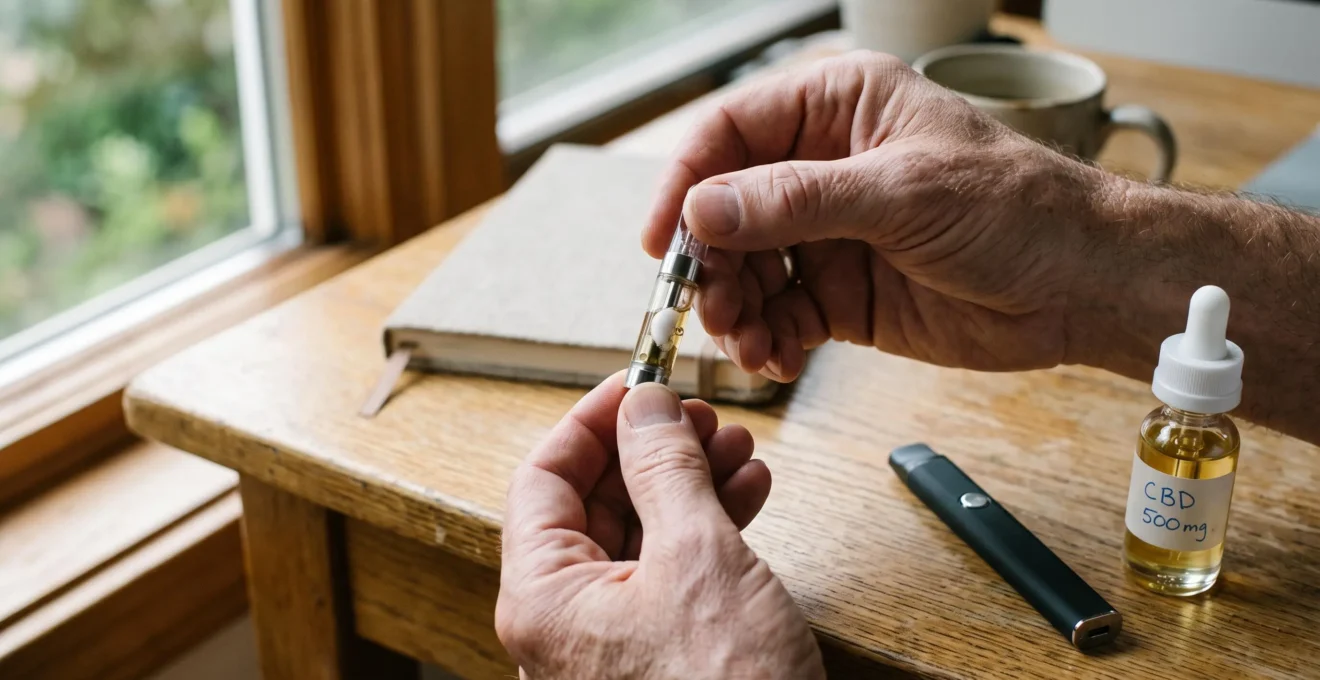
Two cartridges filled with the same CBD vape liquid can behave differently. One may produce relatively consistent aerosol, while another delivers irregular output, develops an unpleasant taste or leaks into the device. These differences often originate in cartridge construction rather than CBD concentration alone.
A specialised cartridge combines a liquid reservoir, feeding openings, a heating element and an airflow pathway. Each component influences how liquid reaches the heated surface, how consistently aerosol forms and whether the cartridge operates within the limits of its battery. Liquid viscosity, coil materials and electrical compatibility must therefore be considered together.
For adults comparing CBD vaping hardware, the useful question is not simply whether a cartridge accepts a particular liquid. It is whether the complete liquid–cartridge–battery combination is supported by the manufacturer’s specifications and remains free from signs of malfunction.
Consistent aerosol production should not be confused with predictable CBD absorption or proof of safety. Heating can change the chemical composition of cannabinoid-containing liquids, and no cartridge design eliminates the health uncertainties associated with inhaling vaping aerosols.
CBD cartridge performance at a glance
- Reservoir feeding, coil construction and airflow jointly determine how consistently a cartridge generates aerosol.
- Physical connection, operating power and liquid formulation must all match the manufacturer’s compatibility requirements.
- Persistent burnt taste, leakage, structural damage or abnormal heating are reasons to stop using the affected equipment rather than compensate with more power.
- Why Can Cartridge Design Change How Consistently a CBD Vape Liquid Performs?
- How Can You Check Whether a CBD Cartridge Matches Your Vape Device Before Use?
- Ceramic or Standard Coil Cartridge: Which Better Handles Thicker CBD Liquids?
- Which Cartridge Faults Mean You Should Stop Using a CBD Vape Device?
- When Should You Replace a CBD Vape Cartridge Instead of Trying to Reuse It?
- Why Can a CBD Vape Liquid Be Too Thick or Too Thin for Some Devices?
- When Should You Check the Coil or Cartridge Before Changing Vape Temperature Again?
- What Makes a CBD Vape Liquid Compatible with a Particular Device?
Why Can Cartridge Design Change How Consistently a CBD Vape Liquid Performs?
Cartridge design affects CBD vape liquid performance because the reservoir must supply liquid to the heating element at a rate that matches evaporation, while airflow carries the resulting aerosol away. Differences in feeding openings, wick materials, coil geometry and battery control can change aerosol consistency even when the liquid formulation remains identical.
The reservoir is more than a container. Its internal shape, liquid capacity and feeding-port placement influence how readily e-liquid reaches the heating assembly. A sufficiently filled reservoir does not guarantee that the wick remains saturated: the liquid must still move through the feeding system at an appropriate rate.
Three cartridge subsystems deserve separate attention:
- Reservoir and liquid supply: Feeding-port dimensions, wick contact and liquid viscosity influence replenishment. Restricted supply can produce dry heating conditions, whereas excessive flow may contribute to flooding or leakage.
- Heating element: Coil material, resistance, geometry and contact with the wick influence heating behaviour and the rate at which supplied liquid evaporates.
- Airflow pathway: Air-channel design and resistance influence aerosol transport, cooling and the pressure conditions around the liquid-feeding system.
When liquid evaporates faster than the wick can replenish it, the heating surface may become insufficiently wetted. The result can be reduced aerosol consistency and overheating. Excessive liquid delivery, by contrast, may interfere with normal aerosol generation and contribute to gurgling or leakage.
Experimental evidence supports the importance of this balance. The Scientific Reports research on ceramic-wick e-cigarettes examined a ceramic-wick device using nicotine-containing formulations. Its discussion identifies efficient liquid delivery to the heating coil as an important condition for aerosol production.
Those findings explain the feeding mechanism but do not establish performance thresholds for CBD cartridges or demonstrate that ceramic systems are universally superior.
Heating control introduces another difference. Actual coil temperature depends on the device and its operating conditions, not simply the voltage printed on the battery. Changes in temperature and airflow can affect aerosol formation, although the precise resulting particle characteristics cannot be assumed without measurements for the relevant device and formulation.
Restricted airflow or weak aerosol may encourage users to inhale more forcefully or use the cartridge more frequently. Such compensation does not establish better CBD delivery and can increase liquid consumption without correcting an underlying hardware problem.
Because these systems interact, the next consideration is whether the cartridge has been designed to operate with the specific battery and liquid selected.
How Can You Check Whether a CBD Cartridge Matches Your Vape Device Before Use?
Check cartridge compatibility by confirming the physical connector, the manufacturer’s electrical operating specifications and the permitted liquid formulation before use. Then inspect the cartridge for damage, contamination and sealing problems. A matching connector alone does not establish compatibility, and an unknown operating range should not be treated as permission to experiment with battery settings.
Begin with the connection type. Many cartridges use a 510-threaded connection, while others rely on proprietary magnetic contacts or pod fittings. Even cartridges sharing a nominal 510 connector may differ in dimensions, contact arrangement or battery compatibility.
Next, compare the cartridge’s stated resistance, voltage or power requirements with the battery’s supported output. Some batteries offer variable-voltage operation or preheating functions, but these features are not universally appropriate for every cartridge.
A useful caution comes from the PLOS ONE study of cannabis vaporizer coil temperatures. Researchers compared three cannabis-extract vaporization systems and found substantially different coil temperatures across device configurations.
Laboratory evidence: voltage does not determine coil temperature on its own
In a 2022 thermography experiment, a variable-voltage system reached a mean coil temperature of 543 ± 95.9 °C at 4.0 V, while a fixed-voltage system reached 450 ± 60.8 °C at 3.2 V.
The researchers tested three configurations with a THC-dominant cannabis extract, not a CBD e-liquid. The study was funded and conducted by PAX Labs, and its authors included company employees. The measurements demonstrate configuration-dependent heating, not universally safe voltage settings or CBD delivery efficiency.
Before connecting a cartridge, examine the seals, housing, threads and electrical contact for obvious defects. Check the manufacturer’s filling instructions and whether the cartridge is designed to be refilled at all. If filling is permitted, follow the specified procedure and allow the wick to saturate as directed. Do not use a cartridge containing visible foreign material or suspected manufacturing residue.
For compatible equipment, any initial operating check should follow the manufacturer’s specified starting procedure. Some manufacturers recommend beginning at the lower end of an approved output range, but this is not a universal instruction. Weak aerosol or an unpleasant taste is a reason to stop and investigate, not automatically to increase voltage.
Five checks to complete before using a CBD cartridge
- Identify the connection standard and record the cartridge and battery model numbers. Deliverable: a confirmed manufacturer-supported physical pairing.
- Compare the cartridge’s rated electrical requirements with the battery’s available settings. Deliverable: a documented compatible operating range, or a decision not to connect the components.
- Review the liquid formulation and the cartridge’s approved filling specifications. Deliverable: confirmation that the liquid type and filling method are permitted.
- Inspect the housing, seals, threads and contacts without disassembling sealed parts. Deliverable: a visible-condition check showing no cracks, leakage, contamination or contact damage.
- Follow the manufacturer’s priming and initial-operation instructions. Deliverable: confirmation that the prescribed preparation has been completed, with use stopped if abnormal heating, leakage or taste occurs.
Once the connection and operating specifications are confirmed, the next distinction is how efficiently different heating assemblies accommodate the liquid’s physical properties.
Ceramic or Standard Coil Cartridge: Which Better Handles Thicker CBD Liquids?
A ceramic-wick cartridge may accommodate certain thicker CBD formulations when its pore structure and feeding channels are designed for their viscosity. However, ceramic construction does not automatically outperform a conventional coil with a cotton or silica wick. The appropriate choice depends on the specific liquid, liquid-supply geometry, heating configuration and manufacturer’s supported formulations.
Conventional cartridges often use a metal heating coil paired with a separate absorbent wick. Liquid travels through the wick toward the heated surface. If a formulation moves through that material too slowly, the heating element can outpace replenishment.
Ceramic-based assemblies may instead use a microporous material to transport liquid toward or around the heating element. Their thermal and capillary characteristics differ from those of conventional wicks, but ceramic pore dimensions, construction and integration vary between products.
Neither design can be evaluated independently of the liquid it is intended to handle.
The comparison below describes design considerations rather than proven universal advantages.
| Comparison criterion | Ceramic-wick cartridge | Conventional wick-and-coil cartridge |
|---|---|---|
| Liquid transport | Through a porous ceramic structure | Through an absorbent wick, commonly cotton or silica |
| Thicker formulations | May be suitable when pore structure and feed openings are designed for the formulation | May be suitable when wick and feeding geometry provide adequate replenishment |
| Heating behaviour | Depends on ceramic geometry, heater integration and electrical control | Depends on coil geometry, wick saturation and electrical control |
| Potential failure | Restricted replenishment, deposits or inappropriate operating conditions | Insufficient wick saturation, deposits or inappropriate operating conditions |
| Selection priority | Verified compatibility with the intended liquid and battery | Verified compatibility with the intended liquid and battery |
The Scientific Reports experiment discussed earlier shows that ceramic-wick technology can support aerosol production under its tested conditions. However, the investigated device used nicotine formulations. Those results do not prove superior performance with high-viscosity CBD distillates.
Likewise, claims that ceramic cartridges always require longer preheating, cost more or tolerate higher temperatures cannot be applied to every design without product-specific evidence.
Operating power also matters. Increasing electrical output when liquid replenishment is inadequate may worsen heating conditions and contribute to residue formation or thermal degradation. A different coil material is not a substitute for compatible power control.
Whichever construction is selected, unexpected flavour changes, leakage or abnormal heating should be interpreted as potential faults, not merely differences in cartridge style.
Which Cartridge Faults Mean You Should Stop Using a CBD Vape Device?
Stop using a CBD vape device when the cartridge leaks into electrical components, its housing is cracked, the battery overheats, or persistent burnt taste, abnormal odour or unusual operation suggests a fault. These symptoms can indicate compromised sealing, electrical damage, inadequate liquid supply or unwanted chemical changes. Do not attempt to overcome them by increasing power.
Some irregularities, such as condensation near the mouthpiece or an intermittent connection, can have relatively simple explanations. They should still be investigated only through manufacturer-approved procedures, with the device powered off and disconnected where applicable.
Other symptoms require a more decisive response:
- Liquid around electrical contacts or inside the battery compartment: Stop using the device. Liquid intrusion may compromise electrical components, and continued operation is inappropriate until the affected equipment has been assessed according to the manufacturer’s guidance.
- Cracked or deformed cartridge housing: Stop using the cartridge. Structural damage can compromise seals, containment and mechanical fit.
- Persistent burnt taste: Discontinue use rather than attempting to burn away residue. Insufficient liquid supply, overheated wick material or deposits may be involved.
- Excessive spitting, unusual hissing or gurgling: Stop and check the manufacturer’s guidance. These symptoms may indicate flooding, unstable liquid delivery or another malfunction.
- Unexpected liquid discolouration, foreign material or abnormal smell: Do not continue using the affected liquid or cartridge until its condition has been established.
- Battery overheating, swelling, smoke or ignition: Stop using the equipment immediately and follow appropriate battery and fire-safety precautions. Do not recharge or reconnect a suspect battery.
The FDA information on reporting vaping-product problems identifies leaking liquid chambers, damaged products, battery overheating and abnormal smells or tastes among reportable safety or quality concerns.
The FDA page is a reporting resource within its applicable regulatory scope, not a CBD-specific troubleshooting standard. Its warning categories nevertheless provide relevant reasons to treat obvious equipment defects seriously.
A small amount of condensation outside the electrical compartment is not necessarily equivalent to a cracked or leaking reservoir. Similarly, a connection problem may result from an incorrectly seated compatible cartridge. Neither observation justifies forcing fittings, opening sealed hardware or continuing to use components whose safety is uncertain.
Manufacturer instructions should determine whether simple exterior inspection or maintenance is permitted. Any suspected electrical damage requires a more conservative approach.
Liquid intrusion may also lead to device damage and associated costs. Whether a specific fault affects warranty coverage depends on the actual warranty terms; leakage alone does not establish that coverage is automatically invalidated.
When a problem persists after permitted basic checks, the relevant question becomes whether the cartridge has reached the end of its useful service life.
When Should You Replace a CBD Vape Cartridge Instead of Trying to Reuse It?
Replace a CBD vape cartridge when it is damaged, persistently leaks, develops a lasting burnt or abnormal taste, or no longer performs normally despite manufacturer-approved checks. A sealed single-use cartridge should not be forcibly opened or refilled. For refillable models, replacement should follow the manufacturer’s instructions and observed component condition rather than an assumed universal lifespan.
Cartridge wear is influenced by how often the heating element operates, the formulation used, residue accumulation and the conditions of operation. These factors vary substantially between products, so a calendar-based replacement rule cannot reliably describe every cartridge.
Observable signs that warrant assessment include:
- Persistently weaker aerosol output despite confirmed compatibility and normal battery operation.
- An enduring harsh, dull or burnt taste that was not present during normal operation.
- Residue accumulation or unusual changes in the remaining liquid’s appearance.
- Recurring gurgling, dry heating symptoms or unstable operation.
- Deteriorated seals, visible cracks or repeated leakage.
None of these signs should be interpreted in isolation as proof of a particular chemical reaction or a precise degree of coil wear. The initial response is to stop and determine whether the manufacturer allows a relevant check or component replacement.
Residues can accumulate on heating surfaces during repeated operation. Wick materials and seals can also deteriorate. Continued use under poor feeding conditions may result in increasingly inconsistent aerosol production.
The distinction between sealed and refillable cartridges is especially important. A cartridge manufactured for single use may not have a removable closure or serviceable wick. Attempting to pry it open can damage the reservoir, seals or electrical assembly.
Purpose-built refillable systems allow maintenance only within their specified instructions. Refillability does not mean indefinite reuse, nor does it guarantee that every liquid formulation is suitable.
Consider a hypothetical adult user choosing between continuing with a worn cartridge and obtaining an appropriate replacement. If the cartridge repeatedly produces an unpleasant taste and wastes liquid through leakage, retaining it may offer little financial benefit. That reasoning does not establish a universal replacement threshold, but it illustrates why purchase cost alone is a poor maintenance criterion.
Before deciding that a cartridge has worn out, however, it is worth considering whether the liquid was physically compatible with its feeding system in the first place.
Why Can a CBD Vape Liquid Be Too Thick or Too Thin for Some Devices?
CBD vape liquid can be too thick when its viscosity prevents adequate movement through a cartridge’s feed openings and wick. It can be too thin when the cartridge’s seals and feeding design cannot control its flow. Both conditions can disrupt aerosol generation, but the effect depends on the complete formulation and cartridge design rather than CBD concentration alone.
Viscosity describes a fluid’s resistance to flow. Different CBD-containing formulations can have substantially different physical properties because their carriers, diluents and other ingredients differ.
A CBD-containing distillate is not necessarily interchangeable with a formulated CBD e-liquid. A cartridge intended for one category may not support the other, even if both contain the same cannabinoid.
When a liquid is excessively viscous for its feeding system, replenishment may be inadequate. The reservoir may visibly contain liquid while the heated surface receives too little. The result can be inconsistent aerosol output or dry heating conditions.
When a liquid is too fluid for the cartridge’s containment and feeding geometry, it may migrate through openings or seals more readily than intended. Flooding, gurgling and leakage can follow, although these symptoms may also arise from mechanical defects.
Temperature adds another variable. Many liquids become less viscous as their temperature increases, but that physical relationship does not justify using uncontrolled heating to modify a CBD formulation. Excessive thermal exposure can also affect chemical stability, and the influence depends on the formulation and conditions.
Some compatible devices include manufacturer-defined preheating functions. Their presence does not establish that preheating is suitable for every cartridge or liquid.
Visual observations, such as slow movement in a dropper or liquid collecting near a feeding opening, may suggest a flow issue. They cannot independently determine viscosity, formulation quality or device compatibility.
A more reliable approach is to identify the liquid category and carrier composition from the product documentation, then compare those details with the cartridge manufacturer’s supported formulations.
If the combination is unsupported, increasing power is not a solution. Select hardware explicitly specified for that liquid, or use a formulation approved for the existing system. Avoid adding unapproved thinning agents or altering the liquid.
Once that distinction is understood, it becomes easier to diagnose weak output without repeatedly changing the device’s electrical settings.
When Should You Check the Coil or Cartridge Before Changing Vape Temperature Again?
Check the coil and cartridge before changing temperature or voltage whenever aerosol output weakens, taste changes, heating becomes irregular or liquid supply appears inconsistent. These symptoms can result from residue, damaged components, inadequate saturation or an incompatible formulation. Increasing power without identifying the cause may worsen overheating and chemical degradation rather than restore normal operation.
A common diagnostic mistake is to assume that weaker output means the device needs more electrical power. That may overlook restricted liquid delivery or deteriorated heating components.
The potential sequence is straightforward: deposits or feeding problems reduce normal operation; the user increases power to compensate; the increased heating demand places additional pressure on an already inadequate liquid-supply system.
Continuing this pattern can worsen the conditions responsible for inconsistent aerosol production. It also makes subsequent diagnosis more difficult because the user has changed the operating conditions while the original fault remains unresolved.
Three observations are particularly useful before considering any permitted setting adjustment:
- A lingering burnt or abnormal taste: Stop use and inspect for an unsuitable liquid, damaged cartridge or deteriorated heating assembly. Do not attempt to clear the taste through repeated heating.
- Increasingly inconsistent aerosol between uses: Check whether the liquid and cartridge are manufacturer-approved partners and whether the cartridge shows damage or other signs of restricted feeding.
- Condensation or liquid around the base: Distinguish ordinary external condensation from suspected reservoir leakage. If liquid has reached electrical contacts, discontinue use.
Laboratory research reinforces the importance of avoiding unsupported power adjustments. A 2025 study titled Thermal transformation of CBD, CBDA, and Δ9-THC during e-cigarette vaping: Identification of conversion products by GC-MS investigated cannabinoid transformations at experimental coil-power settings between 45 W and 105 W.
45–105 W
The experimental power range investigated in the 2025 cannabinoid thermal-transformation study. These are laboratory conditions, not recommended settings for CBD cartridges. Most identified thermal products increased with power in the tested range, although individual compounds behaved differently.
Journal of Chromatography A, 2025; DOI: 10.1016/j.chroma.2025.465909, indexed in PubMed.
The researchers identified cannabinoid transformation products using gas chromatography-mass spectrometry. The results demonstrate that heating conditions can affect chemical composition. They do not establish a universally safe cartridge voltage, a recommended operating temperature or the health outcome of a particular exposure.
If the cartridge is intact, correctly paired with the battery and approved for the formulation, operating settings should still remain within the manufacturer’s stated range. A lower approved setting may change the heating conditions, but it cannot repair a worn wick, leaking seal or unsuitable feeding design.
With fault diagnosis separated from ordinary operating adjustments, the final step is to evaluate compatibility as a property of the entire assembled system.
Key takeaways before selecting a CBD vaping setup
- Confirm physical and electrical compatibility independently; a fitting connector does not prove an appropriate operating range.
- Choose a liquid and cartridge that the manufacturer identifies as compatible rather than relying on CBD concentration or coil material alone.
- Reject damaged or unsupported combinations instead of compensating through increased power, improvised refilling or liquid modification.
What Makes a CBD Vape Liquid Compatible with a Particular Device?
CBD vape liquid compatibility depends on the combined characteristics of the liquid, cartridge and battery. The liquid must flow appropriately through the feeding system, the heating element must operate within its supported electrical range, the cartridge must connect correctly, and the formulation must be approved for that hardware. No single feature establishes compatibility on its own.
This means that compatibility should be evaluated as a relationship between components, not as a property of the CBD e-liquid bottle in isolation.
A product described as suitable for vaping may still be inappropriate for a particular cartridge. Similarly, a battery marketed as compatible with 510 cartridges is not necessarily compatible with every cartridge that uses that connection.
The four principal decision factors can be organised into one practical framework.
| Factor | What to verify | Why it matters |
|---|---|---|
| Liquid viscosity and feeding | Whether the manufacturer supports the formulation type and its carrier composition | Inadequate or excessive liquid delivery can disrupt normal operation |
| Electrical operating range | Cartridge resistance and specified voltage or power compatibility with the battery | Electrical mismatch can produce inappropriate heating conditions |
| Coil and wick design | Whether the heating assembly is intended for the liquid category | Material and geometry influence liquid replenishment and heating behaviour |
| Physical connection | Compatible connector, contact arrangement and mechanical fit | Matching components must connect securely without forcing or modifying parts |
Liquid composition introduces an additional layer of complexity. Two products with equal stated CBD concentrations may use different carriers or additives. Those differences can affect flow behaviour, residue formation and thermal response.
Consequently, CBD concentration alone cannot predict how a liquid will behave in a cartridge. A higher concentration does not automatically imply greater viscosity, nor does a lower concentration guarantee compatibility with conventional wick systems.
The same caution applies to advertised coil categories. The words « ceramic », « standard coil » or « 510 compatible » describe selected hardware properties; they do not provide complete evidence that a particular liquid–device combination has been tested.
Manufacturer documentation should therefore be considered in a clear sequence:
- Identify the exact liquid formulation, including its intended application and carrier information where available.
- Check that the cartridge manufacturer explicitly supports that formulation category.
- Confirm the cartridge’s physical connection and electrical requirements against the battery specification.
- Review any manufacturer restrictions concerning filling, priming, preheating, maintenance and replacement.
- Do not operate the combination when essential compatibility information is missing or contradictory.
This approach reduces reliance on trial and error. It also makes it easier to identify which component is responsible when a problem appears, without treating the adjustment of electrical power as the default troubleshooting method.
Importantly, mechanical compatibility and consistent aerosol generation do not establish safety, clinical effectiveness or predictable CBD absorption. The available laboratory findings concern particular devices and experimental formulations, and cannot be transferred indiscriminately to all CBD vaping products.
The most useful next step is to compare the exact product specifications for the proposed liquid, cartridge and battery, and avoid the combination if those specifications cannot establish compatibility. A well-matched system may reduce avoidable hardware problems, but it cannot remove the health risks or uncertainties associated with CBD aerosol inhalation.
Does a 510-thread CBD cartridge work with every 510 battery?
No. A shared 510 connection does not guarantee matching contact geometry, resistance requirements or electrical operating conditions. Both the cartridge and battery manufacturers’ specifications must support the pairing. Unknown compatibility should not be resolved by forcing the connection or experimenting with output settings.
Can a CBD vape cartridge be used with ordinary nicotine e-liquid?
Not automatically. Cartridges designed for different liquid categories may have different feeding and heating characteristics. Even when the physical connection is identical, the intended formulation and manufacturer-approved operating conditions must match. A product’s appearance does not establish interchangeability.
Does a more expensive ceramic cartridge guarantee better CBD delivery?
No. Cartridge price and ceramic construction do not independently establish better CBD delivery or absorption. Relevant outcomes depend on liquid supply, heating conditions, airflow and the particular formulation. The available ceramic-wick evidence does not establish universal superiority for CBD liquids.
Can cartridge performance reveal how much CBD a person inhales?
Not reliably. Visible aerosol output is not a direct measurement of CBD content or absorbed dose. The amount of CBD delivered and subsequently absorbed depends on factors not established by appearance, taste or cartridge construction alone. Laboratory aerosol measurements and exposure studies would be needed for more specific conclusions.
Is it safe to add a thinning agent to make CBD liquid work in a cartridge?
Do not add unapproved substances to a CBD vape formulation. A thinner liquid is not necessarily safer or more compatible, and additives may behave differently when heated and inhaled. Use only formulations expressly supported by the device manufacturer; if compatibility cannot be established, do not use that combination.