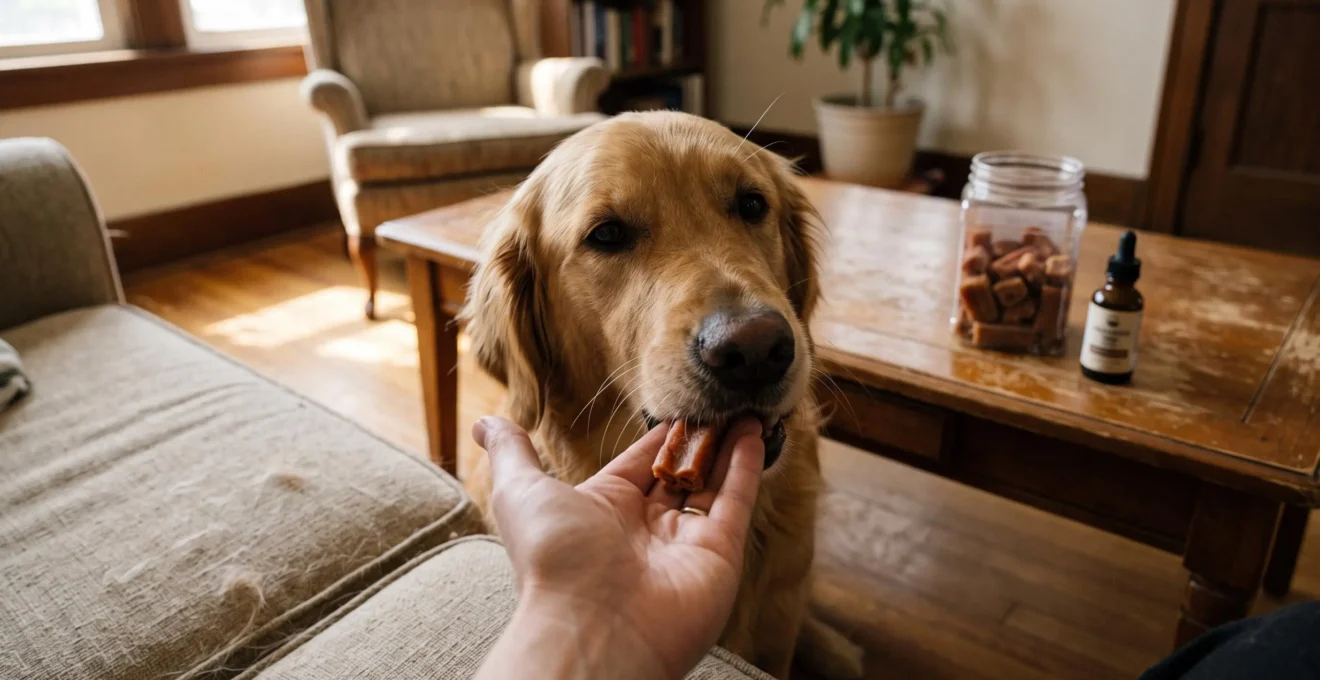
A dog that turns away from a dropper or spits out a plain supplement can make administration difficult. Bacon-flavoured cannabidiol (CBD) chews offer a potentially simpler approach: they combine CBD with a treat-like format and a savoury aroma that some dogs may willingly accept.
The main advantage is practical rather than therapeutic. A dog that voluntarily eats a chew may be easier to manage than one that needs to be restrained for every administration. However, appealing flavour does not prove that CBD is effective, that the chew contains its advertised amount, or that the product is appropriate for the dog.
CBD products intended for pets also raise important safety questions. Ingredient quality, tetrahydrocannabinol (THC) contamination, possible medication interactions and the risk of accidental overconsumption all deserve attention. Veterinary guidance should come before introducing CBD, particularly for older dogs or animals with existing health conditions.
Understanding the difference between acceptance, accurate dosing and clinical safety helps owners decide whether a flavoured chew is a practical option at all.
Bacon-Flavoured CBD Chews: What Dog Owners Should Know
- Easier acceptance: A meat-like aroma and familiar treat format may encourage a reluctant dog to take a chew voluntarily, although individual preferences vary.
- Product verification matters: Check CBD milligrams per chew, ingredients, independent batch testing and THC measurements before considering administration with a veterinarian.
- Safety comes first: Store CBD chews separately from ordinary treats, avoid unsupervised access and contact a veterinarian if unusual symptoms appear.
- Why Do Bacon-Flavoured Chews Appeal to Dogs That Reject Plain Supplements?
- How Can You Read a CBD Dog-Chew Label Before Giving It to Your Pet?
- Bacon-Flavoured Chew or CBD Oil: Which Is Easier for a Reluctant Dog?
- Why Should Bacon-Flavoured CBD Chews Be Stored Away from Regular Dog Treats?
- When Should You Stop Giving a CBD Chew and Contact a Vet?
- CBD Chew or Oil: Which Format Is Easier to Administer to an Older Dog?
- Which Label-Reading Mistakes Cause the Biggest CBD Concentration Errors?
- What Should Owners of Older Dogs Check Before Considering a CBD Product?
Why Do Bacon-Flavoured Chews Appeal to Dogs That Reject Plain Supplements?
Bacon-flavoured chews may appeal to dogs that reject plain supplements because their savoury aroma and familiar treat-like texture can make administration more inviting. Dogs use smell when assessing food, so a meat-scented chew may be easier to accept than an unfamiliar oil or capsule. However, this advantage depends on the individual dog’s preferences and does not establish that CBD itself is beneficial.
Some hemp extracts have distinctive earthy or plant-like sensory characteristics. A bacon-style flavouring may make those characteristics less noticeable, potentially reducing hesitation when a dog encounters the product. This is a plausible explanation for improved acceptance, not a demonstrated masking effect specific to CBD chews.
Research supports the importance of considering canine food preferences, but the available evidence is narrower than marketing claims sometimes suggest. In a pilot study of food and food-odor preferences in dogs, researchers assessed six pet dogs and four commercial food products. The dogs showed food preferences, and the experiment established a preference for food odours over clean air. It did not identify a clear preference between the different food odours tested.
Importantly, that experiment did not involve bacon-flavoured CBD chews. It therefore cannot demonstrate that bacon flavour improves CBD administration or long-term acceptance.
Willingness to eat and reliable administration are different outcomes. A dog might accept a chew enthusiastically on one occasion but reject it later because of changes in appetite, texture preferences or circumstances. An owner should observe whether a veterinarian-approved product is consumed completely and consistently, rather than assuming that the first successful administration predicts future behaviour.
There is also a trade-off: the more closely a CBD chew resembles an ordinary treat, the more tempting it may be to a food-motivated dog. That increases the importance of limiting access to the container and keeping track of any chews administered.
Bacon flavour does not increase CBD potency or therapeutic effectiveness. A pleasant taste cannot compensate for an inaccurate label, unsuitable ingredients or an inappropriate product.
Once a dog appears willing to eat the format, the next question is whether the package provides enough reliable information to assess what the animal would actually consume.
How Can You Read a CBD Dog-Chew Label Before Giving It to Your Pet?
To assess a CBD dog-chew label, first identify the cannabidiol amount in milligrams per chew, then check the ingredient list, product type, intended animal use and batch-specific laboratory results. The stated amount per package is not necessarily the amount in an individual chew. A veterinarian should review the product before administration, especially when the dog takes medication.
Start with the unit of measurement. A label might advertise the total CBD content of an entire pouch, while a separate panel provides the amount in each chew. These figures answer different questions. The package total helps describe the product’s overall contents; the per-chew amount describes the nominal quantity associated with an individual serving.
Consider a hypothetical pouch labelled as containing 300 mg of CBD across 30 chews. Dividing 300 by 30 gives a nominal average of 10 mg per chew. That calculation is useful only when the manufacturer’s formulation and labelling support reasonably even distribution. It does not independently verify the amount in any particular chew or establish an appropriate dose for a dog.
Products that clearly state CBD milligrams per chew are easier to interpret. If instructions use body-weight bands, those directions still need veterinary assessment rather than being treated as proof that the suggested amount is safe.
Next, examine the extract terminology:
- Full-spectrum: Generally describes an extract containing CBD alongside other hemp constituents, potentially including THC. The label alone cannot establish the actual THC quantity.
- Broad-spectrum: Typically indicates multiple hemp constituents with THC reduced or removed, but residual THC must still be checked analytically.
- CBD isolate: Refers to CBD separated from other cannabinoids. The finished chew still requires testing because the name does not verify its contents.
These marketing classifications are not substitutes for measured cannabinoid concentrations. The certificate of analysis (COA) should correspond to the actual manufacturing batch and ideally report CBD, THC and relevant contaminants, including pesticides, heavy metals and residual solvents.
That caution has an empirical basis. The 2024 study of CBD product labelling accuracy and contamination analysed 202 commercially available US CBD products. It found that 149 products, or 74%, differed from their labelled CBD potency by at least 10%.
74%
Of 202 US CBD products examined in the 2024 laboratory study, 149 differed from their labelled CBD content by at least 10%. The sample included tinctures, gummies, vape products and topicals, not a representative collection of veterinary CBD chews.
Frontiers in Pharmacology, 2024; original laboratory analysis of commercial CBD products.
The result does not establish the mislabelling rate for bacon-flavoured dog chews. It does, however, explain why relying exclusively on a printed CBD figure may be insufficient.
Finally, distinguish hemp ingredients from measured CBD. Hemp seed oil or hemp flour may appear in an ingredient list without contributing meaningful cannabidiol quantities. A product described simply as hemp-based should not be assumed to contain a specified dose of CBD.
Five Checks to Complete Before Discussing a CBD Chew With Your Vet
- Record the CBD amount: Find the stated milligrams per chew and write down that figure separately from the package total.
- Identify the product type: Note whether the label says full-spectrum, broad-spectrum or isolate, and record any stated THC concentration.
- Check the ingredients: Photograph the complete ingredient panel and identify any components that are unclear or potentially unsuitable for dogs.
- Match the laboratory report: Find the batch number on the pouch and confirm that it matches the independent COA. Save a copy showing CBD, THC and available contaminant results.
- Prepare the veterinary review: Bring the label, COA, dog’s current weight, health conditions and medication list to the consultation. Record the veterinarian’s recommendation before administering anything.
Only after suitability and product identity have been assessed does it become useful to compare whether a chew or an oil would be easier to administer.
Bacon-Flavoured Chew or CBD Oil: Which Is Easier for a Reluctant Dog?
A bacon-flavoured chew may be easier for a reluctant dog when it is willingly eaten as a familiar treat, avoiding the handling needed to administer oil directly. CBD oil may offer greater flexibility for small measured adjustments, provided its concentration and measuring device are clear. Neither format is universally preferable, and differences in absorption mean their amounts should not be exchanged without veterinary guidance.
For a dog that retreats from a syringe or clenches its mouth during handling, repeated attempts to deliver oil directly can create stressful associations. A chew offered voluntarily may reduce this conflict. However, a dog that refuses unfamiliar treats may be just as difficult to manage with a chew.
Oil can sometimes be mixed with food, subject to the product’s instructions and veterinary advice. Doing so changes the administration experience and may also introduce practical uncertainties if the dog does not finish its meal.
The following comparison separates everyday convenience from dosing considerations.
| Consideration | Bacon-flavoured CBD chew | CBD oil |
|---|---|---|
| Acceptance | May be willingly eaten if the dog likes the aroma and texture. | May be refused when given directly; food mixing can sometimes help. |
| Dose adjustment | Usually supplied in fixed amounts per chew, limiting fine adjustments. | Can permit smaller measured adjustments when concentration and delivery equipment are suitable. |
| Absorption and onset | Depends on formulation; a treat is not necessarily absorbed at the same rate as an oil. | Absorption depends on formulation and administration conditions; not invariably faster. |
| Administration away from home | Convenient to carry and offer when accepted voluntarily, but requires secure storage. | Requires a bottle and accurate measurement; spilling or resisting handling may complicate use. |
Scientific evidence indicates that the formulation itself can affect CBD exposure. In a veterinary study comparing CBD oil and treat pharmacokinetics, researchers examined 16 healthy mixed-breed dogs. The oil formulation produced approximately 2.2 times the dose-normalised systemic exposure measured with the treat formulation.
Average time to peak blood concentration was 2.38 hours for oil and 3.63 hours for treats, but that difference was not statistically significant. The oil and treat groups also received different dosing schemes, and the study investigated particular formulations rather than every product on the market.
Consequently, these results do not prove that all oils work faster or better, nor do they establish equivalent therapeutic doses between formats.
What the Veterinary Formulation Study Actually Demonstrated
The 2025 investigation compared CBD pharmacokinetics following administration of an oil formulation and a treat formulation in 16 healthy dogs, alongside health assessments over a 30-day administration period.
Dose-normalised peak blood concentration was also higher with the tested oil formulation. No clinically adverse effects were identified through the reported haematological and biochemical assessments, but the limited sample and study duration cannot establish long-term safety or effectiveness in older or medically complex dogs.
Some owners may consider changing from a chew to oil if more precise adjustments become necessary. That should be treated as a new formulation decision, not an automatic substitution. A veterinarian may need to reconsider the administered amount and monitoring plan because absorption can differ.
Acceptance alone is not a complete measure of success. A chew that is partly eaten, dropped behind furniture or vomited cannot be assumed to have delivered its full labelled amount. Owners should record what happened rather than automatically giving another chew.
For households choosing a chew after veterinary assessment, its treat-like appeal creates an additional responsibility: preventing unintended access between planned administrations.
Why Should Bacon-Flavoured CBD Chews Be Stored Away from Regular Dog Treats?
Bacon-flavoured CBD chews should be kept separate from regular dog treats because dogs cannot reliably distinguish a cannabinoid-containing product from an ordinary snack. An appealing chew left in a reachable treat jar or bag may be eaten in unintended quantities. Secure storage also helps prevent accidental administration by visitors, children or other household members.
A dog does not understand that one chew is intended to contain a measured cannabinoid amount while another is simply food. The same aroma that encourages voluntary acceptance may encourage the animal to search for more.
Multiple-chew ingestion is therefore a foreseeable household hazard, particularly where products are left on low tables, in open bags or near ordinary rewards. The severity of an exposure depends on what was eaten, the amount, the dog’s condition and potentially other ingredients, including THC.
Keep CBD chews in their original, securely closed and labelled container. The packaging provides essential information if a veterinarian needs to assess an accidental exposure: product identity, claimed CBD content, ingredients and potentially the manufacturing batch.
A closed cupboard or other storage space inaccessible to pets and children is more appropriate than an open treat jar. CBD chews should not be placed in a training pouch, carried loose alongside ordinary treats or transferred into an unlabelled container.
Household communication is equally important. Family members, visitors and pet sitters should understand that the product is not a routine reward. A written administration record can help prevent duplicate servings by different caregivers.
Storage conditions also matter. Heat, moisture, air and light can affect the stability of some formulations over time. The specific consequences depend on the product and packaging, so owners should follow the manufacturer’s stated storage conditions and expiry information rather than assuming a universal temperature limit.
If the container becomes damaged, the chews change noticeably or the label and batch information are lost, do not assume the original CBD content remains reliably known.
Count control complements secure storage. Keeping a simple record of the number of chews remaining can make it easier to recognise a possible accidental ingestion. If more chews are missing than expected, contact a veterinarian promptly rather than waiting for symptoms.
Because exposure can occur despite precautions, owners should also recognise the signs that require stopping administration and seeking veterinary advice.
When Should You Stop Giving a CBD Chew and Contact a Vet?
Stop administering CBD chews and contact a veterinarian if a dog develops unusual lethargy, loss of coordination, vomiting, excessive drooling or marked behavioural changes after consumption. Tremors, inability to stand, seizures or unresponsiveness require immediate emergency veterinary attention. Suspected ingestion of multiple chews also warrants prompt advice, even if the dog initially appears normal.
These symptoms should not automatically be attributed to cannabidiol alone. Some cannabinoid products may contain THC or other ingredients that alter the clinical risk. Existing illnesses, medications and the actual amount consumed can also influence the dog’s response.
The FDA’s information on cannabis products marketed for pets identifies possible adverse signs following cannabis exposure, including lethargy, heavy drooling, vomiting, agitation, tremors and convulsions. The agency advises owners to consult a veterinarian, emergency animal hospital or animal poison control centre immediately when adverse effects are suspected.
Importantly, the FDA’s warnings concern cannabis-derived products broadly. They should not be interpreted as evidence that each symptom occurs at the same frequency, or by the same mechanism, following exposure to CBD alone.
Mild drowsiness may appear less alarming than a dog collapsing or becoming unresponsive, but unexpected sedation still warrants veterinary discussion. Owners should not dismiss it as proof that the product is working, especially if it is new, worsening or accompanied by other changes.
Emergency warning signs include:
- A dog that cannot stand, repeatedly falls or shows pronounced unsteadiness.
- Tremors, seizures or unusual uncontrolled movements.
- Unresponsiveness, collapse or substantially reduced awareness.
- Marked distress or other rapidly worsening symptoms.
When contacting the veterinarian, provide the exact product name, labelled CBD amount per chew, possible THC content, number of chews potentially eaten and approximate timing of administration or exposure. Mention every other medication or supplement the dog receives.
This information can change the assessment. For example, a veterinarian may need to consider concurrent anti-epileptic or anti-inflammatory medication, pre-existing liver problems or possible exposure to an additional ingredient.
Owners sometimes hesitate to disclose that they have used a CBD product. Full disclosure is clinically important because the veterinarian needs an accurate exposure history to assess potential interactions and distinguish adverse product effects from unrelated illness.
Do not induce vomiting, administer additional products or attempt to counteract symptoms without professional instructions. If a dog has vomited after taking a chew, the amount absorbed is uncertain; giving a replacement could increase exposure.
Prompt, accurate communication is more valuable than trying to determine independently whether the symptoms represent a specific dose-related CBD effect or exposure to another cannabinoid.
These precautions are particularly relevant for senior dogs, whose dental health, existing diseases and medication requirements can make product selection more complicated.
CBD Chew or Oil: Which Format Is Easier to Administer to an Older Dog?
For an older dog, the easier CBD format depends on dental comfort, appetite, tolerance of handling and the need for precise adjustments. A soft chew may suit a senior dog that eats voluntarily and can chew without pain. Oil may be preferable when chewing is difficult or finer measurement is necessary, although direct administration can be stressful.
Age alone does not determine the best format. Two dogs of similar age may have very different needs because of differences in oral health, mobility, cognition and concurrent medication.
Dental condition is an important first consideration. Missing teeth, sore gums, periodontal disease or difficulty chewing can make even a strongly flavoured product unsuitable. A dog might pick up a chew enthusiastically but then drop it, leave fragments behind or avoid it after trying to bite.
Those behaviours should prompt an assessment of comfort and product suitability rather than an attempt to increase the number offered.
Reduced appetite creates another practical limitation. A bacon aroma may not overcome nausea, illness or a persistent loss of interest in food. When an older dog repeatedly refuses a previously accepted product, the refusal itself can provide useful information for a veterinary assessment.
Handling tolerance also matters. A dog with mobility limitations may find repositioning for direct oil administration uncomfortable. Cognitive changes can make unfamiliar routines or restraint more distressing. Where a veterinarian considers the product appropriate, a voluntarily accepted chew may avoid some of these difficulties.
However, fixed amounts per chew limit dosing flexibility. Senior dogs may receive several medications, and a veterinarian might prefer smaller adjustments or closer monitoring if CBD is being considered. A clearly measured oil formulation can sometimes provide more flexibility, but that does not make it inherently safer or suitable for every dog.
Before selecting a format, observe whether the dog can comfortably chew an ordinary treat of comparable consistency. Check whether food is dropped, chewing appears one-sided or discomfort is visible. Dental concerns should be evaluated by a veterinarian rather than by deliberately testing CBD products.
If the dog is already receiving an approved CBD product under veterinary supervision, record whether each administration is completed. Persistent refusal, partial consumption or difficulty handling the dog should lead to a discussion about the format and administration plan.
Any change from a chew to oil also requires attention to product-specific absorption. Results from healthy-dog research cannot be assumed to apply directly to seniors with organ disease or multiple medications.
Regardless of the format selected, concentration errors remain a separate hazard, especially when owners compare products with different packaging conventions.
Which Label-Reading Mistakes Cause the Biggest CBD Concentration Errors?
The most consequential CBD label-reading mistake is confusing the total cannabidiol content of a package with the amount in each chew. Other errors include interpreting percentages as serving doses, overlooking THC or hazardous ingredients, and trusting laboratory reports from unrelated batches. These mistakes can make the actual exposure very different from what an owner intended.
Package total versus per-chew amount: A large number on the front of a pouch may refer to every chew combined. It should never be treated as the CBD content of one piece unless the packaging explicitly says so.
For a hypothetical example, suppose a package contains 20 chews and states a total of 400 mg CBD. If the product is uniformly formulated, the nominal average is 20 mg per chew, not 400 mg per chew. Mistaking those quantities represents a twentyfold interpretation error.
This example illustrates how to read quantities, not how much CBD a dog should receive. The average also cannot independently establish the actual CBD content of any chew.
Milligrams versus percentages: A percentage generally expresses a concentration relative to a defined product quantity. It is not automatically the number of milligrams administered in one serving. Converting a percentage into milligrams requires knowing the measurement basis and relevant product mass or volume.
When these details are absent or ambiguous, the percentage should not be used to estimate a dog’s exposure. Owners should ask the manufacturer for clear per-unit information and have the product reviewed by a veterinarian.
Another significant mistake is repurposing a human CBD product for a dog after checking only the cannabinoid quantity. Human formulations may contain ingredients unsuitable for dogs, including xylitol or chocolate-derived components, and may have THC concentrations that present additional concerns.
The full ingredient list and cannabinoid profile therefore matter just as much as the prominent CBD figure. A product intended for people should not be assumed suitable for pets.
Finally, a certificate of analysis is only useful for verifying a specific product when its identity and batch correspondence can be established. A laboratory report showing acceptable concentrations for one batch does not prove that a different batch has the same composition.
A useful verification habit is to compare the package and COA side by side, recording the batch number, CBD value, THC value and relevant testing information. Any unexplained discrepancy should be resolved before considering the product.
The previously discussed 2024 laboratory study demonstrates why independent analysis matters, but its findings cannot be used to estimate the accuracy of an individual unopened chew or to claim that every discrepancy carries an equivalent safety risk.
For older dogs, this careful reading is only one part of a broader suitability assessment involving medical history, current treatments and realistic expectations.
Key Takeaways Before Considering CBD for a Senior Dog
- Medical suitability comes before format: Dental comfort and easy administration cannot outweigh concerns about existing illness or medication interactions.
- Verification must be product-specific: Clear per-chew quantities and matching laboratory results are more informative than flavour claims or broad hemp terminology.
- Decide how progress will be assessed: Agree with a veterinarian on observable outcomes, adverse-effect monitoring and a review point before starting.
What Should Owners of Older Dogs Check Before Considering a CBD Product?
Owners of older dogs should begin with a veterinary review of the animal’s health conditions, current medications and relevant liver or kidney concerns before considering CBD. They should then evaluate the product’s ingredients, cannabinoid content, independent testing and intended animal use. Clear monitoring goals are also essential because convenient administration does not establish safety or clinical benefit.
Senior dogs may have multiple conditions requiring treatment, and those conditions can complicate decisions about introducing an additional substance. A veterinarian can assess whether CBD is appropriate to consider at all, whether medication interactions are a concern and whether further clinical evaluation is needed.
Liver health deserves particular attention because cannabidiol undergoes hepatic metabolism and may interact with medication-metabolising pathways. Existing liver abnormalities or concurrent treatment can affect the clinical decision. Kidney function and other organ-health concerns should also be considered in the context of the individual dog’s medical history.
Owners should provide a complete medication and supplement list. Anti-epileptic drugs, anti-inflammatory medicines and other prescribed treatments should not be interrupted or adjusted independently to accommodate CBD.
Product credibility is the next checkpoint. A prospective veterinary CBD product should provide clearly identifiable ingredients, measured CBD content, batch-matched independent testing and explicit information about THC. Product claims should not substitute for the veterinarian’s judgement.
CBD pet products are also subject to different regulatory frameworks across English-speaking countries. In the United States, the FDA states that it has not approved cannabis for any use in animals and cannot ensure the safety or effectiveness of products marketed for pets. Other jurisdictions may classify CBD products, veterinary medicines and animal-feed ingredients differently, so US regulatory statements should not be assumed to apply worldwide.
Any claim that a chew cures arthritis, epilepsy, anxiety or another medical condition should be treated with particular scepticism. Flavour, consumer testimonials and general references to hemp research cannot establish that a particular chew provides a clinically meaningful benefit.
If a veterinarian supports a carefully monitored trial, owners should agree in advance on what will be observed. Possible monitoring categories include mobility, appetite and rest quality, depending on the dog’s health concerns. These are observation targets, not benefits established for bacon-flavoured CBD chews.
A practical monitoring record might note the dog’s baseline condition, administration details, appetite, activity, unusual symptoms and any relevant changes. The veterinarian should establish when to review the observations and what findings would warrant stopping sooner.
Continuation should depend on veterinary reassessment, not on a dog’s enthusiasm for the taste or a routine that has become easy to follow. A readily eaten chew can still be unsuitable, ineffective or associated with unwanted effects.
Bring the prospective product’s complete label, batch certificate and current medication list to a veterinary appointment. Ask whether CBD is appropriate for the dog, what uncertainties remain and how any supervised use would be evaluated. The goal is an informed decision about the animal’s welfare, not simply finding a treat that is easy to give.
Can bacon flavour make CBD safer for dogs?
No. Bacon flavour may make a chew more appealing, but it does not reduce the risks associated with CBD exposure, THC contamination, unsuitable ingredients or medication interactions. Product composition and the individual dog’s health remain central to safety.
Can a CBD chew be given as an ordinary training reward?
No. CBD-containing chews should not be treated as unrestricted training treats. Repeated rewards could increase cannabinoid exposure unintentionally. Use ordinary non-medicated dog treats for training, and administer CBD products only when specifically supported by veterinary advice.
What if a dog spits out part of a CBD chew?
The amount consumed is uncertain when part of a chew is rejected. Record what happened and do not automatically give a replacement. Ask the supervising veterinarian how to handle an incomplete administration, particularly when the amount swallowed cannot be determined.
Does a THC-free claim guarantee that a dog chew contains no THC?
No. A THC-free statement should be checked against batch-specific laboratory results. The laboratory’s detection or quantification limits also matter: a result reported as not detected does not necessarily prove absolute absence. A veterinarian can help assess whether the available evidence is sufficient for the dog.
Should a dog receive another CBD chew if no improvement is noticeable?
No additional chew should be given merely because an immediate change is not apparent. Visible improvement is not a reliable measure of how much CBD has been absorbed, and a delayed response does not justify increasing exposure. Follow the veterinarian’s agreed plan and seek advice before changing any amount or frequency.