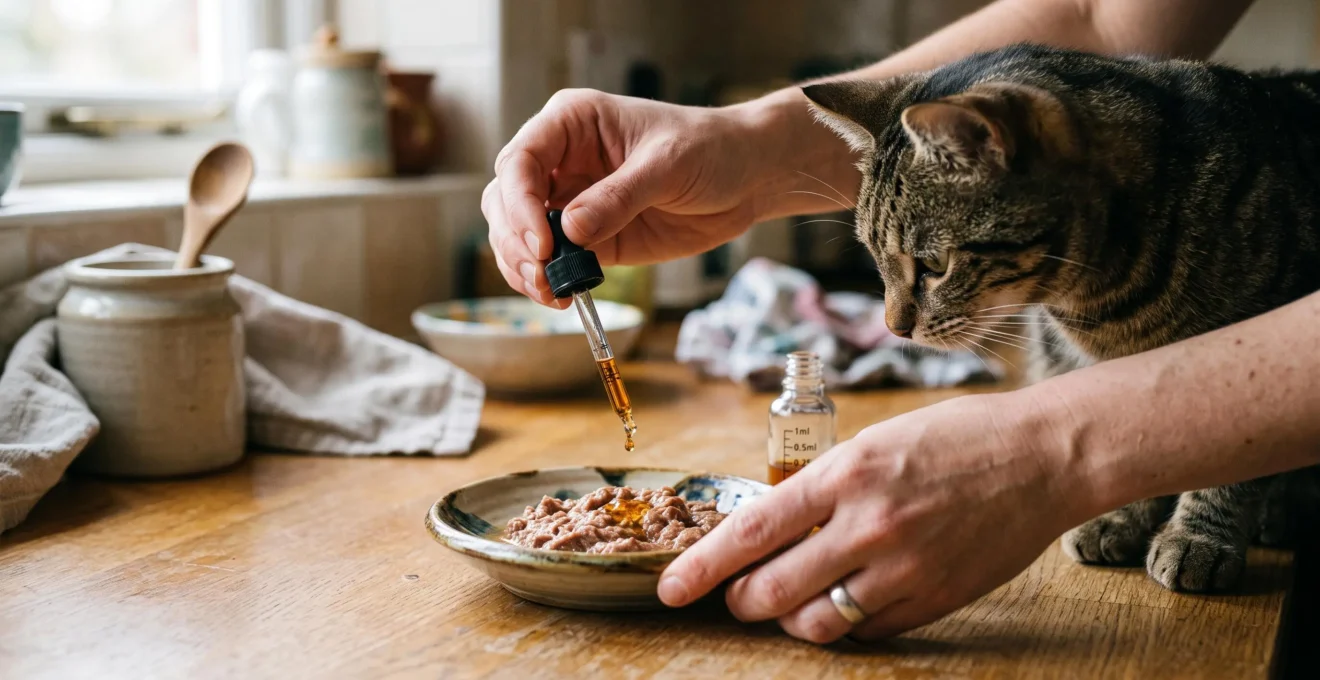
Some CBD products marketed for cats contain relatively small amounts of cannabidiol dispersed in fish oil. This combination is primarily a formulation choice: fish oil acts as a lipid carrier, contributes a recognisable savoury aroma and allows manufacturers to distribute CBD across a larger liquid volume.
For cat owners comparing products intended for wet food, those properties can matter more than an impressive CBD number on the front of a bottle. A concentrated oil may require measuring a very small volume, while a more diluted formulation can make that volume easier to measure with suitable equipment. Whether the cat actually consumes it remains a separate question.
Fish oil is not a proven solution to feline food refusal, and a low CBD concentration does not establish safety or therapeutic effectiveness. Veterinary advice is essential before considering a cannabis-derived product for a cat, particularly one receiving medication or managing an illness.
Low-concentration fish-oil CBD for cats: key points
- Fish oil may make a CBD liquid more acceptable in familiar wet food, but its aroma can also discourage selective cats.
- Compare products using verified milligrams of CBD per millilitre, not bottle size, total hemp extract or marketing descriptions.
- Accurate measurement, complete food consumption, appropriate storage and veterinary oversight matter more than carrier-oil claims.
- Why Can Fish-Oil-Based CBD Liquids Be Easier to Offer to Some Cats?
- How Can You Read the Concentration on a CBD Fish-Oil Product for Cats?
- Fish-Oil Liquid or Soft Chew: Which Is More Practical for a Selective Cat?
- Which Storage Mistakes Can Make a Fish-Oil-Based Pet Product Deteriorate Faster?
- When Should You Stop Mixing a CBD Fish-Oil Product into a Cat’s Food?
- Why Does the Carrier Oil Change How a CBD Oil Tastes and Feels?
- How Can You Calculate CBD Concentration from Milligrams and Bottle Volume?
- Which Carrier Oil Best Fits the Texture and Flavour You Want from CBD Oil?
Why Can Fish-Oil-Based CBD Liquids Be Easier to Offer to Some Cats?
Fish-oil-based CBD liquids may be easier to offer to some cats because their savoury aroma can make the mixture more compatible with familiar fish-flavoured wet food. A lower CBD concentration can also provide a more measurable liquid volume for a small amount of CBD. Neither feature guarantees that a selective cat will accept the food or consume the entire measured amount.
Cats are sensitive to changes in food odour and texture. Some resist unfamiliar foods, a behavioural tendency known as food neophobia. When a new liquid changes the smell of a familiar meal, that change may determine whether the food is approached, tasted or rejected.
Fish oil provides a strong marine aroma that may compete with the herbal or bitter sensory notes of certain hemp extracts. This is a plausible formulation strategy rather than a demonstrated guarantee of cannabinoid taste masking in cats. Its effectiveness depends on the extract, oil quality, food and individual animal.
Lower concentration does not automatically mean lower quality. A manufacturer can formulate a given quantity of CBD in a larger carrier-oil volume to obtain fewer milligrams per millilitre. This may make small quantities easier to measure on a graduated syringe or dropper, provided the required volume remains practical.
However, dilution has a trade-off: delivering the same CBD amount from a weaker liquid requires more oil. A larger addition can make the food smell or feel noticeably different. Therefore, low concentration does not necessarily make a product less detectable to a cat.
A small veterinary pharmacokinetic investigation used CBD-rich hemp material in fish-oil capsules. In a veterinary study of CBD-infused fish-oil capsules in cats, researchers initially administered capsules to eight cats, but complete delivery was uncertain in two after capsule rupture. The study illustrates administration challenges, not improved acceptance of diluted liquids mixed into food.
What a small feline administration study actually showed
Researchers studied the pharmacokinetics of a CBD-rich hemp product in healthy cats using fish-oil capsules. Six cats contributed complete pharmacokinetic data.
Two cats were excluded because the intended amount might not have been fully administered. Heavy salivation was also observed in two cats. These observations highlight delivery and tolerability concerns but do not establish that fish-oil liquids improve acceptance or provide an effective treatment.
For a cat that already accepts oily, fish-flavoured food, mixing a veterinarian-approved quantity into a separate, small portion may avoid the physical stress associated with unwanted direct oral administration. That benefit disappears if food is left uneaten.
A cautious preliminary check is to establish whether the cat accepts the proposed carrier flavour without CBD, using only a veterinarian-approved unmedicated sample. Refusal at this stage is a practical reason not to rely on the formulation.
Before evaluating flavour, owners also need to understand exactly how much CBD the liquid contains.
How Can You Read the Concentration on a CBD Fish-Oil Product for Cats?
Read a feline CBD fish-oil label by finding the amount of CBD in milligrams, checking whether that quantity describes the entire bottle or one serving, and identifying the total liquid volume in millilitres. Divide total CBD by total bottle volume to obtain milligrams per millilitre. Verify that figure against batch-specific laboratory documentation before relying on it.
The number printed most prominently on a CBD bottle may describe several different quantities. It might represent CBD alone, total cannabinoids, hemp extract or an amount associated with a manufacturer’s suggested serving.
Those distinctions matter because CBD is only one possible component of a hemp extract.
- Find the CBD quantity. Look specifically for milligrams of cannabidiol rather than an unspecified hemp-extract weight.
- Identify the quantity’s scope. Confirm whether it applies to the full container, each millilitre or a stated serving.
- Read the bottle volume. Identify the total contents in mL, excluding unrelated packaging measurements.
- Calculate concentration. Divide whole-bottle CBD content by whole-bottle liquid volume.
- Check independent testing. Compare the result with an appropriate certificate of analysis for the corresponding batch.
For example, a hypothetical bottle containing 150 mg of CBD in 30 mL of oil has a concentration of 5 mg/mL. This is a mathematical illustration, not a recommended feline dose.
CBD isolate, broad-spectrum extract and other hemp-derived formulations also require different label interpretation. A label describing total cannabinoids must not be treated as an equivalent measurement of CBD alone. Other cannabinoid content, including THC, requires particular attention in veterinary product assessment.
Concentration affects measurement sensitivity. With the same absolute volume error, a less concentrated liquid results in a smaller absolute CBD measurement error. But a diluted product may require a larger administration volume, and label accuracy remains essential.
Independent verification is worthwhile. In a laboratory analysis of 29 veterinary hemp supplements, only 10 of the 27 products assessed against cannabinoid label claims were within 10% of their stated total cannabinoid concentration. This 2020 investigation examined products selected from the US dog-supplement market, so it does not establish the current accuracy of feline products.
10 of 27
Veterinary hemp supplements evaluated against their cannabinoid label claims were within 10% of the claimed total cannabinoid concentration in the cited laboratory study.
2020 laboratory analysis of commercially available veterinary hemp supplements; findings are not representative of every modern feline formulation.
A useful certificate of analysis should identify the tested product and batch, measured cannabinoid concentrations, testing laboratory and relevant contaminant results. The batch number should match the container. An unrelated, outdated or incomplete certificate cannot verify the specific bottle.
Five checks before comparing feline CBD liquids
- Record the labelled total CBD content in milligrams, producing a clear CBD-content figure.
- Record the full bottle volume in millilitres, producing a corresponding volume figure.
- Calculate total CBD divided by total mL, producing a written mg/mL concentration.
- Match the printed batch number with an independent laboratory report, producing a verified batch reference or noting its absence.
- Ask the veterinarian to review the formulation, measurement method and other medications, producing a documented suitability decision before any administration.
After confirming composition, the next question is whether a liquid is easier to use than an alternative format.
Fish-Oil Liquid or Soft Chew: Which Is More Practical for a Selective Cat?
A fish-oil liquid may be more practical when a cat reliably accepts treated wet food and a veterinarian needs the ability to specify a measured liquid volume. A soft chew is convenient only when its formulation suits cats and the animal consistently consumes the whole piece. Neither format provides accurate delivery when portions are rejected.
The main distinction is measurement flexibility. A suitably graduated liquid applicator can measure different volumes, subject to its resolution and the product’s concentration. A chew generally provides a fixed amount per intact unit.
Breaking a chew into pieces may produce uneven portions, especially when its active ingredients are not validated as uniformly distributed across fragments. Partial consumption also makes the amount swallowed uncertain.
Selective cats present an additional challenge. Many are accustomed to particular wet-food textures but do not readily recognise unfamiliar soft chews as food. A liquid mixed into an established meal may introduce less novelty than a new treat, although the oil itself can still trigger refusal.
Chew formulations also deserve ingredient scrutiny. A product intended for dogs should not automatically be considered appropriate for cats: size, texture, flavourings, cannabinoid concentration and other ingredients may all differ from feline requirements.
Use the following comparison to identify practical constraints rather than to determine medical suitability.
| Practical criterion | Fish-oil liquid | Soft chew |
|---|---|---|
| Measurement flexibility | Variable liquid volumes with a suitable graduated device | Usually fixed quantities per intact chew |
| Feeding routine | May blend into familiar wet food | Requires acceptance of a separate treat or food addition |
| Partial consumption | Uncertain delivery if treated food remains | Uncertain delivery if the chew is partly eaten |
| Texture and flavour | Oily, potentially fish-scented | Solid, with product-specific flavouring and texture |
| Product suitability | Requires composition, concentration and veterinary review | Requires the same review, especially for dog-oriented products |
Consider a hypothetical cat that finishes its usual wet food but consistently leaves half of an unfamiliar chew. The liquid format may be easier to integrate into its routine, but only if the treated food continues to be eaten completely. This is a feeding-behaviour comparison, not evidence that the liquid delivers greater therapeutic benefit.
Owners should not compensate for an unfinished chew or food portion by guessing at an additional amount. The swallowed quantity may be unknown, and repeating administration can create avoidable exposure.
The carrier’s physical condition is another consideration: even an initially accepted liquid may become unappealing when stored poorly.
Which Storage Mistakes Can Make a Fish-Oil-Based Pet Product Deteriorate Faster?
Fish-oil-based pet products can deteriorate faster when repeatedly exposed to air, heat or light, because their polyunsaturated fatty acids are susceptible to oxidation. Poor handling, unsuitable containers and long periods after opening can further compromise product quality. Following manufacturer storage instructions and recognising unusual changes in smell or appearance helps reduce avoidable deterioration.
Fish oil contains polyunsaturated fatty acids, including EPA and DHA. Their chemical structure makes them vulnerable to reactions with oxygen, particularly under unfavourable storage conditions.
As oxidation progresses, undesirable compounds may develop, changing the smell and taste that initially made the oil attractive for food mixing. This is especially relevant when a cat is sensitive to subtle odour differences.
A scientific overview of oxidation in EPA- and DHA-rich oils describes oxygen, light and heat as important contributors to deterioration. It does not establish how rapidly a finished CBD fish-oil product deteriorates or whether fish-oil oxidation directly reduces its CBD concentration.
Several everyday storage habits deserve attention:
- Leaving the container open: prolonged or repeated air exposure can increase opportunities for oxidative deterioration. Close it promptly after use.
- Keeping the bottle near cooking heat: elevated temperatures can accelerate degradation. Choose storage conditions consistent with the label.
- Placing it in direct sunlight: light exposure may contribute to oxidation. Retain suitable protective packaging.
- Transferring oil into a clear or poorly sealed container: this may compromise protection from light and oxygen while obscuring batch and expiry information.
- Contaminating the applicator: a wet spoon, contact with saliva or a dropper placed directly into food can introduce contamination. Keep dispensing equipment clean and dry according to product instructions.
A sharp, paint-like or stale-frying-oil odour may indicate rancidity. Nevertheless, a smell check cannot reliably measure oxidation or establish that a product is safe. A cat’s sudden refusal might reflect altered oil quality, but illness, food aversion and other factors must also be considered.
Marking the opening date on the original container creates a useful reference. If the manufacturer provides a period for use after opening, follow it alongside the printed expiration date. Refrigeration should be used when directed by the manufacturer, rather than assumed appropriate for every formulation.
When an opened bottle’s age, storage history or integrity is uncertain, continued use is difficult to justify. Avoid relying on appearance or smell alone to extend its usable life.
Even a properly stored product may still disrupt a cat’s eating habits, creating a different reason to stop mixing it into meals.
When Should You Stop Mixing a CBD Fish-Oil Product into a Cat’s Food?
Stop mixing a CBD fish-oil product into food when a cat repeatedly refuses the treated meal, eats unpredictable portions, develops aversion to familiar food or shows possible adverse effects. Incomplete consumption makes cannabinoid exposure uncertain, while sustained food refusal can threaten feline nutrition. Suspected reactions or changes in health require veterinary assessment rather than continued experimentation.
Mixing a product into food only produces predictable delivery when the intended portion is fully consumed. If some remains in the dish, the amount swallowed may be uncertain, particularly if the product was not evenly distributed.
A cat that eats around an oily patch is not necessarily receiving a reliable fraction of the intended amount. Even when the original liquid quantity was measured accurately, food consumption becomes a second uncontrolled variable.
Owners should stop the administration attempt and reassess when:
- The cat repeatedly leaves the treated portion or refuses the entire meal.
- Food intake becomes inconsistent across successive meals.
- The cat begins avoiding its regular food after the product is introduced.
- New lethargy, vomiting, unusual drooling or other concerning behaviour appears.
- The cat receives other medication and potential interactions have not been evaluated by a veterinarian.
Food refusal needs particular care in cats. Their normal feeding routine should not be sacrificed to maintain an optional supplement experiment. If the cat is eating substantially less than normal or stops eating, contact a veterinarian promptly.
According to the FDA‘s guidance on cannabis-derived products for animals, the agency has not approved cannabis for animal use and cannot ensure the safety or effectiveness of products marketed for animal health. Its guidance identifies potential adverse signs after cannabis-product exposure and recommends veterinary or animal poison-control assistance where adverse effects are suspected. These US regulatory statements should not be assumed to describe the laws of all English-speaking countries.
The appropriate transition after food refusal is to stop adding the product and offer familiar, untreated food. Owners should not gradually continue administering an unwanted CBD mixture merely to achieve acceptance.
If a veterinarian considers continued administration appropriate, possible alternatives may include a different approved approach to delivery, a smaller separately offered food portion or direct oral administration where tolerated. The choice should account for stress, nutritional intake and measurement reliability.
Do not automatically repeat an amount when a treated meal is unfinished. A clinician needs to know what was offered, what was consumed and which formulation was used before assessing the next step.
Understanding the sensory properties of different carrier oils may also help explain why one formulation was accepted while another was not.
Why Does the Carrier Oil Change How a CBD Oil Tastes and Feels?
The carrier oil changes a CBD formulation’s taste, smell and mouthfeel because it contributes its own sensory properties and affects how concentrated the extract is in each measured volume. Neutral oils may let hemp-derived flavours remain noticeable, while more aromatic oils can change the overall flavour profile. These differences influence acceptance but do not establish safety or effectiveness.
CBD itself is not necessarily the main source of a finished hemp product’s strong herbal or bitter flavour. Other constituents of the extract, including certain terpenes and plant-derived compounds, can contribute to its sensory profile. Purified CBD isolate and less-refined extracts may therefore behave differently in the same carrier.
As the relative proportion of carrier oil increases, the concentration of extract-associated flavour compounds can decrease, although the total volume required for a particular CBD amount increases.
Three carrier families illustrate the differences:
- MCT oil: generally mild in flavour and often relatively light in mouthfeel, making it a candidate when a less distinctive carrier is preferred.
- Hemp seed oil: has a characteristic nutty or plant-like flavour that may reinforce the sensory identity of a hemp formulation.
- Fish oil: contributes a distinctive marine aroma that may fit fish-based wet food but can be objectionable in other feeding contexts.
Texture also influences practical handling. Oils vary in flow characteristics, and temperature and formulation can affect viscosity. A liquid that clings to an applicator may be harder to dispense consistently, while one that coats the mouth may be less tolerated during direct administration.
For cats, these are practical considerations rather than established carrier-specific preferences. Individual taste and odour responses vary, and there is no basis for assuming that every feline patient prefers fish oil to MCT or hemp seed oil.
A stronger flavour is not automatically undesirable. It may be useful when harmonising with an accepted food, whereas a less aromatic product might be easier to introduce by a different method. The same principle applies to mouthfeel: the best sensory characteristics depend on the actual administration routine.
To compare the quantities that accompany those sensory differences, however, owners need a consistent concentration calculation.
How Can You Calculate CBD Concentration from Milligrams and Bottle Volume?
Calculate CBD concentration by dividing the total milligrams of CBD in a bottle by its liquid volume in millilitres. The result, expressed as mg/mL, indicates how much CBD is present in each measured millilitre. It allows meaningful comparisons between products but does not determine an appropriate amount for a cat.
The calculation is:
CBD concentration (mg/mL) = total CBD (mg) ÷ total liquid volume (mL).
For a hypothetical product containing 150 mg of CBD in a 30 mL bottle:
150 mg ÷ 30 mL = 5 mg/mL.
Every 1 mL of this hypothetical liquid contains 5 mg of CBD, assuming the product matches its declared composition and the mixture is suitably uniform.
To calculate the amount contained in a particular measured volume, multiply the concentration by that volume.
For example, 0.2 mL of this hypothetical 5 mg/mL solution contains 1 mg of CBD. This demonstrates the relationship between units only. It is not a feline dosing instruction or an indication that this amount is safe or effective.
Comparing two hypothetical formulations makes the practical difference clearer:
| Measurement | Lower concentration | Higher concentration |
|---|---|---|
| Total CBD | 150 mg | 600 mg |
| Bottle volume | 30 mL | 30 mL |
| Concentration | 5 mg/mL | 20 mg/mL |
| Volume containing 1 mg CBD | 0.2 mL | 0.05 mL |
These illustrative values show that a lower-concentration liquid requires a greater volume to supply the same CBD quantity. A sufficiently graduated measuring device may make the larger volume easier to measure, although adding more carrier oil could affect food acceptance.
Manufacturer-defined serving sizes should not replace this calculation. A printed serving may be designed around the company’s own instructions rather than an individual cat’s veterinary assessment.
Drop counting also introduces avoidable uncertainty. Drop size depends on the oil, dispensing tip, handling and other physical conditions. Unless a validated product-specific conversion is available, counting drops should not be treated as equivalent to measuring a volume.
Use the graduations on a suitable calibrated applicator and confirm that its smallest readable divisions are appropriate for the intended measurement. A nominally 1 mL dropper and a finely marked 1 mL syringe may differ considerably in practical precision.
Once concentration is understood, owners can evaluate which carrier offers the most practical combination of flavour, volume and handling characteristics.
Key takeaways before choosing a carrier
- Prioritise the feeding or administration method the cat already tolerates, rather than assuming one carrier is universally preferable.
- Consider the total oil volume associated with any veterinarian-reviewed amount, not just the CBD concentration.
- Balance flavour compatibility against storage needs and ingredient suitability, with product documentation available for veterinary review.
Which Carrier Oil Best Fits the Texture and Flavour You Want from CBD Oil?
The most suitable CBD carrier oil depends on how the formulation would be offered, the cat’s acceptance of its flavour and texture, and the quality of the finished product. Fish oil may suit some wet-food routines, MCT oil may suit situations requiring a milder carrier, and hemp seed oil offers a more pronounced plant-derived flavour. None is automatically the safest or best option for every cat.
Carrier selection should begin with the administration method rather than an ingredient’s reputation. Fish oil might harmonise with a fish-based meal yet be conspicuous in a different food. A neutral carrier may introduce less odour but still change the meal’s texture.
The practical relationships can be summarised as follows.
| Situation | Potentially suitable carrier | Main limitation |
|---|---|---|
| Wet-food mixing; cat accepts marine aromas | Fish oil | Strong aroma and susceptibility to oxidation |
| Food mixing; cat is sensitive to fish odour | Mild-tasting MCT oil | Neutral flavour does not guarantee acceptance |
| Veterinarian-guided direct oral administration; preference for mild flavour | MCT oil | Handling stress, texture and product suitability still matter |
| Food mixing; cat tolerates plant-like flavours | Hemp seed oil | Distinct flavour and storage sensitivity |
This grid describes potential formulation fit, not proven clinical superiority. Acceptance depends on the finished composition, the individual cat and the particular food or administration method.
Oxidative stability creates another trade-off. Fish oil and hemp seed oil contain unsaturated fatty acids that require attention to storage. MCT oil generally contains more saturated medium-chain fatty acids and is relatively resistant to oxidation, but finished-product stability still depends on the complete formulation and packaging.
The term « whole-plant » also needs care. Hemp seed oil is pressed from seeds and should not be confused with CBD-rich hemp extract. Choosing hemp seed oil as a carrier does not establish that a product contains a particular cannabinoid profile or provides additional therapeutic benefits.
Nor should the carrier be judged independently of the CBD extract. Verified CBD concentration, possible THC content, contaminants, added flavourings, laboratory documentation and veterinary suitability remain central considerations. The rules governing cannabis-derived animal products also vary between countries.
For a household comparing liquid products, the useful decision is whether the formulation’s intended volume can be measured reliably, whether its smell and texture fit the cat’s feeding habits, and whether storage requirements are realistic.
If an animal has already rejected a formulation, changing the carrier without veterinary guidance is not a reason to keep experimenting with cannabinoid administration. Persistent refusal or health changes should be addressed first.
Before purchasing or offering any CBD product to a cat, bring its full ingredient list, verified cannabinoid concentration, batch-specific laboratory report and intended administration method to a veterinarian. That review is a more dependable starting point than selecting a product solely because it tastes like fish or contains fewer milligrams per millilitre.
Does fish oil make CBD safer for cats?
No evidence in the cited research establishes that using fish oil as a CBD carrier makes cannabidiol safe for cats. The carrier can affect formulation and administration characteristics, but it does not resolve uncertainties about cannabinoid exposure, adverse effects, interactions or the suitability of the finished product. Veterinary assessment remains necessary.
Can a fish-oil CBD liquid replace an ordinary omega-3 supplement?
Not automatically. A CBD-containing fish-oil product and an omega-3 supplement serve different formulation purposes. The presence of fish oil does not establish a meaningful EPA or DHA quantity, nutritional suitability or an appropriate supplementation plan. A veterinarian should assess those nutrients separately from any cannabinoid content.
Can an opened fish-oil CBD bottle be used until its printed expiration date?
Not necessarily. The printed expiration date may not describe the full period of acceptable quality after opening. Follow any manufacturer-specific instructions for opened containers, including storage temperature and use-after-opening limits. If the bottle’s history is uncertain or deterioration is suspected, do not rely on the printed date alone.
What should you do if two CBD products list the same milligram amount?
Confirm whether each figure represents CBD or total hemp extract, and whether it refers to the bottle or a serving. Then calculate mg/mL from the verified total CBD and bottle volume. Compare batch-specific laboratory results and ingredients before discussing suitability with a veterinarian. Matching front-label numbers do not establish equivalent formulations.
What if a cat eats untreated food but consistently refuses food containing the CBD liquid?
Stop adding the product, return to familiar untreated food and record the refusal pattern. Avoid forcing the mixture or guessing at replacement quantities. Discuss the situation with a veterinarian before considering another formulation or administration method. If the cat’s overall food intake decreases or other symptoms appear, seek veterinary advice promptly.