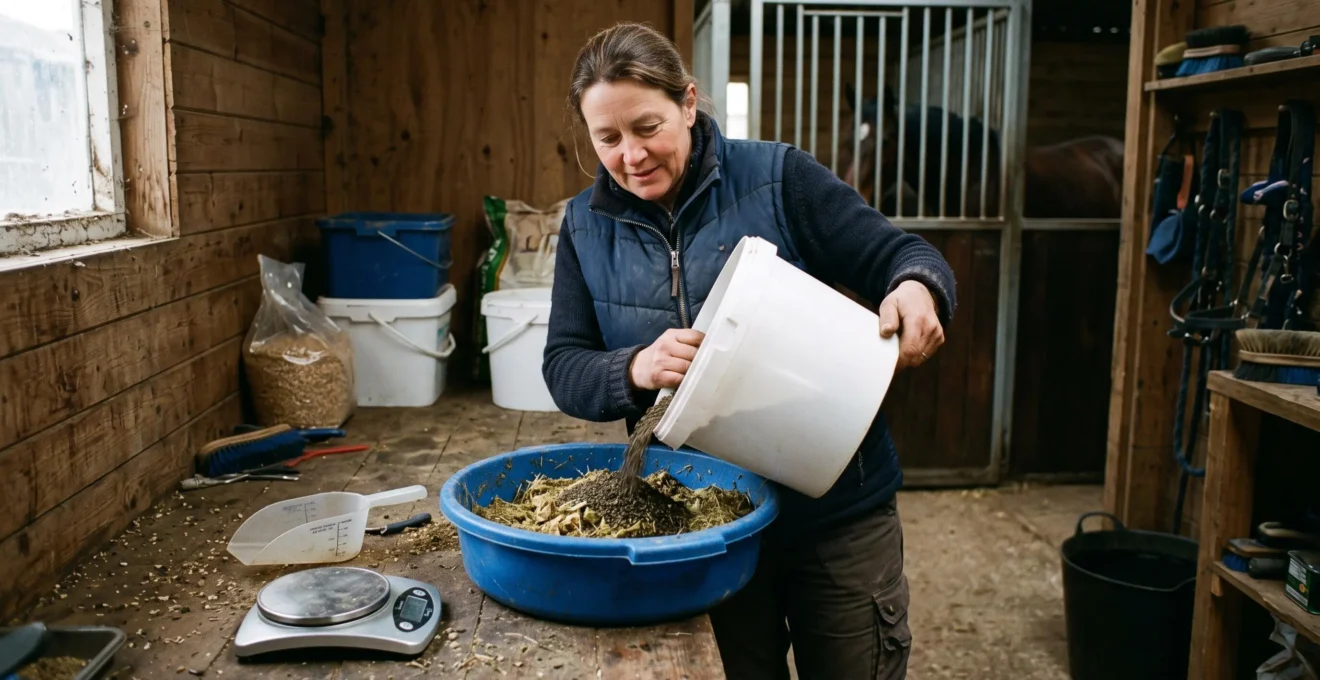
Adding botanical granules to a horse’s daily feed may seem straightforward: measure a portion, mix it into the ration and let the horse eat. However, high-volume granules introduce several practical challenges. An accurately measured quantity can become unevenly distributed, remain at the bottom of a bucket or be consumed only partially.
A consistent routine starts with three controls: weigh the intended portion, mix it into a ration the horse reliably finishes and confirm what was actually eaten. Product composition, storage conditions and veterinary suitability must also be established before any supplement is introduced.
These considerations become particularly important when products contain concentrated botanical extracts or cannabinoids such as cannabidiol (CBD). Accurate measuring cannot establish that an ingredient is safe, effective or legally permitted in horse feed. Those questions require separate assessment.
The practical objective is therefore not simply to make granules disappear into a bucket. It is to establish a repeatable, documented feeding process in which the intended amount, product quality and actual intake can be evaluated independently.
Botanical granules in horse feed: the essentials
- Measure granules by weight, not by an uncalibrated scoop, and check the finished ration for uneaten material.
- Use an appropriate feed base, introduce permitted products cautiously and record each measured portion rather than estimating daily quantities.
- Check ingredient concentrations, batch documentation, storage instructions and veterinary suitability before relying on a supplement routine.
- Why Does Even Mixing Matter with High-Volume Botanical Granules for Horses?
- How Can You Mix Botanical Granules into Horse Feed Without Guessing the Amount?
- Botanical Granules or Liquid Formula: Which Is Easier to Add to an Equine Ration?
- Which Label Problems Should Make You Avoid Botanical Granules for a Horse?
- When Should an Equine Botanical Supplement Routine Be Reviewed with a Vet?
- Which Label-Reading Mistakes Cause the Biggest CBD Concentration Errors?
- Which Everyday Storage Mistakes Can Undermine CBD Extract Integrity?
- How Can You Compare Cannabinoid Concentrations Across Different CBD Products?
Why Does Even Mixing Matter with High-Volume Botanical Granules for Horses?
Even mixing matters because a measured portion of botanical granules does not necessarily remain evenly distributed throughout a horse’s feed. Differences in particle size, density and movement can cause ingredients to separate. The horse may finish the ration yet receive inconsistent quantities of granules between meals, making actual intake difficult to assess.
Feed mixtures containing particles of different sizes or shapes can segregate during handling. Repeated shaking, carrying or scooping may allow larger particles to move towards the surface while smaller particles settle into spaces beneath them. This size-segregation mechanism is sometimes described as the Brazil nut effect.
However, larger particles do not always rise, and lighter granules do not necessarily accumulate at the top. Density, particle shape, moisture and the composition of the surrounding feed influence the direction and extent of separation. For a particular botanical product, segregation should be treated as a practical possibility rather than an experimentally established outcome.
Two different problems can therefore produce apparently inconsistent results:
- Incomplete acceptance: the horse selectively leaves granules or feed particles behind because of their taste, smell or texture.
- Uneven distribution: the horse finishes its meal, but different portions of a poorly mixed ration contain unequal quantities of supplement.
To investigate the first problem, weigh the offered ration and record the leftovers over several consecutive feeds. Where practical, examine the remaining material for visible granules. This reveals incomplete consumption, although leftover weight alone cannot identify the exact botanical quantity rejected.
The second problem is more difficult to detect. A clean bucket establishes that the horse ate the available feed, not that the supplement was distributed uniformly or contained the stated active concentration.
With separately added botanical granules, partial consumption cannot automatically be interpreted as a proportionally smaller active dose. If the granules are concentrated in one part of the ration, eating half the feed might involve consuming considerably more or less than half the supplement. Even with a homogeneous product, variation between individual granules can matter unless manufacturing quality controls establish uniformity.
This differs from a feed manufactured with a uniformly incorporated additive, where the formulation is intended to distribute ingredients across the finished product. Such uniformity should still be supported by appropriate manufacturing controls rather than assumed.
Ultimately, dosage variability complicates any attempt to assess a supplement’s effects. If the daily delivered quantity changes unpredictably, changes in the horse’s condition cannot reliably be interpreted against a consistent intake.
The next priority is to replace approximate scooping with a practical measurement method that remains consistent across different feed preparations and feeding times.
How Can You Mix Botanical Granules into Horse Feed Without Guessing the Amount?
Botanical granules should be measured on a suitable scale and added to a small, manageable portion of feed before being incorporated into the remaining ration. The quantity must come from product-specific instructions that have been checked for suitability. If the horse receives separate morning and evening feeds, each portion should be measured independently.
Weight is more dependable than scoop volume because two granular products can have different bulk densities. A container filled to the same level may hold substantially different masses of different materials.
The Extension Horses guidance on feeding by weight illustrates this principle using conventional equine concentrates. It recommends weighing a feed quantity, marking the measuring container and recalibrating when changing feeds. Although the guidance does not establish a botanical supplement dosage, its measurement principle is directly relevant.
For permitted granules with an appropriate veterinary-reviewed feeding quantity, a practical preparation process is:
- Place a clean, dry container on a gram scale and tare the display.
- Weigh the intended granule portion according to the applicable product instructions.
- If using a scoop, mark its level for that particular product only, then periodically verify the weight.
- Mix the measured granules into a small portion of suitable feed before combining them with the rest of the ration.
- Check the bucket after feeding and record any significant leftovers or granule residue.
A marked scoop can make an established routine quicker, but it should not become a substitute for verification. Reweigh when changing suppliers, formulations or batches, and whenever the granules’ texture or packing behaviour changes.
For a non-CBD botanical product approved as suitable for the individual horse, an introductory period of approximately one to two weeks can be used to assess acceptance, provided the manufacturer and veterinarian agree. Begin with a small fraction of the intended quantity and increase only as directed after confirming normal appetite and complete consumption. This is a practical acceptance approach, not a validated universal safety or dosing protocol.
A small quantity of moistened mash or soaked feed may help granules adhere to the ration rather than remaining as loose particles. However, some formulations become sticky when wet and may cling to the sides or bottom of the bucket. Check the manufacturer’s mixing instructions and avoid prolonged soaking unless the product permits it.
Dividing the daily amount between two feeds can be manageable when each serving is separately weighed. Pre-portioning several days’ supply into appropriately sealed, clearly labelled containers may reduce handling errors, provided storage guidance allows it.
Five checks for a repeatable feeding routine
- Verify the product: retain a photograph of the ingredient label, batch number and applicable feeding instructions.
- Confirm the measured amount: record the veterinary-approved or otherwise appropriate product-specific portion in grams.
- Calibrate the equipment: weigh the intended portion and record the scoop level or container marking used.
- Document each prepared feed: label separately measured morning and evening portions and maintain a daily feeding log.
- Check consumption: inspect the emptied bucket, record leftovers and note any change in appetite or behaviour.
Once accurate preparation is established, the remaining question is whether granules are the most practical format for that horse, or whether another veterinary-appropriate formulation would provide better control.
Botanical Granules or Liquid Formula: Which Is Easier to Add to an Equine Ration?
Granules can be convenient for horses that consistently finish their meals, while liquids allow a measured volume to be dispensed without relying on a scoop. Neither format automatically guarantees accurate active-ingredient delivery. The best choice depends on product concentration, formulation uniformity, administration instructions, the horse’s feeding behaviour and veterinary suitability.
Dry granules can be prepared in advance, handled without spills and incorporated into an established grain or compound-feed routine. Their main limitation is that the horse must consume the intended portion of the ration, including any granules left at the bottom.
Liquid products can be measured using a suitably graduated oral syringe or calibrated dispenser. This provides volume control, but precise millilitre measurement is not the same as verified active-dose accuracy. The liquid must have a known concentration and remain sufficiently uniform during dispensing. Some formulations require shaking, while others may separate or adhere to measuring equipment.
The comparison is therefore more useful when based on specific handling requirements rather than assuming either physical format is inherently superior.
| Criterion | Botanical granules | Liquid formulation |
|---|---|---|
| Measurement | Weigh in grams using a scale | Measure in millilitres using calibrated equipment |
| Mixing | May segregate or remain in the bucket | May distribute readily or separate, depending on formulation |
| Horse acceptance | Depends on consumption of the prepared feed | Depends on palatability when mixed or acceptance of direct administration |
| Storage | Requires protection from moisture and repeated environmental exposure | Requires attention to container closure, formulation stability and opened-bottle instructions |
| Individual portions | Convenient when portions are pre-weighed | Convenient when volume and concentration are clearly specified |
| Main limitation | Measured granules may not all be consumed | Measured volume may not correspond to a reliable active dose without concentration and uniformity data |
A horse that cleans its feed reliably may be a suitable candidate for an appropriately authorised granular supplement. A horse that regularly leaves concentrates may require a different administration strategy or a reassessment of whether the supplement is necessary.
Oral pastes and products specifically formulated for direct oral administration can bypass the feed bucket, although they introduce handling, restraint and swallowing considerations. Direct dosing should only be undertaken with a product intended for that route and according to veterinary guidance. A feed additive should never automatically be used as an oral drench.
Storage also influences the practical choice. Opening a large tub repeatedly exposes its contents to changing stable conditions. Liquid containers may have particular requirements after opening, including mixing instructions or shortened use periods. Neither format should be considered universally more stable without product-specific evidence.
For CBD-containing products, differences in formulation and administration can affect exposure. An equal labelled CBD quantity does not establish an equal biological effect, and choosing a different format does not resolve regulatory or safety concerns.
Before choosing either presentation, the product label must provide enough information to establish what is being measured and whether the ingredient is appropriate for the horse.
Which Label Problems Should Make You Avoid Botanical Granules for a Horse?
Owners should avoid using botanical granules when the label fails to identify the ingredients, their relevant quantities, the manufacturer or the production batch. Unsupported treatment claims, unclear feeding instructions and missing quality documentation are additional warning signs. For CBD-containing products, legal status must also be checked because a detailed label does not make an unauthorised ingredient permissible.
The first task is to distinguish information about the overall product from information about its active components. A label giving the total weight of a botanical mixture may not reveal the concentration of the compound that an owner is trying to measure.
Important warning signs include:
- No batch or lot identifier allowing the container to be traced to manufacturing records.
- An incomplete ingredient declaration or unclear quantities for relevant botanical constituents.
- A proprietary blend that conceals the concentration needed to assess intake.
- No identifiable manufacturer, distributor or appropriate contact information.
- Missing storage, administration or suitability instructions.
- Claims to treat or cure equine diseases without an appropriate regulatory basis.
- Unexplained discrepancies between the label and available batch-testing information.
Required labelling particulars differ by jurisdiction and product classification. Some omissions may indicate legal non-compliance; others may be reasons to seek clarification before purchase or use. A certificate of analysis (CoA) can provide useful information about the tested composition of a particular batch, but its scope, laboratory methods and authenticity should be assessed rather than assumed.
CBD-containing feed products require particular caution. In the United States, the Food and Drug Administration states that CBD is not approved for use in animal food. Its FDA warning letter concerning CBD products for horses identifies CBD pellets and CBD oil marketed for equines among products subject to enforcement findings.
Those findings cannot automatically be extended to every botanical ingredient or to other countries. Equine feed rules, authorised ingredients and veterinary medicinal product classifications differ across English-speaking jurisdictions. Owners must establish the rules that apply where their horses are kept.
A matching batch number is an essential traceability check. It does not, by itself, establish that a certificate is genuine, representative or sufficiently comprehensive. The document should also identify the relevant tested compounds, their concentrations, analytical units and laboratory details.
If the label reports only the total botanical material per serving, even a perfectly calibrated scale cannot reveal how much of a specific active constituent is present. Consequently, ingredient transparency is a prerequisite for meaningful dose measurement.
When the documentation is incomplete or the product’s regulatory status is uncertain, do not use the product until the questions are resolved. A veterinarian can then help determine whether the proposed supplement is appropriate in the context of the horse’s wider care.
When Should an Equine Botanical Supplement Routine Be Reviewed with a Vet?
An equine botanical supplement routine should be reviewed with a veterinarian before introduction and whenever medications, product formulations, administration methods or the horse’s health status change. Veterinary advice is especially important for cannabinoid-containing products, competition horses and animals showing altered appetite, behaviour or droppings. Reliable feeding records help distinguish administration problems from potential adverse effects.
Botanical ingredients may contain pharmacologically active compounds, and their effects cannot be assessed solely from a product’s natural origin. Some may interact with veterinary medicines, affect overlapping metabolic pathways or complicate management of an existing condition.
Veterinary review is particularly important when:
- A new prescription medicine or another supplement is introduced.
- The horse shows unexplained changes in appetite, demeanour, manure consistency or general condition.
- The owner intends to increase, decrease or divide the measured supplement amount differently.
- The product is replaced by another brand, concentration or formulation.
- The horse is pregnant, lactating, young, medically vulnerable or receiving ongoing veterinary treatment.
- The horse is entered in a competition where prohibited-substance rules may apply.
CBD deserves specific attention because equine research remains limited and measured administration does not guarantee safety.
8 of 12 horses
In a small controlled study of oral oil-based CBD administration, eight horses developed elevated liver enzymes. Mild hypocalcaemia was reported in all twelve. The observations concern the study’s experimental conditions and cannot be generalised to every formulation or horse.
Original veterinary research: equine CBD pharmacokinetics and safety study.
The investigation also reported variable oral CBD exposure and changes that improved or normalised after administration ended. It did not establish an effective routine supplementation dose or demonstrate that CBD treats a particular equine disease.
For a useful consultation, bring the actual product container or a clear photograph of its label, the batch-specific testing documentation and a record of every measured portion administered. Include feeding times, changes in the ration, whether meals were completed, all medications and supplements, and any observed changes.
Two different questions should guide the discussion. A safety review asks whether the ingredient, interactions, health status and regulatory circumstances make use appropriate. An efficacy review asks whether there is credible evidence of benefit and whether observed changes justify continuing. Consistent intake records support interpretation but cannot, on their own, demonstrate effectiveness.
Competition rules are an additional boundary. Cannabinoid-related restrictions can apply even where a product is commercially available. Owners should check the current rules of their governing federation and seek appropriate veterinary or regulatory advice rather than assuming that a low-THC or THC-free claim establishes eligibility.
After establishing veterinary suitability, careful interpretation of product concentrations becomes the next safeguard against misleading measurements—especially where the label identifies CBD or another cannabinoid.
Which Label-Reading Mistakes Cause the Biggest CBD Concentration Errors?
The largest CBD concentration errors occur when owners confuse milligrams per serving with milligrams per gram, mistake total extract weight for CBD content or overlook the serving quantity used in a label claim. Batch changes create further uncertainty. The correct comparison starts with the explicitly stated CBD mass and the corresponding product mass, not the size of the scoop or container.
Consider three hypothetical labels, created only to illustrate the arithmetic:
- Product A: 60 mg CBD in a 30 g serving, equivalent to 2 mg CBD per gram.
- Product B: 100 mg CBD in a 25 g serving, equivalent to 4 mg CBD per gram.
- Product C: 1,000 mg CBD in a 500 g container, equivalent to 2 mg CBD per gram.
The normalising calculation is straightforward: divide the stated milligrams of CBD by the corresponding grams of product. This provides a concentration measure for comparison, not a recommended quantity to administer to a horse.
Product B has a higher stated CBD concentration than Products A and C, although its serving size is smaller. Without converting to a common basis, comparing the prominent milligram figures alone would be misleading.
A separate mistake involves the difference between botanical extract weight and CBD weight. A label stating that a serving contains a particular mass of hemp extract does not establish that the whole extract is CBD. It may contain several constituents and carrier materials. Where explicit CBD content is absent, an accurate CBD concentration cannot be calculated.
Serving guidance introduces another source of error. A feeding statement developed for a broad horse weight category should not automatically be applied to a pony, draft horse or young animal. Nor should a CBD quantity be increased proportionally with body weight without veterinary assessment. Body-weight calculations may appear in research or veterinary treatment protocols, but they are not a universal owner-directed CBD dosing rule.
Finally, laboratory values from one production batch should not be assumed to apply unchanged to another. When a cannabinoid concentration matters, compare the current container’s batch number with the relevant CoA and confirm that the reported results use compatible units.
Missing information must not be filled in by estimation. If a label supplies a percentage without a clear reference basis, or provides only an extract quantity, request clarification before drawing conclusions.
Even when the initial concentration is clearly documented, storage and handling can affect product condition over time, making preservation of the supplied formulation another important control.
Which Everyday Storage Mistakes Can Undermine CBD Extract Integrity?
Heat, excessive light, moisture, repeated air exposure and unsuitable containers can compromise the stability of some CBD formulations. Everyday stable-management mistakes include leaving tubs open, storing products near windows or damp washing areas, and transferring granules into unsealed bins. The safest approach is to follow the manufacturer’s formulation-specific storage instructions rather than applying a universal shelf-life assumption.
A working feed room experiences environmental changes that may not be obvious during daily feeding. Sunlight can warm shelves, equipment can generate heat, and wet floors or nearby wash bays can increase humidity. Repeated opening also changes how much of the product is exposed to the surrounding environment.
CBD stability depends partly on the formulation. A laboratory study of CBD powder and oil stability investigated solid cannabidiol and a sunflower-oil formulation under controlled environmental conditions. It found formulation-dependent stability differences, including degradation under particular stress conditions.
The experiments did not test every commercial equine granule, nor do they establish that all powders are more stable than all liquids. Their findings support attention to storage conditions without providing a universal storage temperature or opened-container shelf life.
For routine handling, sensible precautions include:
- Keep products in their original, properly resealed containers unless the manufacturer specifies another suitable option.
- Use a clean, dry scoop to avoid introducing moisture into the bulk material.
- Store containers away from direct sunlight, sources of heat and persistently damp areas.
- Record the opening date and observe any manufacturer-stated in-use period.
- Keep pre-portioned material sealed and clearly identified if advance preparation is permitted.
A best-before date should be interpreted alongside the specified storage conditions. Once a container is opened, its usable period may differ from the original unopened shelf life. There is no evidence-based universal period that applies to every equine cannabinoid granule.
Visible hard clumping, unusual colour changes, packaging damage or unexpected odours are reasons to stop and investigate possible deterioration or contamination. They are not validated measurements of remaining CBD content; a product may also undergo chemical changes without displaying obvious visual signs.
Owners can include a simple monthly packaging and product-condition inspection in their feeding records, while checking for obvious problems at each use. This is a practical handling precaution, not a scientifically validated monthly CBD testing interval.
For horses that receive small quantities from a large tub, choosing a suitably sized package can reduce how long the product remains open, provided smaller packaging meets the same quality and regulatory requirements.
Good storage cannot repair unclear labelling or prove that active concentrations remain unchanged. A final comparison of products must therefore consider documented concentration, batch testing and practical cost together.
Key takeaways before comparing products
- Standardise labelled CBD concentrations to a common unit before comparing product sizes or advertised strengths.
- Prefer verifiable batch information over prominent extract-weight claims; a tested concentration matters only when it is connected to the product being evaluated.
- Check legal status and veterinary suitability first, because favourable concentration, convenience or price cannot establish that a CBD product is appropriate for horse feed.
How Can You Compare Cannabinoid Concentrations Across Different CBD Products?
CBD products can be compared by expressing their verified CBD concentration in a common unit, such as milligrams per gram of product. For liquids, the declared milligrams per millilitre can be used initially, with density information needed for a mass-based conversion. This comparison reveals labelled strength, but it does not establish equivalent absorption, clinical effects, safety or legal suitability for horses.
Start by determining exactly which compound is being reported. CBD, total cannabinoids, hemp extract and other constituent quantities are not interchangeable. A label reporting total cannabinoids may include compounds other than CBD, so it cannot be compared directly with a CBD-specific claim without further compositional information.
For dry granules and pastes reported by mass, the standard calculation is:
CBD concentration (mg/g) = stated CBD content (mg) ÷ corresponding product weight (g).
For a liquid with a verified CBD concentration in mg/mL, comparison by administered volume may be more practical. A conversion to mg/g requires appropriate density data for that particular formulation. Assuming every liquid has the same density can introduce unnecessary error.
A certificate of analysis should then be checked against the product label. Confirm the batch identification, tested constituent, units and reported concentration. Review the laboratory methods and any documented variation or measurement uncertainty before treating a difference between a labelled claim and a laboratory value as significant.
An unexplained or substantial mismatch is a more important quality concern than a lower concentration by itself. A relatively dilute product may still be accurately labelled, whereas a concentrated product with unreliable documentation provides a poor basis for controlled measurement.
Price comparisons can also be standardised. In a hypothetical example, suppose two products are offered at the following prices and stated CBD contents:
| Measure | Product A | Product B |
|---|---|---|
| Container weight | 500 g | 200 g |
| Stated CBD concentration | 2 mg/g | 5 mg/g |
| Total stated CBD content | 1,000 mg | 1,000 mg |
| Hypothetical price | £60 | £45 |
| Calculated price per mg CBD | £0.06 | £0.045 |
Both fictional products contain the same stated total CBD, but Product B has a higher concentration and a lower hypothetical price per milligram. It would also require less product mass to contain an equivalent labelled CBD quantity. These figures illustrate comparison arithmetic only; they are not actual market prices or feeding recommendations.
Higher concentration may reduce the volume of material handled, but it does not eliminate mixing, intake-verification or quality-control requirements. A smaller amount of a more concentrated product can also make a measurement error more consequential.
Most importantly, equal cannabinoid content does not guarantee equivalent biological exposure. Different carriers, formulations and administration routes may affect absorption. The available equine CBD research does not justify treating granules, oils and pastes as clinically interchangeable merely because their labels state the same milligram quantity.
For owners considering CBD, concentration comparison should remain an informational screening exercise until legal permissibility and veterinary suitability have been established. It should not be used to create an independent dosing regimen or to substitute one CBD preparation for another.
The practical next step is to assemble the current label, batch-specific laboratory information and existing ration details, then discuss the product with an equine veterinarian. If a supplement is appropriate and permitted, maintain a simple weighing and consumption log so that preparation stays consistent and any future review is based on dependable records.
Can botanical granules be mixed into soaked horse feed?
Some botanical granules can be incorporated into moistened mash or soaked concentrate, but compatibility depends on their formulation and the manufacturer’s instructions. Add them only after confirming that moisture will not compromise the product. Check for residue on the bucket afterwards and avoid storing prepared wet feeds beyond the applicable feeding and hygiene guidance.
Does an empty feed bucket prove that a horse received the correct supplement amount?
No. An empty bucket supports the conclusion that the prepared feed was consumed, but the original granule weight, product composition and mixing procedure must also have been verified. It does not establish the actual concentration of an active constituent or whether the supplement is safe or effective.
Should an uneaten botanical supplement portion be added to the next meal?
Do not automatically add the apparent remainder to the next serving. Granules may not be evenly distributed through leftovers, so the amount already consumed may be uncertain. Record the incomplete meal and follow the product’s specific instructions or obtain veterinary advice before changing the feeding schedule.
Can one calibrated scoop be used for several botanical products?
A scoop can be reused as measuring equipment, but its fill level must be calibrated separately for each product. Different granules can have different bulk densities, so identical scoop volumes need not represent identical weights. Clean the equipment between products to avoid cross-contamination.
Does a certificate of analysis mean a CBD horse supplement is legal and safe?
No. A certificate of analysis reports specified tests performed on a particular sample or batch. It does not automatically establish product safety, therapeutic benefit or legal authorisation. The United States FDA states that CBD is not approved for use in animal food, and requirements in other jurisdictions must be checked separately. Veterinary assessment remains necessary when considering cannabinoid exposure in horses.