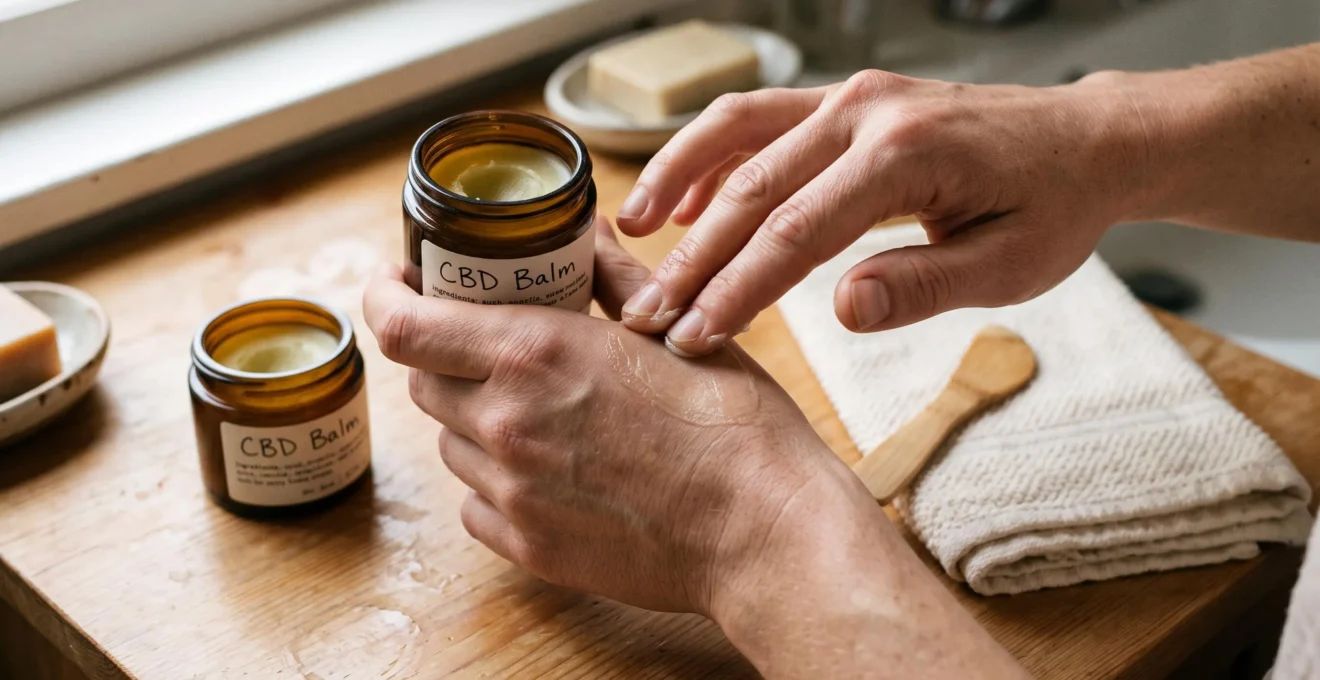
A CBD cream applied to one patch of skin does not automatically distribute cannabidiol throughout the body. Its first point of contact is the skin’s outer barrier, which controls how much CBD can move into deeper layers. The resulting exposure depends on where the product is placed, how it is formulated, and the conditions of application.
This distinction matters when choosing between a balm for a small area, a lotion for broader coverage, or a product specifically engineered for transdermal delivery. These formats may contain the same ingredient without delivering it to the same location or in comparable amounts.
Skin also contains molecular pathways that researchers are investigating for their potential interactions with cannabinoids. However, detecting CBD inside skin tissue does not establish that a finished cosmetic produces a particular biological or therapeutic effect.
Understanding localized epidermal delivery helps consumers establish more consistent application routines, interpret concentration labels, and distinguish ordinary skincare expectations from claims about systemic absorption.
CBD Topicals: What Matters Most
- Application location matters: Ordinary CBD skincare products primarily expose the treated skin area, although some CBD may penetrate beyond the surface.
- Formulation matters as much as concentration: The carrier, skin condition, application amount, and treated area influence how CBD is distributed.
- Local and systemic delivery are different: Measurable bloodstream exposure is possible with specialized transdermal systems but cannot be assumed for conventional balms and lotions.
- Why Does a CBD Topical Mainly Act at the Area Where It Is Applied?
- How Can You Apply a CBD Topical Consistently to One Specific Skin Area?
- Targeted Balm or Broad-Area Lotion: Which Better Fits a Localised Application Routine?
- Does Applying More CBD Topical Automatically Increase How Deeply It Penetrates?
- When Should the Size of the Target Area Change the Type of CBD Topical You Choose?
- Why Is Systemic Circulation Different from Local CBD Topical Exposure?
- Does a CBD Cosmetic Need to Penetrate Deeply to Serve a Surface Skincare Purpose?
- Which Specialised CBD Topical Blend Best Fits Different Skincare Needs?
Why Does a CBD Topical Mainly Act at the Area Where It Is Applied?
A CBD topical primarily creates exposure in the skin where it is applied because cannabidiol must first encounter and cross the local skin barrier. Some CBD can reach deeper skin layers, but movement into the bloodstream is not an automatic consequence. The extent of local deposition depends heavily on the formulation and application conditions.
The outermost skin layer, the stratum corneum, consists of densely arranged cells embedded in a lipid-rich structure. It restricts the passage of many substances, including cannabidiol. CBD is highly lipophilic, meaning it tends to associate with fats and oils, but this property alone does not ensure efficient movement through every skin layer.
Beneath the stratum corneum lie the viable epidermis and dermis. These tissues contain cells, enzymes, receptors, and signaling networks involved in normal skin physiology. Components of the endocannabinoid system, along with other potential cannabinoid-responsive targets, have been identified in skin.
Researchers are investigating how CBD interacts with these pathways. Nevertheless, CBD is not simply a substance that binds uniformly to cannabinoid receptors wherever it is applied. Its pharmacology involves multiple potential molecular targets, and laboratory evidence of skin penetration should not be interpreted as proof of a specific clinical effect.
In a human-skin study of topical CBD delivery and biodistribution, researchers compared several formulations using excised human abdominal skin. They observed CBD delivery into the viable epidermis and papillary dermis, with substantial differences between formulations.
5.25%
The highest reported delivery efficiency under finite-dose conditions was achieved by the experimental 1% colloidal gel. This result is formulation-specific and cannot predict delivery from ordinary retail CBD creams or balms.
University of Geneva researchers, Pharmaceutics, 2024; experimental investigation using excised human skin.
Importantly, local deposition is not the same as complete confinement. Some CBD can move beyond the outer barrier, and the amount retained in specific layers may change with the carrier system, exposure period, and condition of the skin.
It is therefore inaccurate to assume that CBD must enter the bloodstream before a topical product can have any meaningful skincare role. Surface conditioning and the delivery of ingredients into skin tissue are distinct from whole-body drug exposure. Whether CBD itself provides a particular benefit still requires appropriate evidence.
This local-first mechanism explains why precise placement can matter more to an everyday skincare routine than the assumption that CBD will travel throughout the body.
How Can You Apply a CBD Topical Consistently to One Specific Skin Area?
To apply a CBD topical consistently, identify the exact area to cover, use a repeatable amount, and distribute the product within the same boundaries each time. Record the amount and application schedule rather than relying on an undefined instruction to rub it in. This creates a comparable skincare routine without implying a medically validated CBD dose.
Begin by distinguishing the intended application zone from nearby skin. A small dry patch has relatively clear boundaries, whereas the area around a knee can expand considerably depending on how broadly the product is spread.
For intact skin, a practical routine involves cleaning the area gently, allowing it to dry, and using the amount specified on the manufacturer’s label. Spread the product evenly without aggressive rubbing. Follow product instructions concerning washing, reapplication, and contact with clothing.
Amount per unit of skin area is an important concept. Using the same quantity over twice the surface area reduces the average amount initially applied per unit area, even though actual CBD deposition may not change in a simple proportional way.
For example, applying a measured quantity to a small defined patch and then spreading that quantity across the whole forearm represents two different application conditions. Calling both routines the same dose would conceal the difference in coverage.
The following checklist is an organizational method for comparing personal skincare applications. It is not a clinically established CBD dosing protocol.
Five Steps for a Repeatable Local Application Routine
- Define the zone: Identify the intended boundaries and record a brief description or approximate dimensions of the area.
- Check the product: Read the concentration, directions, warnings, and recommended application amount; retain a record of the relevant label information.
- Measure consistently: Use a repeatable quantity consistent with the label instructions and record the amount used per session.
- Keep the application comparable: Apply to clean, dry, intact skin using a consistent spreading technique and record the application time.
- Review the routine: Maintain a short log of application area, amount, skin tolerance, and any changes, without treating subjective observations as evidence of CBD absorption or therapeutic efficacy.
Consistency also means recognizing changes that invalidate the comparison. Applying over damp skin one day, covering the site tightly another day, or switching to a different formulation can change the exposure conditions.
Avoid applying CBD cosmetics to broken or irritated skin unless the product is specifically intended for that use and its instructions permit it. Discontinue use if irritation develops.
Once the application area is defined, the next decision is whether the product’s physical format makes that coverage easy to reproduce.
Targeted Balm or Broad-Area Lotion: Which Better Fits a Localised Application Routine?
A balm is generally more practical for a small, clearly defined area because its thicker texture allows controlled placement. A lotion is often easier to distribute across a larger surface. Neither format automatically delivers more CBD into the skin: actual deposition depends on CBD concentration, the complete formulation, the amount applied, and exposure conditions.
Balms and salves commonly use oils, waxes, and other relatively occlusive ingredients. These create a dense texture that can remain visibly concentrated within a small application zone.
Lotions typically rely on emulsions containing water and oil phases. Their lighter consistency makes them easier to spread over a broader surface, although the properties of individual products vary considerably.
The practical differences can be compared without assuming that one product category is inherently more effective.
| Decision criterion | Balm or salve | Lotion |
|---|---|---|
| Typical consistency | Dense, waxy, or oily | Lighter, often an emulsion |
| Most convenient coverage | Small, defined areas | Medium or broad areas |
| Placement control | Often easier to keep within narrow boundaries | Easier to spread beyond the initial application point |
| Skin feel | May leave a persistent oily or waxy film | Often feels lighter, depending on formulation |
| CBD delivery | Cannot be predicted from texture alone | Cannot be predicted from texture alone |
| Practical limitation | Can be inconvenient across large surfaces | May require more careful measurement for small zones |
A product’s texture influences spreading behavior, but a thicker product is not necessarily a more concentrated product. A balm may contain less CBD per gram than a lotion, and either may incorporate ingredients that influence skin delivery.
A useful decision test starts with the size and clarity of the target area. If the intended zone can be described precisely, such as a small patch on the back of the hand, a balm may provide convenient application control.
If the goal is general skin conditioning over both forearms, a lotion is likely to be easier to distribute evenly. The choice concerns application practicality rather than proof of a different biological effect.
Consumers should also consider residue, fragrance, other ingredients, and suitability for their skin. A light emulsion may contain penetration-enhancing ingredients, while an oily balm may primarily support surface conditioning. Product labels and formulation evidence are more informative than appearance alone.
After selecting a manageable format, the amount applied becomes the next important variable—particularly because increasing the quantity does not guarantee proportionally deeper delivery.
Does Applying More CBD Topical Automatically Increase How Deeply It Penetrates?
No. Applying more CBD topical does not automatically produce proportionally greater or deeper penetration. Skin transport depends on the barrier, CBD concentration, formulation, exposure time, and amount applied per unit area. Additional product can increase the available dose, but it may also remain on the surface rather than moving efficiently into deeper layers.
The stratum corneum restricts the rate at which ingredients move inward. CBD must partition from its formulation into the skin and then diffuse through the relevant tissue structures.
Increasing the amount of a finished product is not equivalent to increasing its CBD concentration. One change increases the mass placed on the skin, while the other changes the composition and potentially the concentration gradient driving transport.
Both variables may affect delivery, but neither produces a universally predictable increase.
Laboratory results illustrate this distinction. In a human-skin study of CBD concentration and penetration enhancers, researchers compared CBD solutions at different concentrations. Under the tested conditions, they found no statistically significant difference in skin absorption between the 5% and 10% CBD solutions.
242.41 ± 12.17 µg/cm²
Reported CBD absorption into skin after 24 hours from the experimental 5% solution, compared with 23.02 ± 4.74 µg/cm² from the 1% solution. These are laboratory findings, not recommended consumer application amounts.
Junaid and colleagues, International Journal of Pharmaceutics, 2022; in vitro human-skin experiments.
The same research found that oleic acid enhanced CBD delivery under certain experimental conditions, whereas the tested penetration enhancers did not all perform similarly.
These findings illustrate why formulation design can matter more than a simple concentration comparison. They do not establish a universal saturation point or prove that applying twice as much finished cream leaves skin absorption unchanged.
Other factors may influence delivery:
- Occlusion: Coverings can change skin hydration and exposure conditions, potentially altering penetration.
- Skin integrity: Damaged or compromised skin may behave differently from intact skin.
- Contact duration: The period before washing or removing a product influences how long it remains available at the surface.
- Carrier ingredients: Oils, solvents, emulsifiers, and other components can influence how CBD partitions into skin.
Applying more than the label recommends is not an appropriate way to compensate for uncertain absorption. It can increase residue, cost, and unwanted ingredient exposure without providing a predictable benefit.
For a practical comparison, keep the product, approximate coverage area, and application schedule consistent. Change only an ordinary skincare variable when appropriate and assess tolerability, rather than experimenting with occlusion, damaged skin, or excessive quantities to force deeper absorption.
The most useful quantity comparison therefore begins with the area being covered, not merely the amount of product squeezed from the container.
When Should the Size of the Target Area Change the Type of CBD Topical You Choose?
The size of the target area should influence product choice when it changes how evenly and economically a topical can be applied. A small, defined zone may suit a balm, while a broad or irregular surface may be easier to cover with lotion. The key comparison is the amount of CBD-containing product distributed per unit of skin.
Covering a small patch and covering an entire limb require different quantities to achieve the same nominal application density. Yet package labels often emphasize total CBD content without indicating how much would be distributed across a particular area during normal use.
Three quantities should be distinguished:
- Total CBD content: The amount of cannabidiol stated for the entire container.
- CBD concentration: The amount of cannabidiol per gram or milliliter of product, when reliably specified.
- Amount applied per area: The estimated CBD mass placed on each unit of skin during an application.
Consider an explicitly hypothetical comparison: a cream contains 300 mg of CBD in a 60 g container, with uniform distribution throughout the product.
Hypothetical Example: Comparing Two Application Areas
Dividing 300 mg by 60 g gives a nominal concentration of 5 mg CBD per gram of cream. If 1 g is applied, the nominal CBD amount placed on the skin is 5 mg.
Spread evenly over a hypothetical 25 cm² patch, that corresponds to 0.20 mg CBD/cm² initially applied. Spread across 100 cm² instead, it corresponds to 0.05 mg CBD/cm².
These figures describe the amount placed on the skin, not the amount absorbed, retained in the epidermis, or delivered to the bloodstream. The example is mathematical and does not represent a dosing recommendation or tested product.
The calculation is useful because it makes the coverage-versus-quantity trade-off visible. The same measured amount can produce very different nominal surface loading when the application boundary changes.
However, equal milligrams per square centimeter do not guarantee equal tissue exposure across products. Formulation properties, skin characteristics, and application duration remain important.
Cost also becomes relevant as the target area expands. A small container of dense balm may be convenient for occasional localized use but cumbersome for broad daily coverage. A larger lotion container may be more practical, even if its CBD concentration differs.
When assessing product information, check whether CBD content is stated per container, per unit of product, or as a percentage. Do not assume that milligrams and milliliters are interchangeable without knowing the formulation’s density.
If concentration or serving information is missing, precise exposure comparisons may not be possible. In that case, product suitability should not be inferred from promotional claims about strength.
Even after estimating local application amounts, one further distinction remains essential: placing CBD on the skin does not establish how much, if any, will reach systemic circulation.
Why Is Systemic Circulation Different from Local CBD Topical Exposure?
Local CBD topical exposure means cannabidiol is present at the skin surface or within skin layers near the application area. Systemic exposure occurs when CBD crosses the necessary tissue barriers and reaches circulating blood. These are distinct delivery outcomes. A conventional cosmetic may deposit CBD locally without producing measurable blood concentrations, while specialized transdermal systems can be designed for systemic delivery.
When a cream is applied, CBD initially encounters the stratum corneum. Depending on the formulation, some may remain near the surface, accumulate in skin tissue, move further inward, or enter dermal circulation.
Reaching the dermis does not automatically establish meaningful systemic exposure. Bloodstream delivery depends on how much CBD moves through the relevant barriers, the rate of transport, clearance, and the sensitivity of the method used to measure circulating CBD.
This explains why ordinary topical skincare and transdermal drug-delivery technology should not be treated as interchangeable.
Transdermal systems may use specially selected carriers, penetration-enhancing components, controlled-release structures, or other engineering approaches intended to increase transport across the skin.
In a clinical study of systemic cannabinoid absorption through the skin, researchers investigated a specialized formulation containing both CBD and THC in 18 healthy adults.
The formulation was applied to the hand, wrist, and forearm, and cannabinoids were subsequently detected in blood samples. This demonstrated that the investigated system could produce systemic absorption under the study conditions.
Human Evidence: Systemic Delivery With an Engineered Cannabinoid Formulation
The exploratory Canadian clinical study investigated a specialized transdermal product containing 100 mg CBD and 100 mg THC. Blood samples were collected over 12 hours, and the per-protocol pharmacokinetic analysis included 13 participants.
The reported mean maximum plasma CBD concentration was 576.52 ± 1016.18 pg/mL, demonstrating substantial variability. The small, uncontrolled study and specialized mixed-cannabinoid formulation prevent these results from being generalized to conventional CBD-only cosmetics.
This evidence establishes the possibility of systemic delivery, not the likelihood of systemic absorption from an ordinary balm or lotion.
Several conditions may influence the difference, including skin integrity, use of occlusive coverings, formulation chemistry, contact time, and applied quantity relative to surface area. However, these factors do not provide a reliable consumer method for predicting blood CBD levels.
People sometimes ask whether a topical will affect the whole body. The scientifically appropriate answer is that local application does not guarantee zero systemic absorption, but neither does it justify assuming that a cosmetic will behave like an oral CBD product.
Products should be used according to their intended purpose, not modified in an attempt to achieve systemic delivery. Anyone concerned about drug interactions, pregnancy, breastfeeding, or potential systemic exposure should seek qualified medical advice before using CBD-containing products.
For many cosmetic routines, the intended result concerns the outer skin itself, making deep penetration an unnecessary benchmark for evaluating the product’s purpose.
Does a CBD Cosmetic Need to Penetrate Deeply to Serve a Surface Skincare Purpose?
No. A CBD cosmetic intended for surface skincare does not necessarily need to deliver CBD into deep skin tissues. Goals such as moisturizing, improving skin feel, and supporting the outer skin barrier can be addressed by ingredients acting at or near the surface. The important question is whether the finished formulation fulfills its stated cosmetic purpose.
The skin’s outer layers play a major role in managing moisture and protecting against environmental exposure. Products containing emollients, humectants, and occlusive ingredients can support these surface functions without requiring active ingredients to reach deeper anatomical structures.
For example, a balm may improve the feel of dry skin through its lipid-rich base. A lotion may help reduce sensations associated with surface dryness by combining moisturizing ingredients with an easily spreadable texture.
These effects should not automatically be attributed to CBD. The finished formulation must be evaluated as a whole, and evidence that a carrier moisturizes skin is not equivalent to proof that cannabidiol itself produces an additional cosmetic benefit.
A distinction is also necessary between cosmetic and therapeutic claims. Cosmetics are generally associated with purposes such as cleansing, beautifying, or altering appearance, whereas products intended to treat disease or affect bodily structure or function may fall under medicines or drug regulation.
In the United States, the FDA’s guidance on cannabis-derived products and cosmetics explains that regulatory classification depends on intended use and claims. A CBD-containing cosmetic does not become an approved drug simply because cannabidiol is present.
Likewise, a balm advertised as treating a medical condition cannot necessarily avoid drug requirements by calling itself a wellness or skincare product.
These are U.S. regulatory distinctions. Other English-speaking countries have their own frameworks governing CBD ingredients, cosmetic claims, product classification, and market access. Legal availability in one country does not establish compliance elsewhere.
For surface skincare, the appropriate performance criteria may include spreadability, skin feel, moisturization, tolerability, and compatibility with the user’s routine. Deep penetration is not inherently desirable, particularly when the product is intended only for external cosmetic use.
Even evidence of CBD accumulation within skin layers must be interpreted carefully. Detectable deposition is a delivery measurement, not a demonstration that the product improves hydration, treats inflammation, or manages a dermatological disease.
This distinction shifts attention away from penetration claims and toward a more practical final choice: selecting a complete topical formulation that matches the skin area, cosmetic goal, and desired application routine.
Key Takeaways Before Choosing a CBD Topical Blend
- Define the cosmetic goal first: improving the feel of a small dry patch is different from moisturizing a broad surface or seeking a medical effect.
- Compare the entire ingredient system, including moisturizers, occlusive ingredients, fragrance, and carrier composition, rather than ranking products solely by CBD concentration.
- Prioritize clear CBD labeling, an appropriate format, realistic claims, and compatibility with the intended application area.
Which Specialised CBD Topical Blend Best Fits Different Skincare Needs?
The most suitable CBD topical blend depends on the skincare goal, the size of the application area, and the formulation’s overall characteristics. A dense, occlusive balm may fit localized surface conditioning, while a lightweight moisturizing lotion may suit broader daily coverage. CBD concentration alone cannot establish which blend will deliver better skincare results.
Specialized topical blends combine different types of ingredients, each serving a potential function in the finished product. CBD may be included alongside carrier oils, waxes, emulsifiers, humectants, emollients, and botanical extracts.
Their combined characteristics influence how the product spreads, feels, retains moisture, and makes CBD available at the skin surface. The presence of a botanical ingredient does not automatically establish additional efficacy, and botanical extracts can introduce irritation or sensitization risks for some users.
The following comparison aligns common formulation characteristics with practical cosmetic needs rather than unsupported therapeutic promises.
| Skincare need | Relevant blend characteristics | What to verify |
|---|---|---|
| Small, localized dry area | Dense balm or salve with emollient and occlusive ingredients | Precise application, comfortable residue, full ingredient list |
| Broad-area daily moisturizing | Spreadable lotion with humectants and emollients | Coverage, skin tolerance, practical container size |
| Surface comfort and barrier conditioning | Moisturizing base appropriate for the user’s skin | Evidence supporting cosmetic benefits, not simply CBD strength |
| Skin sensitive to fragranced products | Simple formulation with fewer potentially irritating additives | Fragrance, essential oils, botanical extracts, and individual tolerability |
| Precise repeatable application | Clearly labeled product with manageable consistency and dispensing | CBD amount per unit, label instructions, and consistent coverage |
One important distinction concerns the ingredient base. Occlusive materials can help limit moisture loss from the outer skin. Humectants attract and retain water, while emollients improve the feel and smoothness of the skin surface.
These established cosmetic functions may contribute more visibly to everyday moisturization than the mere presence of CBD. The actual contribution of cannabidiol cannot be inferred without formulation-specific evidence.
A concentrated topical should therefore not be considered automatically more useful than a lower-concentration product. Different formulations may distribute CBD differently, and the degree of penetration does not by itself predict cosmetic efficacy.
Before purchasing, consumers can use three verification questions:
- Is CBD content clearly stated? Check the total amount, concentration where available, and whether the label specifies CBD rather than a generic hemp-derived ingredient.
- Does the product’s intended use match the goal? Distinguish ordinary cosmetic skin conditioning from products claiming medical treatment or systemic delivery.
- Does the format fit the application area? Choose a consistency that can be spread evenly and repeatedly without unnecessary excess.
Product labeling should also be assessed alongside the applicable requirements in the country where the cosmetic is sold. A marketing description such as topical wellness is not itself a reliable legal classification or evidence of safety and effectiveness.
When available, credible independent testing for stated cannabinoid content and relevant contaminants can improve confidence in product quality. However, a laboratory certificate does not demonstrate clinical skincare efficacy or guarantee a particular depth of penetration.
Ultimately, the most defensible choice is a formulation that suits an identifiable area, supports a clearly defined cosmetic purpose, and can be applied according to reliable instructions. No single balm, lotion, or CBD concentration can be identified as universally superior from the available delivery studies.
Before starting a routine, record the target area, read the product’s full ingredient list and usage directions, and confirm that its claims match the intended cosmetic purpose. This provides a more useful basis for choosing CBD skincare than assuming that higher concentration or deeper penetration necessarily means better performance.
Can CBD remain in the skin after the visible cream has absorbed?
Yes. Laboratory studies have demonstrated that CBD can be deposited within skin tissue after topical application. However, the disappearance of visible residue does not reveal how much CBD entered the skin, where it was retained, or how long it remained there. These outcomes depend on formulation and experimental conditions.
Is a higher CBD percentage always better for skincare?
No. Higher CBD concentration may alter delivery, but the relationship is not necessarily proportional. Human-skin laboratory experiments have shown formulation-dependent differences in absorption, including conditions where increasing CBD concentration did not produce a statistically significant increase. These findings do not establish that higher concentrations provide better cosmetic results.
Can CBD topicals be applied to broken or irritated skin?
CBD cosmetics should not be applied to broken or irritated skin unless they are specifically intended and appropriately labeled for that use. Compromised skin may have altered barrier properties and can be more susceptible to unwanted ingredient exposure or irritation. Seek professional advice for persistent skin problems rather than using a cosmetic as a substitute for treatment.
Does a CBD topical’s ingredient list tell you how deeply CBD penetrates?
Not reliably. An ingredient list can identify the presence of carriers, oils, humectants, and other components, but it does not establish quantitative CBD penetration. Reliable depth and deposition claims require appropriate testing of the particular formulation under defined conditions.
Are CBD skincare products regulated the same way in every English-speaking country?
No. Rules governing cannabinoid ingredients, cosmetic classification, labeling, product safety, and therapeutic claims vary by jurisdiction. U.S. FDA guidance cannot be treated as a universal framework for the United Kingdom, Canada, Australia, or other markets. Product compliance must be assessed under the requirements applicable where the product is marketed.