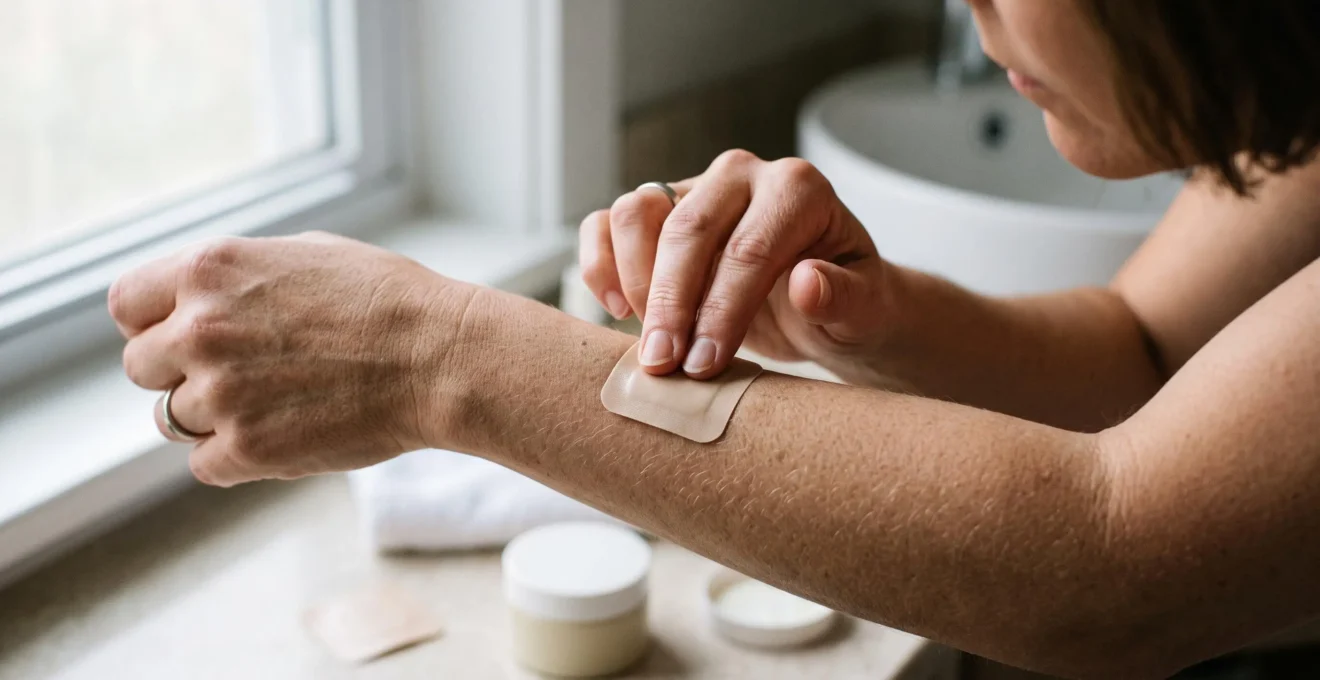
Two CBD products can contain the same cannabinoid, be applied to the same area of skin and still be designed for fundamentally different purposes. A conventional CBD topical generally prioritizes application to the skin and local effects. A transdermal formulation is engineered to move an active substance across the skin barrier, potentially reaching systemic circulation.
The distinction is not simply whether a product is a patch, cream or gel. It involves the formulation vehicle, the intended delivery pathway, the control of exposure and the evidence supporting the manufacturer’s claims. A patch can remain primarily skin-focused, while a specially engineered semisolid formulation may achieve measurable permeation.
For consumers comparing skin-applied CBD products, understanding these differences helps distinguish delivery technology from marketing language. It also clarifies why stronger penetration is not necessarily desirable, particularly when the intended effect is local or the skin barrier is compromised.
Transdermal CBD vs topical CBD: the essentials
- Conventional topicals primarily target the application site; transdermal systems are designed to deliver active substances across the skin barrier, potentially into circulation.
- Patches can provide more controlled contact conditions, but their appearance does not prove consistent CBD delivery or systemic absorption.
- Formulation evidence, skin tolerability and intended effects matter more than CBD concentration, texture or claims of deep absorption.
- Why Is Transdermal Delivery More Technically Demanding Than Ordinary Topical Application?
- How Can You Tell Whether a CBD Product Is Truly Designed for Transdermal Delivery?
- CBD Patch or Cream: Which Format Offers More Controlled Skin Contact?
- Why Should Transdermal CBD Products Be Used Cautiously on Compromised Skin?
- When Does Transdermal Design Matter More Than Texture or Fragrance in a CBD Topical?
- How Can You Recognise a Systemic-Delivery Claim on a CBD Topical Label?
- Why Is the Stratum Corneum Such an Effective Barrier to Topical Ingredients?
- When Does Systemic Circulation Matter in the Design of CBD Delivery Formats?
Why Is Transdermal Delivery More Technically Demanding Than Ordinary Topical Application?
Transdermal CBD delivery is technically more demanding because the formulation must overcome the skin’s protective barrier while managing how much CBD moves through it and when. Conventional topical products can be designed for effects at or near the application site, whereas systemic transdermal delivery requires additional control over permeation, release and exposure.
The first challenge is the stratum corneum, the outermost layer of the epidermis. Its organized lipid structure restricts the movement of many compounds, including highly lipophilic molecules such as cannabidiol. Dissolving CBD in an oil or cream does not establish that meaningful quantities will cross the skin.
A transdermal formulation may need to coordinate several properties:
- Drug availability: CBD must remain sufficiently available within its vehicle to partition into the skin rather than remain trapped in the formulation.
- Barrier penetration: The delivery system must enable movement across the stratum corneum without creating unacceptable local irritation.
- Release behavior: The formulation must provide an appropriate release pattern over its intended application period.
- Dose consistency: Delivery should be characterized under defined application conditions, including the relevant area and duration of contact.
- Formulation stability: The carrier must maintain suitable physical and chemical properties during storage and use.
These concerns change the development process. A conventional CBD cream may focus on spreadability, cosmetic stability and skin feel. An engineered transdermal system also needs experimental evidence describing release, permeation and, where systemic exposure is intended, the resulting concentrations in blood.
In a study of CBD formulation vehicles and skin permeation, researchers compared different CBD preparations using human skin in vitro. Their findings demonstrated that vehicle composition, solubility and partitioning influence permeation and skin retention. The results also showed that increasing CBD solubility in a vehicle does not necessarily increase delivery through the skin.
0.99 ± 0.14 µg/h/cm²
Reported steady-state CBD flux for the liquid paraffin solution tested in the in vitro human skin study. This formulation-specific laboratory result does not establish the performance of commercial CBD patches or clinical systemic delivery.
Original research published in Pharmaceuticals, 2020.
Another challenge is the relationship between penetration and tolerability. Chemical enhancers or occlusive conditions may improve drug movement, but they can also affect skin hydration and irritation risk. Maximizing permeation without examining the skin response would therefore be an incomplete development strategy.
The practical distinction is the engineering objective: conventional topical development can focus on local application, while a systemic transdermal product must demonstrate that its intended delivery pathway is achievable and appropriately controlled.
How Can You Tell Whether a CBD Product Is Truly Designed for Transdermal Delivery?
A CBD product is more convincingly designed for transdermal delivery when its manufacturer identifies a specific delivery system, explains its intended release behavior and provides relevant permeation evidence. Words such as « deep absorption » or « fast-acting » are insufficient. Patch construction, application instructions and validated performance data offer more meaningful clues.
Begin by examining how the product is constructed. A patch may use a matrix, reservoir or drug-in-adhesive arrangement, sometimes combined with an occlusive backing layer. These features can indicate deliberate control of how a substance is held against the skin and released. However, their presence alone does not confirm that CBD reaches systemic circulation.
A manufacturer’s documentation should ideally distinguish three separate stages: release of CBD from the formulation, passage through the skin and measurable exposure at the intended destination.
Duration-of-wear instructions provide another useful signal. A product specifying sustained contact over several hours may have a different formulation objective from a cream intended for brief application. Nevertheless, a stated wear period is an instruction, not experimental proof of continuous release.
Clinical pharmacokinetic evidence is particularly relevant when the manufacturer claims delivery into the bloodstream. A human exploratory study, a human pharmacokinetic study of transdermal CBD and THC delivery, detected cannabinoids in blood after application of a particular experimental formulation. The findings supported systemic exposure for that tested system, but substantial differences between participants limited conclusions about predictability.
What a human transdermal cannabinoid study actually demonstrated
In a single-arm, open-label exploratory study, healthy adults received an investigated formulation containing 100 mg CBD and 100 mg THC. Researchers collected blood samples over 12 hours to examine systemic absorption.
The reported mean time to maximum plasma concentration was 8 hours for both cannabinoids. However, exposure varied considerably between individuals. Detection in blood demonstrated systemic absorption under the tested conditions, not consistent performance across commercial patches or proven therapeutic efficacy.
When reviewing a retail product, ask whether its evidence concerns the actual finished formulation rather than CBD generally, a different patch technology or an isolated ingredient.
Five checks before accepting a transdermal CBD claim
- Identify the delivery architecture: Find the manufacturer’s description of the matrix, reservoir, adhesive or other delivery vehicle. Record the stated technology or note that it is undisclosed.
- Check the intended destination: Locate language distinguishing local skin delivery from delivery beyond the skin. Write down the exact intended effect.
- Document the wear instructions: Record the recommended application area, contact duration and removal instructions.
- Request formulation-specific evidence: Ask for release, skin-permeation or human pharmacokinetic data concerning the finished product. Note which types of evidence are actually available.
- Compare evidence with the claim: Make a short comparison of what the product promises and what its testing demonstrates, marking any unsupported conclusion.
The absence of publicly available technical data does not automatically prove a product is ineffective. It does, however, limit what consumers can reasonably conclude about its delivery performance.
Once the manufacturer’s actual evidence is established, product format becomes a practical consideration: different formats influence how consistently the formulation remains in contact with the skin.
CBD Patch or Cream: Which Format Offers More Controlled Skin Contact?
A CBD patch generally offers more standardized skin contact than a cream because its application area, formulation quantity and intended wear duration are more clearly defined. A cream gives the user greater flexibility but introduces variation through spreading, application thickness, rubbing and reapplication. Neither format inherently guarantees superior CBD penetration or systemic delivery.
A patch can establish a relatively fixed interface between the formulation and the skin. Its backing may reduce exposure to the external environment, while the adhesive helps maintain contact over the designated period.
This arrangement can make formulation testing more reproducible. It does not eliminate differences in adhesion, skin condition, temperature or individual permeation.
Creams behave differently. Their application depends on how much product is dispensed, how widely it is spread and whether it remains in place. Vehicle composition also determines whether the formulation forms a persistent film, changes as volatile ingredients evaporate or retains CBD within surface layers.
Occlusion is another important distinction. Covering the skin can alter hydration and barrier conditions, potentially affecting drug partitioning and penetration. These effects depend on the formulation and application environment rather than following a universal rule that occlusion always improves CBD absorption.
The following comparison concerns application control rather than proven cannabinoid absorption. Actual performance still depends on the finished formulation and its supporting evidence.
| Criterion | CBD patch | CBD cream |
|---|---|---|
| Contact area | Defined by patch dimensions | Varies with spreading |
| Amount applied | Predetermined formulation load per patch | Determined by the user |
| Contact duration | Specified wear period, subject to adhesion | Depends on formulation and user behavior |
| Occlusion | Often relatively high under the backing | Depends on composition and any covering |
| Application flexibility | Restricted by size, shape and instructions | Adaptable to different skin areas |
| Removal | Patch can be peeled away, although residue may remain | Residual product may require washing |
| Systemic CBD delivery | Requires product-specific validation | Also requires product-specific validation |
A patch may therefore suit a product designed for prolonged, defined contact, provided that its performance and tolerability are supported. A cream may be preferable for flexible coverage, localized cosmetic use or an application routine involving massage.
Controlled contact also introduces a limitation. Prolonged exposure at one site can contribute to irritation or adhesive-related reactions. When repeated application is permitted, rotating between suitable intact-skin sites according to the product instructions may reduce repeated exposure to a single area.
For either format, predictable application matters only when the skin can tolerate the formulation. That makes the condition of the application site a central safety consideration.
Why Should Transdermal CBD Products Be Used Cautiously on Compromised Skin?
Transdermal CBD products require additional caution on compromised skin because damage to the protective barrier can change how ingredients enter the tissue. Wounds, inflammation, abrasions and other forms of barrier disruption may increase or destabilize exposure. Penetration enhancers, adhesives and solvents may also aggravate sensitive or injured areas.
The stratum corneum normally limits the movement of external substances. When its integrity is reduced, the skin may no longer resist a formulation in the same way as the intact skin used during product development or laboratory testing.
For a system intended to promote permeation, this creates a particular problem: the relationship between the applied amount and the amount crossing the skin may become less predictable.
Situations warranting caution include open cuts, visibly inflamed skin, active eczema flares, abrasions, significant irritation and recently shaved skin showing signs of disruption. These conditions are not interchangeable, and their effects on penetration cannot be quantified without relevant evidence.
Delivery-enhancing ingredients deserve particular attention. Some vehicles use solvents or chemical agents that influence the skin barrier. An ingredient suitable for an evaluated formulation applied to intact skin is not necessarily appropriate for broken or inflamed skin.
Patch adhesives and prolonged occlusion also have tolerability implications. Moisture accumulation, friction and repeated removal may affect the skin locally, independently of CBD itself.
Before application, inspect the proposed site and consult the finished product’s instructions for approved application areas, skin-condition restrictions and recommended wear time. Do not assume that a topical product is appropriate for damaged skin simply because it is applied externally.
If the skin is broken, unusually inflamed or reacting to a previous application, avoid applying a transdermal CBD product there unless a qualified healthcare professional and the product’s authorized instructions specifically support that use. Seek medical advice for persistent irritation or suspected reactions.
Additional caution is appropriate when a product claims systemic CBD exposure, particularly for people taking medicines, because clinically meaningful systemic CBD can interact with other drugs. The relevance depends on actual exposure, not merely the word « transdermal » on the packaging.
The safety question is therefore inseparable from delivery design: a formulation engineered to cross an intact barrier should not be assumed to behave identically when that barrier is damaged.
When Does Transdermal Design Matter More Than Texture or Fragrance in a CBD Topical?
Transdermal design matters more than texture or fragrance when the objective is controlled delivery beyond the skin surface rather than cosmetic comfort. Sensory qualities influence how pleasant a product is to apply, but they do not establish CBD penetration, sustained release or systemic absorption. The intended effect should determine which characteristics receive priority.
A cream that spreads easily, absorbs pleasantly and leaves little residue may be well suited to a cosmetic routine. Those features are relevant when convenience, local application and skin feel are the principal goals.
They answer a different question from the one addressed by transdermal engineering.
For delivery-focused formulations, characteristics such as CBD thermodynamic activity, release from the carrier, skin partitioning and contact duration become more important. A gel, adhesive matrix or alternative carrier may be selected because of its physicochemical behavior rather than its sensory appeal.
Consider a hypothetical comparison between two CBD products. Product A is a lightly fragranced cream that feels dry shortly after application. Product B is an adhesive matrix intended to remain on the skin for a defined period.
The sensory experience favors Product A for someone who dislikes residue or prolonged contact. But this observation cannot establish that Product A delivers less CBD, just as Product B’s prolonged contact cannot establish that it delivers more. Their actual performance requires formulation-specific testing.
In particular, rapid disappearance from the skin surface is not proof that delivery has stopped. Evaporation, absorption into superficial layers and changes in the remaining film can occur without being obvious to the user. Sensory impressions cannot distinguish these processes reliably.
A useful way to prioritize product attributes is to separate the desired outcome from the preferred experience:
- For ordinary cosmetic skin care, assess texture, fragrance, compatibility and application convenience alongside ingredient safety.
- For prolonged local contact, examine the carrier, intended residence time and tolerability rather than relying solely on how the product feels.
- For intended systemic delivery, prioritize evidence of permeation and systemic exposure, followed by practical considerations such as comfort and wearability.
These dimensions are not mutually exclusive. A delivery-focused formulation can be comfortable, and an elegant cream can be technically sophisticated. Neither quality should be inferred from the other.
Once the intended use is clear, the next question is whether the product’s label describes that purpose accurately, particularly when it suggests effects beyond the application site.
How Can You Recognise a Systemic-Delivery Claim on a CBD Topical Label?
A systemic-delivery claim suggests that CBD is intended to act beyond the application site, potentially after entering the bloodstream. Statements about delivering CBD into circulation, producing whole-body effects or acting throughout the body indicate a different intended purpose from ordinary cosmetic claims about skin appearance or surface comfort.
The wording on a product label should be examined in context. A statement such as « delivers CBD into the bloodstream » explicitly describes a systemic delivery pathway. Claims of « whole-body relief » may imply a systemic effect, while wording about moisturizing or soothing the skin generally points toward a local cosmetic purpose.
Less explicit phrases require interpretation. « Long-lasting comfort » alone does not establish a systemic claim, but its meaning may change when paired with references to internal effects or treatment of a medical condition.
Regulatory classification depends on intended use, not simply product format. In the United States, the FDA‘s regulatory explanation of cannabis-derived products distinguishes cosmetic purposes from claims involving treatment of disease or effects on the body’s structure or function.
A skin-applied product presented as a drug may therefore face different regulatory requirements from a product marketed strictly for cosmetic purposes. An unapproved therapeutic claim does not itself establish that the product works or is legally authorized for that use.
Rules vary between English-speaking jurisdictions, including the United States, United Kingdom, Canada and Australia. A claim or product classification acceptable in one market should not be assumed acceptable elsewhere. Terms such as « cosmetic registration » also should not be interpreted as universal evidence of official approval.
Consumers can examine three connected elements:
- Claimed destination: Does the label refer to the skin, underlying tissues, bloodstream or whole-body effects?
- Claimed outcome: Is the product presented for cosmetic care, local comfort or treatment of a condition?
- Supporting information: Does the manufacturer provide evidence and appropriate regulatory information for that intended use?
A mismatch deserves investigation. For example, a hypothetical patch promoted as delivering CBD throughout the body while offering only cosmetic-style information and no supporting systemic-exposure data leaves an important evidence gap.
Neither the patch format nor the phrase « transdermal technology » resolves that gap.
Recognizing the claim is only the first stage. Evaluating its scientific plausibility also requires an understanding of the skin barrier that the formulation must cross.
Why Is the Stratum Corneum Such an Effective Barrier to Topical Ingredients?
The stratum corneum is an effective barrier because it combines flattened, protein-rich cells with an organized extracellular lipid matrix that restricts molecular movement. This structure protects the body from external substances and water loss. Although CBD is lipophilic, its affinity for lipids does not guarantee that it can cross the entire skin barrier efficiently.
The stratum corneum is frequently described using a brick-and-mortar analogy. The flattened corneocytes represent the bricks, while the surrounding lipids form the mortar. These lipids are organized into structures that influence how different substances move through the outer skin.
Hydrophilic molecules often encounter difficulty entering the lipid-rich pathways. Lipophilic molecules may partition more readily into certain regions, but they can also be retained there rather than passing through to deeper tissues.
This distinction is particularly relevant for CBD. A formulation may produce measurable CBD accumulation in the skin without establishing substantial delivery into the systemic circulation.
Skin retention and skin permeation are different measurements. Retention describes how much substance remains within the investigated skin tissue, while permeation assesses movement through it under the conditions of the experiment.
The previously discussed human skin study demonstrated this distinction with two tested CBD solutions:
| Measurement | Liquid paraffin solution | Propylene glycol solution |
|---|---|---|
| Cumulative CBD permeated | 22.07 ± 3.92 µg/cm² | 23.05 ± 6.79 µg/cm² |
| CBD retained in skin | 15.15 ± 4.02 µg/cm² | 37.81 ± 9.20 µg/cm² |
| Steady-state CBD flux | 0.99 ± 0.14 µg/h/cm² | 1.06 ± 0.34 µg/h/cm² |
These results illustrate how two vehicles can produce relatively similar measured permeation while differing in skin retention. They apply to the specific experimental formulations and conditions, not to all products containing either ingredient.
Skin permeability also varies with hydration, temperature, anatomical location and barrier condition. The stratum corneum continually renews itself, and its physical state is not identical across individuals or application sites.
Delivery technologies may attempt to influence these conditions through occlusion, vehicle selection, penetration enhancers or release-system design. However, a higher CBD concentration alone does not demonstrate that more CBD will traverse the barrier.
The remaining question is whether crossing this barrier into the bloodstream is even necessary for the effect the consumer is seeking.
Key takeaways for choosing a CBD delivery format
- Define the intended destination of CBD before comparing product technologies: delivery into skin tissue is not equivalent to delivery into circulation.
- Match the strength of the evidence to the claim. Laboratory permeation measurements, human blood-concentration data and clinical effectiveness answer different questions.
- Treat systemic exposure as a specific formulation requirement with potential safety implications, not as an automatic advantage over local application.
When Does Systemic Circulation Matter in the Design of CBD Delivery Formats?
Systemic circulation matters when a CBD formulation is specifically intended to deliver the cannabinoid beyond the application site and into the bloodstream. For products intended primarily for cosmetic skin care or local exposure, systemic delivery may be unnecessary. The appropriate design depends on the desired destination, supporting evidence and associated safety requirements.
This creates a useful distinction between delivering CBD to the skin and delivering CBD through the skin. The first objective may involve retention within the epidermis or other local tissues. The second, when systemic exposure is intended, requires sufficient movement across the barrier and into circulation.
A formulation designed for systemic delivery must address more than whether CBD can cross the skin in a laboratory experiment. Developers need to examine the relationship between applied dose, release behavior, permeation and systemic exposure.
The relevant evidence may therefore include controlled formulation testing and human pharmacokinetic measurements. Plasma concentrations help establish whether CBD reached circulation under the investigated conditions, while concentration-time measurements can describe the resulting exposure profile.
Even successful systemic absorption does not independently demonstrate therapeutic benefit. Clinical effectiveness requires evidence appropriate to the specific claimed outcome.
For pharmaceutical delivery systems, these distinctions affect product development and quality assessment. The FDA’s draft guidance on transdermal and topical delivery systems discusses development and quality considerations involving formulation design, manufacturing, adhesion and factors affecting performance and safety. The document is explicitly a draft marked as not for implementation, and it does not validate commercial CBD patches.
For consumers, systemic exposure also changes the risk assessment. If enough CBD enters circulation, potential systemic adverse effects and interactions with medicines become relevant. This consideration cannot be evaluated from patch appearance or labeled CBD content alone.
A practical selection framework begins with the intended effect:
| Primary objective | Relevant delivery consideration | Evidence or information to examine |
|---|---|---|
| Cosmetic skin care | Suitability for local external application | Ingredient safety, cosmetic claims and skin compatibility |
| Localized cannabinoid exposure | CBD release and distribution within relevant skin tissues | Product-specific skin retention or permeation data |
| Prolonged, defined skin contact | Consistency of contact and local tolerability | Wear instructions, adhesion and formulation performance |
| Systemic CBD delivery | Reliable movement into circulation | Human pharmacokinetic evidence, dose characterization and appropriate regulatory status |
The differences also show why « more penetration » is not a universal measure of product quality. A cosmetic cream need not deliver CBD into the bloodstream to fulfill its stated cosmetic purpose. Conversely, a product claiming systemic cannabinoid effects needs evidence beyond attractive texture or prolonged wear.
Neither conventional creams nor transdermal patches should be assumed effective for treating pain or other medical conditions solely because they contain CBD. Such conclusions require appropriate product-specific clinical evidence.
Start with the effect the product is supposed to achieve, identify where CBD would need to act, and check whether the finished formulation has credible evidence for that delivery pathway. This approach provides a more defensible basis for comparing patches, creams and gels than marketing descriptions or cannabinoid concentration alone.
Can a CBD cream penetrate the skin without being called transdermal?
Yes. CBD can enter or pass through skin layers under certain formulation conditions, even when a product is not marketed as transdermal. Laboratory studies have demonstrated measurable CBD skin retention and permeation from selected liquid and semisolid vehicles. However, penetration into skin tissue is not the same as proven systemic delivery, and results cannot automatically be generalized to retail creams.
Does a larger amount of CBD in a patch mean that more reaches the bloodstream?
Not necessarily. The labeled amount describes the quantity of CBD contained in the product, not the quantity released, absorbed or delivered systemically. Vehicle composition, skin partitioning, application conditions and release behavior all influence delivery. Product-specific permeation and pharmacokinetic evidence are needed to assess bloodstream exposure.
Are CBD patches automatically more effective than CBD creams?
No. Patches can provide more standardized contact conditions, but that does not establish greater absorption or superior clinical effects. The available research described here does not provide a universal patch-versus-cream effectiveness ranking. An appropriate comparison must consider the intended effect, finished formulations, relevant measurements and skin tolerability.
Does detecting CBD in the blood prove that a transdermal product works?
Detectable CBD in blood demonstrates systemic exposure under the investigated conditions. It does not necessarily establish predictable dosing, beneficial clinical effects or acceptable long-term safety. Those conclusions require additional evidence. Findings from one experimental formulation also cannot be applied automatically to other CBD patches or creams.
Can CBD patches and creams contain ingredients that irritate sensitive skin?
Yes. Depending on their composition, skin-applied products may contain adhesives, fragrances, solvents, preservatives or penetration-enhancing ingredients that affect tolerability. People with sensitive skin should review the complete ingredient list and application instructions, avoid use on damaged areas unless specifically appropriate, and discontinue application if a reaction occurs.