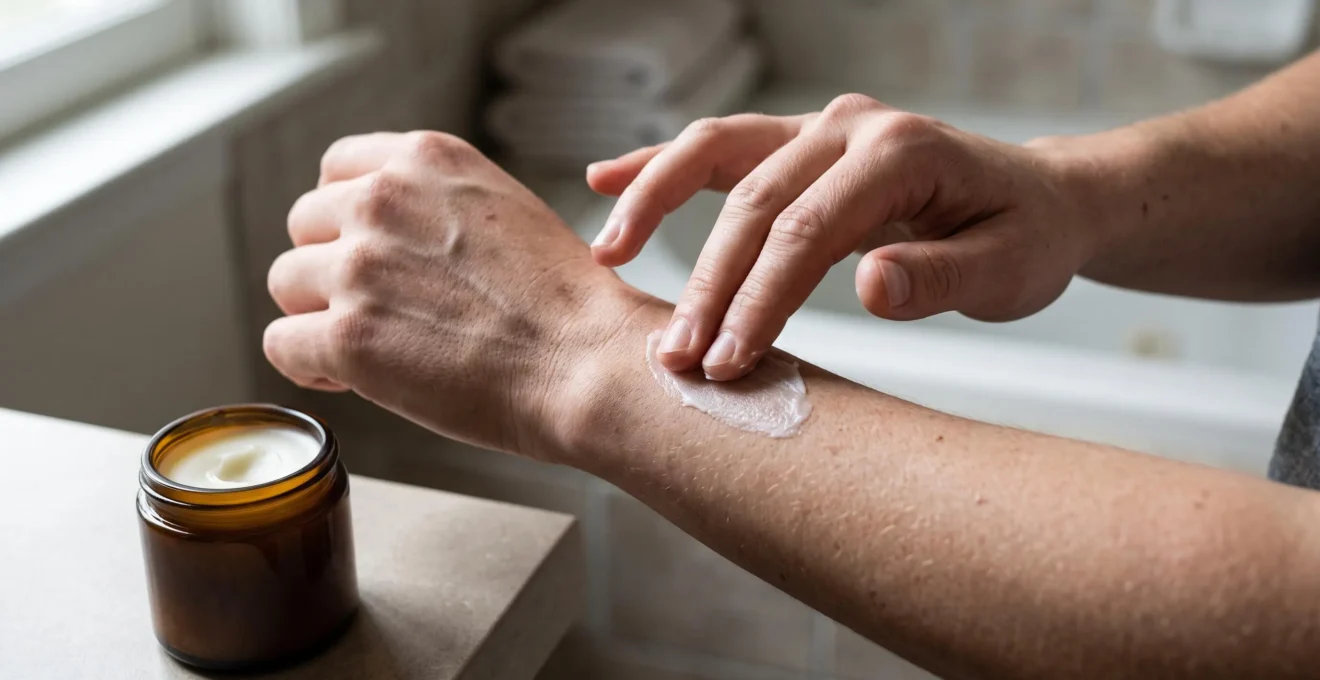
A CBD cream can penetrate the skin without delivering enough cannabidiol into the bloodstream to produce meaningful whole-body exposure. That distinction matters when comparing topical products with swallowed oils, capsules, inhaled formulations and specialised transdermal systems.
Systemic circulation refers to the movement of a substance through the bloodstream, allowing distribution beyond its original administration site. Local exposure, by contrast, describes the presence of a substance near where it was applied. These outcomes depend on the delivery route, formulation and biological barriers involved.
Neither outcome automatically establishes a therapeutic benefit. Even when CBD becomes detectable in blood after topical application, the concentration may not produce measurable physiological effects.
Understanding the difference helps consumers interpret absorption claims, compare CBD delivery formats and recognise when a product’s stated benefits do not match its demonstrated route of exposure.
CBD delivery and systemic circulation: the essentials
- CBD entering skin tissue is not the same as CBD entering the bloodstream; local absorption alone does not establish systemic delivery.
- Oral and inhaled formats are intended to produce systemic exposure through different pathways, while ordinary topical cosmetics are generally designed around local application.
- Claims that a CBD cream delivers whole-body effects require formulation-specific evidence, ideally including measured blood concentrations and appropriate clinical outcomes.
- Why Is Systemic Circulation Different from Local CBD Topical Exposure?
- How Can You Recognise a Systemic-Delivery Claim on a CBD Topical Label?
- Topical or Oral CBD: How Does Systemic Exposure Differ Between These Formats?
- Why Should You Be Sceptical of Unsupported Systemic Claims for CBD Creams?
- When Is Systemic Absorption Unnecessary for a CBD Skincare Product?
- Why Does a CBD Topical Mainly Act at the Area Where It Is Applied?
- Why Can Avoiding the Digestive Tract Speed Up CBD Entry into Circulation?
- Which Specialised CBD Delivery Mechanism Fits Different Everyday Use Cases?
Why Is Systemic Circulation Different from Local CBD Topical Exposure?
Systemic circulation differs from local CBD topical exposure because the two describe different destinations for the ingredient. Local exposure means CBD remains on or within skin tissues near the application site. Systemic exposure occurs when CBD crosses biological barriers, enters the bloodstream and becomes available for distribution elsewhere in the body. Skin penetration alone does not establish that bloodstream delivery has occurred.
The distinction begins with skin anatomy. The stratum corneum, the outermost portion of the epidermis, forms a substantial barrier against the entry of externally applied substances. Its structure restricts molecular transport, although it does not prevent every compound from passing through.
When a CBD cream is applied, several outcomes are possible. Some CBD may remain in the product residue on the surface, some may enter superficial skin layers, and a fraction may move further through the tissue. The proportions depend on the formulation and application conditions.
Penetration, permeation and systemic absorption should therefore not be treated as interchangeable terms. Penetration can describe entry into skin tissue. Permeation describes movement through a defined barrier. Systemic absorption requires entry into the circulation.
Laboratory research examining CBD formulations on human epidermal membranes illustrates this separation. An experimental study of CBD skin permeation and formulation vehicles measured CBD retained within epidermal tissue separately from CBD passing through the membrane. Changes in the formulation altered these outcomes, and the tested preparations predominantly favoured epidermal retention under the experimental conditions.
These laboratory measurements do not directly establish blood concentrations in living people. They do show why ingredient presence and skin delivery are distinct from demonstrated systemic exposure.
The practical consequence is that a cream intended for local skincare should not be assumed to produce effects throughout the body. Conversely, measurable CBD in blood would not automatically prove that the amount is sufficient to cause a particular effect.
Marketing descriptions often blur these boundaries. Phrases such as « deep absorption » or « penetrates quickly » can sound pharmacologically significant while leaving the destination of the ingredient undefined.
Before interpreting a topical product’s promised outcome, establish whether its claim concerns the skin itself or a physiological effect requiring delivery beyond the application site. That distinction provides the starting point for reading product labels.
How Can You Recognise a Systemic-Delivery Claim on a CBD Topical Label?
A systemic-delivery claim on a CBD topical label is language suggesting that CBD reaches the bloodstream or affects parts of the body beyond the application site. Terms such as « transdermal », « whole-body relief » or « internal balance » may indicate this intention. Such wording deserves closer examination because ordinary skin penetration does not demonstrate meaningful systemic absorption.
Begin by identifying what the label actually promises. Wording about skin feel, moisturisation or cosmetic conditioning generally concerns local use. Wording about circulating CBD, internal physiological changes or benefits affecting distant body regions suggests a different delivery objective.
The word transdermal is particularly important. In pharmaceutical terminology, transdermal delivery aims to transport an active substance across the skin into systemic circulation. A product described as transdermal is therefore making a materially different delivery claim from a conventional topical cream.
However, the presence of that word does not establish successful delivery. A credible claim should be supported by relevant testing of the finished formulation, rather than evidence that CBD can penetrate skin under unrelated laboratory conditions.
Blood-level measurements after actual product application can provide evidence of systemic absorption. Appropriate pharmacokinetic testing should identify the administered formulation, application schedule and analytical measurements. Demonstrating a physiological benefit would require additional evidence matched to the claimed outcome.
Regulatory language also matters. In the United States, the FDA explanation of cosmetic labeling claims distinguishes ordinary cosmetic purposes from intended uses that may classify a product as a drug, including treating disease or affecting the body’s structure or function.
A cosmetic appearance or label designation does not independently determine the product’s legal status. Neither does every general wellness phrase automatically establish an unlawful claim. The wording, context and intended use matter. Other English-speaking markets have their own regulatory frameworks and should not be assumed to follow identical rules.
Five checks before trusting a CBD topical delivery claim
- Identify the promised outcome. Copy the product’s main claim into a note and mark whether it concerns local skin use or a wider physiological effect.
- Record the delivery terminology. Identify whether the label uses « topical », « transdermal », « absorbed » or another term, and write down what destination it actually specifies.
- Locate product-specific evidence. Record the title or reference of any finished-product absorption study, or note that none has been supplied.
- Separate exposure from effects. Make two entries identifying whether the evidence measures blood CBD concentrations, clinical outcomes, both or neither.
- Check the product category. Record whether it is presented as a cosmetic, medicine or another regulated product, and flag claims requiring further jurisdiction-specific verification.
Once the promised destination is clear, the next question is whether the product’s administration route can realistically support that outcome. Comparing topical and oral CBD illustrates why the distinction matters.
Topical or Oral CBD: How Does Systemic Exposure Differ Between These Formats?
Oral CBD is administered through the digestive tract and can enter systemic circulation after absorption and first-pass metabolism. A standard topical CBD product instead exposes the skin directly, with systemic absorption depending on whether the formulation and application conditions allow CBD to cross the skin barrier. Equal labelled quantities of CBD therefore do not imply equal bloodstream exposure.
When CBD is swallowed, it passes through gastrointestinal processes before reaching the general circulation. Absorption and metabolism, including substantial first-pass processing, influence how much unchanged CBD becomes available in blood.
Food intake, formulation composition and other pharmacokinetic variables can further alter oral exposure. Consequently, the quantity printed on an oil bottle does not predict a universal blood concentration.
A topical formulation faces a different challenge. Rather than moving through the intestinal environment, CBD must partition from its vehicle into the skin and cross successive tissue barriers. Its concentration in the cream is only one variable governing that movement.
The following comparison describes the intended delivery pathways rather than guaranteed absorption or clinical effectiveness.
| Criterion | Conventional topical CBD | Swallowed oral CBD |
|---|---|---|
| Primary administration site | Skin surface | Digestive tract |
| Principal absorption barrier | Skin, particularly the stratum corneum | Gastrointestinal absorption and presystemic metabolism |
| Intended exposure | Generally local skin exposure | Systemic exposure after absorption |
| First-pass metabolism | Not part of initial skin penetration | Substantial presystemic metabolism can occur |
| Evidence needed for blood exposure | Appropriate finished-product pharmacokinetic measurements | Route- and formulation-specific pharmacokinetic evidence |
| What the labelled CBD quantity cannot establish | Depth of penetration or meaningful systemic absorption | Individual blood concentrations or clinical benefit |
For a consumer seeking a product for ordinary skincare, the local exposure pathway may be entirely appropriate. Someone specifically considering systemic CBD exposure would need to examine a format intended to produce that exposure, alongside its safety profile and relevant regulatory status.
Importantly, topical absorption is not an absolute either-or condition. Particular formulations can produce detectable systemic exposure, and penetration may vary with skin integrity, application area or occlusion. Damaged skin and altered barrier conditions can complicate predictions rather than making absorption reliably greater in every circumstance.
There is also an important difference between detecting CBD in blood and demonstrating an effect elsewhere in the body. Systemic exposure is a pharmacokinetic observation; therapeutic or other physiological outcomes require separate evaluation.
The delivery route should therefore be assessed before comparing milligram amounts. That principle also explains why claims that ordinary CBD creams provide systemic benefits deserve specific scrutiny.
Why Should You Be Sceptical of Unsupported Systemic Claims for CBD Creams?
Unsupported systemic claims for CBD creams deserve scepticism because CBD content alone does not establish delivery into the bloodstream, and detectable bloodstream exposure does not prove a meaningful whole-body effect. Skin permeability, formulation ingredients, application conditions and the measured outcome all matter. A brand claiming systemic benefits should provide evidence relevant to its actual product and promised effect.
The difficulty is pharmacokinetic, not simply semantic. CBD must be released from the formulation, enter the skin and move through sufficient tissue to reach blood vessels before systemic distribution can occur.
Formulation vehicles, permeation enhancers and the physical condition of the skin can influence these steps. Two creams containing the same nominal amount of CBD may therefore generate different exposure profiles.
One controlled human investigation provides a particularly useful example. The 2024 clinical study of topical CBD pharmacokinetics examined commercially available CBD creams, lotions, patches, balms and gels, alongside a placebo group.
3 of 5 active products
Systemic CBD absorption was observed with three of the five active topical products evaluated in a controlled study involving 46 healthy adults. The finding demonstrates that topical systemic absorption is possible, but varies between formulations and does not establish a clinically meaningful effect.
Zamarripa et al., Journal of Analytical Toxicology, 2024.
The study included acute application, repeated application and a washout period. CBD and metabolite concentrations generally reached their highest levels after seven to ten days of use. The greatest CBD exposure was associated with the tested lotion, which contained the most CBD and incorporated a permeation enhancer.
Despite evidence of systemic absorption from some products, the investigators did not observe discernible pharmacodynamic effects in the study.
Detectable systemic absorption is not evidence of systemic efficacy. That finding prevents two opposite oversimplifications: it is inaccurate to claim that no topical CBD can reach the bloodstream, and equally inaccurate to assume that any CBD cream can produce meaningful body-wide effects.
The experiment involved a limited selection of products and participants. Its results cannot be extended automatically to every CBD formulation, application schedule or claimed clinical outcome.
Consumers should also consider the commercial incentives behind broad delivery language. A cream marketed as producing internal benefits may appear more versatile than an ordinary skincare product, even when its supporting documentation addresses only ingredient content or superficial penetration.
Such marketing can encourage consumers to judge the product against outcomes it has not been shown to achieve. It may also obscure the importance of choosing an administration route appropriate to the intended purpose.
The relevant question is not whether systemic absorption is theoretically possible, but whether it has been demonstrated for the particular formulation and whether the evidence supports the promised outcome. For many skincare products, however, systemic absorption is not the intended outcome at all.
When Is Systemic Absorption Unnecessary for a CBD Skincare Product?
Systemic absorption is unnecessary when a CBD skincare product is intended for local cosmetic purposes, such as conditioning the skin or contributing to the feel of a moisturising formulation. In those situations, delivery into the bloodstream is not a prerequisite of the product’s intended use. The relevant questions concern local formulation performance, tolerability and substantiated cosmetic claims.
Skincare products are typically selected for what happens at or near the application site. A cream may be designed to spread easily, remain comfortable on the skin, support moisture retention or contribute to the sensory properties of a skincare routine.
None of these purposes requires the CBD ingredient to circulate throughout the body. Nor do they independently establish that CBD itself causes any particular improvement in skin health.
This distinction changes how a consumer should compare products. Asking only how much CBD a cream contains gives limited information about where the ingredient travels or which outcomes have actually been demonstrated.
A more useful first question is « Where is the CBD intended to act? » If the answer is within or near the applied skin area, local exposure is the relevant delivery concept. If the answer involves distant tissues or body-wide physiological activity, systemic exposure becomes important.
For ordinary cosmetic applications, limited systemic absorption should not automatically be interpreted as a formulation defect. Retaining an ingredient near the application site may align with the product’s design objective.
Nevertheless, local retention alone does not prove effectiveness. A formulation must still be assessed according to the outcome it claims to produce, whether that concerns moisturisation, appearance or another permitted cosmetic purpose.
A useful boundary case is a cream marketed simultaneously as a moisturiser and as a source of sustained whole-body CBD effects. These are separate claims with different evidential requirements. A cosmetic assessment of skin feel cannot establish sustained bloodstream delivery.
When systemic exposure is genuinely intended, a substantiated transdermal product or an appropriately evaluated alternative administration route may be more relevant. The choice should account for safety, interactions, regulatory requirements and the intended outcome.
The absence of systemic delivery is not inherently a weakness. The more consequential issue is whether the ingredient reaches the location required for the claimed purpose, which makes skin anatomy and formulation behaviour worth examining more closely.
Why Does a CBD Topical Mainly Act at the Area Where It Is Applied?
A conventional CBD topical is mainly associated with the application area because the skin restricts molecular transport into deeper tissues and the bloodstream. CBD may remain on the surface or enter skin layers without reaching systemic circulation in substantial amounts. Any local biological effect still requires separate evidence: presence in skin tissue does not automatically demonstrate therapeutic activity.
The stratum corneum is composed of densely organised cells within a lipid-rich environment. This structure helps limit the entry of external substances and influences how ingredients migrate after application.
Below it, successive layers create additional transport challenges. Reaching the epidermis, moving into deeper skin and entering the bloodstream are distinct stages rather than one continuous guarantee of absorption.
CBD’s physicochemical properties and the formulation carrying it affect these processes. The vehicle must allow the compound to leave the product and partition into the skin, but a formulation that supports local retention will not necessarily support substantial systemic transport.
Several conditions can alter the distribution of CBD after application:
- Formulation vehicle: solvents, emulsions, gels and other carrier systems influence CBD release, partitioning and retention.
- Ingredient concentration: the concentration contributes to the available quantity but cannot independently predict penetration depth.
- Application site: skin thickness and barrier characteristics vary across different body regions.
- Skin condition: intact, irritated or damaged skin may present different permeability characteristics.
- Application conditions: the amount applied, duration of contact and use of an occlusive covering can influence exposure.
These variables help explain why results from one CBD topical cannot automatically be transferred to another. Laboratory findings also depend on the experimental membrane, testing conditions and analytical methods used.
It is equally important not to equate local penetration with precise therapeutic targeting. CBD found in superficial epidermal layers has not necessarily reached deeper tissues, joints or other structures beneath the skin.
Claims about effects in deep anatomical structures require evidence beyond confirmation that some CBD entered the epidermis. Even a locally applied formulation described as acting on a specific site must be assessed against the actual depth and nature of its proposed action.
From a consumer perspective, the location of application helps identify the intended exposure area, but it cannot guarantee what biological effect occurs there. Product-specific evidence remains necessary.
Understanding those barriers also prevents a common mistake when comparing delivery technologies: a route that avoids the digestive tract is not necessarily a route that delivers CBD rapidly or effectively into circulation.
Why Can Avoiding the Digestive Tract Speed Up CBD Entry into Circulation?
Avoiding the digestive tract can shorten the route to systemic circulation because a substance need not first undergo gastrointestinal absorption and the associated presystemic processing. For CBD, however, faster bloodstream entry depends on the alternative administration route and formulation. Bypassing digestion does not guarantee rapid absorption, particularly when a product must cross the skin barrier.
After CBD is swallowed, its journey involves absorption from the gastrointestinal tract and presystemic metabolism, including processing in the liver. This can reduce the amount of unchanged CBD reaching general circulation and contribute to variability in blood exposure.
Some alternative routes avoid the initial gastrointestinal pathway. Inhaled CBD, for example, can enter the circulation through the lungs, subject to the specific formulation, administration conditions and pulmonary absorption.
A systematic review of CBD pharmacokinetics in humans examined 24 studies and reported substantial differences in exposure according to administration route and formulation. In the reviewed studies, maximum plasma concentrations generally occurred earlier after smoking or inhalation than after oral or oromucosal administration.
These observations support a route-dependent distinction, not a universal absorption timetable. The studies differed in formulations, doses and participant characteristics, and the review identified important limitations in the available human evidence.
For a transdermal formulation, bypassing digestion removes one obstacle but introduces another: CBD must still cross the skin at a sufficient rate to enter systemic circulation.
Consequently, a skin-based product cannot claim faster systemic onset merely because it does not pass through the stomach. Its absorption characteristics must be measured in the context of the finished delivery system.
Faster systemic entry is not inherently better. It may alter the timing and extent of exposure, but those features only matter when systemic delivery is appropriate to the intended use. They do not establish improved efficacy, convenience or safety by themselves.
The distinction is particularly relevant when considering CBD products for everyday use. Someone seeking routine local skincare has no pharmacokinetic reason to prioritise rapid bloodstream entry, whereas a systemic product requires more careful attention to exposure and potential interactions.
Once digestive processing and skin permeability are considered separately, the remaining task is practical: match the delivery mechanism to the intended location of action rather than assuming one format is superior for every purpose.
Key takeaways before choosing a CBD delivery format
- Define whether the intended outcome concerns the skin at the application site or requires measurable CBD distribution through the bloodstream.
- Evaluate the complete formulation and delivery mechanism, not just the CBD quantity or an appealing absorption claim.
- Treat local penetration, systemic exposure and demonstrated physiological benefits as separate levels of evidence.
Which Specialised CBD Delivery Mechanism Fits Different Everyday Use Cases?
The appropriate CBD delivery mechanism depends on where exposure is intended to occur. Conventional topicals fit skin-local applications, oral products are designed to produce systemic exposure after gastrointestinal absorption, and inhaled formats use the pulmonary route. Specialised transdermal systems aim to move CBD across the skin into circulation, but their actual performance must be demonstrated rather than inferred from the technology’s name.
Matching format to purpose begins with three questions: where should the ingredient be available, which biological barriers must it cross, and what evidence shows that the chosen formulation achieves the intended exposure?
For skin-focused care, a conventional topical offers a direct application route. The relevant assessment concerns the local formulation, evidence supporting any cosmetic claims, and whether the product is appropriate for the user’s skin.
For goals that specifically depend on systemic CBD exposure, a route designed to introduce CBD into circulation becomes relevant. Oral products are one such category, although gastrointestinal processing and variable absorption must be considered. Inhaled delivery follows a different pathway and introduces its own safety considerations.
When avoiding gastrointestinal absorption is an important design objective, the delivery mechanism must be examined more closely. A properly engineered transdermal system aims to transport an ingredient across the skin into blood, whereas an ordinary cosmetic cream does not establish that capability merely through external application.
Specialised delivery technologies may use formulated carriers, permeation enhancers, encapsulation approaches or controlled-release systems. However, encapsulation itself does not prove bloodstream delivery. Its effect depends on the carrier design, route of administration and measurable performance of the finished product.
The following decision map separates the objective from the technology rather than presenting formats as interchangeable.
| Everyday scenario | Relevant delivery logic | Format category to examine |
|---|---|---|
| Using CBD as an ingredient in a local skincare routine | Direct application and potentially local skin retention | Conventional topical cream, lotion, balm or gel |
| Investigating a purpose that requires measurable blood CBD concentrations | Systemic absorption and distribution | Appropriately evaluated oral or other systemic formulations |
| Considering systemic delivery without gastrointestinal absorption | Crossing a non-gastrointestinal absorption barrier | Evidence-supported transdermal systems or other clinically appropriate non-oral routes |
| Comparing products claiming delivery through the skin into blood | Demonstrated transdermal pharmacokinetics | Finished formulations with relevant human absorption data |
| Evaluating a product advertised as both skincare and whole-body CBD delivery | Separate verification of local and systemic claims | Only products with evidence supporting each stated purpose |
These categories describe exposure pathways rather than recommendations for treating medical conditions. Oral CBD can interact with medications, and systemic CBD exposure is not automatically safe or appropriate simply because a product is nonprescription. Inhalation likewise carries route-specific considerations that are not captured by absorption speed alone.
Regulatory status also matters. The evidence and authorisation appropriate to a medicinal CBD product are not interchangeable with those associated with a cosmetic. Requirements vary across the United States, United Kingdom, Canada, Australia and other English-speaking jurisdictions.
A hypothetical example illustrates the distinction. Consider two consumers comparing a CBD cream with a swallowed CBD oil. One wants a product for a local skincare routine; the other is investigating a use that would require CBD in the bloodstream. The first consumer has no reason to demand transdermal delivery merely because it sounds technically advanced. The second cannot assume that a conventional cream will provide systemic exposure equivalent to an oral preparation.
Neither consumer should infer effectiveness from the delivery category alone. Evidence must correspond to the intended outcome, and questions involving medical conditions or medication interactions require appropriate professional guidance.
Before choosing a CBD product, write down the intended site of action, identify the formulation’s delivery route and check whether its specific claims are supported by appropriate evidence. If the desired outcome and demonstrated route do not match, reconsider the format before comparing potency, price or marketing promises.
Can CBD be detected in blood after using a topical cream?
Yes, under some conditions. The 2024 controlled human study described above detected systemic CBD absorption from three of five active topical products. The results varied by formulation, and the researchers reported no discernible pharmacodynamic effects. This demonstrates that some topical products can produce measurable blood exposure without establishing that ordinary CBD creams provide clinically meaningful whole-body benefits.
Does a higher CBD concentration guarantee better skin penetration?
No. Concentration affects the amount of CBD available in a formulation, but skin penetration also depends on the vehicle, molecular transport, skin condition and application conditions. Experimental formulation research has demonstrated differences in CBD retention and permeation even when the investigated preparations contain the same nominal CBD concentration. Concentration alone cannot establish local delivery, bloodstream exposure or clinical effectiveness.
Can a standard CBD cosmetic cream be considered a transdermal product?
Not simply because it contains CBD or is applied to the skin. Transdermal delivery specifically concerns transport across the skin into systemic circulation. A product making that claim should have evidence demonstrating the relevant absorption pathway. Its regulatory classification also depends on its intended use, claims and applicable jurisdiction.
Does applying CBD under a bandage increase systemic absorption?
Occlusion can change skin hydration and permeability, potentially affecting the penetration of certain substances. However, this does not establish how much CBD from a particular product will enter circulation or whether exposure will be clinically meaningful. Consumers should not assume that covering a conventional CBD cream turns it into a validated transdermal system, and should follow the product’s application instructions.
Does measurable CBD in the bloodstream mean it is having an effect?
No. Blood concentration measurements demonstrate exposure, not necessarily a physiological or therapeutic response. Establishing an effect requires suitable pharmacodynamic or clinical evidence, including an appropriate outcome, study design and assessment of safety. CBD detected at low concentrations after topical application should not be treated as proof of an effective systemic dose.