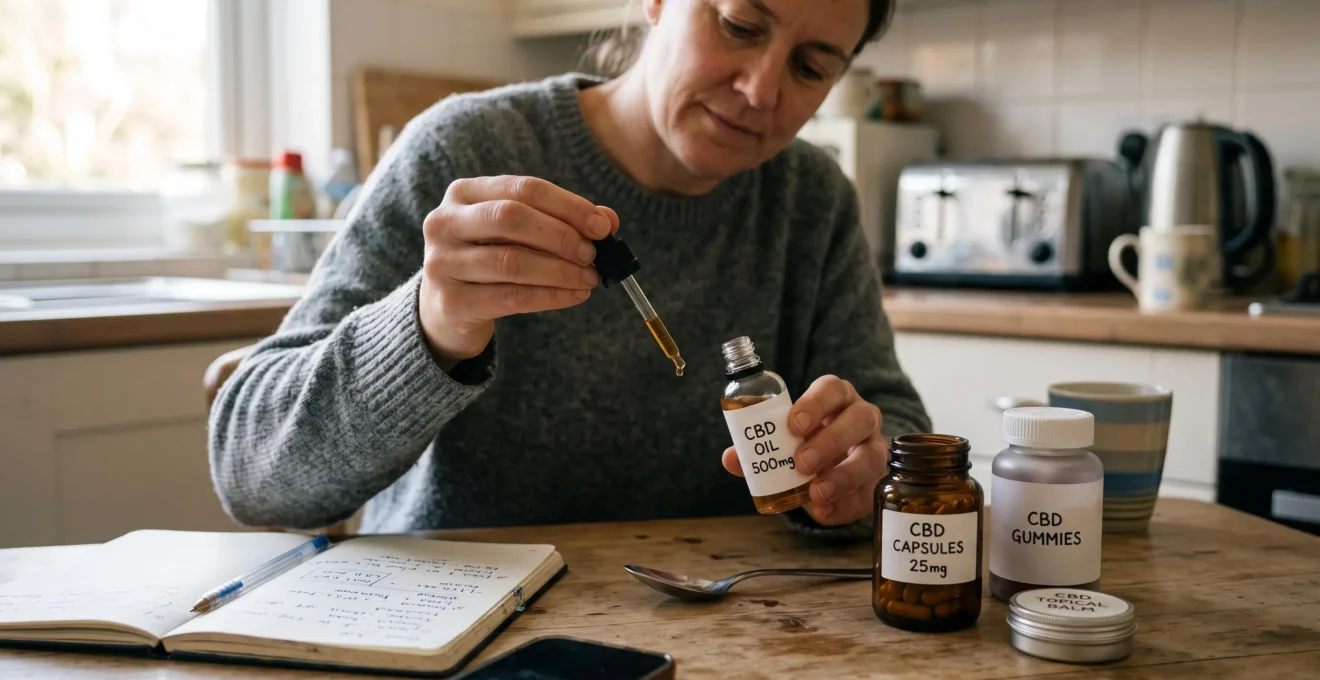
Choosing a CBD product involves more than comparing the number of milligrams on two labels. A bottle of oil, a capsule, an edible and a topical cream can contain the same stated quantity of cannabidiol while delivering very different experiences in terms of preparation, absorption, convenience and dose measurement.
The best format for an everyday routine depends on how the product is intended to be used. Someone who values a pre-measured serving may prefer capsules. Someone who wants flexibility in measuring a serving may find an oil more practical. Drinks, topical products and specialised delivery systems introduce different ingredient and application considerations.
Delivery route also matters, but faster absorption does not automatically mean greater effectiveness. Research shows that CBD exposure depends on formulation, dose, administration route and food intake. These differences need to be considered alongside product quality, possible adverse effects and applicable UK rules.
This comparison focuses on practical choices rather than promising particular health benefits. CBD can interact with medicines and may present liver-related risks, so formulation convenience should never substitute for an appropriate safety assessment.
CBD formulation choices at a glance
- Choose by routine: capsules offer fixed servings, oils allow more flexible measurement, and topicals are designed for external application.
- Compare more than milligrams: administration route, food intake and formulation design influence CBD absorption.
- Check the full product: ingredients, verified CBD content, storage instructions and UK regulatory status matter alongside price.
- Why Can the Same Labelled CBD Amount Feel Different Across Product Formats?
- How Can You Compare CBD Formats Without Focusing on Strength Alone?
- CBD Oil or Capsules: Which Is Easier for a Consistent Daily Routine?
- Which Formulation Mistakes Can Make a CBD Product Inconvenient to Use Regularly?
- When Should You Switch to a Different CBD Format Rather Than Change Strength?
- How Can You Compare CBD Delivery Methods Using Speed, Discretion and Dose Control?
- How Can You Standardise CBD Labels Before Comparing Prices or Strengths?
- Which Specialised CBD Delivery Mechanism Fits Different Everyday Use Cases?
Why Can the Same Labelled CBD Amount Feel Different Across Product Formats?
The same labelled CBD amount can produce different exposure profiles because formulation and administration route influence how much cannabidiol reaches the bloodstream and when it arrives. Swallowed products, oils held in the mouth and inhaled products do not behave identically. However, differences in blood concentration do not reliably predict how strongly an individual will perceive a product.
Bioavailability describes the proportion of an administered substance that reaches systemic circulation. Oral CBD is absorbed through the digestive system and undergoes metabolism before reaching the wider circulation. Inhalation follows a different absorption pathway, while products held beneath the tongue may involve a combination of absorption through oral tissues and swallowing.
This distinction is important because a sublingual label does not guarantee that most of the CBD is absorbed beneath the tongue. Actual exposure depends on the formulation, contact conditions and the amount swallowed.
A systematic review of cannabidiol pharmacokinetics examined 112 trial arms from 39 human studies. Its findings identified CBD dose, administration route and food conditions as important determinants of pharmacokinetic outcomes. Inhalation was associated with faster absorption than oral administration, while consuming CBD with food was associated with greater systemic exposure.
39 studies
The systematic review evaluated 112 trial arms across different CBD routes and formulations. Variation between studies limits direct comparisons between individual retail products.
Cannabis and Cannabinoid Research, systematic review and meta-regression analysis, 2023.
Total CBD content is not the same as absorbed CBD. A capsule containing 20 mg and an oil serving labelled 20 mg specify an equivalent nominal quantity, not necessarily an equivalent concentration in the bloodstream.
Carrier oils, the physical form of CBD and emulsification systems can change how it disperses and is absorbed. Capsule shells primarily influence handling and release characteristics; their presence alone does not establish higher or lower absorption. Similarly, an oil-based formulation does not guarantee that CBD held under the tongue will reach circulation faster than a swallowed product.
The onset of measurable blood concentrations and the onset of perceived effects must also be distinguished. A rapid concentration peak is not proof of greater therapeutic benefit, and there is no dependable universal duration of perceived CBD effects for each format.
Once absorption differences are recognised, the more useful purchasing question becomes which delivery characteristics fit the intended routine rather than which product appears strongest.
How Can You Compare CBD Formats Without Focusing on Strength Alone?
Compare CBD formats using four practical criteria: expected absorption timing, persistence of exposure, serving precision and compatibility with daily activities. Strength is only one input. A format with convenient, repeatable servings may fit an established routine better than a higher-concentration product that is difficult to measure, carry, store or use appropriately.
A decision grid helps separate formulation features from marketing claims. The comparisons below are qualitative: individual products may behave differently, and the available research does not establish universal onset or duration figures for retail CBD products.
| Format | Absorption timing | Persistence of exposure | Serving precision | Lifestyle fit |
|---|---|---|---|---|
| CBD oil | Variable; depends on formulation and how it is used | Product-dependent | Adjustable with a calibrated dispenser | Flexible at home, less convenient when measuring in public |
| Capsules | Digestion-dependent | Product-dependent | Fixed labelled amount per capsule | Portable and discreet |
| Edibles | Digestion-dependent | Product-dependent | Fixed portions when accurately manufactured | Convenient, but serving composition varies |
| Inhaled CBD | Generally faster systemic absorption than swallowed CBD | Product-dependent | Difficult to quantify from individual inhalations | Requires equipment and raises inhalation-safety concerns |
| Topical CBD | Not directly comparable with systemic routes | Depends on skin formulation and application | Applied quantity can be measured, absorbed dose remains uncertain | External application without swallowing |
For example, a person who travels frequently may place greater value on a clearly labelled, pre-measured product than on the ability to adjust a liquid serving. Someone who finds large capsules difficult to swallow may reach the opposite conclusion.
Consistency is a usability measure, not evidence of effectiveness. Taking a labelled serving regularly does not guarantee a beneficial outcome, and higher absorption does not necessarily make a product more suitable.
A simple personal comparison record can reveal practical differences without attempting to recreate a clinical trial:
- Record the product format, ingredients, stated CBD per serving and instructions.
- Note the normal context of intended use, including meals and practical preparation.
- Track measurement difficulty, portability, taste, tolerability and missed occasions.
- When comparing products, change one purchasing criterion at a time rather than simultaneously changing route, concentration and serving size.
There is no evidence-based universal self-testing period or dose-escalation protocol for non-prescription CBD. Personal observations cannot establish a product’s clinical efficacy. Where CBD use may pose risks, a pharmacist or clinician should guide decisions about whether any trial is appropriate.
For many shoppers, the first meaningful format decision is whether a variable liquid serving or a pre-measured capsule better matches everyday habits.
CBD Oil or Capsules: Which Is Easier for a Consistent Daily Routine?
CBD capsules are generally easier for a routine built around pre-measured servings, while CBD oils offer more flexibility in measuring different amounts. Capsules remove the need to operate a dropper, whereas oils allow adjustments within the limits of the dispenser and product instructions. Neither format is inherently more effective or more appropriate for every consumer.
A capsule provides the stated CBD quantity as one unit. This makes it straightforward to check how many units a product contains and avoids having to measure liquid each time. It can be especially practical when travelling, although original packaging and destination-specific rules still require attention.
Oil introduces an extra preparation step. The user must interpret the concentration, measure a volume and follow the manufacturer’s administration instructions. A marked dispenser can make this more reliable than estimating the amount from an uncalibrated drop count.
For oils, the relationship is:
CBD per serving (mg) = CBD concentration (mg/mL) × measured volume (mL).
This calculation establishes a labelled amount, not an absorbed dose. A larger bottle does not necessarily have a larger CBD amount per serving.
Daily convenience can also depend on taste, texture, swallowing preferences, food habits and storage needs. Some people dislike the flavour or mouthfeel of an oil. Others prefer not to swallow capsules. Oil containers may present leakage concerns, while capsules can be less adaptable when a particular product’s fixed unit size is unsuitable.
Convenience at the point of purchase is not necessarily convenience after repeated use. A dropper that initially seems flexible may become inconvenient if every serving requires concentration calculations. Equally, fixed capsules may become frustrating when their ingredient composition or unit size does not suit the consumer.
A useful assessment looks for friction: forgotten products, difficult dispensing, unwanted flavours, packaging problems or uncertainty about how much CBD a serving contains. These are signals of poor routine compatibility, not reasons to increase intake.
Food is another consideration. Human pharmacokinetic research indicates that eating can affect CBD exposure, so a product routinely taken around meals may not behave identically under fasting conditions. Product instructions and professional advice should take precedence over assumptions about the best time of day.
Once the practical format is chosen, checking the carrier ingredients and product stability can prevent avoidable problems that concentration alone will not reveal.
Which Formulation Mistakes Can Make a CBD Product Inconvenient to Use Regularly?
The most common formulation mistakes involve choosing an unsuitable serving size, overlooking carrier ingredients, accepting complicated preparation requirements or misunderstanding storage conditions. These problems can make a CBD product inconvenient even when its labelled concentration appears appropriate. Checking the complete ingredient list and serving instructions before purchase is often more useful than selecting by strength alone.
One frequent mistake is choosing a product whose delivery system makes the intended serving awkward. A highly concentrated liquid may require measuring a very small volume, while a diluted product may require more liquid than expected. Neither situation automatically makes the formulation unsuitable, but both increase the importance of accurate dispensing.
Another mistake is ignoring ingredient compatibility. CBD oils can contain different carrier oils, while capsules and edibles may include additional excipients, sweeteners, flavourings or other active ingredients. These components affect sensory characteristics, dietary suitability and, in some circumstances, tolerability.
Combining ingredients also creates formulation challenges. An ingredient may have limited solubility in a particular carrier, or an emulsion may separate if it is not sufficiently stable. Some added ingredients may require different storage conditions. Such possibilities cannot establish that a particular retail product is unstable; they explain why formulation quality and manufacturer instructions matter.
A product that separates, develops unexpected changes in appearance or has been stored outside its stated conditions should not simply be assumed to deliver a uniform serving. Consumers should follow the manufacturer’s guidance and ask the supplier about suspected quality problems rather than attempting to correct the formulation themselves.
Routine mismatch is another overlooked problem. An adjustable oil may create unnecessary measuring work for someone who prefers fixed portions. Conversely, a fixed capsule may not suit a person who has difficulty swallowing it or avoiding certain capsule ingredients.
Five checks to complete before choosing a CBD formulation
- Calculate the labelled CBD per serving: record the result in milligrams, including the measurement unit used.
- Read the complete ingredient list: produce a short list of carriers, additives and ingredients requiring further checking.
- Review the serving mechanism: identify whether the product requires a dropper, measuring device, fixed unit or external application.
- Check storage and handling instructions: record the temperature, light exposure and handling requirements stated by the manufacturer.
- Verify product documentation: note whether a batch-specific certificate of analysis is available and whether the product’s regulatory status and suitability can be established.
For UK consumers, documentation should also support the product’s identity and compliance with the rules relevant to its category. An ingredient list or certificate of analysis alone does not establish that a CBD product is legally marketable or safe for every person.
Potential medication interactions and liver-related risks are particularly important. The FDA consumer guidance on CBD safety identifies these concerns and warns against assuming that unapproved products have undergone evaluation for appropriate dosing or effectiveness. This is US guidance on safety, not a statement of UK legal requirements.
If the product is accurately labelled and its ingredients are suitable but everyday use remains impractical, reconsidering the delivery format may be more logical than seeking a higher concentration.
When Should You Switch to a Different CBD Format Rather Than Change Strength?
Consider a different CBD format when the main difficulty is preparation, measurement, swallowing, taste, portability or the administration method itself. Changing strength does not resolve these practical problems. If the concern involves absent effects, unexpected reactions or timing of exposure, increasing the dose or changing routes without professional advice is not a reliable or necessarily safe solution.
The distinction is between a delivery-format problem and a question about the amount of CBD consumed. An oil that is difficult to measure creates a usability problem; a capsule that is easy to carry but impossible to swallow comfortably creates a different one. Neither is corrected by increasing the CBD concentration.
Perceived timing can suggest that a delivery route deserves closer examination, but it cannot establish the cause of an individual response. Human pharmacokinetic studies show differences between administration routes, yet the evidence does not validate a fixed onset or duration for every commercial preparation.
| Observed problem | What it may indicate | Appropriate next consideration |
|---|---|---|
| Repeated difficulty measuring oil | Dispensing method does not suit the routine | Compare calibrated dispensers and fixed-serving formats |
| Unpleasant taste or texture | Sensory incompatibility | Review alternative formulations and their ingredients |
| Capsules are difficult to swallow | Unsuitable serving form | Discuss an alternative formulation with a pharmacist |
| Absorption timing seems unpredictable | Possible formulation, meal or administration differences | Review instructions and obtain professional advice |
| No noticeable benefit | Effectiveness is uncertain | Reassess the reason for using CBD rather than automatically increasing intake |
| Adverse reactions occur | Potential tolerability or safety issue | Seek appropriate medical advice rather than switching or escalating independently |
Repeatedly increasing concentration can raise costs and CBD exposure without correcting an unsuitable dispensing method. Higher intake may also increase safety concerns, including adverse effects and interactions with other medicines.
Switching formats introduces another complication: equal labelled amounts are not interchangeable absorbed doses. Moving from a swallowed product to an inhaled or differently formulated product can change systemic exposure even when the packaging displays an identical milligram figure.
Consequently, there is no scientifically established universal conversion ratio between retail CBD formats. Nor is there a universal conservative starting dose or observation period that can safely be recommended for every consumer.
Where CBD use is considered appropriate after a safety assessment, any change in product, route or intake should be reviewed against the new product’s instructions, individual health circumstances and concurrent medication. The transition should not be treated as a self-directed experiment in increasing exposure.
After identifying whether the delivery method itself is the problem, comparing speed, discretion and measurement control can clarify which alternatives are practically relevant.
How Can You Compare CBD Delivery Methods Using Speed, Discretion and Dose Control?
CBD delivery methods can be compared through three practical dimensions: how quickly systemic absorption occurs, how discreetly the product can be used and how accurately a serving can be measured. These dimensions involve trade-offs. Inhalation generally produces faster absorption than swallowing CBD, while capsules offer convenient fixed quantities but limited flexibility within each unit.
For a useful comparison, define each criterion before assigning a preference:
- Speed: the expected timing of CBD entering circulation, without assuming a particular clinical effect.
- Discretion: the amount of preparation, equipment or visible activity required in a shared environment.
- Dose control: the ability to measure the quantity administered consistently and transparently.
The following qualitative scoring framework evaluates practical characteristics rather than medical effectiveness. Scores range from 1 (less favourable for the criterion) to 3 (more favourable). A speed score is meaningful only for systemic routes; topical preparations should be assessed separately.
| Delivery method | Speed | Discretion | Dose control |
|---|---|---|---|
| Oral oil | 2 — variable | 2 — measuring required | 3 — adjustable with calibrated equipment |
| Capsules | 1 — digestion-dependent | 3 — simple to carry and swallow | 2 — fixed unit amounts |
| Edibles | 1 — digestion-dependent | 3 — minimal equipment | 2 — fixed portions if accurately manufactured |
| Inhalation | 3 — generally faster absorption | 1 — visible equipment and inhalation | 1 — inhaled amount is difficult to quantify |
| Topicals | Not comparable | 2 — depends on application | 1 — systemic absorbed dose uncertain |
These scores are editorial assessments of convenience and measurement characteristics, not experimentally established product rankings. They are not intended to imply that inhalation is preferable or safer because it absorbs quickly.
In fact, inhaled CBD products require particular caution. Device operation, aerosol composition and inhalation-related risks introduce considerations that a speed score cannot capture. UK restrictions on the supply of vaping products and other relevant product rules must also be checked. Speed alone is not a sufficient reason to choose an inhaled format.
Dose control differs substantially by delivery mechanism. A calibrated oil dispenser allows measurement by volume, provided the labelled concentration is reliable. Capsules and properly portioned edibles provide fixed quantities. Inhaled products pose additional uncertainty because the amount leaving a device is not necessarily the amount absorbed by the user.
For a person who values simplicity, fixed units may provide the best operational fit. For someone comparing ingredients or dispensing flexibility, a clearly marked oil may be easier to evaluate. In a shared environment, either may be more practical than a product requiring a specialised device.
A weighted comparison can reflect personal priorities: assign greater importance to the feature that creates the most practical difficulty. However, safety, product suitability and legal compliance remain prerequisites rather than optional factors to trade against convenience.
Once a suitable delivery category has been identified, standardising the labels makes product prices and serving quantities considerably easier to compare.
How Can You Standardise CBD Labels Before Comparing Prices or Strengths?
Standardise CBD labels by calculating the total CBD content, CBD per serving and price per labelled milligram. These measures make differently sized bottles, capsule packs and edible portions easier to compare. The calculations should be based on the stated CBD quantity, not the overall weight of hemp extract, and their usefulness depends on the accuracy of product labelling.
Begin by separating three quantities that are frequently presented together:
- Total CBD: the claimed amount of cannabidiol contained in the complete product.
- CBD per serving: the quantity associated with one specified capsule, portion or measured liquid volume.
- Concentration: the amount of CBD relative to the volume or mass of the preparation.
For a liquid, the basic calculation is:
CBD concentration (mg/mL) = total labelled CBD (mg) ÷ bottle volume (mL).
For any product, calculate:
Price per labelled mg of CBD = product price (£) ÷ total labelled CBD (mg).
For fixed-serving products:
CBD per serving (mg) = total labelled CBD (mg) ÷ number of equal servings.
The calculations below use explicitly hypothetical products to demonstrate the method. They do not represent current retail prices, verified products or recommendations for CBD intake.
Illustrative comparison: CBD oil versus capsules
Hypothetical Product A is a 30 mL CBD oil priced at £30 with 600 mg of labelled CBD. Its concentration is 20 mg/mL. A measured 0.5 mL portion would contain a nominal 10 mg of CBD. The price per labelled milligram is £0.05.
Hypothetical Product B contains 30 capsules, each labelled as containing 10 mg of CBD, at a pack price of £24. The total labelled CBD is 300 mg, and the price per labelled milligram is £0.08.
Product A therefore has the lower price per labelled milligram in this hypothetical example. Product B provides individual pre-measured units, avoiding liquid measurement. Neither calculation establishes superior absorption, quality, safety or clinical effectiveness.
| Standardised measure | Product A: oil | Product B: capsules |
|---|---|---|
| Product price | £30 | £24 |
| Total labelled CBD | 600 mg | 300 mg |
| CBD per example serving | 10 mg per 0.5 mL | 10 mg per capsule |
| Nominal number of example servings | 60 | 30 |
| Price per labelled mg | £0.05 | £0.08 |
| Cost per example serving | £0.50 | £0.80 |
Percentage labels require additional care. A percentage concentration cannot always be converted accurately into milligrams without knowing whether it refers to mass per mass, mass per volume or another defined basis. Density may also be needed for some conversions. Prefer a manufacturer-stated total CBD amount in milligrams rather than assuming every percentage label follows the same convention.
Hemp seed oil is not equivalent to cannabidiol extract. A label advertising hemp seed oil must not be interpreted as specifying CBD content unless the product separately identifies and substantiates the amount of cannabidiol present.
Accuracy presents another limitation. A JAMA investigation of CBD label accuracy examined 84 CBD extracts purchased online in the United States in 2016. Only 26 products, or 30.95 %, met the study’s criterion of containing between 90% and 110% of the labelled CBD amount.
30.95%
Of 84 CBD extracts purchased online for a historical US study, this proportion met the researchers’ label-accuracy criteria. The finding does not describe the current UK CBD market or newer product categories.
JAMA, Labeling Accuracy of Cannabidiol Extracts Sold Online, 2017.
A batch-specific independent laboratory report can help buyers assess the stated cannabinoid content, although the report’s scope, sampling date and relationship to the actual batch should be checked. Laboratory documentation does not independently establish overall safety or regulatory compliance.
Price per milligram should not be converted into an assumed price per absorbed milligram using a universal bioavailability percentage. The scientific evidence does not support a single absorption factor for every retail oil, capsule or specialised formulation.
Instead, treat price per labelled milligram as a first-stage financial comparison and assess delivery characteristics separately. A cheaper nominal quantity may involve less convenient handling, while a higher-priced unit does not automatically deliver better absorption.
These calculations establish a reliable comparison structure, but specialised CBD delivery technologies require additional scrutiny because their absorption and performance claims may not be directly comparable.
Key takeaways before considering specialised CBD formulations
- Start with the use case: the ability to mix a product into a drink, apply it to skin or avoid measuring individual portions can be more relevant than advanced formulation terminology.
- Separate technical claims from demonstrated outcomes: improved dispersion, faster absorption and better clinical effectiveness are different propositions.
- Require product-specific evidence: a specialised delivery mechanism is not automatically more reliable, economical or suitable than a conventional oil or capsule.
Which Specialised CBD Delivery Mechanism Fits Different Everyday Use Cases?
Specialised CBD delivery systems address distinct formulation problems. Water-dispersible preparations are designed to mix more readily into drinks, nanoemulsions modify how CBD is dispersed in a formulation, transdermal systems aim to deliver ingredients through the skin, and conventional topicals are intended for external application. Each mechanism requires separate evidence; technical complexity alone does not establish superior absorption or effectiveness.
CBD is a lipophilic compound, meaning it has an affinity for fats and oils rather than dissolving readily in water. Formulators can use emulsifiers, carrier systems or other technologies to change how CBD is distributed within a product.
These approaches may solve practical problems such as dispersion, consistency or handling. However, improved mixing in a glass does not prove that more CBD reaches systemic circulation, and greater systemic exposure does not necessarily establish a better clinical outcome.
| Everyday use case | Mechanism to evaluate | What it is designed to do | Main limitation |
|---|---|---|---|
| Mixing a preparation into a drink | Water-dispersible emulsion | Distribute CBD-containing droplets throughout an aqueous liquid | Dispersion does not prove greater absorption or product stability |
| Seeking a different oral absorption profile | Self-emulsifying or nanoemulsified formulation | Modify droplet dispersion and potentially absorption timing | Performance is formulation-specific |
| Avoiding repeated liquid measuring | Pre-measured specialised oral serving | Provide a defined quantity in a convenient unit | Convenience does not demonstrate higher bioavailability |
| Considering application over an extended period | Transdermal patch | Attempt delivery through the skin using a patch-based system | Actual systemic delivery and release duration require evidence |
| Applying a product to a selected skin area | Topical cream, balm or gel | Provide local external application | Skin penetration and clinical outcomes are not automatically established |
Water-dispersible CBD products can contain emulsifying systems that help distribute CBD-containing droplets in a beverage. The term « water-soluble » is sometimes used commercially, but the underlying technology may be an emulsion or dispersion rather than CBD molecules becoming freely soluble in water.
Product performance depends on formulation factors such as droplet properties, ingredient compatibility and storage stability. Uniform appearance at the moment of mixing does not by itself establish uniform CBD concentration throughout the product’s shelf life.
Nanoemulsified and self-emulsifying systems deserve particular scrutiny because their names can imply a performance advantage that is not always supported by direct comparisons.
A clinical trial comparing oral CBD formulations studied 12 healthy male volunteers receiving CBD powder, CBD in sesame oil and a self-nano-emulsifying preparation. Lipid-based formulations increased systemic exposure relative to the powder. The self-nano-emulsifying preparation produced a more uniform early absorption profile, but overall CBD exposure did not differ from the sesame-oil formulation.
What a human formulation comparison actually demonstrated
In a blinded crossover study involving 12 healthy men, researchers compared three experimental oral CBD preparations to investigate how their delivery systems changed absorption.
The lipid-based formulations increased CBD exposure compared with powder, while the self-nano-emulsifying system produced a more consistent early absorption pattern than sesame oil. It did not increase overall exposure relative to sesame oil. The small, all-male sample and specific experimental preparations limit generalisation to retail products.
This illustrates why « nano » should not be treated as a guarantee of greater bioavailability. A formulation may alter the timing or consistency of absorption without increasing the total amount reaching circulation.
Transdermal systems raise a different question. Unlike conventional surface-applied preparations, a transdermal product is intended to transport an ingredient across the skin barrier into systemic circulation. Demonstrating that a patch contains CBD is not sufficient to show how much penetrates the skin, how consistently it is delivered or how long meaningful exposure persists.
A claim of prolonged or steady delivery therefore needs evidence for the specific patch system. It should not be inferred solely from the fact that a product adheres to the skin for several hours.
Topical creams, balms and gels are generally designed for application to a particular external area. Their ingredients, physical properties and intended skin exposure differ from products intended to deliver CBD into the bloodstream. Topical CBD should not be assumed to provide a predictable systemic dose or clinically established local relief.
Specialised formats may also fall under different regulatory categories depending on their composition, presentation and intended claims. For UK consumers, the status of an ingestible CBD product is not interchangeable with that of a cosmetic, vaping product, medicine or transdermal preparation. Applicable requirements must be verified for the individual product rather than inferred from general CBD terminology.
The most productive buying question is therefore not whether a preparation uses advanced technology, but whether its mechanism addresses a genuine inconvenience and whether independent evidence supports the particular advantage being advertised.
To make a practical decision, shortlist products whose administration method and ingredients genuinely fit the intended routine. Then compare their labelled serving quantities, batch documentation, storage requirements and relevant UK regulatory status. If medication, health conditions or uncertainty about CBD safety are involved, consult an appropriate healthcare professional before use.
Can two CBD products with the same strength have different absorption profiles?
Yes. CBD exposure can vary with the administration route, carrier formulation, dose and food conditions. Equal labelled milligram quantities do not guarantee equal systemic exposure. However, absorption differences alone cannot establish that one retail product will produce stronger perceived effects or better health outcomes.
Does full-spectrum CBD require a different delivery method from CBD isolate?
Full-spectrum CBD products and CBD isolate products describe different cannabinoid compositions rather than specific delivery routes. Either may be incorporated into suitable formulations, depending on ingredient compatibility and manufacturing design. The provided evidence does not establish a universally superior administration method for either composition. Additional cannabinoids, including THC where present, also require appropriate safety and legal assessment.
Is a certificate of analysis enough to establish CBD product quality?
No. A certificate of analysis can document measurements such as cannabinoid content and, where tested, specified contaminants. Its usefulness depends on the laboratory, testing scope, sample and batch identification. It does not by itself establish accurate dosing under all conditions, long-term stability, regulatory compliance or clinical effectiveness.
Can CBD oil be added to food or drinks instead of being used as directed?
The suitability of mixing a CBD preparation into food or drinks depends on its formulation and the manufacturer’s instructions. Conventional CBD oils may not disperse uniformly in water, whereas specialised emulsions are designed to improve dispersion. Altering the administration method may change how a product behaves, so its labelled quantity should not be taken as proof of equivalent absorption. UK food-related regulatory requirements must also be considered.
Does a more expensive CBD formulation provide better value?
Not necessarily. A higher price may reflect packaging, ingredients, formulation technology or other commercial factors, but it does not prove better absorption or effectiveness. Compare the price per labelled milligram alongside serving convenience, ingredient suitability, independent testing and product-specific evidence. Without reliable comparative absorption data, cost per absorbed milligram cannot be calculated accurately.