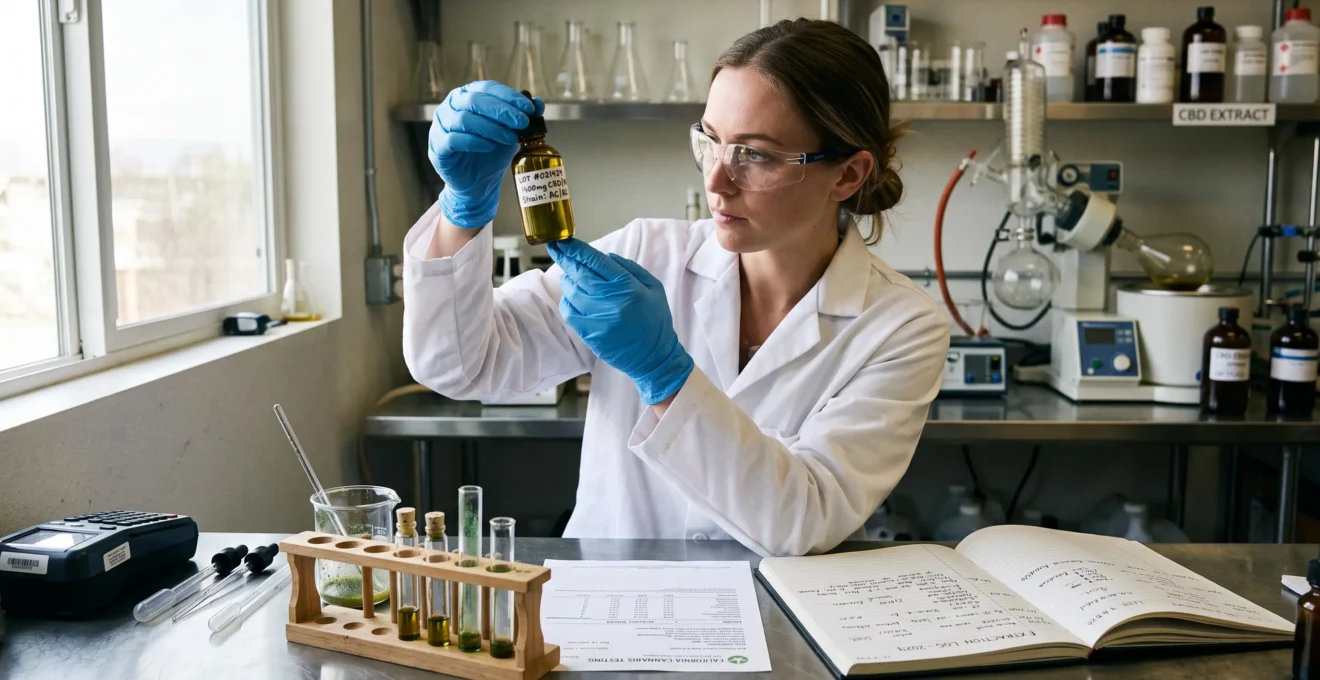
Two CBD oils can contain similar amounts of cannabidiol yet smell and taste remarkably different. One may have a pronounced herbal, pine-like or citrus character, while another is almost neutral. Much of that distinction can come from terpenes, a diverse family of aromatic compounds naturally present in cannabis and many other plants.
Terpenes matter when comparing full botanical CBD extracts because they help describe the plant-derived composition that remains after harvesting, processing and storage. Their presence can reveal something about an extract’s aromatic character, but it does not automatically demonstrate better purity, greater effectiveness or superior manufacturing.
Understanding their value requires looking beyond the fragrance of a bottle. Extraction methods, laboratory measurements, formulation choices and storage conditions all influence the final profile. A meaningful comparison therefore considers measurable terpene content alongside cannabinoid concentrations, contaminant testing and the transparency of the producer.
Terpenes in CBD extracts: the essentials
- Terpenes contribute to botanical aroma and flavor, but a higher concentration does not automatically mean a better or more effective CBD product.
- Harvesting, extraction, refinement and storage can all change the terpene profile before a bottle reaches the consumer.
- A batch-specific terpene analysis, combined with cannabinoid and contaminant testing, offers more meaningful evidence than fragrance or marketing terminology alone.
- Why Can Terpene Levels Drop Before a CBD Product Reaches the Consumer? (4.1)
- How Can You Check Whether a CBD Product Actually Contains Measurable Terpenes? (4.2)
- Terpene-Rich or Neutral CBD Oil: Which Better Fits Your Taste Preferences? (4.3)
- Does a Strong Botanical Aroma Really Mean a Higher-Quality CBD Extract? (4.4)
- How Can You Store a Terpene-Rich CBD Oil to Limit Aroma Loss After Opening? (4.5)
- Cannabinoid Panel or Wider Plant Profile: Which Test Tells You More About Extract Complexity? (14.3)
- Why Can Heat, Light and Air Gradually Change a Botanical Extract? (22.1)
- How Can You Evaluate Full-Spectrum Extracts Beyond the Marketing Label? (13)
Why Can Terpene Levels Drop Before a CBD Product Reaches the Consumer? (4.1)
Terpene concentrations can decline at several stages between harvesting cannabis and bottling a CBD extract. Drying temperatures, extraction conditions, heating, refinement and storage may each alter the original aromatic profile. These changes are not necessarily manufacturing failures: some production methods deliberately prioritize cannabinoid concentration, consistency or a neutral flavor rather than maximum terpene retention.
The process begins with harvested plant material. Drying removes moisture, but it can also release volatile aromatic compounds. Curing and subsequent handling introduce additional opportunities for changes in terpene composition, depending on the conditions and duration involved.
A scientific review of cannabis postharvest processing summarizes experiments demonstrating how drying conditions influence terpene retention. In one reported comparison, retention declined from 82.1% to 29.9% as drying temperature increased from ambient conditions to 90 °C. These results concern particular experimental conditions and should not be interpreted as a universal prediction for bottled CBD products.
82.1% to 29.9%
Reported terpene retention across a drying-temperature comparison summarized in a 2022 scientific review. The figures describe a specific experiment involving cannabis plant material, not all commercial CBD oils.
Das and colleagues, Bioengineering, 2022.
Extraction introduces another set of variables. Solvents, operating temperatures and processing duration influence which compounds transfer into the extract and which remain detectable afterward. Decarboxylation, a heating step used to convert acidic cannabinoids into their neutral forms, can further change volatile constituents. Distillation and filtration may remove additional aromatic compounds while refining the cannabinoid fraction.
These differences help explain why **terpene preservation and cannabinoid concentration are distinct production goals**. A minimally refined botanical extract may retain a broader range of aromatic constituents, whereas a distillate or isolate is produced to achieve a more concentrated or selective cannabinoid composition.
The type of extract therefore provides context, not proof of retention. A product described as full botanical can still contain few measurable terpenes if its processing conditions were unfavorable to preserving them.
Packaging and distribution also matter. A clear container may allow greater light exposure, while repeated opening, extended storage and unfavorable temperatures can gradually change sensitive compounds. A bottling date, batch number or opaque container offers useful contextual information, although none can establish terpene freshness without analytical testing.
The practical distinction is between an extract that contains fewer terpenes because of its intended formulation and one whose composition is simply undocumented. That question leads directly to laboratory verification.
How Can You Check Whether a CBD Product Actually Contains Measurable Terpenes? (4.2)
The most reliable way to confirm measurable terpenes in a CBD product is to examine a batch-specific certificate of analysis containing an individual terpene panel. Look for named compounds, numerical results, measurement units and laboratory identification. A general claim about a complete plant profile cannot establish terpene content when no relevant analytical results are provided.
A certificate of analysis, commonly abbreviated COA, should identify the tested sample and the compounds included in the laboratory’s analytical scope. A cannabinoid report alone may document CBD and THC concentrations without measuring any terpenes.
A genuine terpene panel can include compounds such as myrcene, limonene, alpha-pinene, beta-caryophyllene and linalool. The precise list depends on the laboratory’s method and the constituents selected for analysis.
When reviewing a report, check whether it provides:
- Individual compound names rather than a general statement that terpenes are present.
- Numerical results with units, such as a percentage by mass or milligrams per gram.
- A batch or sample identifier that can be matched to the purchased product.
- The laboratory’s identity, analysis date and relevant testing method where disclosed.
- Detection or quantification limits when a compound is reported as not detected or below the measurable threshold.
The distinction between “not detected” and “not tested” is especially important. A laboratory may report no measurable concentration for a particular compound under its method, but this is different from never analyzing that compound.
Laboratory methods and reporting formats can differ. Terpene analysis is not necessarily included in routine cannabinoid testing, and different panels may cover different compounds or use different reporting thresholds. Consequently, two reports should only be compared quantitatively when their units, sample types and analytical scope are compatible.
An analytical study of terpene profiles in medicinal cannabis oil compared preparations with broadly comparable cannabinoid profiles but differing terpene compositions. The researchers used chromatographic techniques to investigate compounds including limonene and alpha-pinene, illustrating why cannabinoid measurements alone do not fully describe aromatic composition.
Scent provides a secondary cross-check. A citrus-like aroma may be consistent with limonene, while a pine-like note may correspond partly to pinene. However, aromas arise from mixtures, their perception varies, and carrier oils or added flavorings can affect the result. **Smell cannot quantify terpenes or replace laboratory measurement**.
If a report omits terpenes entirely, the appropriate conclusion is that their concentration remains undocumented, not that the oil necessarily contains none. The available measurements can then be considered alongside personal preferences for aromatic or neutral formulations.
Terpene-Rich or Neutral CBD Oil: Which Better Fits Your Taste Preferences? (4.3)
Terpene-rich CBD oil generally suits people who appreciate a pronounced botanical aroma and distinctive herbal aftertaste. A neutral oil may be preferable when minimal flavor interference is important. Neither option is inherently superior: the better fit depends on sensory preferences, intended use, formulation transparency and verified product quality rather than terpene concentration alone.
Terpenes can introduce citrus, pine, floral, woody, peppery and herbal notes. Their overall sensory effect depends on which compounds are present, their relative concentrations and the influence of the carrier oil and other ingredients.
For consumers who find strongly botanical oils unpleasant, a neutral formulation can provide a more acceptable experience without necessarily compromising the accuracy of its labeled cannabinoid concentration.
The following comparison focuses on taste and handling, not medicinal effectiveness.
| Criterion | Terpene-rich CBD oil | Neutral CBD oil |
|---|---|---|
| Aroma | Potentially pronounced herbal, citrus, pine or floral notes | Usually mild, depending on carrier oil and ingredients |
| Taste | More distinctive botanical character | Generally less aromatic, though not necessarily tasteless |
| Aftertaste | Botanical notes may linger | Often less persistent |
| Mixing with food or beverages | May noticeably change the flavor | Less likely to interfere with delicate flavors |
| Best sensory fit | People who enjoy recognizable plant character | People who prefer restrained flavor |
Neutrality can be intentional. Isolate-based formulations, highly refined cannabinoid extracts and products designed for a mild sensory experience may contain little of the original plant’s terpene fraction. This describes a formulation choice, not automatically an inferior product.
Between these categories are broad-spectrum oils and formulations with reintroduced terpenes. Some manufacturers may recover aromatic compounds during processing and add them back; others may use terpene ingredients obtained from different botanical sources.
Therefore, **terpene-rich does not necessarily mean that every terpene originated from the same cannabis material as the CBD**. A product with added aromatic compounds may have a distinctive profile without reproducing the chemical composition of its original plant material.
Consumers interested in botanical authenticity can ask whether the terpenes were retained during extraction, recovered and reintroduced, or added from external sources. Ingredient information and manufacturing disclosures are useful here, but a terpene panel alone cannot always establish provenance.
A pleasant flavor matters to the person using the product, while analytical quality remains a separate question. This distinction is particularly important when a powerful aroma creates an impression of exceptional purity.
Does a Strong Botanical Aroma Really Mean a Higher-Quality CBD Extract? (4.4)
A strong botanical aroma does not prove that a CBD extract is higher quality. Terpenes contribute to fragrance, but scent intensity cannot establish cannabinoid accuracy, contaminant levels, extraction quality or therapeutic effectiveness. An intensely aromatic oil may be well characterized, poorly documented or deliberately flavored, while a nearly odorless extract may meet rigorous analytical specifications.
Fragrance is a sensory property influenced by compound mixtures and human perception. Some constituents are noticeable at relatively low concentrations, meaning that aroma intensity does not translate directly into the total quantity of terpenes present.
Furthermore, a pronounced smell may come from added flavorings or terpene blends introduced during formulation. Even when those ingredients are accurately declared, the resulting scent cannot prove that the original extraction process preserved the plant’s aromatic constituents.
The reverse assumption is equally unreliable. A faintly scented oil may simply have undergone additional refinement or have been formulated with a neutral cannabinoid ingredient.
Quality evaluation should emphasize characteristics that can be independently checked, particularly:
- CBD concentration and relevant THC measurements matching the product’s declared composition.
- Contaminant screening appropriate to the material and manufacturing process, including relevant pesticides, heavy metals and residual solvents.
- Accessible, batch-specific laboratory reports with identifiable testing scope.
- Transparent extraction and formulation information, including added aromatic ingredients.
- Reasonable batch consistency and clear product identification.
The FDA consumer information on CBD product quality and safety describes concerns involving inaccurate CBD labeling, potential contamination and unsupported medical claims. These findings reinforce the importance of independent testing rather than promotional descriptions. They are specific to the agency’s regulatory and consumer-safety context and should not be treated as a universal assessment of every national CBD market.
There is also no adequate basis for assuming that a stronger terpene aroma delivers greater therapeutic effectiveness. The presence of multiple plant compounds may be relevant to research on botanical composition, but a consumer cannot infer clinical benefit from fragrance or the breadth of a laboratory profile.
Aroma can be appreciated as part of the product experience without being promoted into a substitute for evidence. Once a preferred profile is selected, appropriate storage helps limit avoidable changes in its character.
How Can You Store a Terpene-Rich CBD Oil to Limit Aroma Loss After Opening? (4.5)
Store terpene-rich CBD oil in its original, tightly closed container, away from direct sunlight, heat and repeated temperature changes. A cool, dark, stable location helps limit conditions associated with volatile-compound loss and oxidation. These precautions can support aroma preservation, although they cannot guarantee a fixed shelf life or prevent every chemical change.
Terpenes include volatile compounds, meaning some can enter the air from a liquid formulation. Opening a bottle repeatedly exposes its contents to fresh air and creates opportunities for evaporation of aromatic constituents.
Oxidation is another concern. Depending on their chemical structures and the surrounding conditions, terpenes may react with oxygen and form different compounds. These changes can modify a formulation’s scent even when the change is not obvious by looking at the bottle.
Simple storage habits are therefore preferable to complicated preservation techniques:
- Keep the original amber or opaque bottle when it is suitable for the formulation.
- Close the cap securely immediately after each use.
- Choose a cupboard or another location protected from sunlight and excessive warmth.
- Avoid leaving the bottle in a car, near cooking equipment or in a bathroom with frequent temperature and humidity fluctuations.
- Do not routinely transfer the oil into another container, which adds handling and possible oxygen exposure.
Visible and sensory changes require careful interpretation. A gradual reduction in aroma or a slight color shift may accompany aging, but neither observation can identify which terpenes have changed or quantify the loss. A carrier oil can also influence color, cloudiness and viscosity.
Cloudiness, for example, is not inherently evidence of contamination: some oil formulations can become cloudy under cooler conditions. By contrast, unexpected particles, a distinctly rancid or otherwise abnormal odor, leakage or signs of contamination warrant caution. When a product shows unexplained deterioration, avoid using it and seek clarification from the manufacturer; discard it if contamination or spoilage is suspected.
Follow the manufacturer’s storage instructions and labeled expiration information. No universal post-opening lifespan can be established merely from the presence of terpenes, because formulations, packaging and storage histories differ.
However, preserving an aroma is not the same as verifying the complete chemical profile. For that broader question, cannabinoid and terpene analyses must be understood as complementary measurements.
Cannabinoid Panel or Wider Plant Profile: Which Test Tells You More About Extract Complexity? (14.3)
A cannabinoid panel is the more direct tool for checking CBD concentration, THC content and other cannabinoids included in the test. A wider plant profile adds information about terpenes and, where specifically analyzed, other botanical constituents. The broader panel describes more aspects of extract composition, but neither type of report independently proves overall safety or effectiveness.
A cannabinoid analysis answers practical composition questions. Does the sample contain the stated amount of CBD? Is THC detectable, and at what concentration? Are other cannabinoids such as cannabigerol (CBG) or cannabinol (CBN) reported?
Those measurements can help consumers compare labeled composition with actual results. They do not, however, establish whether the oil retains the aromatic compounds originally present in the harvested plant.
A terpene panel addresses a different dimension by identifying and quantifying compounds associated with botanical scent and flavor. Some extended analytical programs may also investigate flavonoids or additional plant constituents, but these are not automatically included in every product report.
| Question | Cannabinoid panel | Wider plant profile |
|---|---|---|
| How much CBD is present? | Directly measured when CBD is included | Available if cannabinoid testing is included |
| What is the THC concentration? | Measured according to the panel’s scope | Available if cannabinoid testing is included |
| Which terpenes are detectable? | Not established | Reported when individual terpenes are tested |
| Are minor botanical constituents documented? | Limited to included cannabinoids | Potentially, depending on analytical scope |
| Does the report establish contaminant safety? | No | No; separate relevant contaminant testing is needed |
A broader profile is valuable when a manufacturer emphasizes whole-plant complexity. It provides more opportunities to check whether the claimed range of constituents is actually reflected in the sample.
Yet **the number of detected compounds is not a universal quality score**. A report containing many identified substances does not establish that the formulation is purer, safer or more effective than one containing fewer.
Wider analytical programs can also involve additional testing, specialist instruments and expense. A manufacturer that provides only cannabinoid results may have chosen a narrower testing scope. That omission should be recognized as an information gap, not automatically interpreted as concealment.
Similarly, a complete-looking report may still omit relevant contaminants or fail to correspond to the product’s batch. Consumers should evaluate the quality and relevance of the evidence rather than the number of pages in a certificate.
Even a well-documented extract can change after testing. Its chemical stability depends partly on the environment encountered during bottling, distribution and everyday storage.
Why Can Heat, Light and Air Gradually Change a Botanical Extract? (22.1)
Heat, light and oxygen can contribute to chemical changes in CBD extracts through different mechanisms. Higher temperatures may accelerate reactions, light can initiate changes in susceptible compounds, and oxygen can participate in oxidation. Their effects depend on the formulation, exposure conditions and duration, so changes in aroma or color do not automatically imply that an extract has become unsafe or entirely ineffective.
Temperature influences both chemical reaction rates and the behavior of volatile constituents. Excessive warmth can increase opportunities for aroma loss while also accelerating some degradation processes. The size of these effects depends on which compounds are present and the conditions involved.
Light exposure introduces a separate variable. Certain molecules can undergo photochemical changes when exposed to appropriate wavelengths and sufficient light. Ultraviolet exposure is often a particular consideration, although not every component of a CBD formulation responds identically.
Oxygen can react with susceptible constituents, including some cannabinoids, terpenes and components of the carrier oil. A bottle repeatedly opened and closed therefore experiences a different exposure history from one stored unopened under controlled conditions.
An experimental study of CBD stability in sunflower oil examined cannabidiol under defined temperature and air-exposure conditions. Researchers found that solid CBD was more stable than CBD dissolved in sunflower oil under the conditions investigated, with substantial degradation observed in open oil samples exposed to higher temperatures.
Controlled stability testing of CBD in sunflower oil
Kosović, Sýkora and Kuchař investigated purified CBD powder and CBD dissolved in sunflower oil, examining storage conditions that included 25 °C ± 2 °C and 40 °C ± 2 °C, alongside differences in air exposure.
The study identified greater stability for solid CBD and substantial degradation in open oil samples under elevated-temperature conditions. Its results concern CBD stability in a specific oil matrix; they do not quantify individual terpene losses or establish a universal shelf life for full botanical products.
The study also found that light alone did not produce strong adverse effects on CBD under its particular test conditions, although combined environmental factors could contribute to degradation. This distinction matters: light, heat and oxygen should not be treated as interchangeable threats with identical effects.
For terpene-rich extracts, changes in the aromatic mixture can alter flavor and scent over time. Two bottles produced from the same formulation may therefore develop different sensory characteristics if one has experienced greater heat or air exposure.
However, **a changed scent does not quantify CBD degradation**, and a darker appearance does not establish contamination or complete loss of product value. Those conclusions would require suitable testing and interpretation of the product’s specific formulation.
Environmental stability is one part of product quality, but the final purchasing decision also involves composition, transparency and the credibility of the manufacturer’s claims.
Key takeaways before comparing CBD products
- Start with the product’s verified composition: botanical richness is meaningful only when the relevant compounds have actually been measured.
- Distinguish documented extraction and formulation choices from assumptions based on scent, flavor or label terminology.
- Consider the entire product history, including batch identification, contaminant screening and storage conditions, before interpreting an aromatic profile.
How Can You Evaluate Full-Spectrum Extracts Beyond the Marketing Label? (13)
Evaluate a full-spectrum CBD extract by examining what it contains, how that composition was verified and whether its manufacturing and storage information is credible. Look for batch-specific cannabinoid measurements, relevant contaminant screening, optional terpene data and clear formulation disclosures. Terms such as full-spectrum, full botanical or whole-plant provide context, but cannot substitute for analytical evidence.
These descriptions may be used differently across brands and markets. Full-spectrum generally suggests that the formulation contains a range of cannabis-derived constituents rather than CBD alone, but the wording does not establish a specific quantity of terpenes or minor cannabinoids.
Likewise, full botanical and whole-plant can evoke comprehensive plant retention without specifying which compounds survived processing. The presence of a broad mixture should be demonstrated rather than assumed.
The most informative approach is to compare products using the same evidence categories, even when their manufacturers use different terminology.
Five checks to document before choosing a CBD extract
- Match the laboratory report to the bottle. Record the product’s batch number and the corresponding report identifier. The result should be a verified batch match, or a clearly noted information gap.
- Check the cannabinoid composition. Record the measured CBD and THC values, their units and whether they are consistent with the label. Produce a short comparison of claimed versus reported content.
- Document terpene evidence. Identify whether the report includes individual terpene measurements, only general statements or no terpene testing. Note at least the reported compounds and values where available.
- Review contaminant and manufacturing information. Record which relevant contaminant categories were tested and whether extraction methods or added ingredients are disclosed. List any missing information separately.
- Inspect packaging and product identification. Note the container type, storage instructions, batch identification and any available bottling or expiration information. Finish with a brief product comparison based on documented strengths and unresolved questions.
Using the same five checks across competing products makes it easier to distinguish genuine transparency from persuasive packaging. A strongly aromatic oil may perform well on documentation, but it should not receive an automatic advantage over a neutral one.
When terpene testing is absent, mark botanical complexity as unverified rather than assigning a negative result. When the manufacturer publishes a broader profile, examine what the analytical method actually measured before interpreting it as comprehensive.
Relevant safety information deserves separate attention. Contaminant tests must be appropriate to the product and supported by traceable results. A terpene analysis cannot compensate for missing safety-related measurements.
For consumers in different English-speaking markets, product legality, THC restrictions, labeling obligations and permitted CBD uses may vary by jurisdiction. Analytical transparency remains useful across markets, but legal compliance must be assessed under the applicable local requirements rather than inferred from a foreign laboratory certificate.
Finally, no botanical profile establishes that a CBD oil is suitable for treating a medical condition. CBD may cause adverse effects and interact with medicines, making professional advice important where personal health or medication use is involved.
The practical next step is to select two products of interest, obtain their batch reports and compare the documented cannabinoid, terpene and contaminant information side by side. Value terpenes for the botanical characteristics they contribute, while allowing the wider evidence to determine how confidently each extract can be assessed.
Does a CBD oil need terpenes to contain cannabidiol?
No. Cannabidiol and terpenes are different categories of plant compounds. A formulation based on purified CBD can contain cannabidiol without retaining a measurable range of the original cannabis terpenes. The presence of CBD therefore does not establish the presence of a broad aromatic profile.
Can two CBD oils have similar CBD levels but different terpene profiles?
Yes. Extraction and preparation conditions can yield oils with comparable cannabinoid measurements but different terpene compositions. This distinction has been demonstrated in analytical research comparing medicinal cannabis oil preparations. It explains why CBD concentration alone cannot describe the complete aromatic character of an extract.
Are naturally retained terpenes distinguishable from added terpenes in a standard lab report?
Not necessarily. A standard terpene panel identifies and quantifies selected compounds, but it does not automatically establish their botanical origin or whether they were retained during extraction or introduced afterward. Ingredient declarations, manufacturing records and additional specialized analysis may be needed to investigate provenance.
Does a terpene listed as not detected mean the product contains absolutely none?
Not necessarily. A not-detected result depends on the laboratory method and its detection threshold. The compound may be absent or present below the method’s detection capability. A compound excluded from the test panel is different again: its concentration has not been assessed by that report.
Does the presence of more terpenes prove a stronger entourage effect?
No. The entourage effect is a hypothesis concerning possible interactions among cannabis constituents, but the number or concentration of terpenes in a consumer CBD oil does not independently establish a clinically meaningful benefit. A wider chemical profile documents composition, not proven therapeutic superiority.