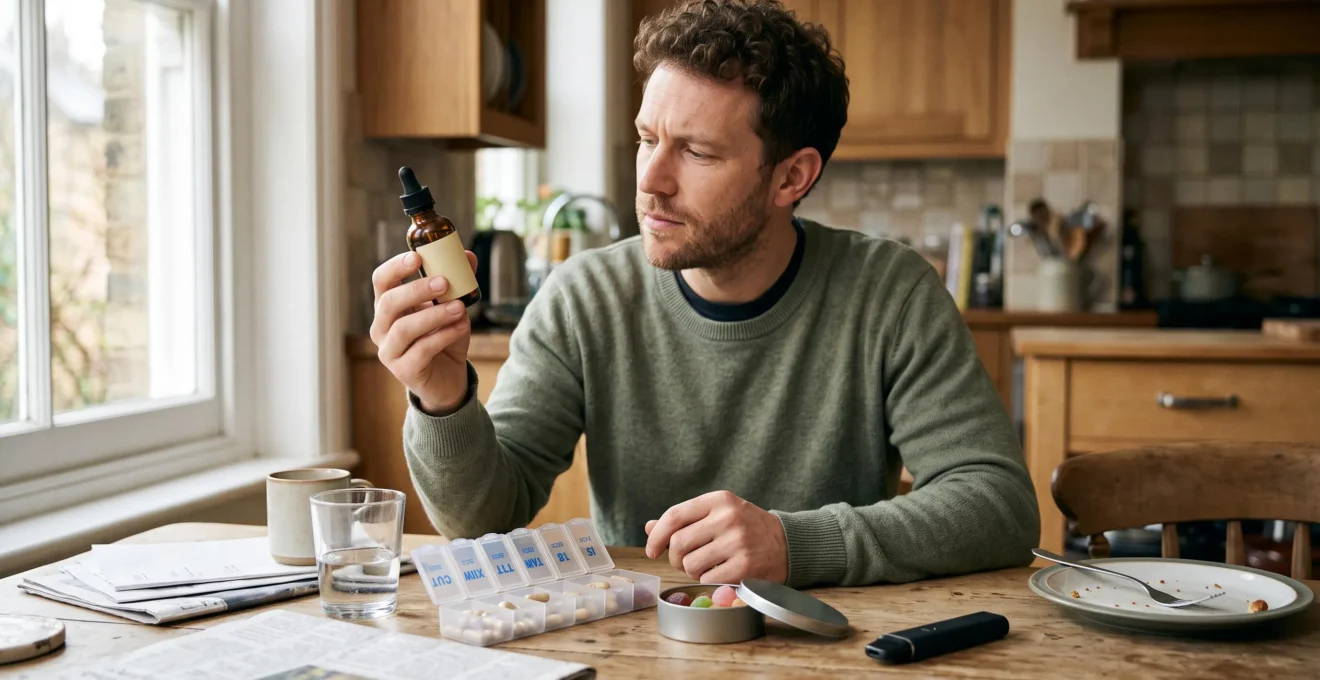
CBD delivery mechanisms determine how cannabidiol enters the body, how quickly it reaches the bloodstream and how practical a product is to use. Sublingual oils, swallowed capsules, edibles, inhaled preparations and skin-applied products differ in more than appearance. Each introduces distinct absorption pathways, formulation requirements and handling constraints.
For someone comparing everyday formats, the most useful question is not which method is universally strongest or fastest. It is which delivery system matches the intended setting, the need for measurable servings and the amount of preparation the user can realistically accommodate.
Delivery route also needs to be considered separately from product quality and safety. A convenient format is not necessarily an effective, accurately labelled or appropriate one. Published CBD pharmacokinetic research describes substantial variation between formulations, while evidence connecting these differences to everyday consumer outcomes remains limited.
A practical comparison therefore starts with four considerations: where the CBD is absorbed, how the formulation influences that absorption, how reliably the serving can be measured and whether the method suits the user’s circumstances.
CBD delivery methods at a glance
- Route changes exposure: inhaled, oral and oromucosal CBD follow different pathways, but faster absorption does not guarantee greater benefit.
- Format changes usability: capsules offer fixed servings, oils provide measurement flexibility, and inhaled formats introduce equipment and respiratory considerations.
- Practical fit matters: compare product instructions, independent testing, regulatory status and safety before prioritising convenience or speed.
- Why Does Delivery Route Change the Journey of a CBD Formulation Through the Body?
- How Can You Compare CBD Delivery Methods Using Speed, Discretion and Dose Control?
- Sublingual Oil or Swallowed Capsule: Which Better Fits a Structured Routine?
- Which Delivery-System Mismatches Can Make a CBD Product Harder to Use Correctly?
- When Should Convenience Matter More Than Delivery Speed in a CBD Routine?
- Oral or Inhaled CBD: How Do Their Delivery Pathways Differ Before Circulation?
- Why Are Some CBD Formats Easier to Use Discreetly Than Others?
- What Does Bioavailability Really Tell You When Comparing CBD Formats?
Why Does Delivery Route Change the Journey of a CBD Formulation Through the Body?
CBD delivery route changes systemic exposure because the digestive tract, oral mucosa and lungs provide different routes into circulation. Swallowed CBD undergoes gastrointestinal processing and first-pass metabolism, while inhaled CBD reaches the bloodstream through the lungs. Oromucosal products may allow some direct absorption, although a portion can also be swallowed.
With an oral capsule or edible, CBD travels through the gastrointestinal system before absorption. Much of the absorbed substance then passes through the liver, where metabolism can reduce the amount of unchanged CBD reaching systemic circulation. Food and formulation composition can substantially change this process.
An oil held beneath the tongue introduces another potential pathway: absorption across the oral mucosa. However, not all CBD necessarily crosses this tissue. Some can remain in the mouth and subsequently be swallowed, creating a combination of oromucosal and gastrointestinal delivery.
Inhaled CBD enters through the lungs and can reach circulation without first passing through gastrointestinal absorption and initial hepatic metabolism. This generally produces earlier peak plasma concentrations, although actual exposure depends on the device, formulation and inhalation conditions.
The distinction between absorption and bioavailability is important. A substance may be absorbed from the intestine yet undergo enough first-pass metabolism that relatively little unchanged CBD becomes systemically available.
A systematic review of CBD pharmacokinetics covering 39 human studies identified administration route, dose, formulation and food intake as important influences on CBD exposure. It also found lower systemic exposure with oromucosal than oral administration in its meta-regression, challenging the assumption that holding CBD under the tongue always delivers more to circulation.
Formulation adds another layer. MCT oil, hemp seed oil, other lipid vehicles and emulsion systems may affect CBD dispersion and absorption. These ingredients cannot be ranked reliably without product-specific comparative evidence.
Exposure profiles may also matter differently in different contexts. Earlier systemic delivery could be relevant when timing is a practical priority, while delayed absorption may be easier to accommodate in a scheduled routine. Neither pattern establishes a predictable duration of benefit.
Once the pathway is understood, the next step is to compare formats using criteria that can actually guide a purchasing or usability decision.
How Can You Compare CBD Delivery Methods Using Speed, Discretion and Dose Control?
CBD delivery methods can be compared using three practical criteria: expected absorption timing, discretion during use and serving-size control. Inhaled formats generally deliver CBD into circulation more quickly, capsules provide convenient pre-measured servings, and oils allow adjustable measurements. However, none of these advantages establishes superior effectiveness or safety.
The following grid compares typical handling characteristics rather than guaranteed effects. Absorption speed refers to systemic delivery patterns, not the time when a person will necessarily notice a change.
| CBD format | Absorption timing | Discretion | Serving control |
|---|---|---|---|
| Sublingual oil | Variable; both oral-mucosal and swallowed absorption may contribute | Moderate; requires handling and a pause | Adjustable, but dependent on concentration and measuring device |
| Swallowed capsule | Delayed and variable through digestion | High in suitable settings | Fixed, pre-measured serving if accurately manufactured |
| Gummy or edible | Delayed and variable through digestion | High visually, but product recognition and storage matter | Pre-portioned, subject to label accuracy |
| Inhaled vaporised CBD | Generally earlier systemic exposure | Low where vapour or device use is noticeable | Delivered amount depends on equipment and technique |
| Conventional topical cream or balm | No established comparable systemic onset | Often high after application | Amount applied can be measured, but absorbed amount is uncertain |
There is often a trade-off between rapid delivery and measurable repetition. Inhalation can produce earlier systemic concentrations, but the amount delivered may depend on puff characteristics and device performance. Capsules provide predetermined contents, although what reaches circulation still varies between individuals.
Oils offer an intermediate practical option. A graduated dropper can support measured volumes, but counting drops alone may introduce inconsistency. The CBD concentration per millilitre is more informative than the bottle’s total CBD content when calculating a serving.
Two self-assessment questions help narrow the options:
- Is rapid systemic delivery a practical requirement, or can delayed and variable absorption fit the intended schedule?
- Is a repeatable labelled amount more important than having the flexibility to measure different amounts?
These questions should not be used to infer a medically appropriate dose or promise an onset of effects. Product testing, individual circumstances and safety considerations remain separate requirements.
Among the more familiar options, the difference between sublingual oil and swallowed capsules illustrates how route and routine interact.
Sublingual Oil or Swallowed Capsule: Which Better Fits a Structured Routine?
A swallowed CBD capsule generally fits a structured routine when fixed servings, minimal handling and consistent administration steps are priorities. Sublingual oil offers more flexibility in measuring a serving and deciding when to use it, but requires additional attention to instructions. Neither format guarantees consistent blood concentrations or predictable effects.
Capsules can be incorporated into an established schedule alongside other permitted products. Their main practical advantage is that the user does not need to operate a dropper or measure a liquid each time. However, changing a serving amount is less straightforward, and product-specific directions must be followed.
Oil introduces a different sequence. The user measures a volume, places it beneath the tongue if directed, holds it according to the product’s instructions and eventually swallows the remainder. This creates opportunities for inconsistent measurement or administration.
Importantly, swallowing an oil immediately may change its intended absorption pathway. More of the CBD may follow the gastrointestinal route rather than having an opportunity for oromucosal absorption. However, even oil held beneath the tongue can be partly swallowed, so the difference cannot be quantified reliably for every retail product.
Holding time alone does not establish how much CBD enters through the oral mucosa. The product’s composition, contact with the tissue and swallowed fraction all affect the overall exposure profile.
Formulation can make the comparison even less straightforward. A capsule containing an optimised lipid formulation might behave differently from a basic oil preparation, despite both containing the same declared amount of CBD. This is why the route and the formulation need to be examined together.
A useful decision rule is to favour the capsule’s handling characteristics when repetition and simplicity are priorities. Consider an oil’s measurement flexibility when that flexibility has a clear purpose and the instructions can be followed reliably.
Even a theoretically suitable delivery system can become impractical when its instructions are misunderstood or its actual route differs from what the user expects.
Which Delivery-System Mismatches Can Make a CBD Product Harder to Use Correctly?
A CBD delivery-system mismatch occurs when a product’s administration requirements conflict with how someone expects or intends to use it. Common examples include swallowing a sublingual oil immediately, expecting an edible to act rapidly, treating a conventional topical as a systemic product or selecting an inhaled format without considering its equipment and respiratory risks.
Marketing terms such as “fast-acting” or “high absorption” are not sufficient to explain how a formulation works. They need context: the tested route, formulation, experimental conditions and outcome measured.
For instance, a CBD drink mix is swallowed even if its ingredients use advanced dispersion technology. Similarly, a mouth spray might be intended for oromucosal contact or simply for swallowing. Instructions are more informative than names alone.
Topicals require another distinction. A conventional balm or cream is applied to the skin, but that does not mean it reliably delivers meaningful amounts of CBD into systemic circulation. A specially designed transdermal system has a different objective and needs evidence supporting that mechanism.
Labelling introduces a further practical risk. A product advertising a large total CBD quantity may contain many separate servings. The relevant comparison is the declared CBD amount per serving, supported where possible by independent analysis.
24%
Of 89 sampled US topical cannabinoid products declaring a total CBD quantity, only 24% were within the study’s labelling-accuracy tolerance. Products were purchased in 2020; the finding does not describe current market-wide accuracy.
JAMA Network Open investigation of topical CBD labelling, published in 2022.
The finding highlights why a declared CBD quantity should not be treated as independently verified. It does not establish that any particular delivery route is ineffective.
Five checks before choosing a CBD delivery format
- Identify the intended route. Read the administration instructions and write down whether the product is swallowed, held in the mouth, inhaled or applied to the skin.
- Calculate the declared serving. Record CBD per capsule, gummy, measured liquid volume or specified application, separately from total package content.
- Check the handling requirements. Note any holding instructions, food-related directions, equipment needs and storage conditions.
- Verify composition and testing. Look for batch-specific independent analytical information and record whether CBD and relevant cannabinoid content match the label.
- Review safety and local restrictions. Record unresolved questions about medication interactions, product status or administration suitability for discussion with a qualified professional.
A completed comparison should identify not only the claimed delivery advantage but also the evidence supporting it and any unresolved practical limitations.
Once unsuitable administration requirements have been excluded, convenience becomes a meaningful factor rather than a substitute for product verification.
When Should Convenience Matter More Than Delivery Speed in a CBD Routine?
Convenience deserves greater weight than delivery speed when a format must fit a repeated schedule and rapid systemic absorption is not an essential requirement. Straightforward preparation, consistent serving measurement and appropriate storage may make a format easier to manage. However, convenience alone cannot establish that regular CBD use is beneficial or safe.
A capsule may require fewer handling steps than a sublingual oil. An oil, by contrast, may require measuring a volume and following a timed administration procedure. Those differences can matter when someone is evaluating how demanding a format would be in daily life.
For a hypothetical consumer who already follows a structured morning routine, a pre-measured product could reduce the number of decisions involved. Someone comparing options for occasional use might instead focus on administration timing and whether the product requires specialised equipment.
These are usability scenarios, not clinical recommendations. There is insufficient evidence to conclude that a particular CBD route provides reliable everyday wellness benefits simply because it is convenient or produces earlier systemic exposure.
The hidden costs of a delivery method can include:
- Preparation steps, cleaning requirements or repeated handling.
- Uncomfortable taste, texture or swallowing requirements.
- Limited privacy or restrictions in the intended setting.
- Difficulty interpreting serving measurements or instructions.
- Storage requirements and the risk of accidental access by children or pets.
A simple sustainability question is: “Could these administration steps realistically fit my schedule over the coming month?” The question tests practicality, not whether continued consumption is advisable.
Using multiple formats to meet different circumstances also requires caution. Combining CBD products can increase total exposure, making it harder to interpret actual intake and potential adverse effects.
Any plan for repeated use should first account for possible medication interactions, adverse effects and the regulatory status of the products being considered.
Convenience becomes especially relevant when comparing oral products with inhaled preparations, where the physiological pathways and practical constraints differ substantially.
Oral or Inhaled CBD: How Do Their Delivery Pathways Differ Before Circulation?
Swallowed CBD must pass through gastrointestinal absorption and first-pass hepatic metabolism before reaching systemic circulation, whereas inhaled CBD crosses the pulmonary absorption surface and can enter circulation more directly. Inhalation generally produces earlier plasma concentrations, but delivered amounts depend on technique and equipment, and faster exposure does not establish greater benefit.
For oral CBD, the sequence begins with ingestion, continues through the digestive tract and includes absorption and metabolism before unchanged CBD becomes available systemically. The presence of food, the delivery vehicle and individual physiology can change the resulting concentration profile.
For inhaled CBD, the substance is carried in an inhalable aerosol or smoke, reaches the respiratory tract and may be absorbed through the lungs. This bypasses the initial gastrointestinal route, although CBD remains subject to metabolism after entering circulation.
The systematic review described earlier reported the following ranges of arithmetic mean time to maximum plasma concentration in single-dose studies:
| Administration route | Reported mean Tmax range | Interpretation |
|---|---|---|
| Inhaled | 0.00–0.60 hours | Earlier peak concentrations in the included studies |
| Oromucosal | 1.00–5.01 hours | Variable exposure, potentially including swallowed CBD |
| Oral | 0.59–10.45 hours | Broad variation across formulations and conditions |
These are study-level pharmacokinetic observations, not reliable onset-of-effect predictions for consumer products. The observed ranges cannot be used to assign a precise duration of action to any individual format.
Inhalation also introduces considerations beyond speed. Delivered amounts vary with device design, formulation, temperature and inhalation behaviour. Aerosol exposure raises respiratory-safety questions, particularly for people who do not already use inhaled products.
Vaping and smoking are not equivalent processes. Vaping typically heats a formulation to generate an aerosol without intentionally burning plant material, whereas smoking involves combustion. Nevertheless, the absence of combustion does not make inhalation harmless.
Oral formats avoid the inhalation step, but delayed and variable CBD exposure can complicate assumptions about timing. Neither route should be selected solely on the basis of its peak concentration profile.
Beyond the biological pathway, a format’s visibility, smell and required actions can determine whether it suits the setting in which it would be used.
Why Are Some CBD Formats Easier to Use Discreetly Than Others?
CBD formats differ in discretion because they require different visible actions, produce different smells and resemble different everyday products. Capsules are often easy to handle unobtrusively, while oils require measuring and administration steps. Inhaled formats can be more noticeable because of equipment and aerosol. Discretion is contextual rather than an inherent guarantee.
Three dimensions help make the comparison more precise. Visual discretion concerns whether the product or device attracts attention. Olfactory discretion concerns whether the formulation or its use produces a detectable smell. Behavioural discretion concerns the movements, time and equipment needed for administration.
For example, an unbranded capsule may look similar to other capsule products and require little preparation. A gummy can also be visually unobtrusive, although its appearance introduces important storage and accidental-ingestion concerns.
An oil bottle may be small, yet opening it, measuring liquid and holding a serving beneath the tongue involves a distinctive sequence. Some formulations also have noticeable flavours or odours.
Inhaled formats introduce a different profile. Even a compact device may be recognisable, and visible aerosol, odour and repeated inhalation gestures can draw attention. Legal restrictions and workplace or transport policies may also apply.
Conventional topical preparations can be unobtrusive after application, but their practicality depends on where they are applied, whether they leave residue and whether the user needs to wash their hands or wait before dressing.
Discretion can therefore conflict with other preferences. A capsule may be simple to carry and consume, yet its serving is fixed and its gastrointestinal absorption is delayed and variable. An oil offers more measurement flexibility but may require a less convenient administration procedure.
It is also worth distinguishing social discretion from responsible product handling. Keeping CBD hidden from public view does not resolve questions about labelling, use restrictions or safe storage.
These practical properties make more sense when considered alongside bioavailability, a frequently misunderstood measure of systemic delivery.
Key takeaways before comparing bioavailability
- A higher or earlier blood concentration does not establish better everyday outcomes.
- Two products using the same route can produce different exposure profiles because formulation and administration conditions matter.
- Useful comparisons combine systemic exposure evidence with measurable servings, handling requirements and product safety.
What Does Bioavailability Really Tell You When Comparing CBD Formats?
CBD bioavailability describes the fraction of an administered dose that reaches systemic circulation as unchanged cannabidiol. It helps explain how administration route and formulation influence exposure, but it does not directly measure perceived effects, safety or therapeutic value. A bioavailability claim is useful only when its measurement conditions and relevance to the specific product are clear.
Several related concepts need to be kept separate:
- Serving amount: how much CBD the product is intended to deliver per administration.
- Bioavailability: the proportion of that amount reaching systemic circulation unchanged.
- Absorption rate: how quickly CBD enters the body and becomes systemically available.
- Systemic exposure: the concentration of CBD in circulation over time, commonly assessed using pharmacokinetic measurements.
A product can contain a comparatively large serving yet deliver a smaller fraction of it systemically. Another may produce an earlier concentration peak without providing greater overall exposure. Neither observation is sufficient to predict how a consumer will feel.
Published bioavailability results are not fixed specifications for all products in a category. Differences in study design, dosage, food intake, formulation and participant characteristics can produce substantially different findings.
A scientific review of CBD bioavailability and delivery strategies describes lipid-based vehicles, emulsions and encapsulation technologies investigated to change CBD delivery. Some formulations produce faster systemic delivery, but the review also identifies major gaps between pharmacokinetic improvements and demonstrated therapeutic benefits.
This matters when evaluating claims about nanoemulsions or enhanced absorption. A technology may have a plausible scientific basis without establishing that every retail product using that description achieves the same result.
Nor does the research justify a universal bioavailability hierarchy of inhaled CBD above sublingual CBD above swallowed CBD. Although inhalation generally produces earlier plasma concentrations, oromucosal administration has not consistently shown greater systemic exposure than oral delivery.
Bioavailability should therefore be used as one consideration in a broader assessment, not as a percentage that automatically determines which format to purchase.
Safety remains an independent question. The FDA consumer information on CBD products and safety identifies concerns including possible liver injury, medication interactions, sedation and uncertainty about the quality of some marketed products. It also distinguishes approved prescription CBD medication from other CBD products. US regulatory requirements should not be assumed to apply identically in other English-speaking countries.
Before choosing any CBD format, compare its documented route, independently supported formulation claims, declared serving and applicable safety information. Where medication use, underlying health conditions or repeated CBD exposure are relevant, seek qualified healthcare advice rather than treating delivery efficiency as proof of suitability.
Does a higher CBD concentration on the label mean better absorption?
No. Label concentration describes the declared amount of CBD in a specified quantity of product. Bioavailability describes the proportion reaching systemic circulation unchanged. Absorption depends on route, formulation, administration conditions and individual physiology, so a higher declared concentration does not establish a higher absorbed fraction.
Are nanoemulsion CBD products automatically more bioavailable?
No. Some emulsion-based formulations have demonstrated improved pharmacokinetic characteristics, but their performance depends on the exact composition and testing conditions. The term “nanoemulsion” alone does not verify increased systemic exposure or superior outcomes for a particular commercial product.
Can CBD cream deliver CBD into the bloodstream?
Skin-applied formulations differ substantially. Ordinary topical creams and balms should not be assumed to produce meaningful systemic exposure. Specialised transdermal systems are designed for delivery across the skin, but evidence for the individual formulation is needed before making claims about its systemic absorption.
Can someone switch between equal-milligram CBD servings from different formats?
Equal labelled CBD quantities do not guarantee equivalent systemic exposure. Oral, oromucosal and inhaled products may produce different concentration profiles, and some preparations have uncertain serving accuracy. Switching formats or combining products should not be treated as a straightforward milligram-for-milligram substitution, particularly where medications or health conditions are involved.
Do CBD product rules differ between English-speaking countries?
Yes. Product classification, permitted ingredients, marketing claims and restrictions on food, supplements or inhalable products depend on the jurisdiction. Rules described by the US FDA should not be applied automatically to the United Kingdom, Canada, Australia, New Zealand or other markets. Check the relevant national authority and current local requirements before purchasing or using a product.