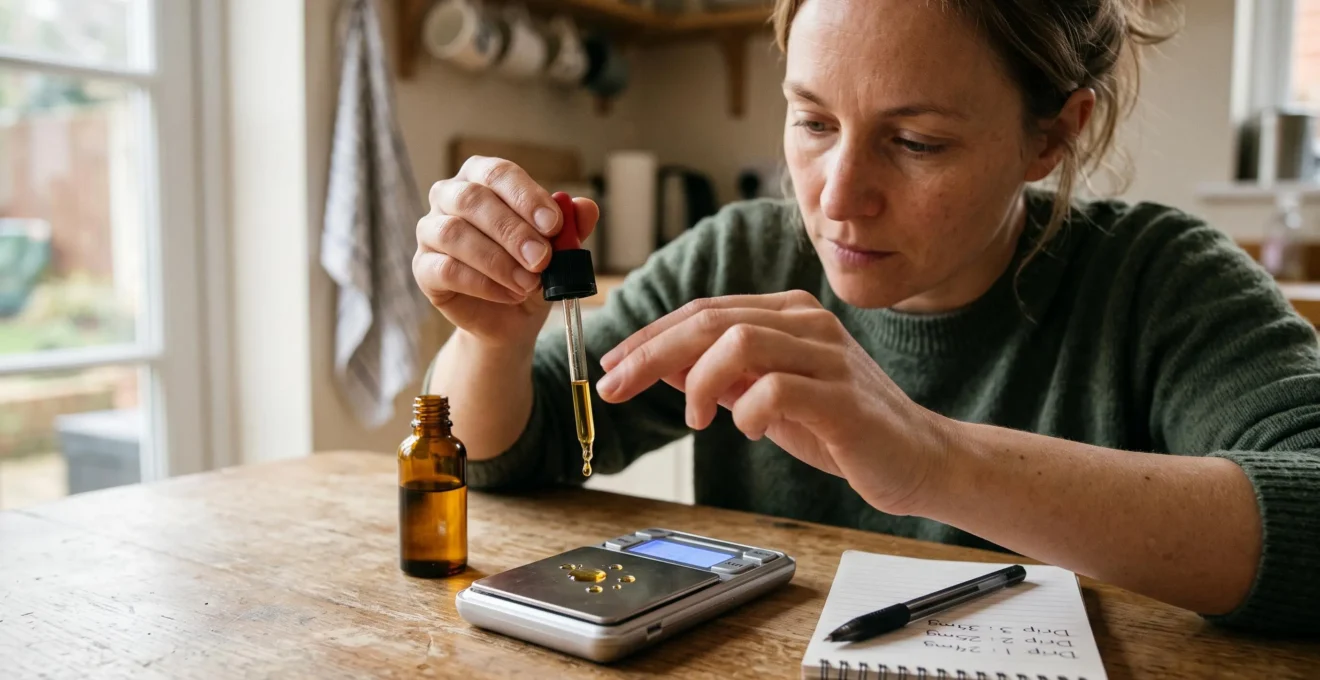
A CBD dropper marked 1 ml does not necessarily deliver exactly 1 ml of oil. The printed graduation indicates an intended volume, but the amount transferred can change with filling technique, trapped air, dropper position and liquid remaining inside the pipette.
Calibrating a CBD dropper means checking its actual delivered volume under repeatable conditions. A practical home method is to weigh the oil transferred from a measured draw, convert its mass into an estimated volume using the oil’s density, and repeat the measurement. Counting drops can also help establish a personal dispensing baseline, although it cannot independently verify absolute volume.
The distinction matters because CBD quantities are usually expressed in milligrams, while droppers measure liquid volume. Even a correctly measured volume gives an inaccurate CBD calculation when the product’s stated concentration is wrong.
A useful calibration therefore combines three elements: verified liquid volume, reliable concentration information and a consistent dispensing technique. The aim is repeatability, not laboratory-grade certification.
CBD Dropper Calibration: The Essentials
- Check actual delivered volume by weighing the dispensed oil and dividing its mass by an appropriate density estimate.
- Repeat the same fill-and-dispense procedure three times, keeping the pipette vertical and checking for air bubbles.
- Calculate CBD in milligrams from verified liquid volume and labeled CBD concentration, recognizing that label accuracy remains a separate uncertainty.
- Why Can a 1 ml CBD Dropper Give Inconsistent Measurements Between Uses?
- How Can You Check a CBD Dropper’s Real Volume Before Using It Regularly?
- Marked Dropper or Plain Pipette: Which Gives Better Control Over CBD Oil Portions?
- Which Dropper Mistakes Can Distort a CBD Oil Measurement by More Than Expected?
- When Should You Recheck CBD Dropper Calibration After Changing Products?
- How Can You Calculate CBD Concentration from Milligrams and Bottle Volume?
- Which Daily Sublingual Habits Can Contaminate a Dropper or Distort Measurements?
- How Can You Make Daily Sublingual CBD Administration More Consistent?
Why Can a 1 ml CBD Dropper Give Inconsistent Measurements Between Uses?
A 1 ml CBD dropper can produce inconsistent measurements because its graduation describes an intended liquid volume, not necessarily the volume successfully delivered. Air bubbles, incomplete filling, pipette angle, dispensing technique and retained oil can all influence the result. Variability may also arise from differences between individual droppers, even when they appear identical.
Two types of uncertainty must be separated. The first is **graduation accuracy**: whether the marked 1 ml line corresponds to the intended volume in the pipette. The second is **delivery accuracy**: whether the liquid actually leaving the pipette matches that volume.
For example, a dropper may be filled consistently to its printed line but release different amounts if the user alternates between squeezing the bulb completely and allowing the oil to drain naturally. Residual liquid matters because a pipette calibrated for one dispensing procedure may not deliver the same volume under another.
Oil characteristics introduce additional practical considerations. Cooler oil can be more viscous, taking longer to enter the pipette and drain along its walls. A hurried draw may trap air, while an insufficiently submerged tip can aspirate air instead of liquid.
Viscosity should not, however, be treated as proof that every thicker oil produces larger dosing errors. In a comparative study of oral dropper dose uniformity, researchers found that viscosity, surface tension and density had little or no influence on delivered drop volume under their controlled vertical-dispensing conditions. Tilting the dropper toward 45 degrees increased variation, and manual dispensing by volunteers was less consistent than controlled dispensing.
The research examined pharmaceutical droppers rather than CBD pipettes, but its practical lesson is relevant: **hold the dispensing device vertically** and maintain the same operating technique.
Drop size is particularly sensitive to the way liquid separates from the tip. Surface tension, tip geometry and orientation affect drop formation, meaning that a graduation on the glass cannot guarantee uniform individual drops.
Manufacturing differences present another possible uncertainty. Two apparently identical pipettes can have different internal dimensions or tip shapes. Without manufacturer specifications or direct measurements, their actual tolerances cannot be assumed.
A personal measurement baseline is therefore more valuable than relying on the appearance of a precision-marked dropper.
The practical next step is to measure what the dropper actually transfers, using the same procedure that will be repeated during normal use.
How Can You Check a CBD Dropper’s Real Volume Before Using It Regularly?
You can check a CBD dropper’s delivered volume by dispensing a marked fill into a tared container on a precision scale, recording the oil’s mass and dividing that mass by its density. Repeat the process three times to estimate average delivery and variability. Without a scale, drop counting can assess repeatability but cannot independently confirm milliliters.
Checking Delivered Volume by Weight
Gravimetric measurement uses a straightforward relationship:
Volume (ml) = Mass (g) ÷ Density (g/ml)
The National Institute of Standards and Technology documents the technical principles of mass-based volume measurement in NIST’s procedures for volumetric calibration.
Those procedures concern controlled laboratory measurement. A home scale provides only an approximate consistency check, not certified calibration.
For a practical test:
- Place a clean, dry, lightweight collection container on a stable digital scale with 0.01 g readability, then tare it.
- Bring the oil to a consistent room temperature and gently fill the pipette to its 1 ml graduation, with its tip fully submerged during drawing.
- Check for visible air bubbles and keep the pipette vertical while reading the graduation at eye level.
- Dispense into the container using the same technique intended for daily use, allowing a consistent drainage period.
- Record the displayed mass, reset the apparatus and repeat the complete test twice more.
A scale displaying hundredths of a gram is useful for an approximate check but should not be called a milligram-resolution balance: 0.01 g equals 10 mg. Scale repeatability, tare behavior and container movement can also affect results.
Oil does not necessarily weigh 1 g per milliliter. MCT and hemp seed carrier oils commonly have densities below that of water. Their precise densities vary by composition and temperature, and the product’s actual density is preferable to a generic estimate.
Consider an explicitly hypothetical oil with a density of 0.92 g/ml. If a full draw deposits 0.874 g, the estimated delivered volume is:
0.874 ÷ 0.92 = 0.95 ml
This is a worked mathematical example, not a measured density or performance claim for a commercial CBD product.
For three hypothetical results of 0.94 ml, 0.95 ml and 0.96 ml, the average is 0.95 ml. The observed spread is 0.02 ml, while the nominal graduation still reads 1 ml.
Using Drop Counts Without a Scale
If an independently verified 1 ml volume is available, counting the drops it produces provides a useful reference for that oil-and-dropper combination.
Keep the dropper vertical and count every fully detached drop. Repeat the process three times without changing the dispensing method.
If three trials produce similar counts, the method is reasonably repeatable under those conditions. A large difference suggests checking for bubbles, changes in pressure, inconsistent dropper angle or incomplete filling.
There is no source-supported universal number of CBD oil drops per milliliter. The count depends on the liquid, tip and technique. A result should be compared with an independently measured baseline, rather than accepted or rejected solely because it differs from a generic drops-per-milliliter rule.
When no volume reference exists, drop counting measures consistency between trials, not absolute accuracy.
Five Actions to Establish Your Dropper Baseline
- Identify the bottle, carrier oil and dropper; record them together in a notebook entry.
- Measure or obtain an appropriate oil density; record its value and source, or mark the result as an estimate.
- Complete three identical weigh-and-dispense trials; produce three mass readings.
- Convert each mass to an estimated volume and calculate the average; record the mean and observed range.
- Keep the same dispensing method and save the baseline with the test date; create a reference for future comparisons.
Once the baseline is established, the appropriate measuring device depends on whether the main priority is readability, convenience or repeatability.
Marked Dropper or Plain Pipette: Which Gives Better Control Over CBD Oil Portions?
A graduated glass dropper generally provides better control over partial CBD oil volumes than an unmarked pipette because its scale offers a visible reference. However, markings alone do not guarantee accurate delivery. Tip geometry, bulb condition, retained liquid and consistent handling can make an unmarked pipette more repeatable than a damaged graduated model.
The distinction is between measuring a specified volume and repeating an established operation.
A graduated pipette allows users to target visible fractions of its nominal capacity. An unmarked pipette does not provide that information unless its volume has been verified through an independent method.
However, printed or etched graduations require careful reading. The pipette should be held vertically, and the intended line should be viewed at eye level to reduce parallax error. The liquid surface and the applicable reading convention also need to be interpreted consistently.
The rubber bulb presents another variable. Wear, cracking or reduced elasticity may change how reliably it draws oil. A precise-looking graduation cannot correct erratic bulb performance.
Research examining viscosity and oral medication dosing accuracy found that device performance depended on the formulation tested. In laboratory measurements, syringes performed well with certain viscous suspensions, while a dropper performed well with a less viscous solution.
Those findings do not establish that any one device is universally superior for CBD oils.
The following comparison focuses on measurement characteristics rather than an unsupported ranking.
| Criterion | Graduated Glass Dropper | Unmarked Pipette | Pre-Measured Product |
|---|---|---|---|
| Volume reference | Visible graduation, subject to verification | Requires an independent baseline | Declared unit or serving size |
| Partial portions | Can be read against markings | Less straightforward without weighing | Depends on product format |
| Residual liquid | Can remain in the pipette | Can remain in the pipette | Depends on delivery mechanism |
| Repeatability factors | Bulb, tip, angle and reading method | Bulb, tip and dispensing technique | Manufacturing and delivery consistency |
| Practical limitation | Markings may not match delivered volume | No direct volume indication | Individual portions may be less adjustable |
For maximum measurement control, a person may weigh the bottle before and after dispensing. The difference in bottle mass estimates the mass transferred, provided no spillage or other loss occurs.
For everyday convenience, a serviceable graduated dropper with a verified baseline may be sufficient. Pre-measured capsules or sprays can reduce some manual steps, but their actual content or delivery accuracy still depends on the product.
Regardless of which device is chosen, several preventable operating mistakes can introduce errors larger than the difference between the devices themselves.
Which Dropper Mistakes Can Distort a CBD Oil Measurement by More Than Expected?
The most consequential CBD dropper mistakes are trapping air during filling, mixing residual oil from different products, reading graduations at an angle and changing the dispensing technique between uses. Their effects cannot be ranked universally without testing, but each can invalidate a previously established volume or concentration baseline.
A reproducible measurement requires controlling both the liquid entering the pipette and the liquid leaving it.
One common mistake is mishandling the rubber bulb. To draw oil, compress the bulb before immersing the tip, keep the tip below the liquid surface and release the bulb smoothly. Squeezing while the tip is submerged can force air or liquid back into the bottle and create bubbles.
Another mistake is interrupting a draw, lifting the pipette out of the bottle and topping it up without checking whether air has entered the liquid column. The visible graduation may then be read against a discontinuous column containing trapped air.
Cross-contamination introduces a different error. When residual liquid from one CBD bottle remains inside the dropper and is subsequently mixed with another oil, the resulting concentration cannot reliably be calculated from either label alone.
This is not simply a cleanliness issue. It directly compromises the relationship between measured milliliters and estimated milligrams of CBD.
Temperature also influences the handling process. Cooler, more viscous oil may drain more slowly and leave additional liquid on the inner walls during a fixed dispensing interval. This does not prove that viscosity always changes drop volume, but it is a reason to avoid comparing measurements made under noticeably different conditions.
Other avoidable problems include:
- Reading a graduation while the glass is tilted or viewed from above.
- Dispensing before the bulb has completed the intended draw.
- Alternating between complete bulb expulsion and passive drainage.
- Touching the tip against the collection surface in some trials but not others.
- Reusing a dropper with a visibly damaged tip or deteriorating bulb.
A useful diagnostic method is to repeat one controlled draw after correcting a suspected error. If the result returns near the established baseline, technique may explain the deviation. If it does not, the device, product or measurement setup warrants further checking.
No general percentage error should be assigned to these mistakes without device-specific evidence.
Even when the technique remains stable, replacing the bottle or changing the oil formulation can create a legitimate reason to verify the dropper again.
When Should You Recheck CBD Dropper Calibration After Changing Products?
Recheck CBD dropper calibration whenever a change could affect the volume drawn or delivered. Important triggers include switching carrier oils, introducing a different pipette, changing storage temperature or observing damage to the bulb or tip. A short verification may be enough when the existing baseline remains close; otherwise, repeat the full three-trial procedure.
A calibration result belongs to a specific **dropper–oil–technique combination**, not permanently to a printed 1 ml marking.
Switching from an MCT-based product to hemp seed oil, for example, may change flow behavior. Differences in carrier composition, viscosity or additives can influence how quickly the liquid fills and drains.
A thicker formulation may also leave a different residual film after the usual drainage period. These effects are product-dependent and should be measured rather than assumed.
The same principle applies to droppers. A new bottle may include a pipette with a different internal diameter, tip opening or bulb design, even if the nominal capacity is unchanged.
Rechecking is especially appropriate when:
- A new formulation uses a different carrier oil or has noticeably different flow characteristics.
- The dropper is replaced or transferred between bottle types.
- Oil storage conditions change substantially.
- The rubber bulb becomes loose, stiff, cracked or otherwise unreliable.
- Repeated measurements begin to differ from the established baseline.
A simple verification consists of one controlled weigh test or a drop-count comparison against an already verified reference. When that check gives an unexpected result, repeating the original three-trial method helps separate ordinary measurement variability from a meaningful change.
A compact reference log prevents unnecessary guesswork. It should identify the oil, dropper, date, test conditions, recorded mass or drop count and, where justified, estimated delivered volume.
A hypothetical log could look like this:
| Record | Test Information | Follow-Up |
|---|---|---|
| Product A | Original dropper; average delivery 0.95 ml | Save initial baseline |
| Product A recheck | Same dropper; measured delivery 0.96 ml | Compare with previous variability |
| Product B | Different oil and dropper; no verified result | Perform new three-trial check |
These values demonstrate recordkeeping only. They are not measurements from real CBD products.
A matching result supports continued use of the existing technique. An unexplained difference calls for investigation, not an automatic adjustment to the intended CBD quantity.
The next calculation translates that verified liquid volume into milligrams using the concentration declared for the product.
How Can You Calculate CBD Concentration from Milligrams and Bottle Volume?
CBD concentration in milligrams per milliliter is calculated by dividing the total milligrams of CBD in a bottle by its liquid volume in milliliters. Multiplying that concentration by the verified volume delivered from the dropper gives the estimated CBD amount in the portion. The calculation is only as reliable as the concentration information supplied.
The core formula is:
CBD concentration (mg/ml) = Total CBD (mg) ÷ Bottle volume (ml)
Consider a hypothetical bottle containing 1,000 mg of CBD in 30 ml of finished oil.
The labeled concentration would be:
1,000 mg ÷ 30 ml = 33.33 mg/ml
If a particular dropper has an independently estimated delivered volume of 0.95 ml, the amount calculated from that concentration is:
33.33 mg/ml × 0.95 ml ≈ 31.67 mg CBD
By comparison, assuming the dropper delivers exactly 1 ml would produce an estimate of 33.33 mg. The difference illustrates why an independently measured volume matters.
The values are hypothetical and do not establish an appropriate CBD dose for any individual.
Labels require careful interpretation. A statement of total CBD per bottle is not the same as CBD per serving. Some products also distinguish total extract content from the amount of CBD within that extract.
Before applying the formula, confirm that the milligram figure refers to CBD in the entire finished bottle, rather than total botanical extract mass or an individual serving.
For partial portions measured by drops, a second relationship can be used:
Estimated CBD per drop = CBD concentration (mg/ml) × Verified volume per drop (ml)
Suppose a verified 1 ml portion of the hypothetical 33.33 mg/ml oil consistently produces 25 drops under one dispensing technique.
The average calculated content would be:
33.33 mg ÷ 25 ≈ 1.33 mg CBD per drop
This calculation is based on average drop volume. Individual drops need not have identical volumes, and the 25-drop count is illustrative rather than universal.
The most important limitation concerns label accuracy. The FDA’s information on CBD product safety and quality notes that testing has found CBD contents inconsistent with labeling in some products.
A calibrated dropper cannot correct an inaccurate concentration declaration. Independent product testing and reliable batch information therefore matter when calculating cannabinoid content.
The FDA also identifies potential CBD-related liver injury and medication interactions. Volume calibration should not be confused with medical dose selection, particularly for people using prescription medication.
Practical Calculation: Nominal Versus Verified Volume
In this explicitly hypothetical example, a 30 ml bottle contains 1,000 mg CBD, giving a labeled concentration of approximately 33.33 mg/ml. Its dropper is marked 1 ml but delivers an estimated average of 0.95 ml under the user’s usual technique.
Using the nominal graduation gives 33.33 mg, while using the measured average gives approximately 31.67 mg. This difference reflects the assumed 5% volume shortfall; it does not account for uncertainty in density, scale readings or actual CBD concentration.
Once the measurement is established, preserving a clean dropper and stable oil properties becomes an important part of maintaining that estimate.
Which Daily Sublingual Habits Can Contaminate a Dropper or Distort Measurements?
Touching a CBD dropper to the tongue, lips or teeth can transfer saliva and oral residue onto the tip. Returning that dropper to the bottle creates a contamination pathway. Besides hygiene concerns, introduced moisture or residue may affect liquid appearance and dispensing behavior, making measurements less dependable if contamination becomes significant.
Two distinct contamination mechanisms deserve attention.
The first is **microbial contamination**. Saliva can carry microorganisms, and repeated contact with a bottle’s dispensing instrument creates an avoidable route for introducing them into the product.
The second is **physical contamination**. Saliva, food particles or another oil can introduce material that was not part of the original formulation. If a sufficient amount becomes incorporated, it may change the liquid’s behavior or make its concentration less predictable.
The available evidence does not quantify how much saliva contamination changes CBD oil viscosity, drop size or product shelf life. Those effects should therefore be treated as possible consequences rather than guaranteed outcomes.
For routine handling, keeping the dropper tip away from the mouth is a practical precaution.
One option is to dispense the measured oil into a clean spoon or separate dosing container before administration. A second dedicated utensil can then transfer the oil without bringing the bottle’s original dropper into contact with the mouth.
This arrangement also creates an opportunity to inspect the oil before use. Visible separation, unusual particles or foaming warrant attention, but they do not independently prove microbial contamination.
Using a separate spoon introduces a potential transfer loss: oil may remain on the spoon. The method should therefore be performed consistently, and the additional retained liquid should not be ignored when very precise delivery is required.
If a dropper has already touched the mouth, avoid placing the contaminated tip directly back into the bottle. Follow the product manufacturer’s cleaning or replacement instructions where available.
For products supplied with medical administration instructions, those instructions take precedence over an improvised household technique.
Good hygiene becomes most useful when combined with consistent storage, filling, measurement and administration practices throughout daily use.
Key Takeaways Before Building a Daily Routine
- Use the same verified oil-and-dropper combination until a relevant variable changes; a new formulation deserves its own measurement reference.
- Treat milligrams as a calculation based on both delivered volume and product concentration, not as a quantity guaranteed by the dropper markings.
- Choose a repeatable handling method that preserves cleanliness, minimizes unnecessary transfer and makes unexpected measurement differences easy to identify.
How Can You Make Daily Sublingual CBD Administration More Consistent?
Daily sublingual CBD administration becomes more consistent when the product, measured volume, dispensing technique and handling conditions remain stable. Use a verified dropper baseline, maintain similar oil temperature, prevent contact between the pipette and mouth, and record relevant measurements. Follow product-specific administration instructions without treating measurement consistency as a guarantee of consistent absorption or effects.
A reliable routine begins before the bottle is opened.
Store the product according to its label and avoid unnecessary temperature changes. Before each draw, confirm that the tip and bulb appear clean and undamaged.
Hold the bottle securely, immerse the tip, release the bulb in a consistent manner and check the liquid column for bubbles. When using graduations, hold the pipette upright and read the level at eye height.
During dispensing, keep the orientation consistent and follow the procedure used when the delivered-volume baseline was established.
A compact daily checklist makes these steps easier to maintain:
- Storage: Keep the oil under the same appropriate storage conditions and note meaningful changes.
- Drawing: Use the same dropper, fill technique and visual reading position.
- Measurement: Record either the verified-volume reference or the number of drops when counting is the chosen method.
- Administration: Avoid mouth contact with the bottle dropper and follow the product’s relevant instructions.
- Verification: Recheck when changing products, equipment or conditions, or when measurements become inconsistent.
For the sublingual step, maintaining a consistent period before swallowing may help standardize the user’s procedure. However, the evidence supplied here does not establish a universally optimal holding duration or demonstrate how a specific duration changes CBD absorption.
Sublingual and swallowed administration can involve different absorption pathways, and the actual exposure from a CBD oil product depends on its formulation and how it is used. Consistent timing cannot guarantee consistent blood concentrations or perceived effects.
A simple tracking record can include the product, time of day, measured portion and any unusual handling condition. During the first weeks of using a new measuring setup, this information can help identify operational drift.
Tracking is intended to monitor measurement repeatability, not to justify unsupervised dose escalation.
The final milliliters in a bottle require particular care. As the level falls below the depth needed to cover the pipette tip, a normal draw can introduce air and become unreliable.
Tilting the bottle may help immerse the tip, but it can also change the filling procedure. The most transparent choices are to verify the resulting draw or recognize that the last portion cannot be measured to the established standard. Do not assume that squeezing the bulb more forcefully restores accuracy.
Most importantly, reproducible measurement and appropriate medical use are different goals. CBD may interact with medication and carries safety considerations that are not solved by calibrating a dropper. Individual use and dosing decisions should follow relevant clinical guidance.
For the next bottle, record the product details, check the dropper against the previous baseline and calculate milligrams only after confirming the concentration information. That small measurement record provides a practical foundation for repeatable CBD oil portions without claiming laboratory precision.
Can a kitchen scale accurately calibrate a CBD dropper?
A digital kitchen scale may help with a rough volume check if its readability and repeatability are adequate for the oil mass being measured. Many ordinary kitchen scales lack sufficient sensitivity for small individual drops. A 0.01 g scale can support approximate full-draw comparisons, but it does not provide certified calibration. Correct density information and repeated measurements remain necessary.
Can purified water be used instead of CBD oil for calibration?
Water can be useful for checking a dropper’s basic filling characteristics under a separate testing procedure. However, its density, surface tension and flow behavior differ from those of CBD oil, so its dispensing results should not automatically be transferred to an oil-based product. If water is used, the pipette must be thoroughly cleaned and dried before returning to the oil bottle, following applicable manufacturer instructions.
Does a 1 ml mark mean the dropper holds 1 ml when completely full?
Not necessarily. A 1 ml graduation indicates a designated reference level, which may be below the pipette’s physical capacity. Filling the glass above that line or drawing liquid into the bulb does not establish a measured 1 ml portion. The delivered volume must be interpreted using the device’s intended measurement convention and verified when accuracy is important.
Is counting drops sufficient for calculating CBD milligrams?
Drop counting can support a milligram estimate only when the average drop volume has been established for the specific oil, pipette and technique, and when the CBD concentration is known. Counting drops from an unverified graduation shows repeatability but does not independently establish their volume. Individual drops may also differ from the calculated average.
Should a CBD dropper be replaced when its measurement changes?
Not automatically. First check for air bubbles, changed storage conditions, inconsistent dispensing and scale errors. Repeat the measurement using the established method. If the bulb or tip is visibly damaged, or repeated measurements remain unreliable despite consistent conditions, replacing the device with a suitable manufacturer-compatible dropper may be preferable to relying on its old calibration.