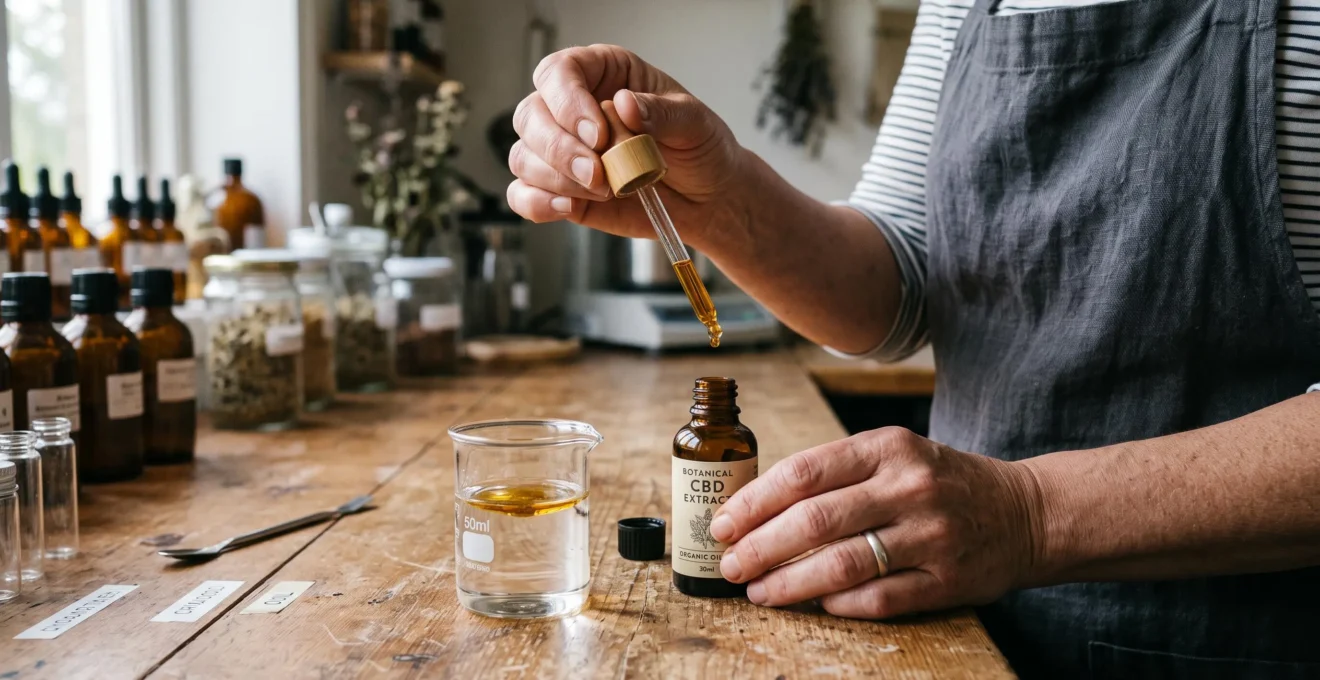
CBD is commonly formulated with oils because cannabidiol is a lipophilic molecule: it has a much greater affinity for fatty substances than for water. Dissolving CBD in a suitable lipid carrier helps manufacturers prepare concentrated liquids, distribute the ingredient throughout a product and deliver measurable quantities without relying on water alone.
Yet an oil-based formulation is not necessarily the best choice for every application. A CBD tincture, a softgel capsule and a cannabinoid-infused beverage place different demands on their ingredients. Where one product benefits from a straightforward oil solution, another may require a carefully stabilized emulsion containing microscopic oil droplets suspended in water.
The distinction matters for more than appearance. Carrier selection influences handling, consistency, flavour, storage conditions and potentially the way CBD becomes available for absorption. Understanding how these factors interact makes it easier to distinguish meaningful formulation characteristics from broad marketing claims about absorption or water solubility.
CBD and lipid formulations: the essentials
- CBD dissolves poorly in water, so lipid carriers provide a practical medium for incorporating it into many products.
- Emulsified CBD can disperse in water without becoming genuinely water-soluble at the molecular level.
- Carrier selection affects product texture and stability, but neither greater oil content nor smaller droplets automatically guarantees better absorption.
- Why Do Lipid-Soluble CBD Ingredients Behave Differently from Water-Soluble Compounds?
- How Can You Tell Whether a CBD Formulation Uses Lipids as Its Main Carrier?
- Oil-Based or Emulsified CBD: Which Formulation Approach Better Fits Different Products?
- Does a Higher Oil Content Automatically Mean Better CBD Delivery?
- When Should the Type of Lipid Carrier Influence Your Choice of CBD Oil?
- MCT or Longer-Chain Oil: Which Carrier Produces a Lighter CBD Formulation?
- Why Is Labelled CBD Amount Not the Same as Systemic Availability?
- Which Carrier Oil Best Fits the Texture and Flavour You Want from CBD Oil?
Why Do Lipid-Soluble CBD Ingredients Behave Differently from Water-Soluble Compounds?
CBD behaves differently from water-soluble ingredients because its molecular structure is predominantly hydrophobic. It dissolves poorly in water but can dissolve in suitable oils and other compatible solvents. This difference determines how CBD must be mixed, dispersed and stabilized in a formulation, particularly when the finished product contains a substantial aqueous phase.
Cannabidiol contains a large nonpolar region that interacts more favourably with lipid-like environments than with water molecules. This characteristic helps explain why oil carriers are widely used in CBD drops, capsules and other cannabinoid-containing preparations. The scientific discussion of challenges in CBD solubility describes CBD’s high lipophilicity and limited aqueous solubility as important obstacles for formulation and oral delivery.
Two concepts are especially important: solubility and dispersion. Solubility describes whether a substance is incorporated into a liquid at the molecular level. Dispersion describes how particles or droplets are distributed throughout a medium, even when the ingredient itself has not dissolved in that medium.
A conventional CBD oil can form a solution when the cannabinoid is dissolved in its lipid carrier. Adding that oil to water does not create an equivalent aqueous CBD solution. Instead, the oil may remain at the surface, adhere to the container or break into droplets that subsequently merge again.
For product developers, this behaviour creates practical handling requirements. Crystalline CBD isolate must first be dissolved in a compatible medium under appropriate processing conditions. Adding isolate directly to a water-based beverage can produce visible particles, uneven distribution or precipitation. Premixing into a suitable carrier and using controlled agitation or emulsification can help address these problems.
The frequently advertised expression “water-soluble CBD” therefore deserves careful interpretation. Many such products are emulsions or other solubilizing systems designed to make CBD compatible with aqueous applications. Their appearance in water does not establish that the CBD molecules themselves have become intrinsically water-soluble.
Once this chemical distinction is clear, the next practical question is how to recognize the carrier system used in a finished product.
How Can You Tell Whether a CBD Formulation Uses Lipids as Its Main Carrier?
The most reliable starting point is the ingredient list. MCT oil, coconut-derived triglycerides, olive oil, sunflower oil or hemp seed oil suggest a lipid-based carrier, while emulsifiers alongside an aqueous phase indicate a potentially more complex system. Appearance and behaviour in water provide additional clues, but neither replaces ingredient disclosure or formulation documentation.
In conventional CBD drops, the carrier often accounts for a substantial proportion of the finished liquid. Ingredient descriptions such as medium-chain triglycerides, caprylic/capric triglyceride or olive oil identify materials commonly used to dissolve or dilute cannabinoid extracts.
Other ingredients require more careful interpretation. Lecithin and polysorbates can function as emulsifiers, helping stabilize mixtures containing both oil and water. However, their presence does not establish the exact composition, structure or performance of an emulsion.
A useful distinction is whether a product is primarily an oil solution, an oil-in-water dispersion or a formulation combining several delivery technologies. A CBD distillate dissolved in MCT oil is structurally different from cannabinoid-containing oil droplets suspended in an aqueous beverage.
Simple observations may help identify the physical behaviour of the product. A plain oil may form visible droplets or a surface film when introduced into water. An emulsified concentrate may produce a cloudy dispersion, while some formulations with sufficiently small droplets can appear relatively transparent.
These observations are indicative rather than definitive. Cloudiness can depend on droplet size, concentration and the surrounding liquid. A product that appears to disperse initially may still separate during storage. A clear appearance does not, by itself, prove molecular solubility or predict absorption.
Certificates of analysis, or COAs, answer a different question. They can report cannabinoid identity, concentration and other analytical properties included in the testing scope. A standard potency COA does not necessarily establish the carrier composition, emulsion droplet size or long-term physical stability.
Five checks to identify a CBD carrier system
- Read the complete ingredient list and record every identified oil or triglyceride carrier.
- Identify water, lecithin, polysorbates or other declared emulsifying ingredients and note whether the formula appears to have multiple phases.
- Record the product’s appearance and flow at room temperature, creating a simple observation note.
- Request the product COA and note which properties it actually verifies, including cannabinoid concentration and batch identification.
- Ask the supplier whether the CBD is dissolved in oil or incorporated into a dispersed system, and request available formulation or stability documentation.
The resulting notes should distinguish confirmed ingredients from assumptions based on appearance. Suppliers of emulsified ingredients may also be able to provide droplet-size measurements, storage observations and recommended application conditions.
Knowing the formulation structure makes it possible to judge whether that structure fits the intended product, rather than assuming that one delivery technology is universally preferable.
Oil-Based or Emulsified CBD: Which Formulation Approach Better Fits Different Products?
Conventional oil-based CBD formulations are generally suited to oil drops and capsules, while emulsified systems are more appropriate when CBD must be distributed throughout a water-rich product. Neither approach is automatically superior. The better fit depends on the intended application, acceptable appearance, manufacturing complexity and the physical and chemical stability required during storage.
Simple oil solutions can be relatively straightforward to manufacture when CBD is compatible with the chosen lipid carrier. They avoid the additional challenge of stabilizing droplets between two otherwise poorly miscible liquids.
Water-rich beverages and other aqueous products present different requirements. Adding an ordinary CBD oil directly to a drink can lead to floating droplets, uneven ingredient distribution or separation. Emulsification addresses this problem by distributing the cannabinoid-containing lipid phase throughout water.
The following comparison summarizes practical formulation differences rather than making claims about which technology delivers more CBD into the bloodstream.
| Formulation factor | Oil-based CBD | Emulsified CBD |
|---|---|---|
| Typical application | Oil drops, oil-filled capsules | Water-based beverages, aqueous food systems |
| CBD location | Dissolved in a compatible oil phase | Usually within dispersed lipid droplets or a related delivery structure |
| Water compatibility | Generally poor without further processing | Designed for dispersion in an aqueous phase |
| Appearance | Oily, often transparent or coloured | May appear cloudy or relatively clear depending on the system |
| Manufacturing | Typically fewer formulation steps | Requires suitable emulsifiers and processing controls |
| Stability considerations | Solubility, oxidation and possible precipitation | Droplet stability, phase separation and chemical degradation |
| Relative production cost | Often structurally simpler | May require additional equipment and quality control |
Emulsifiers are essential to many oil-in-water systems because they help prevent dispersed oil droplets from combining. Their effectiveness depends on the full formulation, including oil composition, emulsifier concentration, processing conditions and the surrounding aqueous environment.
An experimental study of CBD oil-in-water nanoemulsion stability illustrates the distinction. Researchers dissolved cannabinoid-rich distillate in soybean oil, then dispersed the oil phase in water using quillaja saponin and homogenization.
Research example: a CBD nanoemulsion under storage stress
In the 2021 experimental investigation, the optimized formulation contained oil droplets measuring approximately 120 nm and used 1.5% quillaja saponin by weight.
The system resisted major droplet agglomeration and phase separation across several tested conditions over six weeks. However, strongly acidic conditions around pH 2 or below and sufficiently elevated calcium chloride concentrations destabilized the tested formulation. The researchers also observed changes in cannabinoid potency during storage.
These results demonstrate why physical and chemical stability must be evaluated separately. A beverage can remain visually homogeneous while cannabinoid content changes, and an emulsion that performs well under one set of conditions may not tolerate another.
Acidity, mineral content and other beverage ingredients should therefore be tested with the actual emulsifying system. Alcohol-containing products also require compatibility evaluation, but the cited experiment does not establish a universal alcohol-related failure threshold.
Once an appropriate formulation type is selected, increasing the amount of carrier oil is not necessarily the next step toward improving delivery.
Does a Higher Oil Content Automatically Mean Better CBD Delivery?
No. Increasing the oil content of a CBD product does not automatically increase the amount of cannabidiol absorbed by the body. A lipid carrier can help maintain CBD in a suitable formulation, but absorption also depends on the delivery route, ingredient concentration, administration conditions and individual physiology. More carrier oil alone is not a reliable indicator of better performance.
Oil quantity and CBD quantity are separate formulation variables. Two bottles can contain the same total amount of CBD but different volumes of carrier oil, producing different concentrations without establishing any corresponding difference in systemic absorption.
For example, in a purely hypothetical comparison, one bottle contains 600 mg CBD in 20 mL of finished oil, while another contains 600 mg in 30 mL. Their calculated concentrations are 30 mg/mL and 20 mg/mL, respectively. Both contain the same total CBD amount; the second simply distributes it across more liquid.
Concentration matters because it affects how much liquid is required to deliver a labelled quantity. However, a very concentrated formulation also needs appropriate solubility and stability, since an ingredient may crystallize or precipitate if its concentration exceeds what the carrier can reliably accommodate under relevant conditions.
Texture can influence administration convenience. A more viscous oil may be harder to measure or distribute consistently using a dropper. Nevertheless, thickness alone does not demonstrate reduced sublingual absorption, and there is no universal viscosity threshold establishing such an effect.
Administration conditions provide another important distinction. A controlled human pharmacokinetic investigation found that a high-fat meal substantially changed CBD exposure compared with fasting. That finding concerns dietary intake accompanying a specific CBD-rich extract, not the effect of adding more oil to an existing product.
For practical comparison, readers should prioritize CBD concentration in mg/mL, the labelled amount per serving and the product’s intended administration route over vague references to oil percentage or lipid-rich delivery.
The next consideration is the identity of the carrier itself, since different lipids can affect suitability, handling and storage even when CBD concentrations are similar.
When Should the Type of Lipid Carrier Influence Your Choice of CBD Oil?
The lipid carrier deserves particular attention when a user has ingredient sensitivities, dietary restrictions, specific texture preferences or demanding storage conditions. MCT, olive, sunflower and hemp seed oils differ in fatty-acid composition, flavour and oxidation susceptibility. These differences can affect whether a particular product is suitable, although the carrier name alone cannot establish its shelf life or clinical performance.
Ingredient suitability comes first. Coconut-derived MCT products warrant checking when coconut or related ingredients are a personal concern. Coconut is botanically distinct from conventional tree nuts, so it should not automatically be treated as equivalent to every nut allergen. Anyone with a known allergy should rely on manufacturer-specific allergen information and appropriate medical guidance rather than assuming safety from the carrier’s common name.
Dietary and religious considerations can also influence selection. Plant-derived oils may fit vegan preferences, but other capsule or formulation components need independent review. Where certification matters, the entire finished product should be assessed rather than treating the presence of a vegetable oil as sufficient evidence.
The chemistry of the carrier becomes especially relevant during storage. Oils rich in polyunsaturated fatty acids generally have greater susceptibility to lipid oxidation than highly saturated triglyceride preparations under comparable conditions. Hemp seed oil and certain sunflower oil compositions may therefore require particular attention to oxidation control.
However, lipid oxidation and CBD degradation are not identical processes. A carrier may resist rancidity while another ingredient in the formulation remains sensitive to temperature, oxygen or other storage factors.
A laboratory study of CBD stability in sunflower oil investigated purified CBD powder and CBD dissolved in sunflower oil under controlled storage conditions. The investigators found that CBD in the oil solution was less stable than solid CBD powder under the conditions examined.
Temperature and exposure to the surrounding environment were particularly important. Extended testing also documented changes in oil appearance and viscosity, alongside chemical degradation. These findings concern the investigated sunflower-oil preparation and cannot establish a universal storage-life ranking across all commercial carriers.
Carrier choice should also reflect practical handling. For oral oil drops, flow and taste may matter more than compatibility with cooking temperatures. For an ingredient intended for food manufacturing, processing temperature and food-matrix compatibility may be more important. Products should not be assumed suitable for heating merely because their carrier is an edible oil.
Digestive tolerance is another individual consideration. MCT-containing preparations can cause gastrointestinal discomfort in some circumstances, particularly with larger amounts, but the label alone cannot predict a particular user’s response.
Finally, the cannabinoid extract itself affects formulation behaviour. Purified CBD isolate dissolved in a carrier differs from a broad-spectrum preparation containing additional cannabinoids and other extract constituents. Differences in composition may influence solubility, sensory properties and storage stability. They should be evaluated in the finished formulation rather than attributed solely to the carrier.
These considerations lead naturally to one of the most common carrier comparisons: relatively neutral MCT oil versus oils dominated by longer-chain triglycerides.
MCT or Longer-Chain Oil: Which Carrier Produces a Lighter CBD Formulation?
Refined MCT oil commonly produces a comparatively light, fluid and neutral-tasting CBD formulation, while longer-chain oils such as olive, avocado or hemp seed oil can contribute more distinctive textures and flavours. The precise difference depends on the specific oil and processing conditions. A lighter sensation can make CBD drops easier to handle, but does not establish superior bioavailability.
MCT stands for medium-chain triglycerides. Common commercial MCT carriers are rich in triglycerides containing caprylic (C8) and capric (C10) fatty acids. Olive, sunflower and avocado oils predominantly contain longer-chain fatty acids, although their individual compositions vary.
These structural differences can influence flow behaviour, mouthfeel and temperature response. Refined MCT oil is frequently used when formulators want a relatively unobtrusive carrier that does not strongly alter the sensory characteristics of the cannabinoid extract.
Longer-chain oils can offer different attributes. Olive oil may provide a richer mouthfeel and a recognizable flavour, depending on refinement and grade. Hemp seed oil can introduce a more pronounced botanical character. Highly refined sunflower oil may be comparatively neutral, so the distinction should not be reduced to the assumption that all longer-chain oils are thick or strongly flavoured.
Temperature also changes how an oil behaves. Some formulations become more viscous in cooler conditions, while certain lipid fractions can crystallize or produce cloudiness. Such changes are not necessarily evidence that the CBD has degraded, although persistent particles or changes inconsistent with the manufacturer’s specifications warrant attention.
From a stability perspective, saturated triglyceride carriers tend to be less susceptible to fatty-acid oxidation than oils rich in polyunsaturated fatty acids. This provides a useful formulation principle, not proof that CBD will remain chemically stable for longer in every MCT product.
Nutrition and sensory preferences may also differ. A consumer might prefer the taste and fatty-acid composition of olive or hemp seed oil even when MCT offers easier dropper handling. The contribution of a carrier to the overall diet depends on the quantity actually consumed.
When comparing options, observe flow at the recommended storage temperature, check ingredient refinement and assess whether the taste of the underlying extract remains acceptable. A carrier’s perceived lightness should be treated as a handling characteristic, not an absorption measurement.
The distinction between ease of handling and biological performance is particularly important when interpreting CBD amounts printed on labels.
Why Is Labelled CBD Amount Not the Same as Systemic Availability?
The labelled CBD amount describes how much cannabidiol a product is intended to contain, not how much reaches systemic circulation. Systemic availability depends on several subsequent processes, including CBD remaining available in the formulation, release during administration, absorption and metabolism. Lipid carriers and food intake can influence these processes, but the label cannot predict an individual’s resulting blood concentration.
CBD delivery involves a sequence of related but distinct stages. The product must contain the stated cannabinoid quantity, maintain acceptable chemical and physical stability, release the ingredient under the conditions of use and permit absorption through the relevant biological pathway.
For swallowed CBD, digestive processing and metabolism add further variability. The amount entering systemic circulation is therefore not equivalent to the amount originally measured in the bottle or capsule.
Label terminology can obscure this distinction. Total CBD, concentration and serving quantity describe different measurements:
- Total CBD (mg): the amount declared for the entire container.
- CBD concentration (mg/mL): the amount declared per millilitre of finished liquid.
- CBD per serving (mg): the quantity associated with the manufacturer’s stated serving volume.
- CBD percentage: a concentration expression whose precise meaning depends on whether the manufacturer uses a weight-based or another defined convention.
For example, a hypothetical 10 mL bottle labelled as containing 500 mg CBD has a nominal concentration of 50 mg/mL. This arithmetic establishes the labelled concentration, not the amount absorbed. A per-drop estimate additionally depends on the actual drop volume, which can vary with dropper design and liquid properties.
Administration conditions can have a substantial effect on oral CBD exposure.
11 participants
In a randomized crossover study published in 2025, 11 healthy adults received a CBD-rich extract equivalent to 70 mg CBD under fasting conditions and after a standardized high-fat meal. The study reported markedly higher CBD blood exposure after the meal, illustrating the influence of dietary conditions. The finding is specific to the investigated extract, dose and study population.
Saals and colleagues, Scientific Reports (2025), human pharmacokinetic study of CBD taken with a high-fat meal.
In that investigation, peak plasma CBD concentration and overall exposure differed substantially between feeding conditions. However, the experiment did not directly compare different commercial carrier oils, and the observed exposure ratios cannot be applied as universal multipliers to unrelated products.
The same caution applies to emulsions promoted as high-bioavailability CBD. Droplet-size distribution, emulsifier choice, physical stability and behaviour during digestion can all influence performance. An emulsion described as nano-sized does not automatically demonstrate superior human absorption.
Evidence supporting a specific bioavailability claim should ideally come from appropriate comparative human pharmacokinetic research on the relevant formulation. Laboratory dispersion tests, appearance and droplet measurements provide useful formulation data but do not independently establish systemic exposure.
With dose labelling and absorption claims considered separately, everyday product choice can return to attributes that are more directly observable: texture, flavour, consistency and storage suitability.
Key takeaways before choosing a carrier oil
- Choose a carrier for its compatibility with the finished product and your ingredient requirements, not solely for claims about faster absorption.
- Compare measured CBD concentration and product-specific documentation before treating sensory differences as evidence of performance.
- Assess flavour, flow and storage conditions together, since the same oil can offer desirable mouthfeel but require different handling or preservation considerations.
Which Carrier Oil Best Fits the Texture and Flavour You Want from CBD Oil?
MCT oil is a practical starting point when a neutral flavour and relatively fluid texture are priorities. Olive oil may suit readers who prefer a richer mouthfeel and recognizable taste, while hemp seed oil offers a more pronounced botanical flavour. The best sensory fit also depends on the cannabinoid extract, its concentration and the finished product’s storage behaviour.
Carrier oils influence how CBD drops feel during dispensing and in the mouth. Refined MCT preparations generally contribute little flavour, allowing the character of the cannabinoid ingredient to remain more apparent. This can be an advantage when a manufacturer wants a consistent, relatively neutral sensory profile.
Olive oil may produce a fuller impression and can contribute fruity, grassy or peppery notes depending on its grade and processing. Refined olive oil will not necessarily taste like extra-virgin olive oil, so the ingredient’s specification matters.
Hemp seed oil often has a nutty, grassy character and a naturally distinctive colour. Its botanical relationship to hemp may appeal to certain users, but that relationship does not establish superior cannabinoid delivery or therapeutic effects.
Texture comparisons are most meaningful when made at the same temperature. An oil that flows readily in a warm room may behave differently after refrigeration. If a manufacturer specifies room-temperature storage, refrigeration should not be assumed to improve preservation without checking the product guidance.
The nature of the cannabinoid extract can be just as important as the carrier. CBD isolate generally lacks the complex mixture of additional cannabinoids and extract constituents found in broad-spectrum or full-spectrum preparations. Depending on composition, the latter can contribute stronger aromatic, bitter or botanical sensations.
Terpenes and other constituents may further modify the perceived flavour of the final mixture. The same cannabinoid extract dispersed in two different oils can therefore produce noticeably different sensory experiences, although flavour intensity is not a measure of cannabinoid potency.
Packaging and storage deserve attention alongside taste. Opaque or amber containers can help limit light exposure, while appropriate closures and careful handling help reduce unnecessary contact with the environment. Nevertheless, material compatibility, closure integrity and storage stability should be demonstrated for the actual product. A transparent bottle or plastic dropper cannot be assigned a specific degradation rate without corresponding evidence.
Signs such as an unusual rancid odour, pronounced colour changes, persistent sediment or unexpected separation may warrant checking the product’s instructions or contacting the manufacturer. These observations do not identify the precise chemical changes involved and cannot replace analytical testing.
For a useful pre-purchase comparison, consider the declared carrier, CBD concentration, extract type, recommended storage conditions and manufacturer documentation. When sample products are available, compare their flow and flavour under similar conditions rather than relying on promotional descriptions such as “ultra-light” or “maximum absorption.”
Before choosing a CBD oil, review its ingredient list and batch documentation, compare the labelled mg/mL concentration, and check that the carrier, flavour and storage instructions suit the intended application. Treat absorption claims as separate questions requiring formulation-specific evidence. For products intended for consumption, also consider the applicable local rules and consult a qualified healthcare professional about potential medicine interactions when relevant.
Can CBD oil be mixed directly into a hot drink?
CBD oil can be added physically to a drink, but that does not mean it will dissolve or distribute evenly. Without an appropriate emulsifying system, oil droplets may separate or remain on the surface. Heat also introduces formulation-specific stability considerations, so the manufacturer’s handling instructions should be checked before adding CBD products to hot beverages.
Does a clear CBD beverage prove that the CBD is dissolved in water?
No. Some finely dispersed emulsions can appear relatively transparent, particularly when diluted. Visual clarity alone cannot establish whether CBD is molecularly dissolved or contained within microscopic droplets or another delivery structure. Formulation information and suitable analytical characterization are needed to establish the system used.
Can a CBD oil lose potency without visibly separating?
Yes. Chemical degradation and physical separation are different phenomena. Research on CBD in sunflower oil has demonstrated that storage conditions can affect chemical stability, while research on emulsions has also recorded cannabinoid potency changes without treating visual homogeneity as sufficient evidence of chemical preservation. A product may therefore appear uniform without retaining its original cannabinoid content.
Are CBD isolate and broad-spectrum extract interchangeable in the same carrier oil?
Not necessarily. CBD isolate and broad-spectrum extracts have different compositions, which may influence solubility, flavour and stability. A carrier suitable for one extract or concentration cannot automatically be assumed to perform identically with another. Compatibility should be evaluated using the intended formulation and storage conditions.
Does a certificate of analysis confirm that a CBD carrier oil is stable?
Only if the relevant stability characteristics are actually included in its testing scope. A typical cannabinoid potency COA reports analytical results for a particular sample or batch, not necessarily a complete shelf-life assessment. Product-specific stability documentation is needed to evaluate how CBD concentration, carrier properties and physical appearance change over time under defined storage conditions.