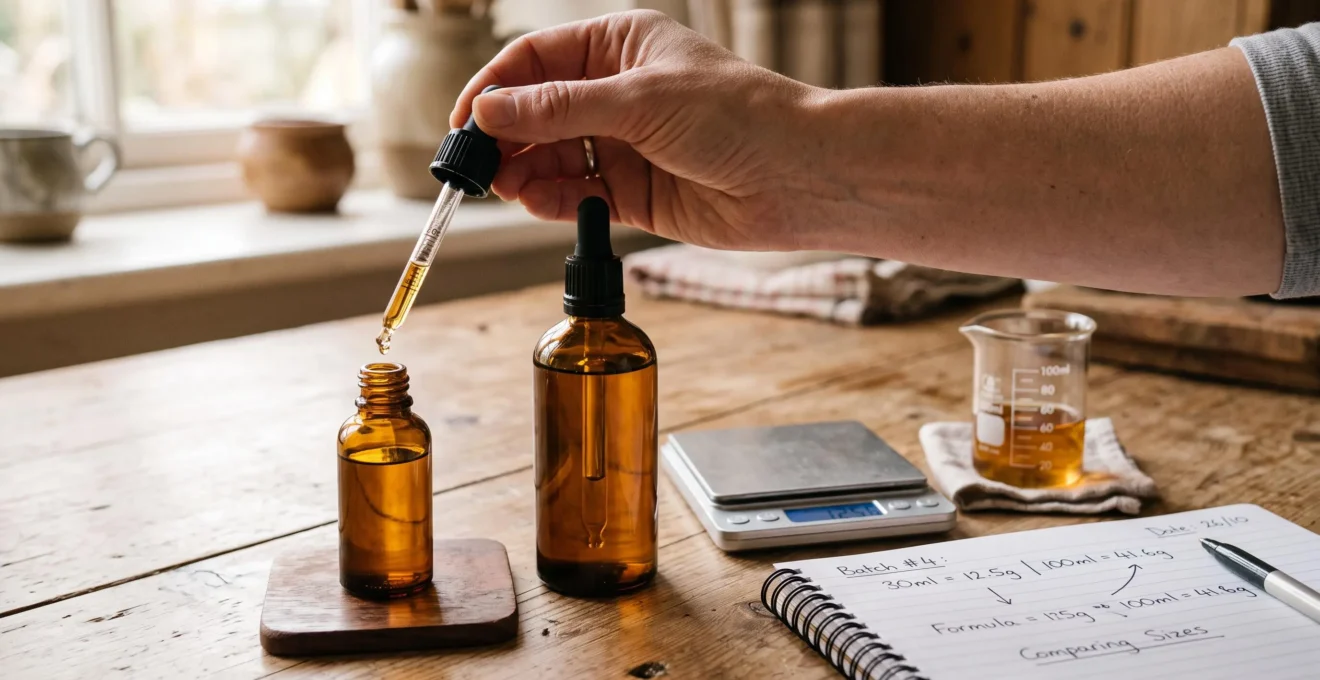
A CBD oil containing 2,000 mg of cannabidiol is not necessarily stronger than one containing 1,000 mg. The difference depends on how much liquid holds that CBD, how much you measure per serving and whether the label refers to CBD alone or a mixture of cannabinoids.
To compare CBD concentrations accurately, divide the total CBD content in milligrams by the bottle volume in millilitres. This gives a standard measurement, mg/ml, that allows meaningful comparisons between liquid products of different sizes. For capsules and gummies, compare the milligrams of CBD in each individual unit instead.
Percentages, serving sizes and prices become easier to interpret once everything is expressed in consistent units. But the arithmetic only establishes what the product claims to contain. Independent laboratory testing matters because the declared cannabinoid amount may differ from the actual amount.
The same distinction applies to CBD isolate, broad-spectrum and full-spectrum formulations: comparing CBD concentration is not necessarily the same as comparing total cannabinoid content or expected effects.
CBD concentration comparison: the essentials
- Total CBD is not concentration: divide bottle milligrams by bottle millilitres to obtain mg/ml.
- Compare like with like: use mg/ml for liquid oils, mg per unit for capsules and gummies, and measured serving volumes instead of assumed drop counts.
- Check the evidence: compare price per mg of verified CBD and review cannabinoid-specific laboratory results before judging value.
- Why Can a Higher Total CBD Amount Still Mean a Lower Concentration?
- How Can You Calculate CBD Concentration from Milligrams and Bottle Volume?
- CBD Percentage or mg per ml: Which Label Makes Product Strength Easier to Compare?
- Which Label-Reading Mistakes Cause the Biggest CBD Concentration Errors?
- How Can You Standardise CBD Labels Before Comparing Prices or Strengths?
- How Can You Check a CBD Dropper’s Real Volume Before Using It Regularly?
- Why Can the Same Labelled CBD Amount Feel Different Across Product Formats?
- Which Cannabinoid Formulation Best Matches Your Preferred Way of Using CBD?
Why Can a Higher Total CBD Amount Still Mean a Lower Concentration?
A bottle can contain more CBD overall while delivering less CBD per millilitre because the cannabidiol is distributed through a larger volume of liquid. A hypothetical 30 ml bottle containing 1,500 mg CBD has a concentration of 50 mg/ml, whereas a 100 ml bottle containing 2,000 mg has only 20 mg/ml. The smaller bottle is therefore 2.5 times as concentrated.
Three different quantities need to be separated before comparing products:
- Total CBD content: the complete amount of cannabidiol inside the bottle, measured in mg.
- CBD concentration: the amount of cannabidiol in each millilitre of liquid, measured in mg/ml or sometimes expressed as a percentage.
- CBD per serving: the quantity contained in the particular volume or unit actually used.
Consider the two hypothetical bottles again. A measured 0.5 ml serving of the 30 ml oil contains 25 mg CBD. The same volume from the 100 ml bottle contains only 10 mg. Conversely, both products can provide the same stated CBD amount if different serving volumes are measured.
A large milligram number on the front label can draw attention because it represents the entire amount purchased. It does not independently establish the concentration or amount in an individual serving. Nor does it prove that a person will experience a stronger effect.
This distinction changes for solid products. A pack of 60 gummies containing 1,500 mg CBD in total provides 25 mg per gummy if distributed evenly. Bottle volume is irrelevant. Capsules are compared similarly, while topical products may also require examining CBD per gram of cream or per application.
Practical example: more CBD, weaker oil
Hypothetical Product A: 1,500 mg CBD in 30 ml = 50 mg/ml. Hypothetical Product B: 2,000 mg CBD in 100 ml = 20 mg/ml.
Product B contains 500 mg more CBD overall, but Product A delivers 30 mg more CBD in every measured millilitre. The ranking reverses when comparing total content rather than concentration.
The useful question is therefore not simply how much CBD a package contains, but how much cannabidiol is present in the volume or individual unit being compared. That answer starts with a straightforward conversion.
How Can You Calculate CBD Concentration from Milligrams and Bottle Volume?
Calculate CBD concentration by dividing the stated milligrams of CBD by the bottle’s total liquid volume in millilitres. For example, 600 mg CBD in a 30 ml bottle equals 20 mg/ml. To calculate CBD per drop, divide the mg/ml figure by the actual number of drops delivered per millilitre, rather than assuming that every dropper works identically.
The primary formula is:
CBD concentration (mg/ml) = total CBD (mg) ÷ bottle volume (ml).
For a hypothetical oil labelled 1,200 mg CBD in 30 ml, the calculation gives 1,200 ÷ 30 = 40 mg/ml. A measured 0.25 ml portion contains 10 mg CBD, while a measured 0.5 ml portion contains 20 mg.
If this particular dropper delivers 40 drops per measured millilitre, one drop represents approximately 40 ÷ 40 = 1 mg CBD. If it delivers only 25 drops per millilitre, each drop contains approximately 1.6 mg. The concentration remains identical: what changes is the liquid volume of each drop.
For CBD oils where the percentage is expressed as mass per volume (grams of CBD per 100 ml of finished liquid), 1% corresponds to 10 mg/ml. Under that convention, 20 mg/ml is 2%, 50 mg/ml is 5% and 100 mg/ml is 10%.
This conversion should not be applied blindly to every label. A mass-by-mass percentage uses product weight rather than volume, and conversion then requires the liquid’s density. If the percentage basis is unclear, the labelled CBD milligrams and measured volume provide a more transparent starting point.
A useful consistency check is to multiply concentration by bottle volume. A 30 ml oil labelled 5% under the mass-per-volume convention should contain 50 × 30 = 1,500 mg CBD. If the same label claims 600 mg, those figures conflict unless the manufacturer defines the percentage differently.
Drop-based estimates are inherently less dependable. Research on pharmaceutical oral droppers found that dispensing angle and handling affected delivered volumes, supporting caution about generic drop-count assumptions. See the study of oral dropper dose uniformity.
Once concentration is established, percentage and milligrams per millilitre can be compared fairly—but only when their definitions and measurement bases match.
CBD Percentage or mg per ml: Which Label Makes Product Strength Easier to Compare?
Both percentage and mg/ml can communicate CBD concentration effectively when they describe the same measurement basis. Percentage is convenient for quickly comparing similarly labelled oils, while mg/ml makes it easier to calculate CBD in a measured liquid serving. For gummies, capsules and other individually portioned products, milligrams per unit provide a more useful comparison.
Suppose two hypothetical CBD oils both show 5% CBD using a mass-per-volume convention. One contains 10 ml and the other 30 ml. Both provide 50 mg/ml, despite containing 500 mg and 1,500 mg total CBD respectively.
At the same measured serving volume, their labelled CBD amounts are equivalent. Yet a label stating 5% on an e-liquid, capsule blend or cream cannot automatically be treated as interchangeable with a 5% CBD oil. Different formulations may express percentages by weight, volume or another defined basis.
The following decision table identifies the most practical comparison unit.
| Product or task | Preferred unit | Reason |
|---|---|---|
| Comparing bottled CBD oils | mg/ml or consistently defined % | Normalises different bottle sizes |
| Calculating a measured oil serving | mg/ml × serving volume | Determines labelled mg in the selected volume |
| Comparing capsules or gummies | mg CBD per unit | Reflects the individual portion |
| Comparing CBD creams | mg/g, where available | Accounts for different container weights |
| Checking other cannabinoids | Individual cannabinoid mg or mg/g | Separates CBD from THC, CBG and other compounds |
The easiest notation is not necessarily the most informative one. A clearly disclosed mg/ml figure removes ambiguity about liquid content, but its usefulness still depends on whether the manufacturer’s stated CBD amount is accurate.
Labelling conventions and regulatory requirements differ between English-speaking markets. A percentage printed on a bottle should therefore be interpreted according to its stated basis rather than an assumed international standard.
Neither unit compensates for an ambiguous ingredient declaration. Before comparing strength, identify exactly what substance is being counted in the first place.
Which Label-Reading Mistakes Cause the Biggest CBD Concentration Errors?
The largest CBD concentration errors come from confusing total CBD with CBD per serving, treating the amount of carrier oil as the amount of cannabidiol, and overlooking whether a figure describes CBD alone or multiple cannabinoids. Misreading percentages, drop volumes and product-specific serving definitions can then compound the error, sometimes producing comparisons that are several times too high or too low.
The main mistakes are best checked in this order:
- Confusing CBD with total oil: a product containing 1,000 mg of oil is not necessarily a product containing 1,000 mg of CBD.
- Confusing bottle and serving totals: 1,000 mg per bottle does not mean 1,000 mg in one pipette, drop or gummy.
- Assuming a serving means one drop: a manufacturer may define a serving as a particular fraction of a millilitre or several drops.
- Combining different cannabinoids: 1,000 mg total cannabinoids does not necessarily mean 1,000 mg CBD.
- Ignoring concentration units: a cannabinoid figure per gram of flower or cream cannot directly be compared with an oil’s mg/ml value.
Full-spectrum and broad-spectrum labels describe formulation categories rather than a guaranteed quantity of CBD. A full-spectrum extract might contain CBD alongside measurable amounts of other cannabinoids, while a CBD isolate formulation primarily supplies cannabidiol. The actual CBD quantity must still be identified independently.
This matters because two bottles advertised as containing 1,000 mg of extract may have different CBD content. Conversely, two bottles accurately labelled as containing 1,000 mg CBD may have different accompanying cannabinoid profiles.
26 out of 84
In a 2017 JAMA research letter, only 26 of 84 CBD extracts bought online for the US market met the researchers’ predefined label-accuracy range of 90–110%. The sample was purchased in 2016 and does not establish today’s market-wide accuracy.
Original research: JAMA study on CBD product labeling accuracy.
Serving-size claims introduce another difficulty. If one label defines a serving as 0.25 ml and another as 1 ml, their per-serving values are not directly comparable. First standardise both products to mg/ml, then calculate CBD for an identical measured volume.
E-liquids and topical formulations require particular care because their usage patterns differ from oral oils. For flower, a percentage by weight or cannabinoid content per gram is more relevant than a drop-based calculation.
A correct calculation cannot repair an inaccurate label, but it can reveal internal contradictions and clarify precisely which manufacturer’s claims need independent verification.
How Can You Standardise CBD Labels Before Comparing Prices or Strengths?
Standardise CBD products in three stages: calculate mg/ml for liquids or mg per unit for solid servings, divide the purchase price by the total labelled milligrams of CBD, and check whether independent laboratory results support those figures. This distinguishes concentration from economic value and prevents a cheaper bottle from automatically appearing to be the better purchase.
Consider these hypothetical products, priced in pounds sterling solely to illustrate the arithmetic. The same method works with US, Canadian or Australian dollars.
| Comparison | Oil A | Oil B |
|---|---|---|
| Bottle volume | 10 ml | 30 ml |
| Total labelled CBD | 500 mg | 900 mg |
| CBD concentration | 50 mg/ml | 30 mg/ml |
| Retail price | £25 | £36 |
| Price per mg CBD | £0.050 | £0.040 |
| Labelled CBD in 0.5 ml | 25 mg | 15 mg |
Oil A costs less upfront and has a higher concentration. Oil B costs more per bottle but provides a lower price per labelled milligram: 4 pence compared with 5 pence. Oil B is cheaper per mg, while Oil A provides more CBD in the same measured liquid volume.
Neither price nor concentration alone establishes product quality. The next step is to request a current, batch-matched certificate of analysis (COA) from an independent laboratory. It should report CBD separately from other cannabinoids, use identifiable units and allow comparison with the bottle’s labelled claims.
The FDA information on CBD product safety and quality highlights discrepancies between declared and measured cannabinoid content, as well as concerns about contaminants and undeclared substances. This information concerns the United States; legal requirements differ across countries.
Five checks to complete before comparing CBD products
- Record each product’s stated CBD milligrams and package volume or unit count in a comparison sheet.
- Calculate and write down mg/ml, mg/g or mg per individual unit as appropriate.
- Calculate the labelled CBD amount in a consistent serving, recording the serving volume or number of units.
- Divide each product’s actual selling price by its total labelled CBD milligrams and record the cost per mg.
- Find the matching laboratory certificate, record its batch identifier and CBD result, and flag missing or inconsistent evidence.
A laboratory certificate is useful evidence, not an automatic guarantee. Check whether it covers the relevant batch, the finished product where appropriate, and the specific cannabinoid quantities being compared. Where available, contaminant testing adds another dimension of quality assessment.
Price per mg measures the cost of labelled cannabinoid content, not absorption, clinical benefit or personal suitability. For liquid products, even the labelled amount per drop requires a separate measurement check.
How Can You Check a CBD Dropper’s Real Volume Before Using It Regularly?
Check a CBD dropper by measuring a known volume of oil, ideally 1 ml with a suitable graduated device, and counting how many drops that particular dropper releases under consistent conditions. Divide the oil’s mg/ml concentration by the observed drops per millilitre to estimate CBD per drop. For better repeatability, measure servings by marked liquid volume rather than drop count whenever possible.
A drop is not a standard unit of volume. Droplet size can vary with the dispensing tip, handling angle and liquid characteristics, and dispensing technique may alter consistency. This means a generic estimate such as 30 or 40 drops per millilitre should never be treated as a verified property of a specific product.
For a practical check, use the following method:
- Identify the oil’s labelled concentration in mg/ml.
- Measure 1 ml using a suitable graduated pipette or measuring device capable of accurately measuring that volume.
- Release the oil vertically into a clean container, counting the drops while keeping the dispensing technique consistent.
- Divide the labelled mg/ml by the counted drops to estimate the labelled CBD amount per drop.
- Record the result alongside the product and dropper details, and repeat if dispensing appears inconsistent.
For example, a hypothetical oil containing 30 mg/ml that yields 30 drops per measured millilitre delivers approximately 1 mg per observed drop. If a second dropper produces 20 drops from the same volume, each drop instead represents approximately 1.5 mg.
A pipette with reliable 0.25 ml, 0.5 ml and 1 ml markings is usually more practical than manually counting drops for each serving. With a 30 mg/ml oil, a measured 0.5 ml contains a labelled 15 mg CBD, regardless of the number of drops produced.
Graduations must be accurate and readable. If a dropper is unmarked, produces air bubbles or dispenses irregularly, avoid assuming its full bulb or tube represents exactly 1 ml. A measuring device intended for small liquid volumes may be more dependable.
Recheck whenever the dropper or formulation changes, including when a replacement bottle comes with a different pipette. Holding the dropper consistently also matters for repeatable measurements.
Once the delivered volume is reasonably consistent, the amount of CBD per measured serving becomes easier to track. Different product formats, however, introduce another variable: how that CBD enters the body.
Why Can the Same Labelled CBD Amount Feel Different Across Product Formats?
The same labelled CBD amount can lead to different experiences because oils, capsules, gummies, inhaled products and topicals deliver cannabidiol through different routes. Digestion, formulation, food intake and absorption affect how much CBD reaches systemic circulation and when that happens. Equal milligram amounts therefore indicate equivalent labelled content, not necessarily equivalent exposure, onset, duration or perceived effects.
Swallowed CBD products pass through the gastrointestinal tract and undergo first-pass metabolism, so the amount reaching circulation differs from the amount consumed. Food intake and formulation can substantially affect the resulting exposure.
Oils held under the tongue may involve some absorption through oral tissues, but a portion can also be swallowed. It is not scientifically sound to assume that every sublingual CBD oil is better absorbed than every ingested CBD product.
Inhalation uses another route, with different pharmacokinetic characteristics. The amount loaded into an inhalation device is not automatically the amount actually inhaled or absorbed. In addition, inhaled CBD products raise route-specific respiratory and product-quality considerations.
Topical products require separate interpretation. A cream with 200 mg CBD describes its cannabinoid content, not how much enters the bloodstream or reaches deeper tissues. Application area, product composition and intended local use matter.
A systematic review of cannabidiol pharmacokinetics identified administered dose, route, formulation and diet as important determinants of CBD exposure. The findings do not establish a universal conversion ratio between commercial CBD formats.
| Format | What to compare | Important limitation |
|---|---|---|
| Sublingual oil | mg/ml and measured ml | Actual oral absorption varies |
| Capsule | mg CBD per capsule | Digestion, formulation and food affect exposure |
| Gummy | mg CBD per gummy | Labelled content is not absorbed dose |
| Inhaled product | mg/ml or mg per device, as applicable | Delivered and absorbed quantities vary |
| Topical cream | mg/g and amount applied | Local or systemic delivery cannot be inferred from content alone |
Full-spectrum, broad-spectrum and isolate formulations also differ in their accompanying compounds. Those compositional differences may matter, but they do not establish that one formulation reliably produces stronger clinical effects per milligram of CBD.
When moving between formats, recalculate the labelled CBD content and avoid applying an assumed absorption multiplier. A comparable number of milligrams is a measurement reference, not an interchangeable personal dose.
This distinction makes format selection a practical decision about measurement, handling and individual needs rather than a contest to find the largest milligram figure.
Key takeaways before choosing a CBD format
- Select the measurement unit that matches the product: mg/ml for liquids, mg per unit for pre-portioned products, and mg/g where relevant for creams or plant material.
- Separate ingredient preferences from strength: CBD isolate, broad spectrum and full spectrum describe different cannabinoid profiles, not a universally superior concentration.
- Consider measurement consistency, legal restrictions, third-party testing and route-specific risks alongside price per mg.
Which Cannabinoid Formulation Best Matches Your Preferred Way of Using CBD?
The most suitable CBD formulation depends on how precisely you want to measure a serving, how convenient the format is and which accompanying cannabinoids you prefer to avoid or include. Oils support flexible volume measurement, capsules and gummies offer pre-portioned quantities, topicals suit local application preferences, and inhaled products introduce different delivery characteristics and respiratory considerations.
For buyers prioritising repeatable measurement, capsules make the arithmetic straightforward: a capsule labelled 20 mg CBD contains a claimed 20 mg portion, subject to manufacturing accuracy. Gummies offer similar portion-based comparisons but may differ in ingredients and composition.
Oils allow more flexibility because a graduated pipette can measure fractional millilitres. A 40 mg/ml oil, for instance, contains a labelled 10 mg in a measured 0.25 ml. This example illustrates measurement only; it is not a recommended personal dose.
Inhaled formats may appeal to people interested in different onset characteristics, but their labelled CBD content cannot be converted directly into a reliable absorbed dose. Product quality and respiratory risks deserve particular attention. Topicals may be convenient for local application, although CBD concentration alone cannot establish local effectiveness.
Beyond the delivery format, distinguish three broad cannabinoid profiles:
- CBD isolate: primarily cannabidiol, useful when a simpler cannabinoid profile is preferred, though testing is still necessary to assess purity.
- Broad spectrum: CBD alongside other cannabinoids or plant compounds, commonly marketed with THC removed or reduced; a THC-free claim still requires verification.
- Full spectrum: CBD with additional plant constituents, potentially including THC, subject to product composition and applicable local law.
Some consumers prefer products containing multiple cannabinoids, while others want to minimise THC exposure. Neither a broad-spectrum nor an isolate label guarantees zero THC, and even laboratory results have detection limits. People subject to workplace drug testing should be especially cautious about claims of being THC-free.
The legal treatment of CBD, THC and inhaled cannabinoid products varies by country and sometimes by region. Restrictions and permitted claims must be checked in the relevant jurisdiction rather than inferred from product availability in another English-speaking market.
Combining formats can also complicate tracking: CBD from an oil, gummy and capsule contributes to total labelled intake. Maintaining a consistent record of products, quantities and relevant laboratory results is more meaningful than assuming each format has an independent or automatically equivalent serving.
CBD can interact with medications and carries safety considerations, including possible liver-related effects. Anyone taking prescription medicines, pregnant or breastfeeding, or managing a medical condition should seek appropriate professional advice rather than choosing a CBD amount based only on concentration calculations.
For the next product comparison, write down its labelled CBD content, standardised strength, intended measured serving, price per mg and batch-specific laboratory result. Then choose the format whose measurement method and cannabinoid profile match your practical preferences—without treating its labelled strength as a promise of effectiveness.
Does a 10% CBD oil always contain 100 mg of CBD per ml?
Yes, if 10% explicitly means 10 grams of CBD per 100 ml of finished liquid, a mass-per-volume measurement. This equals 100 mg/ml. If the percentage is defined by weight instead, density information is needed for an exact conversion into mg/ml.
Can you compare CBD and CBG concentrations using the same formula?
Yes. For a liquid, divide the milligrams of each identified cannabinoid by the bottle volume in millilitres. Calculate CBD, CBG, THC and other cannabinoids separately, then add their measured quantities only if a total-cannabinoid comparison is specifically needed. Their milligram amounts should not be treated as equivalent effects.
What should you do if a CBD bottle lists a percentage but no total milligrams?
Identify whether the percentage is mass per volume or mass per mass, then check the package volume or weight. If the percentage is mass per volume, multiply the percentage number by 10 to obtain mg/ml, and multiply by bottle volume for total mg. If the basis remains unclear, request clarification and a batch-specific laboratory report rather than assuming a conversion.
Can a certificate of analysis show a different CBD concentration from the bottle label?
Yes. Laboratory results may differ from labelled values, and the figures may also use different units, such as mg/g and mg/ml. Confirm the tested batch, sample type, reporting units and whether the result concerns CBD alone or other cannabinoids before assessing the discrepancy.
Does a lower CBD price per milligram mean a product is better?
Not necessarily. Price per mg compares the cost of stated CBD content. It does not establish product purity, label accuracy, absorption, suitability or effectiveness. Use it alongside independent cannabinoid results, relevant contaminant testing and the practicality of measuring consistent servings.