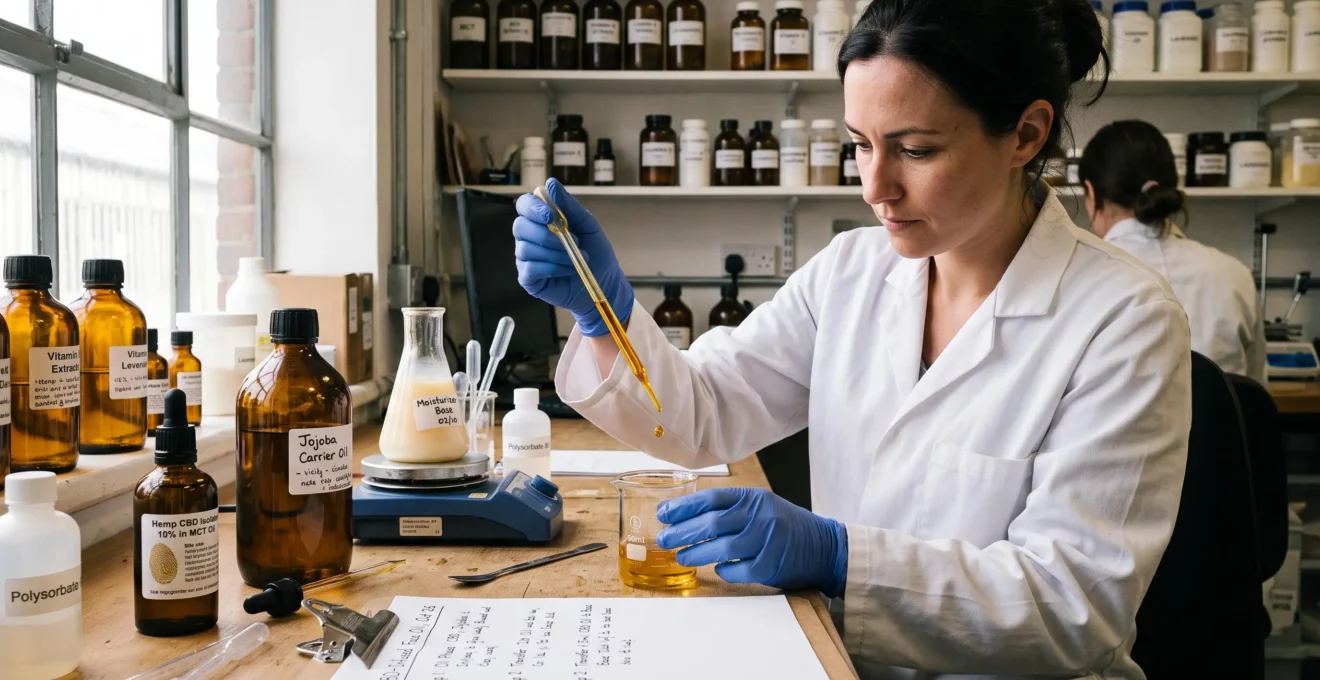
Two botanical compounds can look remarkably similar on a molecular diagram yet behave differently when exposed to heat, mixed with oil or incorporated into a water-based product. The explanation often begins with small differences in their chemical structures.
Cannabidiol (CBD) is a useful example. Its arrangement of carbon, hydrogen and oxygen atoms gives it a strong affinity for lipid environments and limited solubility in water. Related cannabinoids may differ in functional groups, molecular geometry or chemical reactivity, affecting how they respond to processing and storage.
However, molecular structure is only the starting point. The surrounding ingredients, manufacturing conditions and packaging can substantially influence the behaviour of the finished formulation. Chemical similarities also cannot establish equivalent biological effects or substantiate health claims.
Understanding these boundaries makes molecular information practical. It helps explain why manufacturers choose particular carriers, why certain formulations require additional technology and why laboratory evidence matters more than structural assumptions when evaluating CBD products.
CBD molecular structure: the essential points
- Chemical architecture affects formulation: CBD’s hydrophobic regions favour oils over water, while functional groups influence molecular interactions and degradation pathways.
- The complete formulation determines performance: carrier oils, emulsifiers, processing conditions and packaging can change stability and dispersion without changing CBD’s molecular identity.
- Structure is not proof of quality or health benefits: reliable product assessment requires batch-specific analytical evidence, and biological claims require appropriately designed human research.
- Why Can Small Molecular Differences Alter CBD Ingredient Stability So Much?
- How Can a Beginner Read a Cannabinoid Molecular Diagram Without a Chemistry Degree?
- Similar Structures or Similar Effects: Why Are These Not the Same Question?
- What Can Go Wrong When You Judge a CBD Product from Molecular Structure Alone?
- When Is Molecular Structure Actually Useful During CBD Product Research?
- Why Do Lipid-Soluble CBD Ingredients Behave Differently from Water-Soluble Compounds?
- Why Can Biological Pathway Research Not Automatically Prove a CBD Health Claim?
- Why Are Many CBD Molecules Formulated with Lipids Rather Than Water Alone?
Why Can Small Molecular Differences Alter CBD Ingredient Stability So Much?
Small molecular differences can alter cannabinoid stability because they change how electrons are distributed, which chemical reactions are possible and how readily a compound responds to its environment. A changed functional group or bond position can affect oxidation, thermal reactions and molecular interactions. Nevertheless, the stability of a finished CBD formulation also depends on its carrier, processing conditions and packaging.
Consider a cannabinoid molecule as an arrangement of connected atoms rather than a fixed collection of ingredients. Changing the position of a double bond can modify local electron distribution. Altering a side chain can influence how the molecule interacts with neighbouring compounds, while adding or removing a functional group may introduce or eliminate a particular reaction pathway.
The relationship between cannabidiolic acid (CBDA) and CBD illustrates this principle. CBDA contains a carboxylic acid group that CBD lacks. During decarboxylation, CBDA loses carbon dioxide and becomes CBD. An analogous transformation converts tetrahydrocannabinolic acid (THCA) into tetrahydrocannabinol (THC).
These are separate cannabinoid pairs: CBDA becomes CBD, while THCA becomes THC. Removing a carboxyl group from CBD is not a route for turning CBD into THC.
The scientific review of acidic cannabinoid decarboxylation examines the reactions and conditions underlying these transformations. They demonstrate how a localized structural change creates a distinct chemical compound, although they do not establish that all cannabinoid pairs undergo equally large changes in solubility or stability.
For formulation purposes, several environmental factors deserve attention:
- Heat during processing: elevated temperatures can accelerate chemical reactions, including decarboxylation of acidic cannabinoids under suitable conditions.
- Oxygen exposure: air entering a container can contribute to oxidation of susceptible formulation components.
- Light exposure: illumination may promote degradation pathways, depending on the compound and formulation.
- Storage duration: longer storage creates more opportunity for chemical or physical changes to develop.
An important distinction is that the stability of an isolated molecule is not the stability of a finished product. Carrier composition, local chemical environment, antioxidants and packaging can influence the rate and type of degradation. In an emulsion, the pH of the aqueous phase may also affect relevant chemical processes.
For example, two hypothetical CBD formulations containing the same concentration of cannabinoid might age differently if one uses an oxidation-sensitive oil in a transparent container and the other uses a more stable carrier in light-protective packaging. Their different performance would not require any difference in the original CBD molecule.
Before predicting shelf life from a chemical structure, it is therefore necessary to ask which ingredient is being examined, what surrounds it and which degradation mechanisms have actually been tested.
How Can a Beginner Read a Cannabinoid Molecular Diagram Without a Chemistry Degree?
A beginner can read a cannabinoid molecular diagram by identifying three features: the connected ring structures, oxygen-containing functional groups and carbon-rich side chains. These reveal useful clues about molecular geometry, interactions with water and affinity for oils. A diagram cannot predict every behaviour, but it provides a practical starting point for comparing related compounds.
Most cannabinoid diagrams use skeletal notation. Lines represent chemical bonds, corners and unlabeled line ends generally represent carbon atoms, and hydrogen atoms attached to carbon are usually omitted. Oxygen atoms and other non-carbon elements are typically shown explicitly.
The first step is to identify the molecule’s connected framework. Rings constrain parts of its geometry, while bonds outside those rings may allow sections of the molecule to rotate. These features determine how different regions can be positioned in three-dimensional space.
Next, look for groups labelled OH. These hydroxyl groups contain oxygen and hydrogen and can participate in hydrogen bonding. Their number and position affect intermolecular interactions, although they do not, by themselves, determine whether the entire compound will dissolve readily in water.
Finally, identify the carbon-rich side chains. Hydrocarbon regions are generally compatible with nonpolar environments, helping explain why molecules containing substantial hydrocarbon portions often favour lipid-based carriers.
A useful analogy is a key: the arrangement of its features affects which lock it can engage. For molecules, however, the analogy has limits. Unlike a rigid metal key, many chemical structures are flexible, and their interactions depend on surrounding molecules and environmental conditions.
Three visual cues are particularly valuable for formulation research:
- Hydroxyl groups: identify where hydrogen bonding may occur and whether a structural change could alter polar interactions.
- Carbon-chain length and arrangement: examine the extent of hydrocarbon regions, which can influence lipid affinity and molecular packing.
- Overall geometry: consider how rings, substituents and flexible bonds may affect the molecule’s three-dimensional shape and interactions.
To test this method, compare the published diagrams of CBDA and CBD. Identify the additional carboxylic acid group in CBDA. Then predict one possible consequence: this functional group creates additional opportunities for polar interactions and introduces a decarboxylation pathway absent from CBD.
That prediction is a chemical hypothesis, not a quantitative solubility result. Confirming its importance in a particular formulation would require measurements under relevant conditions.
Once a reader can recognize structural differences, the next question is whether those differences reliably translate into different functions. That requires separating physical behaviour from biological activity.
Similar Structures or Similar Effects: Why Are These Not the Same Question?
Structural similarity describes how closely two molecules resemble each other chemically, whereas functional similarity describes whether they behave alike in a particular setting. Related cannabinoids may share solubility characteristics but interact differently with biological targets. Conversely, chemically different substances can sometimes produce overlapping biological outcomes through separate mechanisms. Similarity must therefore be evaluated in context rather than treated as a universal prediction.
CBD and THC illustrate the distinction. They share the same molecular formula, yet their atoms are connected and arranged differently. These structural differences contribute to distinct interactions with biological systems, including differences in their relationships with cannabinoid receptors.
THC’s interactions with CB1 receptors are important to its characteristic intoxicating effects. CBD has a different pharmacological profile and does not interact with CB1 receptors in the same manner. Sharing a molecular formula does not mean sharing the same receptor behaviour or observable effects.
Researchers describe the relationship between molecular structure and biological activity through structure-activity relationships. The position of a functional group, molecular flexibility and three-dimensional orientation can influence how a compound interacts with a biological target.
Yet receptor behaviour is only one element of a larger process. Actual biological outcomes can also depend on concentration, metabolism, tissue distribution and interactions with other targets.
For formulation research, structural comparisons can be more immediately useful for generating expectations about physicochemical properties than for predicting complex biological effects.
| Question | What structure can suggest | What still requires evidence |
|---|---|---|
| Will two compounds dissolve similarly in oil? | Shared nonpolar regions may indicate comparable lipid affinity. | Actual solubility in the selected oil at the relevant concentration and temperature. |
| Will they respond similarly to heat? | Shared or different reactive functional groups may reveal possible pathways. | Reaction rates and degradation measurements. |
| Will they bind to the same receptor? | Shape and functional groups may suggest candidate interactions. | Experimental receptor-binding and functional studies. |
| Will they produce similar health outcomes? | Structural information may help formulate a research hypothesis. | Appropriately designed human studies examining the outcome. |
The opposite situation is also possible: structurally different compounds can influence overlapping physiological processes through different molecular targets. For example, distinct classes of pain-relieving medicines may affect related outcomes without sharing the same molecular architecture or mechanism.
This does not establish any comparable benefit for a particular cannabinoid. It simply shows why common effects do not require common molecular structures.
Molecular comparisons are most useful when the property of interest is clearly defined. Without that definition, a plausible chemical relationship can easily become an unsupported claim about an entire product.
What Can Go Wrong When You Judge a CBD Product from Molecular Structure Alone?
Judging a CBD product from molecular structure alone can lead to incorrect conclusions about stability, absorption, composition and quality. A well-characterized CBD molecule may be incorporated into a poorly controlled formulation, while a chemically plausible delivery system may perform differently than expected. Reliable evaluation requires evidence from the finished product, not just information about its principal ingredient.
One common mistake is assuming that a chemically stable ingredient guarantees a stable preparation. An oil-based product can experience changes in its carrier even when the original cannabinoid structure is well understood. Water-compatible emulsions introduce other variables, including droplet size, separation and interactions with emulsifiers.
Another mistake is treating lipophilicity as a direct measure of absorption. Although lipid affinity influences how CBD behaves, oral exposure also depends on factors such as the delivery system, food intake, gastrointestinal conditions and first-pass metabolism.
The so-called entourage effect creates another interpretation challenge. Cannabinoids, terpenes and other formulation ingredients may interact chemically, physically or biologically, but proposed interactions cannot be assumed to generate predictable or beneficial outcomes in every finished product. Research has not established a universal formula for such effects.
A practical example is the difference between a label describing highly purified CBD and evidence that the final commercial batch contains its declared cannabinoid concentration. Ingredient purity does not independently establish dosage accuracy, absence of contaminants or stability throughout the stated shelf life.
U.S. Food and Drug Administration has identified concerns involving CBD product labeling, contaminants and unsupported medical claims. Its consumer information on CBD product quality and safety also distinguishes approved prescription CBD medicine from unapproved consumer products. The regulatory implications are specific to the United States and should not automatically be generalized to other countries.
A certificate of analysis (COA) offers a more relevant basis for checking measured composition, provided it comes from a competent laboratory, identifies the tested sample and includes suitable methods and analytes. A COA is not, by itself, a guarantee of safety or future stability.
Five checks before relying on a CBD product claim
- Match the batch: find the product lot number and record whether it matches the COA’s sample identification. Deliverable: a documented batch match or mismatch.
- Compare declared and measured content: identify the label’s CBD amount and the corresponding laboratory result, including units. Deliverable: a two-column comparison.
- Review the testing scope: check which cannabinoids and contaminants were actually analyzed. Deliverable: a list of covered and untested categories.
- Record manufacturing information: note any declared extraction method and carrier ingredients, distinguishing verified facts from manufacturer claims. Deliverable: a short formulation record.
- Check storage and shelf-life support: record the expiry date, packaging type and storage instructions, and whether supporting stability evidence is available. Deliverable: a storage-risk checklist with unresolved questions.
Missing batch identifiers, unexplained differences between laboratory and label values, and claims of indefinite stability are meaningful warning signs. None can be resolved merely by examining CBD’s molecular diagram.
The most useful role of chemistry is therefore to identify the questions a product must answer. The answers themselves should come from relevant analytical and formulation evidence.
When Is Molecular Structure Actually Useful During CBD Product Research?
Molecular structure is most useful in CBD product research when it helps answer a specific formulation question. It can explain why CBD is commonly carried in oils, identify potential stability concerns and clarify the meaning of certain laboratory findings. It cannot independently establish product quality, individual absorption, clinical effects or the truth of a health claim.
Start with the decision rather than the chemistry. Someone comparing an oil tincture with a water-compatible CBD preparation needs information about solubility and delivery systems, not necessarily a detailed account of cannabinoid receptor pharmacology.
Similarly, someone interpreting a report listing both CBD and CBDA benefits from understanding the structural distinction between acidic and neutral cannabinoids. That distinction helps explain why analytical results may report them separately and why processing history can matter.
A focused research sequence follows three steps:
- Define the practical question. Is the concern dissolution, storage stability, ingredient identity or the plausibility of a product’s claimed format?
- Identify the relevant chemical property. Examine polarity and lipid affinity for solubility questions, reactive groups for degradation questions, or molecular identity for cannabinoid comparisons.
- Find evidence at the correct level. Use compound-specific measurements for molecular properties and finished-formulation testing for product performance.
For example, the claim that a beverage contains dispersed CBD is chemically plausible when a suitable delivery system is present. However, whether that beverage remains homogeneous during storage requires evidence about the actual formulation.
Research quality also matters. Peer-reviewed experimental studies can directly investigate specific formulations under defined conditions. Scientific reviews help organize existing evidence, but their conclusions remain dependent on the quality and comparability of the underlying studies.
Pharmacopeial or regulatory monographs, where applicable, may provide specifications or analytical standards. Independent laboratory reports can provide batch-specific measurements. None should be treated as interchangeable with clinical research.
When evaluating sources, identify the tested compound, preparation, methods and experimental conditions. Check whether the conclusions are limited to physical stability, analytical performance, absorption or clinical outcomes.
A useful scientific paper may establish that a carrier performed well under laboratory conditions without demonstrating that a commercial product using a similar carrier will have the same shelf life.
Once the relevant property has been identified, the unusually strong relationship between CBD and lipid environments becomes one of the most useful concepts for understanding formulation choices.
Why Do Lipid-Soluble CBD Ingredients Behave Differently from Water-Soluble Compounds?
Lipid-soluble CBD ingredients behave differently from water-soluble compounds because CBD contains substantial nonpolar molecular regions that interact more favourably with oils than with water. This affects dissolution, distribution and formulation design. Water-compatible CBD products generally rely on additional delivery technology rather than a fundamental change in the intrinsic water solubility of ordinary CBD molecules.
Water is a highly polar solvent that supports extensive hydrogen bonding. Nonpolar hydrocarbon regions interact less favourably with this environment. CBD contains oxygen-bearing groups, but its substantial hydrophobic structure contributes to its low aqueous solubility and strong affinity for lipid phases.
As a result, CBD can be incorporated into suitable oils more readily than into plain water. This is an important reason why oil-based preparations are common.
The scientific review of CBD solubility and formulation strategies discusses lipid carriers, nanoemulsions, cyclodextrin systems and other approaches intended to address cannabidiol’s physicochemical limitations. It also identifies formulation characteristics and physiological factors that can influence absorption.
The term water-soluble CBD requires particular care. In many commercial formulations, the CBD molecule has not become intrinsically water-soluble. Instead, the formulation enables CBD-containing droplets or complexes to be dispersed through an aqueous environment.
A nanoemulsion, for example, uses small droplets and suitable interfacial ingredients to support dispersion. Its physical stability depends on formulation design. Modified chemical derivatives and molecular-complexation approaches represent different strategies, each with its own compatibility and stability requirements.
These distinctions affect product evaluation:
| Property | Oil-based CBD preparation | Water-compatible CBD dispersion |
|---|---|---|
| Ingredient distribution | CBD may be dissolved in a suitable lipid carrier. | CBD may be carried within dispersed droplets or other delivery structures. |
| Uniformity concern | Maintaining a dissolved, consistent preparation under specified storage conditions. | Maintaining even dispersion and preventing separation or aggregation. |
| Supporting ingredients | Carrier oils and potentially antioxidants. | Emulsifiers, stabilizers or encapsulating materials, depending on the technology. |
| Evidence needed | CBD content, compatibility and stability testing. | CBD content, dispersion characteristics and physical stability testing. |
To assess a water-compatibility claim, examine whether the manufacturer identifies a delivery method, discloses relevant emulsifying or encapsulating ingredients and provides meaningful formulation data. Particle-size information may support a nanoemulsion description, but a number without a method or stability context is insufficient verification.
Claims of improved bioavailability require additional scrutiny. A formulation that disperses CBD effectively in water does not automatically demonstrate greater or more consistent absorption in humans. Such conclusions depend on the preparation, dose, administration conditions and study design.
This distinction also shows why molecular and formulation properties must be interpreted separately from claims about biological outcomes.
Why Can Biological Pathway Research Not Automatically Prove a CBD Health Claim?
Biological pathway research cannot automatically prove a CBD health claim because demonstrating an interaction in cells or animals does not establish a meaningful clinical benefit in humans. Laboratory conditions, concentrations, metabolism and exposure can differ substantially from real-world use. A health claim requires evidence connecting the specific CBD preparation and dose to the claimed outcome in an appropriate human population.
Early-stage cannabinoid research often investigates how compounds interact with receptors, enzymes, signalling proteins or other molecular systems. These experiments can reveal plausible mechanisms and help scientists decide which questions deserve further study.
However, a mechanism is not equivalent to a treatment effect. Cells maintained in laboratory conditions may be exposed directly to concentrations that human tissues do not reach after an oral dose. Animal studies add biological complexity but still cannot establish that humans will experience the same outcome.
The route of administration introduces another complication. Oral CBD passes through gastrointestinal absorption and metabolic processes that influence how much of the compound becomes available to different tissues. These factors cannot be understood from a receptor interaction alone.
Evidence can be assessed as a sequence:
- In vitro experiments: does CBD interact with a proposed molecular pathway under defined laboratory conditions?
- Animal studies: is an associated effect observed in a whole organism, and under what exposure conditions?
- Human pharmacokinetic studies: what exposure occurs with the specific formulation and administration method?
- Controlled human studies: does the intervention produce the claimed outcome in the studied population, at the investigated dose and compared with an appropriate control?
Each stage answers a different question. A positive result at one stage does not guarantee success at the next.
For example, suppose a hypothetical cell-culture experiment finds that CBD modifies a signalling pathway associated with inflammation. It would be accurate to describe that observed interaction under the experimental conditions. It would not establish that a particular CBD oil treats an inflammatory condition in humans.
The distinction matters when evaluating references in product marketing. A scientific citation may be authentic yet insufficient for the claim attached to it.
Readers can screen a cited study by checking the experimental model, CBD concentration or dose, administration route, formulation and measured endpoint. For human research, they should also distinguish observational findings from controlled interventions and examine whether the reported result matches the advertised benefit.
Biological plausibility can justify further investigation. Clinical claims require evidence of clinical relevance, alongside appropriate consideration of safety and the regulatory requirements of the jurisdiction concerned.
Recognizing this boundary allows molecular science to inform product research without turning preliminary findings into promises. The same evidence-based approach is valuable when examining why particular delivery systems are chosen.
Key takeaways for evaluating CBD formulations
- Start with the delivery strategy: identify whether CBD is dissolved in a lipid carrier or dispersed through a more complex system.
- Evaluate the complete ingredient matrix and its stability, including carrier degradation and any emulsifier or antioxidant system.
- Use formulation-specific analytical evidence to assess quality, and keep those findings separate from biological or clinical claims.
Why Are Many CBD Molecules Formulated with Lipids Rather Than Water Alone?
Many CBD preparations use lipid carriers because cannabidiol has a strong affinity for nonpolar environments and dissolves poorly in water. Suitable oils offer a relatively straightforward way to incorporate CBD into a liquid formulation. Water-based formats generally require additional engineering, while every delivery system introduces its own stability, manufacturing and quality-control considerations.
CBD’s molecular structure helps explain the popularity of oil tinctures, but the carrier should never be treated as an inert background ingredient. Different oils have different chemical compositions, oxidation characteristics and compatibility profiles.
Some carriers contain fatty acids that are relatively susceptible to oxidation. If the carrier deteriorates, the finished formulation may change even when the quantity of CBD initially added was accurate. Antioxidant systems, packaging and storage conditions can therefore be relevant to maintaining product quality.
Three broad formulation families illustrate the available trade-offs:
| Formulation | Potential advantages | Main considerations |
|---|---|---|
| Oil tinctures | Relatively straightforward formulation with suitable lipid carriers; concentration can be specified for measured portions. | Carrier oxidation, taste, measuring accuracy and storage stability. |
| Lipid-based softgels | Premeasured units and a contained lipid formulation. | Capsule compatibility, fill stability, manufacturing controls and suitability of the dosage format. |
| Water-compatible emulsions | Potential incorporation into aqueous products without requiring intrinsic water solubility of CBD. | Emulsifier selection, droplet stability, separation, taste and manufacturing complexity. |
None of these formats is universally superior. Suitability depends on the intended application, composition and performance requirements, as well as the evidence available for the specific preparation.
Experimental comparison of CBD carrier systems
A 2025 study published in Pharmaceutics compared liquid CBD preparations using different oils and oil-in-water emulsions. Researchers assessed formulation characteristics and analytical performance using methods including UV spectrophotometry and high-performance liquid chromatography.
Under the investigated conditions, sunflower oil showed favourable CBD compatibility and stability, while linseed and pumpkin seed oils exhibited analytical interference and oxidative instability. Certain emulsions also demonstrated favourable physical properties. These findings illustrate the importance of the surrounding carrier, but cannot be generalized to every product using those ingredients.
The experimental study comparing CBD oils and emulsions provides a concrete example of why the identity of the carrier matters. Its findings concern specific materials and experimental conditions, not universal shelf-life predictions or proof of greater human bioavailability.
Ingredient lists offer a useful starting point for understanding delivery design. A named vegetable oil indicates a lipid carrier. Emulsifiers can suggest an attempt to support oil-in-water dispersion, while antioxidants may indicate attention to oxidation control.
Nevertheless, an ingredient list cannot reveal droplet-size distribution, confirm a product’s stability or establish that its declared CBD amount has been maintained. Those questions require suitable analytical and stability data.
When researching a CBD product, begin by identifying its carrier and delivery technology. Then examine the supporting laboratory evidence, storage information and limits of any performance claims. This connects molecular chemistry to practical formulation decisions without assuming more than the evidence establishes.
Does dissolving CBD in oil change its molecular structure?
Ordinary dissolution in a compatible oil does not require changing CBD’s molecular identity. The CBD molecules become distributed within the carrier through physical interactions. This is different from a chemical reaction that produces another compound. Processing and storage conditions can nevertheless influence whether degradation reactions occur.
Is a CBD nanoemulsion the same as chemically modified CBD?
No. A nanoemulsion is a formulation system in which small droplets help distribute an otherwise poorly water-soluble ingredient through an aqueous phase. Chemically modified CBD derivatives involve changes to the chemical structure. These approaches should be evaluated separately because their properties and supporting evidence may differ.
Can a certificate of analysis determine the shelf life of a CBD product?
A COA can document the properties measured in a particular sample, such as cannabinoid content or specified contaminants. A single batch result generally cannot establish how the formulation will perform throughout storage. Shelf-life claims require relevant stability evidence covering suitable conditions and time points.
Why might two CBD products with identical CBD concentrations behave differently?
Equal declared concentrations do not mean identical formulations. Carrier composition, emulsifiers, other ingredients, processing history and packaging can influence solubility, physical stability and chemical degradation. Differences in absorption are also possible, but they must be established with appropriate evidence rather than inferred from concentration alone.
Does a CBD molecular diagram reveal whether a product is safe?
No. A molecular diagram identifies chemical structure but does not establish contaminant levels, accurate dosing, product stability or individual safety. Those questions require product-specific quality evidence and appropriate safety information. Potential medication interactions and other risks cannot be excluded from structural analysis alone.