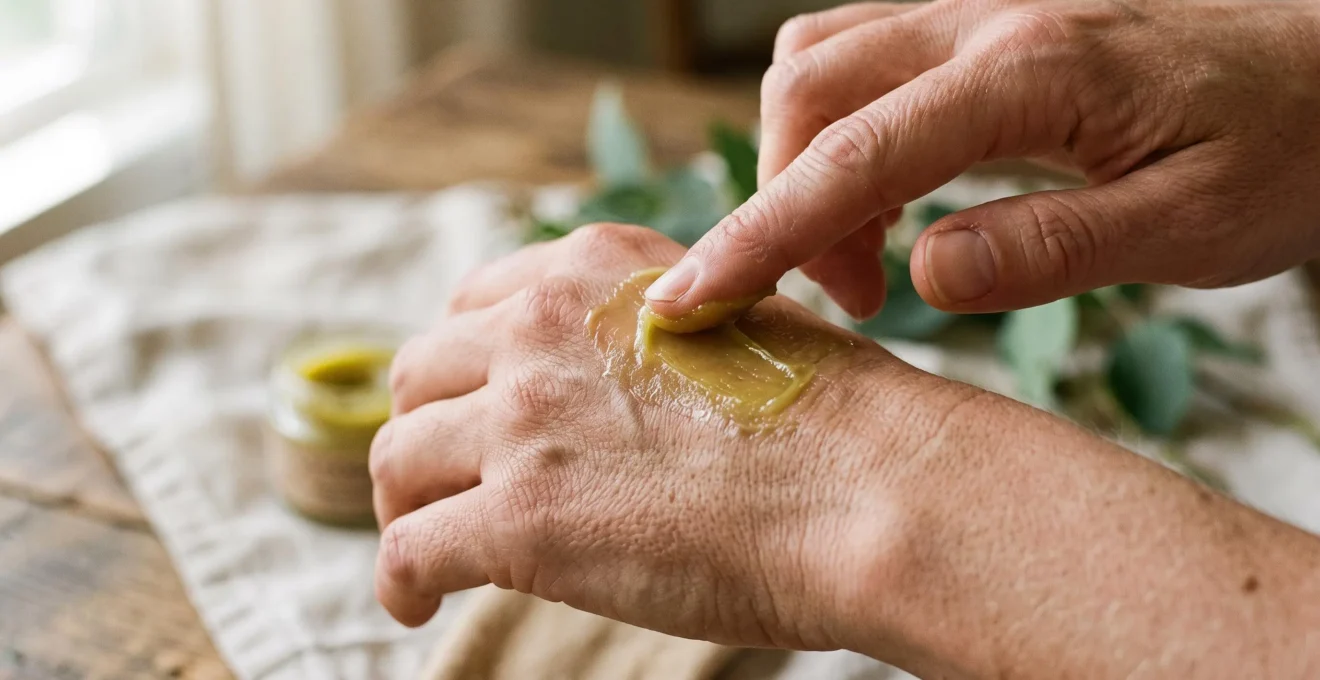
The stratum corneum is the outermost layer of the epidermis and the main permeability barrier encountered by a CBD topical. Its tightly organised cells and surrounding lipids restrict how readily cannabidiol moves from a cream, serum or balm into deeper skin layers. This barrier is selective rather than completely impermeable: some CBD may enter or remain within the outer skin, while the amount reaching deeper tissue depends strongly on the formulation.
CBD is lipophilic, meaning it has an affinity for fats and oils. That property influences its interaction with the skin’s lipid-rich barrier, but it does not guarantee efficient penetration. Molecular characteristics, the product’s carrier system, the condition of the skin and the amount applied all influence the outcome.
For everyday cosmetic use, deeper delivery is not necessarily the objective. A product may be intended to condition the surface, reduce moisture loss through its supporting ingredients or improve skin feel. Understanding the stratum corneum therefore helps distinguish realistic cosmetic functions from assumptions about absorption.
CBD Topicals and the Stratum Corneum: Key Facts
- The stratum corneum restricts CBD movement through its densely packed corneocytes and highly organised intercellular lipids.
- CBD penetration depends on the complete formulation, not simply the percentage of cannabidiol printed on the label.
- Surface conditioning and moisturising do not require substantial delivery into deeper skin layers.
- 43:Why Is the Skin Barrier So Important in CBD Topical Formulation?
- 43.1:Why Does Healthy Skin Block Many Ingredients from Penetrating Deeply?
- 45.1:Why Is the Stratum Corneum Such an Effective Barrier to Topical Ingredients?
- 38.4:Does Applying More CBD Topical Automatically Increase How Deeply It Penetrates?
- 45.3:CBD Serum or Balm: How Does Each Sit on the Stratum Corneum?
- 45.4:Does a CBD Cosmetic Need to Penetrate Deeply to Serve a Surface Skincare Purpose?
- 45.2:How Can You Use a CBD Topical Without Overworking the Stratum Corneum?
- 45.5:When Should a Dry Stratum Corneum Change How You Use a CBD Moisturiser?
43:Why Is the Skin Barrier So Important in CBD Topical Formulation?
The skin barrier determines how a CBD topical should be formulated because it controls contact, retention and movement of ingredients within the outer skin. Formulators must account for the stratum corneum’s selective permeability when choosing oils, emulsifiers and delivery vehicles. A product intended to condition the surface requires a different formulation strategy from one designed for deeper cutaneous delivery.
The stratum corneum consists of flattened, keratin-rich cells called corneocytes, embedded within a structured lipid matrix. These intercellular lipids contain ceramides, cholesterol and free fatty acids. Their organisation helps prevent excessive water loss while limiting the entry of external substances.
Because CBD is poorly soluble in water and relatively lipophilic, placing it in a topical product requires careful consideration of the carrier. Oils can dissolve CBD, while emulsions and other delivery systems influence how cannabidiol is distributed, released and brought into contact with skin.
However, dissolving CBD successfully in a product does not establish that it will penetrate the stratum corneum efficiently. CBD must also leave its vehicle and partition into the skin. A carrier that holds CBD strongly may not release it in the same way as another formulation with an identical CBD concentration.
In an experimental study of CBD delivery and distribution in human skin, researchers compared several colloidal preparations with simpler formulations and marketed products. The results showed meaningful differences in cutaneous CBD delivery depending on the vehicle.
5.25%
Reported delivery efficiency for a tested 1% CBD colloidal gel under finite-dose experimental conditions using excised human skin. This formulation-specific result does not represent an expected absorption rate for commercial CBD topicals.
Lapteva, Faro Barros and Kalia, Pharmaceutics, 2024.
There is also an important distinction between overcoming the barrier and supporting it. A cosmetic balm containing suitable emollient or occlusive ingredients may be developed primarily to improve surface comfort and reduce moisture loss. In that situation, remaining near the surface is consistent with the product’s intended function.
The skin barrier can therefore be both a limitation on CBD delivery and the intended beneficiary of a cosmetic formulation. These are different formulation goals, not competing definitions of product quality.
To understand why a carefully designed vehicle still encounters resistance, it helps to examine what healthy skin is structurally designed to keep out.
43.1:Why Does Healthy Skin Block Many Ingredients from Penetrating Deeply?
Healthy skin blocks many external ingredients because the stratum corneum combines densely packed corneocytes with a continuous, highly organised lipid matrix. This arrangement limits the movement of large, strongly water-soluble or otherwise poorly compatible molecules. CBD can interact with the lipid environment, but its molecular properties and formulation do not make passage through healthy skin automatic.
The familiar brick-and-mortar model describes the structure: corneocytes form the bricks, while intercellular lipids act as the mortar. Unlike ordinary mortar, however, these lipids are organised into specialised layered structures that strongly influence permeability.
A scientific review of stratum corneum lipid organization identifies this lipid arrangement as central to the skin’s barrier function. The intercellular lipid matrix provides the main continuous pathway for movement across the stratum corneum.
Whether a molecule crosses this barrier depends on several interacting characteristics:
- Molecular size: smaller molecules generally have fewer diffusion constraints, although size alone cannot predict penetration.
- Lipid and water affinity: a compound must partition into the barrier and move through its complex environment rather than simply dissolve in oil.
- Vehicle composition: solvents, oils, emulsifiers and other excipients influence the availability of a molecule at the skin surface.
- Skin condition: hydration, lipid organisation and physical integrity can change the environment encountered by the formulation.
CBD has a molecular mass of approximately 314.5 g/mol and is strongly lipophilic. These characteristics make interaction with skin lipids plausible, but substantial lipophilicity may also favour retention in lipid-rich regions rather than continued movement into more aqueous tissue.
The result is limited penetration rather than an absolute prohibition on penetration. Some formulations can deposit measurable CBD within skin layers under experimental conditions, but their performance cannot be assumed to apply to all consumer products.
Compromised skin presents another situation. Dryness, irritation or disrupted lipid organisation can alter permeability. A weakened barrier may allow certain substances to interact with skin differently, but it can also increase sensitivity to solvents, fragrances and other formulation components.
Greater permeability is therefore not automatically a cosmetic advantage. Protecting an intact barrier remains important even when an ingredient is being applied specifically to the skin.
A visible droplet illustrates the distinction between surface contact and penetration, although its appearance cannot reveal how much dissolved CBD has entered the skin. The serum’s other ingredients also influence whether the droplet spreads, evaporates or leaves a film.
The next question is what makes this protective outer layer so effective, including the pathways that small quantities of ingredients may still follow.
45.1:Why Is the Stratum Corneum Such an Effective Barrier to Topical Ingredients?
The stratum corneum is an effective barrier because its lipid organisation restricts diffusion while its corneocytes provide a dense structural framework. Hydration regulation, surface acidity and continual cell turnover support the functioning of this outer layer. Ingredients can follow several penetration routes, but for lipophilic substances such as CBD, the intercellular lipid pathway is particularly relevant.
The most important permeability mechanism lies in the arrangement of lipids between corneocytes. Ceramides, cholesterol and free fatty acids form ordered structures that limit the unrestricted movement of external molecules.
These lipids do not behave like a simple layer of oil. Their composition, arrangement and physical organisation influence which substances can enter the barrier and how readily those substances diffuse through it.
Other components contribute to normal stratum corneum physiology:
- Natural moisturising factor: a mixture of water-binding substances within corneocytes helps maintain hydration and appropriate mechanical properties.
- Desquamation: the regulated shedding of outer corneocytes continually renews the skin surface and influences how long deposited material may remain associated with it.
- Surface acidity: the skin’s acidic environment supports enzymes, microbial balance and aspects of normal barrier function.
- Corneocyte cohesion: specialised connections help maintain the integrity of the cellular framework until normal shedding occurs.
These mechanisms work together, but they should not be interpreted as independently proven CBD-blocking systems. The organised intercellular lipid matrix remains the principal structural explanation for the stratum corneum’s low permeability.
Topically applied molecules may encounter three recognised transport routes:
| Pathway | How it works | Relevance to CBD |
|---|---|---|
| Intercellular | Movement through the lipid structures surrounding corneocytes. | Particularly relevant to CBD because of its lipophilic character. |
| Transcellular | Movement across corneocytes and intervening lipid regions. | Potential route, but repeated transitions between different environments constrain diffusion. |
| Appendageal | Entry along structures associated with hair follicles and sweat ducts. | May contribute to local deposition or entry, depending on the formulation and application site. |
Another important phenomenon is the reservoir effect. Certain molecules can accumulate in or associate with the stratum corneum rather than moving continuously into deeper layers.
For CBD, its affinity for lipid-rich environments makes retention within the outer skin scientifically relevant. However, the extent of that retention must be measured for a particular formulation rather than assumed.
This is why three observations must be distinguished: CBD remaining in the applied product, CBD deposited within skin layers and CBD crossing the full skin barrier. Each represents a different outcome.
Experimental CBD biodistribution research has demonstrated that the amount detected within skin can vary with formulation and depth. Such measurements provide more information than the appearance or feel of a product after application.
These mechanisms also place a practical limit on what can be inferred from application quantity: depositing more formulation at the surface does not necessarily drive CBD proportionally deeper.
38.4:Does Applying More CBD Topical Automatically Increase How Deeply It Penetrates?
Applying more CBD topical does not automatically increase the depth of penetration. Additional product may increase the amount of CBD available at the skin surface, but diffusion also depends on formulation, concentration gradients, contact conditions and barrier properties. A thicker layer is therefore not reliable evidence that cannabidiol will reach deeper tissue or produce greater cosmetic benefits.
Skin absorption is not equivalent to a sponge taking up unlimited liquid. The stratum corneum has a finite capacity to retain substances under particular conditions, while movement beyond it depends on how molecules partition and diffuse.
Retention and penetration depth are separate measurements. A product may deposit more CBD in the outer layer without creating an equivalent increase in deeper delivery.
It would nevertheless be inaccurate to claim that the skin reaches one universal CBD saturation point after which additional product can never penetrate. Any such threshold would depend on the substance, vehicle, applied amount, exposure duration and experimental conditions.
The human-skin CBD delivery study discussed earlier used different dosing conditions and formulations, demonstrating why concentration alone is insufficient to describe delivery performance. It did not establish a maximum useful consumer dose.
Applying thicker layers may also alter the conditions at the surface. Depending on the vehicle, additional product can produce greater occlusion, leave more residue or increase contact with ingredients that some skin types find irritating.
For everyday cosmetic application, a useful approach is to begin with the amount indicated by the manufacturer and spread it gently over the intended area. Increase or reduce the amount only within the product’s directions and according to skin tolerance.
Surface residue can help assess the practical feel and finish of an application. For example, a persistent greasy layer may indicate that the chosen amount is excessive for the desired cosmetic finish. It cannot quantify CBD absorption or prove that no CBD entered the skin.
Similarly, the complete disappearance of a lotion is not proof of deep delivery. Water may evaporate, ingredients may spread into a very thin film and some components may enter superficial skin layers.
A reasonable application amount should therefore be judged by the formulation’s intended use, its directions and the skin’s response, rather than by the assumption that applying more automatically improves penetration.
Product texture adds another variable, making it useful to compare how a serum and a balm interact with the outer skin.
45.3:CBD Serum or Balm: How Does Each Sit on the Stratum Corneum?
CBD serums and balms interact differently with the stratum corneum because their carrier systems and textures differ. A lightweight serum typically spreads into a thin layer, while a wax-rich balm tends to form a more persistent surface film. These differences affect skin feel, hydration and contact conditions, but they do not establish that either format universally delivers CBD more deeply.
A serum may contain water, solvents, emulsifiers or other delivery-supporting ingredients. Depending on its composition, some components may evaporate after application while others remain at the surface or partition into superficial skin.
A balm generally contains a greater proportion of oils, waxes or other lipid-rich ingredients. Such formulas often spread more slowly and leave a protective-feeling film.
This film can be useful for cosmetic conditioning because it may reduce moisture loss when suitable occlusive ingredients are present. It may also change the hydration of the stratum corneum, potentially influencing how other molecules interact with the barrier.
Occlusion can alter penetration conditions, but it does not guarantee increased CBD penetration. The direction and magnitude of any change depend on the complete product and the skin environment.
For example, two products containing the same declared CBD percentage may have different delivery characteristics if one holds cannabidiol within a lipid-rich matrix and another uses a specially designed dispersed system.
The appearance of these textures provides useful clues about finish and surface coverage, rather than measured evidence of cannabidiol biodistribution. A thin serum can leave an active ingredient in a surface film, while a balm can allow some ingredient partitioning into the stratum corneum.
For a cosmetic choice, it is more useful to match formulation characteristics to skin needs than to assume the lighter option is always more penetrating.
| Selection factor | CBD serum | CBD balm |
|---|---|---|
| Typical texture | Lightweight, fluid and easy to distribute thinly. | Thicker, oil-rich or wax-rich, with a more persistent finish. |
| Surface objective | Light conditioning or compatibility with a layered routine, depending on ingredients. | Surface cushioning and moisture retention when appropriately formulated. |
| Dry skin | May require an additional moisturising product. | May suit a preference for a richer, more occlusive finish. |
| Oily skin | May feel lighter, depending on the full formula. | May feel heavy or leave more noticeable residue. |
| Upper-layer CBD delivery | Cannot be predicted from texture alone. | Cannot be predicted from texture alone. |
| Sensitive skin | Check solvents, fragrance and other potentially irritating ingredients. | Check fragrance, botanical extracts and the suitability of the entire formula. |
Neither product category has a guaranteed advantage for penetration. A serum’s specialised vehicle may influence CBD release, while a balm’s occlusive properties may modify local hydration. The final outcome requires formulation-specific evidence.
For a surface-focused skincare routine, the immediate selection criteria are therefore comfort, moisturising properties, ingredient compatibility and the desired finish.
Once the formulation has been selected, the more fundamental question is whether deeper penetration is even necessary for the product’s cosmetic purpose.
45.4:Does a CBD Cosmetic Need to Penetrate Deeply to Serve a Surface Skincare Purpose?
No. A CBD cosmetic does not necessarily need to deliver cannabidiol deeply into the skin to serve a surface skincare purpose. Moisturising, conditioning and improving skin feel can depend largely on interactions at or within the stratum corneum. Whether the product achieves those objectives depends on its complete formulation, rather than on evidence of substantial CBD penetration alone.
The stratum corneum is where many familiar cosmetic outcomes become noticeable. Surface lipids influence smoothness, water-binding components influence hydration, and occlusive ingredients can limit the evaporation of water from the skin.
For example, a balm may leave the skin feeling softer because its emollient ingredients reduce friction and smooth the superficial surface. A moisturiser may improve the appearance of dryness through humectants and occlusive materials.
These effects do not establish that CBD itself caused the observed outcome. The cosmetic performance of a CBD-containing formulation should not automatically be attributed to cannabidiol.
It is also important to distinguish the location of an ingredient from its intended function. An ingredient may be present within outer skin layers while the marketed product is intended primarily to improve appearance or moisturise.
In the United States, the FDA explanation of cosmetic and drug classifications makes clear that regulatory status depends on intended use and product claims, not a fixed depth of ingredient penetration.
Products intended to cleanse, beautify or alter appearance may qualify as cosmetics. Claims to treat disease or affect bodily structure or function may trigger drug classification. Some products can meet both definitions.
These distinctions do not mean that cosmetic ingredients are physically restricted to the skin surface. Nor does cosmetic classification establish that a particular CBD product is authorised, safe or effective.
CBD-specific regulatory requirements vary between countries, including among English-speaking markets. An explanation of United States cosmetic classification should not be treated as confirmation of the rules applying in the United Kingdom, Canada, Australia or elsewhere.
For the reader assessing an ordinary CBD skincare product, a more relevant question than « How deeply does it penetrate? » may be « What is this formulation intended to do at the surface, and what evidence supports that function? »
A product can be cosmetically useful without reaching the dermis. Conversely, a formulation that delivers measurable CBD into deeper skin layers does not thereby demonstrate superior moisturising performance or any therapeutic effect.
With the cosmetic objective established, application technique should focus on preserving the barrier rather than attempting to force ingredients through it.
45.2:How Can You Use a CBD Topical Without Overworking the Stratum Corneum?
Use a CBD topical without overworking the stratum corneum by starting with gently cleansed skin, applying an appropriate amount and spreading the product without aggressive rubbing. Avoid unnecessary exfoliation, very hot water and excessive layering of potentially irritating products. The objective is consistent cosmetic application while preserving the skin’s normal barrier function.
Applying a topical product changes the substances in contact with the skin, but application should not require deliberate disruption of the outer barrier.
Vigorous scrubbing, repeated exfoliation or aggressive cleansing may disturb the skin surface. These practices are not necessary to demonstrate that CBD is being absorbed, and they can make skin less comfortable when additional formulations are applied.
A gentle surrounding routine is particularly relevant because a CBD topical usually contains more than cannabidiol. Preservatives, solvents, fragrances, botanical extracts and other excipients may influence tolerance.
The condition of the skin before application matters. A well-hydrated, comfortable surface is not equivalent to skin that has just been aggressively exfoliated or is already visibly irritated.
Layering also deserves attention. Combining several cosmetics can increase the total number of ingredients contacting the skin, and the resulting skin feel may differ from that of any product used separately.
There is no established universal waiting interval between CBD skincare products and other cosmetics. Where a routine involves multiple products, follow their respective instructions and avoid unnecessary combinations that produce discomfort or persistent residue.
Five Checks for a Barrier-Conscious CBD Topical Routine
- Review the product instructions and ingredient list. Check completed: record the recommended application amount and any relevant warnings.
- Examine the application area for tightness, flaking, redness or visible irritation. Check completed: note whether the skin appears comfortable before use.
- Cleanse gently without adding an exfoliating step solely to improve CBD penetration. Check completed: the application area is clean without deliberate abrasive preparation.
- Apply the directed amount with light, even strokes. Check completed: the intended area is covered without vigorous rubbing or repeated unnecessary application.
- Observe skin comfort and the product’s finish. Check completed: note any stinging, redness or persistent excess residue to inform future product choices.
This checklist is a practical barrier-conscious application framework, not a clinically validated CBD absorption procedure. Its purpose is to make application habits observable without using irritation or exaggerated product quantities as proxies for efficacy.
If a product causes persistent discomfort, discontinue its use and review the formulation rather than trying to compensate by rubbing harder or applying more.
The final consideration is skin dryness, because an uncomfortable or visibly compromised stratum corneum may require a different moisturising approach altogether.
Key Takeaways Before Adjusting a CBD Moisturiser Routine
- Assess the current state of the skin barrier before changing application quantity or frequency.
- Prioritise appropriate hydration and tolerable ingredients over attempts to increase CBD penetration.
- Treat persistent stinging, cracking or irritation as reasons to reconsider the product rather than intensify application.
45.5:When Should a Dry Stratum Corneum Change How You Use a CBD Moisturiser?
A dry stratum corneum should change how you use a CBD moisturiser when tightness, flaking, roughness or irritation indicate that the barrier needs additional care. In that situation, prioritise gentle cleansing and adequate moisturisation before trying to increase CBD application. Markedly irritated or cracked skin may tolerate some formulation ingredients poorly, making product selection especially important.
Dryness can arise when the outer skin loses water or its normal lipid and hydration balance is disturbed. The surface may feel tight, look dull or show visible scaling.
In more pronounced cases, cracks and irritation can develop. These changes may alter permeability and skin sensitivity, although dryness alone does not establish how much CBD from a particular product will penetrate.
Dry skin does not necessarily absorb CBD better. A disrupted barrier may change ingredient movement in different ways, and any potential increase in exposure can occur alongside a greater likelihood of irritation.
Before selecting a CBD moisturiser, consider whether the immediate need is light surface conditioning or richer moisture retention. A formula containing suitable humectants, emollients and occlusive ingredients may address different aspects of dry-skin care.
General recommendations from the American Academy of Dermatology for dry skin include limiting exposure to hot water, choosing gentle cleansing products and applying suitable fragrance-free moisturisers while the skin is still damp.
Creams and ointments can be particularly useful for pronounced dryness. Examples of commonly used moisturising ingredients include glycerin, dimethicone, petrolatum, mineral oil and shea butter.
These recommendations concern moisturisation generally; they do not establish that CBD itself restores skin barrier function.
For skin experiencing mild dryness but no evident irritation, an appropriate CBD moisturiser can be considered within a simple skincare routine, provided its ingredients and product directions are suitable.
Where dryness is accompanied by stinging, marked redness or fissures, the complete formulation deserves closer scrutiny. Fragrance, certain solvents or other potentially irritating ingredients may be poorly tolerated.
A richer product should not automatically be applied more frequently simply because it contains CBD. Instead, base the routine on the skin’s hydration needs, product instructions and individual response.
Layering order should likewise be guided by the intended functions of the products. A moisturiser designed to support surface hydration may be more relevant to immediate comfort than introducing additional potentially irritating actives.
Severe cracking, bleeding, persistent burning or dryness that does not improve with gentle skincare warrants professional assessment. Continuing to experiment with CBD application is not a substitute for identifying the cause of ongoing skin irritation.
For the next application, assess the skin’s comfort, check the full ingredient list and choose an appropriately moisturising product that can be used gently according to its directions. A stable, comfortable stratum corneum is a more meaningful cosmetic objective than trying to make CBD penetrate as deeply as possible.
Can CBD enter the skin without reaching the bloodstream?
Yes. Cutaneous deposition and systemic absorption are different outcomes. CBD may be detected within skin layers without evidence that a comparable amount has crossed the entire skin barrier and reached systemic circulation. Measuring CBD in the epidermis or dermis does not, by itself, establish meaningful bloodstream exposure.
Does CBD’s affinity for oils make it easy to penetrate the skin?
No. CBD’s lipophilicity can favour interaction with the lipid-rich stratum corneum, but penetration also requires release from the formulation and continued diffusion through skin structures. Strong lipid affinity can contribute to retention in superficial regions instead of guaranteeing efficient deeper delivery.
Can you tell how much CBD has penetrated by looking at the skin?
No. A topical becoming less visible can reflect spreading, evaporation or changes in the distribution of its ingredients. Likewise, visible residue does not prove that all CBD remains outside the skin. Quantifying CBD penetration requires an appropriate analytical method rather than visual inspection.
Do hair follicles provide an alternative entry route for CBD topicals?
Hair follicles are a potential appendageal route through which certain ingredients or formulation particles may enter or accumulate. Their contribution depends on the formulation and application conditions. Follicular entry does not establish that a CBD product will achieve substantial deeper delivery or therapeutic effects.
Does a higher CBD percentage mean a more effective moisturiser?
Not necessarily. Moisturising performance depends on the complete formulation, including water-binding, emollient and occlusive ingredients. A higher CBD concentration does not guarantee greater penetration or superior surface hydration, and the amount of CBD alone cannot establish cosmetic effectiveness.