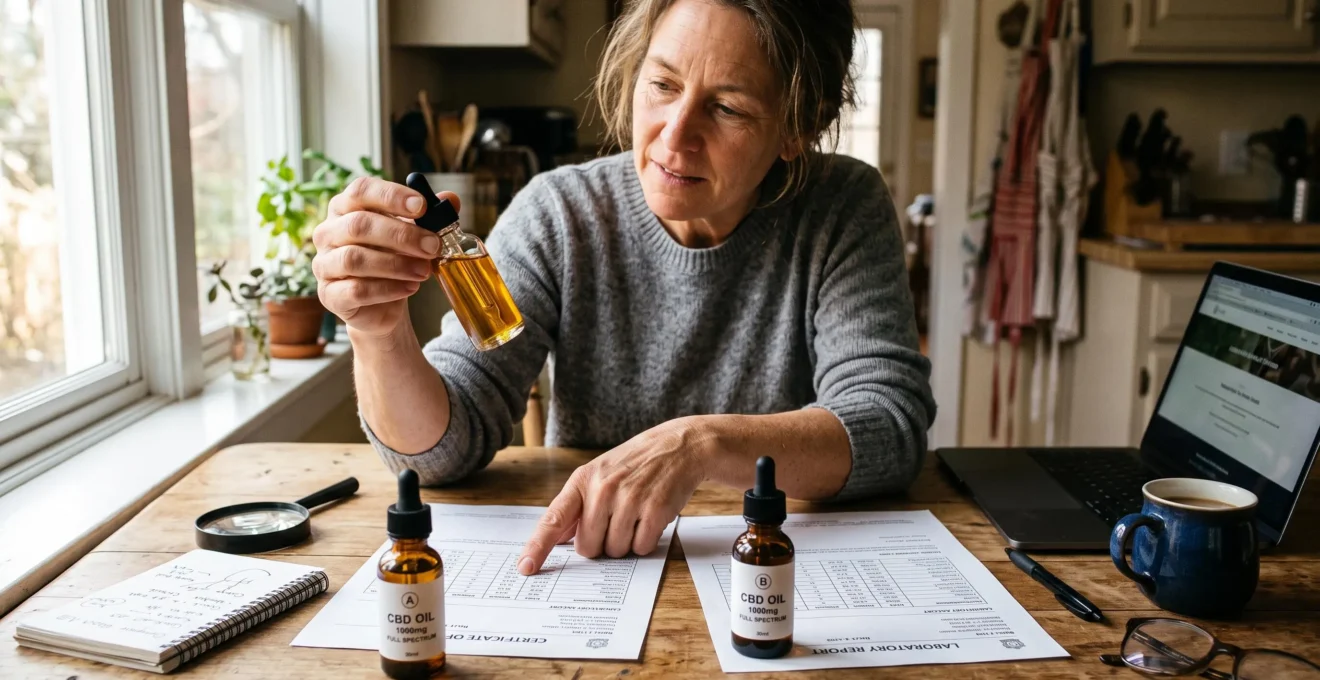
Two CBD oils can carry identical « full-spectrum » labels while containing markedly different combinations of cannabinoids, terpenes, and other botanical constituents. The term suggests a broader plant-derived composition than purified CBD alone, but it does not establish exactly which compounds are present, their concentrations, or how consistently they appear across production batches.
Evaluating a full-spectrum extract therefore requires more than checking its CBD strength or extraction method. A useful assessment considers the diversity of compounds detected, their measured quantities, the laboratory methods used, and the relationship between the finished product and its advertised manufacturing process.
These distinctions matter particularly when a product costs more because of its botanical complexity. A broader chemical profile may be a legitimate purchasing preference, but complexity does not automatically demonstrate greater effectiveness or safety. For consumers, the strongest evidence comes from a batch-specific certificate of analysis, supported by appropriate testing and transparent manufacturing information.
Full-Spectrum CBD Evaluation: Key Points
- A full-spectrum label describes a product category, not a verified minimum number or concentration of plant compounds.
- Batch-specific cannabinoid and terpene results provide more useful evidence of extract complexity than CBD potency alone.
- Extraction claims, laboratory accreditation, contaminant screening, and THC measurements should be assessed together before comparing products.
- Why Can Two Full-Spectrum CBD Oils Have Very Different Botanical Profiles?
- How Can You Check Whether a Full-Spectrum CBD Oil Shows a Broad Compound Profile?
- Full-Spectrum Extract or CBD Isolate: Which Offers the Simpler Ingredient Profile?
- Which Full-Spectrum Claims Should You Verify Before Trusting a CBD Product Label?
- When Is a Full-Spectrum CBD Oil Worth Comparing More Closely Than a Simpler Formula?
- Cannabinoid Panel or Wider Plant Profile: Which Test Tells You More About Extract Complexity?
- Which Extraction Claims Should Make a Careful CBD Buyer Look for More Evidence?
- When Do Isolated CBD Formats Make More Sense Than Broader Botanical Extracts?
Why Can Two Full-Spectrum CBD Oils Have Very Different Botanical Profiles?
Two full-spectrum CBD oils can differ substantially because their botanical composition depends on the original hemp material, growing conditions, extraction process, and subsequent refinement. The same marketing label may describe oils with different minor cannabinoids, terpene concentrations, and acidic cannabinoid forms. Their chemical profiles must therefore be measured individually rather than assumed to be equivalent.
Plant genetics establish the starting point. Hemp cultivars have different chemotypes, meaning their characteristic cannabinoid distributions can vary. Cultivation conditions, environmental stresses, plant maturity, and harvest timing can further influence the constituents available for extraction. Consequently, two manufacturers processing different plant materials may produce distinct oils even if they use similar equipment.
Manufacturing adds another level of variation. Supercritical carbon dioxide extraction, ethanol extraction, and other procedures recover different proportions of plant constituents depending on operating parameters. Winterization can remove waxes and other unwanted fractions, while further refining and distillation can change the balance of cannabinoids and volatile compounds.
An experimental study comparing hemp extraction procedures demonstrated these differences using material from a CBD/CBG-dominant Cannabis sativa cultivar. Among the procedures evaluated, supercritical CO2 extraction produced the greatest cannabinoid variety and abundance, while hydrodistillation yielded the greatest terpene variety and abundance. These results illustrate process-dependent composition, not the universal superiority of any extraction technique.
Experimental Evidence: Different Processes, Different Profiles
In the 2024 experimental comparison, hydrodistilled extracts contained beta-caryophyllene at 25–42 mg/g, while supercritical CO2 extracts showed CBD concentrations of 12.8–20.6 mg/g. Ethanol extracts contained 3.2–4.1 mg/g of CBDA and relatively low terpene levels.
The measured concentrations apply to the study’s specific plant material and extraction conditions. They should not be interpreted as standard specifications for commercial full-spectrum CBD oils.
These observations support a useful two-dimensional assessment:
- Spectrum breadth: How many different compound classes and individual constituents can analytical testing identify?
- Spectrum fidelity: How closely does the resulting composition resemble the original botanical material, considering changes introduced during processing?
These are practical comparison concepts, not standardized scientific quality grades. Breadth can be investigated through finished-product laboratory testing. Fidelity requires additional information about the original plant material and processing stages; a finished-product certificate alone cannot establish it.
Batch consistency also matters. Natural raw materials vary between harvests, and manufacturers may blend or standardize extracts to reduce those differences. Comparing several batch reports can reveal whether a producer maintains a reasonably consistent composition rather than presenting one unusually diverse sample.
The important distinction is between a broad marketing category and a measurable chemical identity. Once that distinction is established, the next task is finding reliable evidence for the compounds actually present.
How Can You Check Whether a Full-Spectrum CBD Oil Shows a Broad Compound Profile?
To check whether a full-spectrum CBD oil contains a broad compound profile, obtain its batch-specific certificate of analysis and examine the cannabinoid results, terpene measurements, laboratory identity, and analytical detection limits. Confirm that the report matches the purchased product and distinguishes quantified compounds from undetected or untested substances. A CBD percentage alone cannot establish spectrum breadth.
A certificate of analysis, commonly abbreviated COA, should identify the tested sample, its batch or lot number, the laboratory, testing dates, analytical methods, and measured results. These details help establish whether the report concerns the actual product rather than a different formulation or earlier production run.
Begin with the cannabinoid potency table. Depending on the laboratory’s analytical panel, results may cover CBD, CBDA, CBG, CBN, delta-9-THC, THCA, and additional minor cannabinoids. Quantified results provide stronger evidence of composition than broad statements such as « contains multiple cannabinoids. »
Next, inspect any terpene report. Compounds such as beta-caryophyllene, myrcene, limonene, and pinene may appear when included in the testing method and present above its reporting thresholds. A diversified terpene profile supplies an additional dimension of botanical information, although terpene detection alone does not prove that the finished product faithfully represents the original plant.
A useful laboratory credibility check is accreditation under the ISO/IEC 17025 laboratory competence standard. Accreditation concerns laboratory competence, impartiality, and consistent operation. Buyers should also check whether the relevant analytical methods fall within the laboratory’s accredited scope.
The notation « ND » requires particular attention. It usually means « not detected » under the laboratory’s testing conditions, but it does not necessarily establish absolute absence. A compound might be present below the method’s limit of detection. Similarly, a result reported below the limit of quantification may indicate that the substance was detected but could not be reliably measured at that concentration.
The distinction between undetected and unreported compounds is equally important. If a laboratory measures only CBD and THC, the report provides no direct evidence about CBG, CBN, terpenes, or other unmeasured constituents.
A practical interpretation grid helps prevent overconfident conclusions:
| Laboratory finding | What it supports | What remains uncertain |
|---|---|---|
| Several minor cannabinoids quantified | Measurable cannabinoid diversity | Whether other botanical classes are present |
| Multiple terpenes quantified | Additional documented chemical complexity | Whether they originated from the original extract or were added later |
| Only CBD and THC reported | Information about the measured cannabinoids | The wider botanical composition |
| Most minor compounds marked ND | Concentrations below the method’s detection thresholds | Absolute absence and original manufacturing method |
| Only an in-house report available | Manufacturer-reported analytical information | Independent confirmation |
A limited chemical profile may justify asking whether a product contains purified CBD combined with selected additional ingredients. However, laboratory results alone generally cannot establish that an oil was manufactured by adding cannabinoids to isolate. Confirmation requires manufacturing documentation.
Five Checks to Complete Before Buying
- Match the bottle’s lot number with the COA and record both identifiers as proof that the tested batch is relevant.
- Copy the reported CBD amount and individual cannabinoid results into a comparison sheet, including their measurement units.
- Identify whether a terpene panel exists and record the quantified compounds or note « not tested. »
- Check the laboratory name, independent status, accreditation, and relevant method scope; save the verification details.
- Record contaminant results, detection thresholds, and any missing tests in a short evidence summary before deciding.
The result should be an evidence-based description of what the laboratory measured, not a premature judgment that a product is authentic or fraudulent. That restraint becomes especially useful when comparing complex extracts with chemically simpler alternatives.
Full-Spectrum Extract or CBD Isolate: Which Offers the Simpler Ingredient Profile?
CBD isolate offers the simpler active-ingredient profile because it consists primarily of purified cannabidiol, whereas full-spectrum extracts contain multiple plant-derived constituents. Isolate is generally easier to characterize chemically, while full-spectrum products require broader analytical testing. Neither format is automatically better: the relevant distinction is compositional simplicity versus botanical complexity, together with each format’s quality-control requirements.
In an isolate-based oil, purified CBD is typically combined with a carrier ingredient, such as an edible oil. A full-spectrum formulation may contain CBD alongside minor cannabinoids, residual acidic forms, terpenes, and other extracted constituents. The exact composition depends on the extract and any additional formulation steps.
The simpler active-ingredient structure makes isolate attractive when the buyer wants fewer chemical variables. CBD concentration still needs verification, however, and the finished formula can contain ingredients beyond cannabidiol. Purity specifications and testing remain important.
Full-spectrum extracts introduce a different analytical burden. Greater chemical diversity means that a single CBD potency measurement describes only part of the formulation. Separate measurements may be necessary to evaluate minor cannabinoids, terpenes, THC, and other relevant components.
| Evaluation criterion | CBD isolate | Full-spectrum extract |
|---|---|---|
| Active-ingredient composition | Predominantly cannabidiol | CBD alongside other measurable plant compounds |
| Testing priorities | CBD identity, purity, potency, and contaminants | Potency, minor cannabinoids, broader constituents, and contaminants |
| THC considerations | No intentionally retained THC, subject to purity verification | May contain measurable THC |
| Flavor and aroma | Usually relatively neutral before formulation | May retain stronger botanical characteristics |
| Batch standardization | Generally more straightforward | More variables to monitor and control |
Sensory characteristics can provide clues but are unreliable analytical evidence. An earthy or bitter taste may reflect retained botanical constituents, carrier oils, or added flavoring. A pale, mild-tasting oil might also have undergone refinement without necessarily becoming pure isolate.
Nor is the market limited to two categories. Broad-spectrum extracts, cannabinoid distillates, and reconstituted formulations can occupy intermediate positions. Their actual chemical profiles may overlap despite different labeling terms.
Complexity should not be confused with proven clinical superiority. The presence of several plant compounds creates possibilities for interactions, but measuring their co-presence does not demonstrate that a particular commercial blend delivers better health outcomes.
For consumers concerned about THC, isolate can reduce exposure when the product is appropriately manufactured and tested. It cannot guarantee that every finished product is absolutely THC-free, nor can any product label alone guarantee a negative drug-test result.
Choosing between them starts with the purchaser’s objective. The next step is establishing whether the label accurately describes the product offered for sale.
Which Full-Spectrum Claims Should You Verify Before Trusting a CBD Product Label?
Before trusting a full-spectrum CBD label, verify its cannabinoid content, the presence of additional botanical compounds, batch-specific laboratory testing, THC measurements, and any advertised sourcing credentials. Claims about the entourage effect, organic production, or extraction quality require separate supporting evidence. Objective measurements should carry more weight than descriptive language because the term « full-spectrum » lacks a universally consistent definition.
A full-spectrum claim is strongest when accompanied by quantified minor cannabinoids and, where botanical breadth matters, a terpene analysis. A certificate reporting only the total CBD content does not establish that the finished oil contains a diverse botanical profile.
The same reasoning applies to claims about the « entourage effect. » This term commonly refers to proposed interactions between cannabis constituents. Demonstrating that compounds coexist in a formulation, however, does not establish that they produce a clinically meaningful combined effect at the concentrations present.
Organic sourcing statements also require precision. « Organically grown » may describe a manufacturer’s production approach, whereas formal organic certification depends on the applicable jurisdiction, certification scheme, and product category. A verified cultivation credential does not replace finished-product contaminant testing.
Similarly, « third-party tested » is incomplete without an identifiable laboratory, a relevant report, and an associated batch. A certificate for a different product or historical formulation may provide little evidence about the bottle being purchased.
30.95%
Of 84 CBD products purchased online for a historical US study, 26 met the researchers’ CBD labeling-accuracy criterion of within ±10%. The samples were purchased in 2016, so this is not an estimate of current CBD labeling accuracy.
JAMA study on CBD extract labeling accuracy, published November 2017.
The same research found THC in 18 of the 84 samples. These findings illustrate why measurable composition matters, but the sampling period, US market focus, and selected product types prevent generalizing the percentages to today’s international CBD market.
Buyers can cross-check a product’s numerical claims using a common unit. For example, if the label gives the CBD content per bottle and the COA reports CBD concentration per milliliter, the reported concentration can be multiplied by the corresponding bottle volume. This comparison assumes the units and tested formulation are compatible.
A discrepancy may arise from incorrect labeling, differing analytical conventions, or confusion between CBD and total potential CBD, which may include a conversion allowance for CBDA. Such differences deserve clarification rather than an immediate allegation of misrepresentation.
Claims can be prioritized according to their verifiability:
- Directly measurable: cannabinoid concentration, certain contaminants, and quantified terpenes.
- Documentary: batch traceability, laboratory credentials, cultivation certification, and manufacturing records.
- Interpretive or promotional: « premium, » « exceptional purity, » « maximum entourage, » and similar descriptions without defined measurement criteria.
Legal terminology presents another challenge. English-speaking markets have different CBD rules, THC thresholds, product classifications, and marketing restrictions. Full-spectrum should not be assumed to be a uniform certified designation, and an acceptable product specification in one jurisdiction does not automatically establish compliance elsewhere.
Once the label’s credibility is established, additional comparison is worthwhile only when the details have a meaningful influence on the buyer’s decision.
When Is a Full-Spectrum CBD Oil Worth Comparing More Closely Than a Simpler Formula?
A full-spectrum CBD oil deserves closer comparison when botanical diversity is a purchasing priority, when a price premium depends on spectrum-related claims, or when THC exposure and batch consistency have practical consequences. Detailed comparison is less valuable when the buyer primarily wants measured CBD content and has no preference for accompanying plant constituents. The appropriate scrutiny follows the purchasing objective.
For a consumer specifically interested in botanical composition, two oils containing the same labeled CBD amount may represent different products. One may have several quantified minor cannabinoids and a documented terpene profile; another may contain mainly CBD with few additional constituents reported.
Those differences can justify a more detailed comparison, although they do not establish different health outcomes.
Consider two hypothetical CBD oils sold at different prices. Product A provides a batch-matched cannabinoid report, a terpene panel, and comparable reports from earlier production lots. Product B provides CBD potency and basic contaminant information but no further profile measurements.
Product A offers more evidence for evaluating botanical diversity. That additional documentation could justify further investigation for a spectrum-focused buyer. It does not prove that Product A is safer or more effective, nor does it mean Product B necessarily contains fewer plant compounds; some may simply be unmeasured.
The most useful comparison criteria are:
- Panel breadth: Which cannabinoids and other compound classes are actually tested?
- Quantified diversity: How many constituents have measurable results, and in what concentrations?
- Batch consistency: Do multiple lot reports show comparable profiles under comparable methods?
- Testing transparency: Are laboratory details, analytical thresholds, and contaminant results accessible?
- THC exposure: What THC concentrations are reported, and do they fit the buyer’s restrictions?
THC is particularly relevant because full-spectrum formulations may retain small quantities of this cannabinoid. Buyers subject to workplace drug testing, professional requirements, or restrictive local laws should not assume that a low-THC label eliminates exposure risk.
A broad-spectrum product or verified isolate may be more suitable when avoiding THC is the principal requirement, although even a non-detectable laboratory result has methodological limits.
Conversely, someone comparing products strictly by the amount of CBD purchased may gain little from an elaborate terpene comparison. More testing can improve compositional transparency, but its value depends on whether the information informs a real choice.
Pricing should be interpreted with equal care. Additional processing, analytical testing, raw-material selection, and standardization can contribute to production costs. Retail prices also reflect branding, distribution, and commercial positioning, so a higher price cannot be treated as proof of greater botanical breadth.
When two reports seem equally comprehensive, understanding what each laboratory method actually measures can reveal differences that the number of reported results alone obscures.
Cannabinoid Panel or Wider Plant Profile: Which Test Tells You More About Extract Complexity?
A cannabinoid panel measures the concentrations of selected cannabinoids, making it essential for verifying CBD strength and detecting other targeted cannabinoids. A wider plant profile adds information about terpenes and potentially other constituents, offering a more informative picture of extract complexity. Neither approach identifies every compound in the product, and broader testing should be selected according to the buyer’s evaluation priorities.
Cannabinoid potency testing commonly uses chromatographic methods to separate and quantify specific analytes. Reports can distinguish CBD from CBDA, THC from THCA, and selected minor cannabinoids when those substances are included in the validated method.
However, a detailed cannabinoid panel cannot independently establish the presence of terpenes, flavonoids, or other non-cannabinoid botanical compounds. Those constituents require suitable additional analytical methods.
Terpene analysis can help document volatile constituents that contribute to an extract’s chemical identity and sensory characteristics. Results should specify the compounds tested, their concentrations, and the relevant reporting units. Because processing and storage can affect volatile compounds, the finished-product result is especially important.
The US National Institute of Standards and Technology‘s NIST cannabinoid laboratory quality assurance report illustrates the importance of analytical scope and measurement comparability. The described exercise included THC, THCA, total THC, CBD, CBDA, total CBD, and up to 13 additional cannabinoids, alongside other measurements.
That program addresses analytical performance rather than defining a commercial full-spectrum product. It helps explain why laboratories need appropriate methods and quality assurance, not why any particular number of detected cannabinoids should qualify an oil for a specific marketing category.
Consumer testing priorities can be separated into complementary questions:
| Test | Principal information | Main limitation |
|---|---|---|
| Cannabinoid potency panel | Measured CBD, THC, and other targeted cannabinoids | Does not describe the entire botanical composition |
| Terpene profile | Identity and concentration of targeted terpenes | Does not establish therapeutic benefit or botanical origin |
| Residual solvent screening | Tested solvent residues remaining in the sample | Does not prove the manufacturer’s claimed extraction method |
| Heavy metal analysis | Concentrations of specified toxic elements | Does not address pesticides or microbiological contamination |
| Pesticide screening | Residues included in the analytical panel | Does not detect substances outside its testing scope |
For safety-focused evaluation, appropriate potency and contaminant screening should take priority. For botanical-composition evaluation, minor cannabinoid and terpene measurements provide additional information.
Testing depth must also be interpreted in context. A low-cost product without a terpene panel is not necessarily contaminated or misrepresented. It simply offers less evidence about that dimension of composition.
Most importantly, laboratories measure what their methods are designed to detect. Unscreened synthetic cannabinoids, certain degradation products, unexpected compounds, or substances below reporting thresholds may fall outside the available results.
Certificates reduce uncertainty but cannot establish complete chemical knowledge of a product. A laboratory report should therefore be assessed by its analytical targets, methods, and limitations rather than the number of pages it contains.
These testing distinctions are particularly useful when manufacturers make technical claims about how the extract was produced, because processing choices affect what the resulting analytical profile may show.
Which Extraction Claims Should Make a Careful CBD Buyer Look for More Evidence?
Extraction claims such as « CO2 extracted, » « solvent-free, » « cold-pressed, » and « whole-plant » deserve scrutiny when they are presented as proof of superior quality without corresponding analytical evidence. Extraction techniques influence which compounds are recovered and retained, but the process description alone does not establish the finished oil’s composition, purity, or safety. Relevant batch-specific measurements are more informative.
Supercritical CO2 extraction uses carbon dioxide under controlled pressure and temperature conditions to recover selected constituents from botanical material. The process can be adjusted to influence extraction behavior, but the phrase « CO2 extracted » does not identify the operating parameters or guarantee terpene preservation.
Ethanol extraction uses a solvent to recover compounds from plant material. Subsequent processing removes the solvent to the required degree and may also change the recovered botanical profile.
The distinction between solvent-based and solvent-free marketing can therefore be misleading. A carefully controlled ethanol extraction with acceptable measured residual solvent levels may provide stronger evidence of finished-product cleanliness than a CO2 extraction claim offered without relevant testing.
« Solvent-free » itself needs clarification. It may mean no organic extraction solvent was used, that no solvent residues were detected under a specified method, or simply that the manufacturer is emphasizing its preferred process. These interpretations are not interchangeable.
Likewise, « cold-pressed » may indicate a mechanical process or low-temperature manufacturing approach, but it does not establish a standardized cannabinoid or terpene profile. Buyers should determine precisely which material was pressed and whether the resulting product underwent further extraction or refinement.
« Whole-plant » is similarly ambiguous. It may refer to the botanical material entering the process rather than the compound classes retained in the finished oil. Starting with more plant parts does not demonstrate that more constituents survive extraction, filtration, or subsequent processing.
Extraction and refinement can also alter acidic cannabinoids such as CBDA. Heating during processing may promote decarboxylation, converting acidic cannabinoid forms into their neutral counterparts. Volatile terpenes can likewise be lost or selectively recovered during manufacturing.
These mechanisms offer useful cross-checks. If a manufacturer emphasizes an unrefined, terpene-rich extract, a relevant terpene panel can help evaluate the finished composition. If the brand promotes retained acidic cannabinoids, the cannabinoid report should show whether those compounds are actually measurable.
Nevertheless, a chemically plausible result does not verify the manufacturing history. Similar finished-product profiles can arise through different processing routes, including blending or the addition of selected compounds. Process documentation remains necessary to confirm how an extract was made.
Residual solvent analysis addresses a narrower but important question: whether specified solvents remain at measurable concentrations. The report should identify the tested substances, results, units, and applicable acceptance criteria. A non-detect result for a particular solvent does not establish that every possible solvent is absent.
The most useful buyer heuristic is to separate two types of evidence. A manufacturer’s technical explanation can describe the intended process, while independent finished-batch testing can help substantiate specific compositional and residue claims. Neither substitutes completely for the other.
After assessing extraction, the final decision returns to personal requirements: whether broader botanical complexity offers enough value to justify its additional evaluation burden.
Key Takeaways Before Choosing a CBD Format
- Choose the comparison criteria that match your actual requirements, whether those involve botanical breadth, reproducibility, or reduced THC exposure.
- Separate product composition from claimed benefits: more detected compounds do not establish better clinical results.
- Prefer a transparent, appropriately tested formulation over a more elaborate marketing category with incomplete supporting information.
When Do Isolated CBD Formats Make More Sense Than Broader Botanical Extracts?
Isolated CBD formats often make more sense when ingredient simplicity, reproducible CBD concentration, minimal botanical flavor, or reduced THC exposure matter more than preserving a broad plant profile. Full-spectrum extracts remain a reasonable choice for buyers specifically interested in multiple botanical constituents and willing to verify them. The decision depends on the intended product characteristics, not a universal ranking of extract quality.
Purified cannabidiol offers a relatively defined starting material. Manufacturers can formulate it to a specified concentration without relying on the naturally variable cannabinoid ratios of a less-refined botanical extract.
That simplicity may be useful for consumers who want to compare CBD concentrations across products or avoid additional cannabis-derived constituents. It can also help when the taste or aroma of a less-refined extract is undesirable.
Consumers seeking minimal ingredient lists should still read the entire formulation. A CBD isolate oil may contain carrier oils, flavors, preservatives, or other ingredients. Isolate describes the CBD ingredient’s purification, not necessarily the composition of the finished bottle.
THC-related requirements deserve particular caution. A verified isolate-based product can minimize the potential for THC exposure relative to some full-spectrum alternatives. However, manufacturing impurities, contamination, analytical detection limits, and product-specific variability prevent an unconditional zero-THC guarantee.
Where workplace drug testing or strict THC restrictions apply, a manufacturer statement alone is insufficient. Consumers should consider the consequences of even low-level exposure and recognize that a certificate showing THC below a detection threshold cannot guarantee a negative biological drug test.
Full-spectrum extracts serve a different purchasing objective. Buyers may value documented minor cannabinoids, a retained terpene profile, and evidence of the original botanical composition. Such preferences are legitimate product-selection criteria even when no superior clinical effect has been established.
They also involve trade-offs. Maintaining a broader extract profile may require more extensive analysis, additional process controls, and tighter raw-material management. These requirements can influence production complexity, but they do not establish a consistent price difference across all manufacturers.
Isolate production involves purification steps of its own. Although standardized isolate formulations may be simpler to characterize and reproduce, it would be inaccurate to assume that isolate is always cheaper to manufacture or retail than every full-spectrum alternative.
The practical decision can be framed around three priorities:
- Choose a verified isolate-based formula when a relatively defined CBD ingredient, neutral flavor, or fewer cannabis-derived constituents is the main goal.
- Consider a documented full-spectrum formula when minor cannabinoids and broader botanical composition are central purchasing criteria.
- Evaluate intermediate formulations individually when broad-spectrum extracts or refined distillates may provide a preferred balance of chemical composition and THC-related considerations.
Whatever the format, CBD is not free from potential adverse effects or interactions with medication. Product-composition testing helps evaluate what is in the bottle but cannot establish whether a particular CBD product is appropriate for an individual’s health circumstances.
For the next CBD oil you consider, request the matching batch report, identify the compounds that matter to you, check the relevant contaminant results, and compare only what the evidence supports. The full-spectrum label is a starting description; the documented composition is what makes an informed comparison possible.
Does a darker CBD oil necessarily contain more plant compounds?
No. Oil color can reflect pigments, processing conditions, concentration, carrier ingredients, oxidation, and other formulation characteristics. Darker appearance does not reliably establish a higher number of cannabinoids or terpenes. Laboratory measurements are needed to compare chemical diversity.
Can a certificate of analysis prove that no THC is present?
A COA can report that THC was not detected under a specified analytical method. That finding means the concentration was below the relevant detection threshold, not necessarily that the sample contained absolutely no THC. Check which THC forms were tested, the laboratory’s limits, and whether the report corresponds to the purchased batch.
Can terpenes be added to CBD oil after extraction?
Yes. Manufacturers can formulate products with terpenes added separately from the original extraction process. A terpene report confirms the presence of tested compounds but generally cannot establish when or how they entered the formulation. Ingredient disclosure and manufacturing documentation are needed to investigate their origin.
Does a certificate for CBD extract also cover the finished bottled oil?
Not necessarily. An extract certificate may describe a concentrated intermediate ingredient before dilution, blending, or bottling. Testing the finished formulation provides more directly relevant information about the product purchased. Check the sample description and batch identifiers to determine which manufacturing stage was analyzed.
Does a broader cannabinoid profile prove that CBD oil works better?
No. A broader profile establishes chemical diversity only for the compounds measured. It does not demonstrate superior therapeutic effectiveness, stronger biological interactions, or better tolerability. Such conclusions require appropriate clinical evidence concerning defined formulations, doses, and outcomes rather than a general full-spectrum designation.