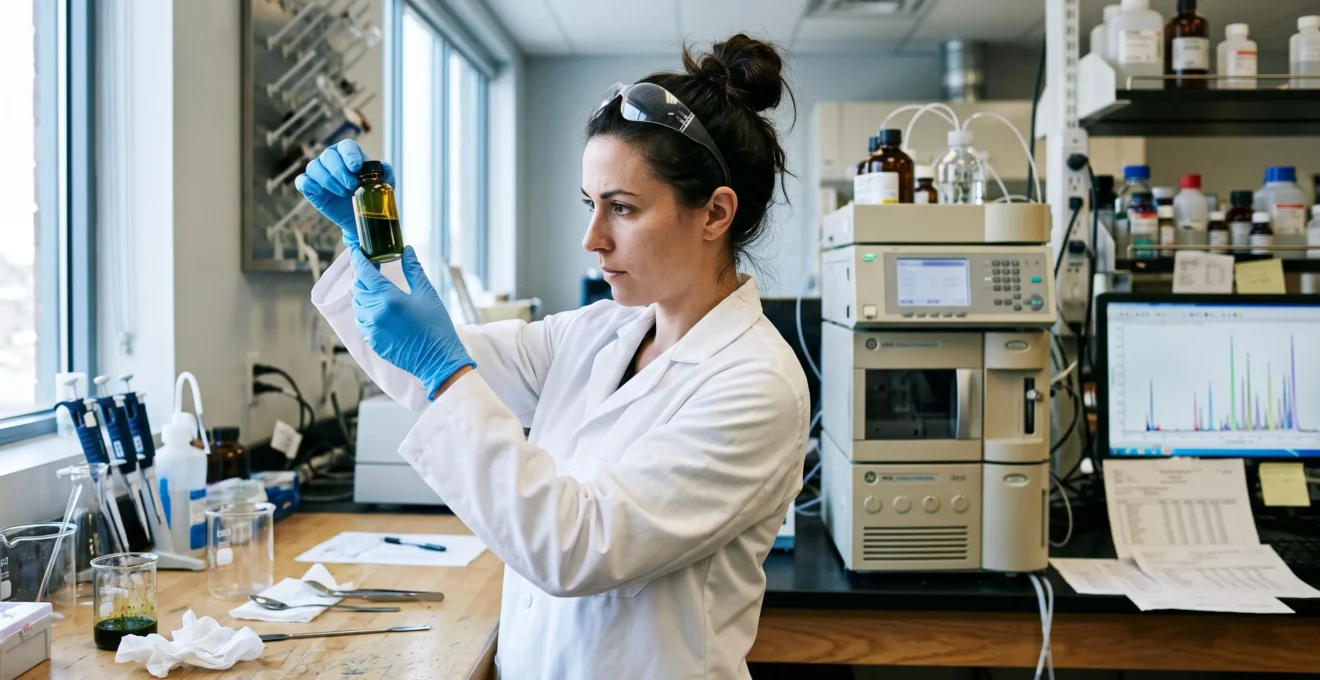
Two botanical CBD extracts can contain comparable amounts of cannabidiol while differing substantially in their minor plant compounds. Among these compounds are flavonoids, a diverse family of phenolic substances whose presence depends on plant genetics, growing conditions, harvested tissues and processing methods.
Unlike CBD concentration, which is routinely measured in cannabinoid potency testing, flavonoid diversity is rarely described on consumer product labels. Even extracts marketed as full-spectrum may have different flavonoid profiles because extraction and refinement do not preserve every plant compound equally.
Scientific research supports the chemical diversity of Cannabis sativa, but it does not establish that a larger number of flavonoids makes a finished CBD product more effective or inherently safer. Understanding this distinction is essential when comparing less-refined botanical extracts.
The useful question is therefore not simply how many compounds an extract contains. It is what its measured composition reveals, how reliably that composition is documented, and whether the available evidence supports the claims made about it.
Flavonoid diversity in CBD extracts: the essentials
- Flavonoid profiles vary with plant tissue, genetics, maturation, growing conditions and extraction processes.
- Standard cannabinoid laboratory reports cannot establish flavonoid diversity; specific analytical testing is needed.
- A more complex profile is not automatically better. Verified cannabinoid content, contaminant screening and batch consistency deserve priority.
- Why Can Two CBD Extracts from the Same Plant Have Different Compound Profiles?
- Why Can Growing and Processing Conditions Change Flavonoid Profiles in CBD Extracts?
- Low-Temperature or Intensive Extraction: Which Better Preserves a Complex Botanical Profile?
- How Can You Check Whether a CBD Laboratory Report Includes Flavonoid Data?
- Cannabinoid Panel or Wider Plant Profile: Which Test Tells You More About Extract Complexity?
- Does a More Complex Flavonoid Profile Automatically Mean a Better CBD Product?
- When Is Flavonoid Information Worth Checking Before Buying a Botanical Extract?
- How Can You Evaluate Full-Spectrum Extracts Beyond the Marketing Label?
Why Can Two CBD Extracts from the Same Plant Have Different Compound Profiles?
Two CBD extracts associated with the same Cannabis plant or cultivar can have different chemical profiles because plant compounds are not distributed uniformly. Flowers, leaves and other tissues contain different concentrations of cannabinoids and flavonoids. Harvest timing, sampling, extraction conditions and natural variation can further change which compounds appear in the finished extract.
Cannabis is chemically heterogeneous. Its flowers, leaves and glandular structures do not contribute identical proportions of secondary metabolites. Cannabinoids are strongly associated with glandular trichomes, whereas flavonoids follow different patterns of tissue distribution and biosynthesis.
A scientific review of Cannabis cannflavin chemistry and analysis describes this distinction and reports that more than 30 flavonoids have been isolated from Cannabis. These include compounds belonging to different flavonoid groups, as well as Cannabis-associated molecules such as cannflavins.
Consequently, an extraction process emphasizing cannabinoid-rich floral material cannot be assumed to recover the same flavonoid proportions as one incorporating a different mixture of plant tissues. Higher trichome density does not necessarily indicate greater flavonoid abundance.
Genetic identity is also different from chemical expression. A cultivar or chemovar name identifies plant material according to a particular classification or commercial description. It does not guarantee identical concentrations of secondary metabolites across cultivation cycles.
Even when producers work with closely related or genetically similar plants, environmental conditions and harvest decisions can influence the resulting chemical profile. The composition of a particular batch must therefore be measured rather than inferred solely from its cultivar name.
A 2025 chromatographic investigation examined inflorescence and leaf material from three commercial Cannabis strains. Researchers tentatively identified 79 phenolic compounds and observed differences in flavone derivatives between strains. The findings illustrate the diversity accessible through advanced analytical methods, without proving that extracts from genetically identical plants necessarily differ by the same amount.
This distinction becomes especially important when comparing two retail oils bearing similar cannabinoid concentrations. Their labels may provide no information about the underlying phenolic composition.
Batch-to-batch variation makes consistent documentation valuable: the chemistry of the actual material is more informative than a shared strain name or a generalized botanical description.
Why Can Growing and Processing Conditions Change Flavonoid Profiles in CBD Extracts?
Growing and processing conditions can alter flavonoid profiles because these compounds participate in plant responses to environmental conditions and undergo chemical changes after harvest. Light exposure, temperature, water availability and maturation can influence their formation, while drying, heating, oxidation and storage may affect which molecules remain detectable in an extract.
Flavonoids belong to the broader family of plant phenolic compounds. Their production is influenced by plant development and environmental signals, but individual flavonoids do not necessarily respond to those signals in the same way.
Several cultivation variables may contribute to differences:
- Light and ultraviolet exposure: changes in illumination can influence flavonoid biosynthesis, although responses depend on the compound, plant material and exposure conditions.
- Temperature: thermal conditions affect plant physiology and metabolic processes, without establishing a universally preferable growing temperature for flavonoid diversity.
- Water availability: water stress can modify secondary metabolism, but its effects are not uniform across cultivars or growing systems.
- Harvest maturity: flavonoid concentrations and relative proportions can change as plant tissues develop.
- Drying and curing: post-harvest handling introduces additional opportunities for chemical transformation or loss.
These factors interact. Two greenhouse crops can be exposed to different combinations of light, temperature and water conditions even when their cultivar names and cultivation objectives are identical.
After harvest, the problem changes from biological production to chemical preservation. Heat exposure may reduce the recovery of certain flavonoids, while oxygen exposure and storage conditions can influence the stability of susceptible compounds. The magnitude of these effects depends on the chemical structure and the surrounding extract matrix.
A cannabinoid-stable extract is not necessarily flavonoid-stable. Measuring CBD concentration after storage does not establish that minor phenolic constituents have remained unchanged.
There is also a commercial trade-off. Cultivation designed to support cannabinoid production does not automatically maximize flavonoid diversity. Because these groups of compounds have different biological distributions and regulatory pathways, they should not be treated as interchangeable indicators of plant quality.
For a buyer, cultivation disclosures provide context rather than a quantitative answer. Identifying the growing environment may help explain differences, but only suitable chemical testing can establish the actual flavonoid profile.
The next source of variation is the manufacturing process itself, where the objective shifts from producing plant compounds to selectively recovering and retaining them.
Low-Temperature or Intensive Extraction: Which Better Preserves a Complex Botanical Profile?
Low-temperature extraction may help retain certain heat-sensitive botanical compounds, but it does not automatically produce a more complex flavonoid profile. Intensive processes can improve recovery of selected molecules, while solvent choice, extraction duration, pressure and subsequent filtration determine which compounds remain. No extraction category is universally superior for preserving botanical diversity.
Extraction is a selective chemical operation. A solvent and a set of processing conditions recover some compounds more efficiently than others, depending on their solubility, molecular characteristics and accessibility within plant tissues.
Many flavonoids are comparatively polar compounds, although their properties vary considerably across individual structures and derivatives. This matters when interpreting processes designed primarily to recover cannabinoids.
A review of conventional and intensified Cannabis extraction methods examines the recovery of phenolic compounds and terpenes using different technologies. Its central implication is that operating conditions influence both extraction yield and chemical composition.
Temperature is therefore only one dimension of a broader processing decision.
Consider three commonly discussed approaches and their limitations:
| Processing approach | Potential advantage | Important limitation |
|---|---|---|
| Lower-temperature solvent extraction | May reduce thermal exposure of susceptible compounds. | Solvent selectivity and extraction efficiency may still exclude some flavonoids. |
| Intensified extraction, including ultrasound-assisted techniques | Can improve recovery efficiency under suitable operating conditions. | Greater extraction yield does not necessarily mean greater compound diversity. |
| Extraction followed by extensive refinement | Can support a more controlled composition of selected constituents. | Purification and filtration may remove minor phenolic compounds. |
Supercritical carbon dioxide extraction adds another example of why marketing categories require caution. Its operating conditions can be adjusted, but the recovery of comparatively polar compounds may remain limited without appropriate process modifications. The term CO2 extraction alone therefore says little about flavonoid retention.
Multiple processing stages can further reshape the profile. Winterization, filtration, concentration and purification may each change the compounds present in the final material.
Reproducibility is often more informative than an extraction slogan. A producer consistently using a documented process may provide more comparable batches than one emphasizing a supposedly gentle technique without disclosing important parameters.
When comparing manufacturers, useful disclosures include the extraction technology, solvent system, subsequent refining steps and evidence that the process is applied consistently across batches. These details help interpret laboratory findings, although they cannot replace measurements of the finished extract.
Even a detailed manufacturing description ultimately leaves an analytical question: which compounds were actually recovered, and can a laboratory report demonstrate their presence?
How Can You Check Whether a CBD Laboratory Report Includes Flavonoid Data?
To determine whether a CBD laboratory report includes flavonoid data, inspect its analyte list rather than relying on the presence of a certificate of analysis. Look for a specific flavonoid or phenolic-compound panel, named substances and measurable results. A cannabinoid or terpene panel alone does not demonstrate that flavonoids were tested.
A certificate of analysis, commonly abbreviated COA, documents the results of particular laboratory tests on an identified sample. Its scope depends on the methods requested and performed.
A typical CBD-related report may contain several sections:
- Cannabinoid potency: measured concentrations of CBD, THC and other cannabinoids included in the laboratory’s panel.
- Terpenes: concentrations or detection results for selected volatile plant compounds, when tested.
- Contaminants: results for specified substances such as pesticides, heavy metals, residual solvents or microbiological contaminants.
- Flavonoids or phenolic compounds: individual analytes and their results, but only when specific testing has been conducted.
Flavonoids require suitable analytical methods. High-performance liquid chromatography, potentially combined with mass spectrometry or other detectors, can separate and characterize these compounds. Reliable quantitative identification also depends on appropriate calibration, reference materials and method validation.
Advanced profiling may detect features that cannot be confidently assigned to a specific molecule. A tentative identification is not equivalent to a confirmed quantitative measurement.
Unlike established cannabinoid potency panels, detailed flavonoid panels are not routinely included in consumer CBD testing. Analytical complexity, additional cost and the absence of broadly harmonized requirements help explain this limited availability, although the precise regulatory position varies by jurisdiction.
Five checks to make before relying on a CBD laboratory report
- Obtain the full certificate of analysis and save a copy showing the laboratory name and report identifier.
- Compare the product’s batch or lot number with the report and record whether they match exactly.
- Identify every analytical panel included and note explicitly whether flavonoids are listed among the tested analytes.
- Check the laboratory’s accreditation and, where accessible, its relevant testing scope; record whether the method used for the claimed results is covered.
- Compare the sample collection or testing date with available production information and summarize any uncertainty about whether the report represents the purchased batch.
A report dated after production is not inherently problematic, but its relevance depends on the documented sample and batch relationship. Similarly, accreditation indicates competence within a defined scope, not an automatic guarantee that every conceivable botanical compound was measured.
When flavonoid testing is absent, the appropriate interpretation is simply that the report does not establish a flavonoid profile. It does not prove that the extract contains no flavonoids.
Once the report’s actual scope is clear, the next consideration is what different analytical panels can—and cannot—reveal about extract complexity.
Cannabinoid Panel or Wider Plant Profile: Which Test Tells You More About Extract Complexity?
A wider phytochemical profile provides more information about extract complexity than a cannabinoid-only panel because it can examine additional compound families, including flavonoids and other phenolics. However, wider testing is not necessarily more reliable for every purpose. Cannabinoid panels are generally better suited to verifying labeled cannabinoid concentrations, while broader profiling investigates chemical diversity.
These approaches answer different questions.
A targeted cannabinoid panel quantifies a defined selection of compounds against laboratory standards. For CBD buyers, it can establish whether the tested sample contains the stated amount of cannabidiol and reveal other measured cannabinoids relevant to the product’s claimed composition.
A broader phytochemical assessment may target selected flavonoids, phenolic acids, terpenes or additional constituents. Some methods instead screen for numerous chemical signals without restricting analysis to a short, predefined list.
These distinctions affect interpretation:
| Evaluation criterion | Cannabinoid panel | Wider phytochemical profiling |
|---|---|---|
| Primary objective | Measure selected cannabinoids. | Characterize a larger range of botanical constituents. |
| Flavonoid information | Generally not included. | Possible when relevant analytical methods are used. |
| Quantitative comparability | Often more straightforward for established target analytes. | Depends on standards, identification confidence and method validation. |
| Compound coverage | Restricted to the measured cannabinoid list. | Potentially broader but still incomplete. |
| Best practical use | Check cannabinoid content and label claims. | Investigate extract breadth and support compositional comparisons. |
One limitation deserves particular attention: a greater number of reported peaks does not necessarily indicate a greater number of confidently identified compounds. A highly sensitive analytical method can detect additional low-abundance signals that a less sensitive method cannot resolve.
For example, two hypothetical laboratories might examine the same botanical sample with different analytical platforms. The more sensitive method could report additional tentative compounds without any difference in the sample itself.
This is why comparisons require compatible analytical methods, identification criteria and reporting thresholds.
A 2025 chromatographic study of Cannabis phenolics used comprehensive two-dimensional liquid chromatography coupled with high-resolution mass spectrometry. Researchers tentatively identified 79 compounds, including a range of flavone derivatives, across material from three commercial strains.
79 tentatively identified compounds
The 2025 study characterized phenolic compounds in Cannabis inflorescence and leaf samples. The figure reflects the study’s analytical findings, not the established flavonoid content of any retail CBD oil.
Muller M and de Villiers A, Journal of Chromatography A, 2025.
The research demonstrates the analytical depth available for Cannabis phenolics. It does not establish that finished CBD products routinely contain all these compounds or that reporting a larger number improves the extract’s practical value.
For purchase decisions, a cannabinoid panel should therefore serve its defined verification function. Wider profiling is supplementary evidence of composition, not a universal numerical quality score.
The existence of measurable chemical diversity leads to a separate question: whether that diversity establishes anything useful about overall CBD product quality.
Does a More Complex Flavonoid Profile Automatically Mean a Better CBD Product?
No. A more complex flavonoid profile does not automatically make a CBD product better, safer or more effective. Chemical diversity describes the number and types of compounds detected under particular analytical conditions. Product quality also depends on accurate cannabinoid content, contaminant limits, manufacturing consistency and stability, none of which can be established by flavonoid diversity alone.
The distinction between composition and performance is particularly important in the marketing of less-refined botanical extracts.
Flavonoids are scientifically interesting because their structures and biological properties vary. Research into cannflavins and other Cannabis phenolics provides legitimate reasons to characterize them. However, findings from chemical analysis or laboratory biological experiments do not automatically translate into demonstrated benefits from consuming a finished CBD preparation.
There is no established universal rule that more detected flavonoids produce better consumer outcomes. A product containing a larger variety of minor constituents has not thereby demonstrated superior efficacy, safety or consistency.
Two hypothetical examples illustrate the distinction.
Hypothetical comparison: chemical richness versus documented quality
Extract A has an extensive reported flavonoid profile, but its available documentation does not adequately establish contaminant testing or consistent CBD concentration.
Extract B has a simpler documented composition, but its batch-specific cannabinoid results and contaminant screening are complete and verifiable.
Extract A may be more chemically diverse according to the reported measurements. That observation alone does not make it the more reliable product. The example is illustrative and does not describe tested commercial products.
The commercial attraction of complexity claims is understandable. Expressions such as rich botanical matrix or exceptionally broad spectrum suggest differentiation without necessarily providing measurable criteria against which consumers can compare products.
Such language is not inherently false. A broad extract can contain numerous plant-derived substances. The problem arises when the description is treated as evidence of effectiveness or quality without showing what was measured and why it matters.
The analytical method itself adds another limitation: the number of detectable constituents changes with testing sensitivity and reporting thresholds. Without comparable laboratory methods, even numerical complexity claims can be misleading.
A simpler, appropriately standardized formulation may offer better compositional consistency for someone who prioritizes predictable cannabinoid content. Conversely, a less-refined extract may be of particular interest to someone examining botanical chemistry.
Neither preference establishes a universal health advantage.
Flavonoid information is most useful when interpreted within a broader evidence framework, rather than used as a substitute for essential product verification.
When Is Flavonoid Information Worth Checking Before Buying a Botanical Extract?
Flavonoid information is worth checking when comparing botanical extracts whose producers emphasize broad plant composition, especially when reliable batch-specific analyses are available. It is less useful as an initial purchasing requirement because such testing remains uncommon. Cannabinoid accuracy, contaminant screening and batch traceability should take precedence over optional flavonoid detail.
The practical order of evaluation matters because not all available information has equal relevance to a purchasing decision.
First, determine whether the product is accompanied by credible testing for relevant contaminants and whether the measured cannabinoid profile corresponds to its label. Check the results against applicable requirements in the country or jurisdiction where the product is sold.
Second, confirm the identity and relevance of the reported batch. A technically impressive laboratory document may offer little assurance about a specific bottle if the associated lot number cannot be matched.
Third, review the timing of testing, available production records and storage information. These factors help establish how closely the available evidence represents the product being considered, although they do not substitute for dedicated stability testing.
Only after these checks should detailed flavonoid information carry substantial weight.
There are nevertheless situations where that information becomes particularly meaningful.
- When comparing producers that explicitly emphasize preservation of a wider botanical profile.
- When assessing whether two similarly labeled extracts differ in their measured minor constituents.
- When examining the consistency of phytochemical composition across documented batches.
- When distinguishing a comprehensively characterized botanical extract from one supported only by cannabinoid potency results.
Differences in individual experiences with two CBD products may prompt questions about their broader composition. Minor compounds are one possible variable, but differences in formulation, cannabinoid delivery, actual dose and other factors must also be considered. Flavonoid data alone cannot establish the cause of a reported difference.
The absence of flavonoid testing should not automatically disqualify a product. Limited analytical availability and incomplete standardization make it unreasonable to treat this optional dataset as a universal gatekeeping criterion.
Conversely, a manufacturer voluntarily supplying credible flavonoid data may offer useful compositional transparency. The information is strongest when tied to a defined method, identifiable analytes and the purchased batch.
For consumers navigating marketing claims, a sensible approach is to place the greatest decision weight on evidence that is directly relevant, independently verifiable and sufficiently specific to the product.
This hierarchy is especially useful when examining products sold under broad descriptors such as full-spectrum, where the label itself may communicate less than buyers expect.
Key takeaways before assessing a full-spectrum claim
- A spectrum label should be treated as a compositional claim requiring supporting analytical evidence, not as proof of a fixed botanical formula.
- Verification should connect the exact product batch to its measured cannabinoid content and relevant safety testing.
- Additional flavonoid information can refine the interpretation of extract breadth, but cannot compensate for missing fundamental documentation.
How Can You Evaluate Full-Spectrum Extracts Beyond the Marketing Label?
To evaluate a full-spectrum CBD extract, compare the manufacturer’s description with batch-specific laboratory results, disclosed processing methods and available contaminant testing. The term full-spectrum does not establish an internationally uniform chemical composition or prove the presence of particular flavonoids. Actual measurements provide stronger evidence than the marketing category alone.
Full-spectrum is generally used to describe extracts retaining multiple constituents from the source plant, rather than purified CBD alone. In practice, however, its interpretation can vary between manufacturers, product categories and jurisdictions.
English-speaking countries do not operate under a single harmonized CBD labeling framework. Applicable definitions, permissions and product requirements must therefore be checked within the relevant jurisdiction rather than inferred from international marketing terminology.
Some products described as full-spectrum may undergo relatively limited refinement. Others may undergo substantial processing while retaining or incorporating selected minor constituents. The wording alone does not reveal which pathway was used.
Laboratory evidence shows why label verification matters.
A 2024 US study examined 202 commercially available CBD products. Among products with a declared spectrum category, 26% did not meet the researchers’ definition of the claimed category. The study also reported that 74% of the products differed from their labeled CBD potency by at least 10%.
74%
Of the 202 CBD products examined in the 2024 US study, this proportion differed from the stated CBD potency by at least 10%. The finding applies to the study sample and should not be generalized to all products currently on the market.
Gidal BE and colleagues, 2024 study of CBD labeling accuracy and contamination, Frontiers in Pharmacology.
The investigation also identified various contaminants in the sampled products, although detection alone does not necessarily mean a relevant safety threshold was exceeded. Importantly, the research did not establish the detailed flavonoid diversity of those products.
The findings support a practical distinction between what a label claims and what a product-specific analysis demonstrates.
For a meaningful assessment, examine three connected sources of information:
- Laboratory composition: identify the cannabinoids actually measured, their concentrations and whether the reported pattern is consistent with the manufacturer’s spectrum description.
- Processing disclosure: establish whether the producer describes the extraction process, subsequent refinement and any addition of selected compounds.
- Batch-specific documentation: confirm that the certificate refers to the purchased product and includes relevant quality and contaminant results.
If a producer additionally publishes flavonoid data, examine the named compounds, analytical methodology and identification confidence. Such testing may help establish whether a claimed botanical breadth extends beyond the cannabinoid fraction.
Nevertheless, even extensive laboratory characterization is incomplete. No routine panel captures every constituent or predicts every biological interaction within an extract.
This is the central limitation of using chemical complexity as a consumer-facing quality measure. A product may be compositionally broad without having demonstrated superior performance, and a detailed analytical report may describe chemistry without establishing clinical outcomes.
Before choosing a botanical CBD extract, request its current batch-specific certificate of analysis, verify the fundamental cannabinoid and contaminant results, and then use any available flavonoid data to understand the extract more fully—not to assume that greater complexity means better quality.
Are cannflavins present in every CBD extract?
Not necessarily. Cannflavins are flavonoid-related compounds identified in Cannabis, but their presence in a finished CBD extract depends on the source material, extraction and processing methods, and analytical detection limits. A product containing CBD does not automatically have a verified cannflavin profile.
Can a CBD isolate contain flavonoids?
Highly purified CBD isolate is intended to contain predominantly cannabidiol rather than the broader collection of plant constituents. Flavonoids would not ordinarily be expected as meaningful components of a highly purified isolate. A finished formulation made with CBD isolate could, however, contain other botanical ingredients, including separately added compounds.
Does a darker CBD oil contain more flavonoids?
Color is not a reliable measure of flavonoid concentration. The appearance of a CBD oil can reflect multiple constituents, carrier ingredients and processing differences. Darker coloration does not establish a larger number of flavonoids, and comparative concentrations require suitable analytical testing.
Are flavonoids the same as terpenes in CBD products?
No. Flavonoids are phenolic compounds, while terpenes belong to a different family of plant metabolites. Both can contribute to botanical chemical diversity, but they differ in structure, properties and analytical requirements. A terpene laboratory panel does not establish the presence or concentrations of flavonoids.
Can flavonoid results from two laboratories be compared directly?
Only with appropriate methodological context. Laboratories may use different extraction preparations, analytical instruments, reference standards, reporting thresholds and identification criteria. Comparisons are more meaningful when methods are validated for the same analytes and results use compatible concentration units and sample bases.