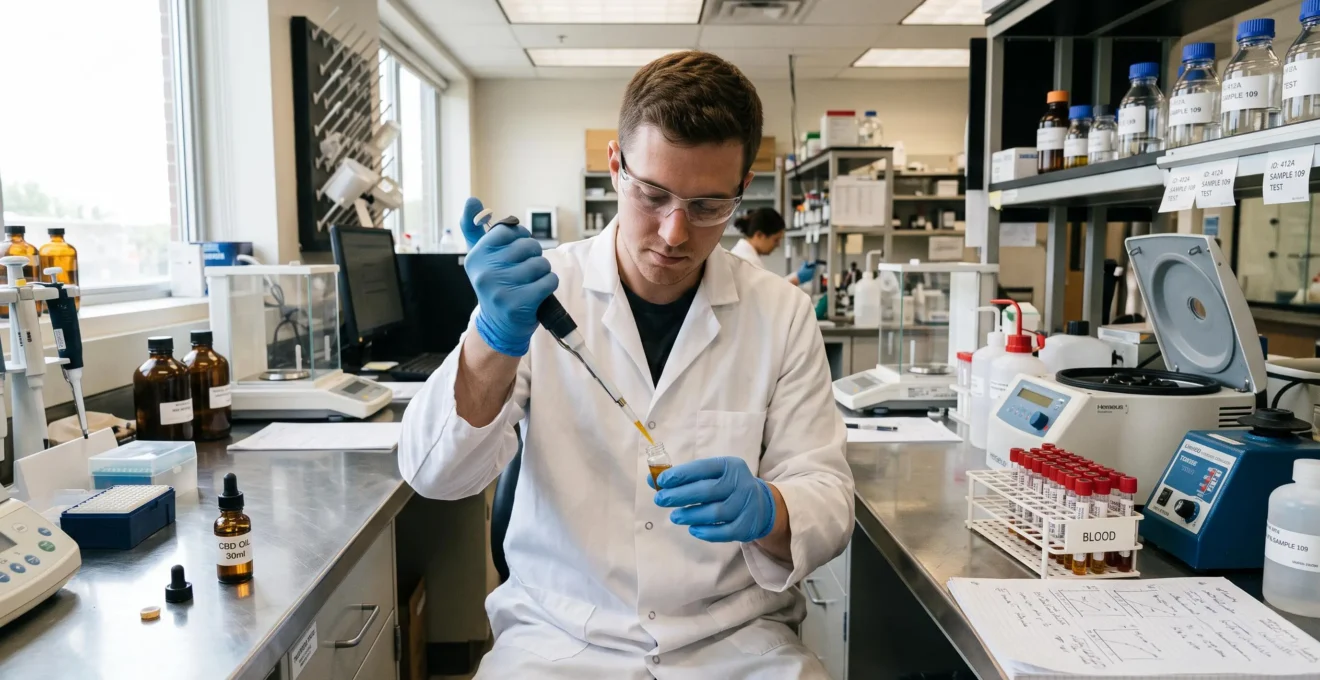
A CBD oil containing 30 mg per serving does not necessarily deliver 30 mg of CBD into the bloodstream. Some of the compound may never be absorbed, while another portion may be metabolised before reaching systemic circulation. The amount ultimately available depends on the formulation, administration route, food intake and individual physiology.
Bioavailability helps researchers investigate these differences. In pharmacokinetics, it describes the extent to which an administered drug reaches systemic circulation unchanged. It is not a measure of how powerful a product feels, how quickly someone notices an effect or whether one delivery format is clinically better than another.
This distinction becomes important when comparing capsules, oils, inhaled products and formulations advertised as having enhanced absorption. A manufacturer may report impressive percentages or relative improvements without explaining the reference product, experimental conditions or endpoint measured.
Understanding what the evidence actually measures makes those claims easier to evaluate without assuming that greater bloodstream exposure automatically means a better personal outcome.
CBD bioavailability: essential distinctions
- Bioavailability concerns unchanged CBD reaching systemic circulation, not the milligrams printed on a label or the intensity of a perceived effect.
- Administration route, formulation, food intake and study conditions can substantially change measured exposure.
- A useful CBD comparison considers exposure timing, consistency, evidence quality and cost rather than ranking products by advertised absorption percentages.
- Why Is the Labelled CBD Amount Not the Same as What Reaches Your System?
- How Can You Evaluate a CBD Bioavailability Claim Without Being Misled by Percentages?
- Oral or Inhaled CBD: How Do Their Delivery Pathways Differ Before Reaching Circulation?
- Why Can Higher Measured Bioavailability Fail to Predict Your Personal Experience?
- When Should Bioavailability Actually Matter in a Practical CBD Product Comparison?
- Why Does the Delivery Route Change the Whole Journey of a CBD Formulation Through the Body?
- How Can You Read Rapid-Onset CBD Research Without Overinterpreting the Timing Claims?
- Which Specialised CBD Delivery Mechanism Fits Different Everyday Use Cases?
Why Is the Labelled CBD Amount Not the Same as What Reaches Your System?
The labelled CBD amount represents the quantity a product claims to contain, not the amount that reaches the bloodstream unchanged. Between administration and systemic circulation, CBD must be released from its formulation, absorbed through biological tissues and, depending on the delivery route, pass through metabolic processes. Each stage can change the resulting exposure.
Three quantities should therefore be distinguished:
- Labelled CBD content: the nominal milligram quantity declared for a serving or product. Whether the actual content matches that declaration is a separate product-quality question.
- CBD released from the formulation: the portion made available for absorption as the product dissolves, disperses or otherwise releases its contents.
- Systemically available CBD: the fraction of the administered dose that reaches systemic circulation as unchanged CBD.
Bioavailability refers specifically to the last quantity relative to the administered dose. Researchers may measure CBD plasma concentrations to investigate exposure, but concentration measurements alone do not establish an absolute bioavailability percentage. That generally requires comparison with intravenous administration, which provides a reference for complete systemic availability.
Swallowed CBD illustrates the distinction particularly well. After release from an oral formulation, the compound encounters gastrointestinal absorption barriers. Absorbed CBD entering the portal circulation can then undergo metabolism in the intestinal wall and liver before reaching systemic circulation. This process, known as first-pass metabolism, contributes to the relatively limited and variable availability of orally administered CBD.
A higher oral dose can increase circulating exposure without producing a proportional increase. Absorption processes, formulation characteristics and metabolic handling may all influence the relationship between dose and exposure.
A systematic review of cannabidiol pharmacokinetics in humans provides the scientific background for these distinctions, including how administration route and absorption processes complicate comparisons between administered quantities and measured concentrations.
For example, two products each labelled as containing 30 mg of CBD may produce different plasma concentration profiles even when the declared doses are accurate. Their carrier ingredients, release behaviour and administration conditions may differ.
Once these quantities are separated, the next question becomes whether a manufacturer’s reported percentage actually describes absolute bioavailability, relative exposure or something else entirely.
How Can You Evaluate a CBD Bioavailability Claim Without Being Misled by Percentages?
A CBD bioavailability claim is meaningful only when it identifies what was measured, how it was measured and what served as the comparison. A statement such as “three times better absorption” may describe higher plasma exposure relative to one reference formulation, not three times more CBD reaching the bloodstream or three times greater effectiveness.
Begin by identifying the pharmacokinetic endpoint. Researchers commonly report maximum plasma concentration (Cmax), area under the concentration-time curve (AUC) and time to maximum concentration (Tmax). These measurements describe different characteristics of exposure.
- Cmax: the highest measured CBD concentration in plasma during the observation period.
- AUC: the integrated measure of concentration over time, used to compare systemic exposure.
- Tmax: the time at which the measured peak concentration occurs.
- Absolute bioavailability: the fraction reaching systemic circulation unchanged, generally established using an intravenous reference and appropriate dose adjustment.
- Relative bioavailability: comparative systemic exposure between specified non-intravenous formulations or administration conditions, usually assessed through dose-normalised AUC.
These measures are not interchangeable. A higher Cmax may reflect a sharper concentration peak rather than a proportional increase in total exposure. A shorter Tmax says something about the timing of the peak, not necessarily the fraction absorbed.
The reference product is equally important. Consider a 2025 randomized crossover study comparing oral CBD formulations. The investigators administered the same nominal 40 mg dose through an enhanced capsule, an enhanced liquid and an unformulated CBD isolate capsule.
What a 2025 formulation comparison actually measured
The study enrolled 12 healthy adult men, of whom nine completed all three treatment periods. Each formulation was administered after a standardised low-fat breakfast.
Mean AUC over 72 hours was 38.0 h·ng/mL for the enhanced capsule, 20.2 h·ng/mL for the enhanced liquid and 11.7 h·ng/mL for the reference capsule. The investigators reported approximately 3.3-fold higher AUC for the enhanced capsule relative to that reference.
These results establish differences in measured exposure under the study conditions. They do not establish an absolute absorption percentage, superior therapeutic effects or the performance of every commercially available enhanced CBD product.
The study also measured CBD and 7-hydroxy-CBD separately. That distinction matters because a rise in metabolite concentration is not the same measurement as an increase in circulating unchanged CBD.
The apparent strength of any percentage also depends on the reference. A substantial improvement relative to a poorly absorbed formulation may still leave the absolute fraction reaching circulation unknown. Furthermore, a comparison conducted under fed conditions cannot automatically be applied to fasting use.
Five checks before accepting a CBD absorption claim
- Identify the endpoint. Record whether the claim concerns CBD AUC, Cmax, Tmax, absolute bioavailability or another measurement. Deliverable: a named pharmacokinetic endpoint.
- Identify the comparator. Locate the reference formulation, dose and administration route. Deliverable: an explicit comparison pair.
- Record the study conditions. Note participant characteristics, fed or fasted status and whether dosing was single or repeated. Deliverable: a brief study-context summary.
- Check the evidence source. Find the published clinical study or research report supporting the advertised claim. Deliverable: a verifiable publication and its relevant results.
- Rewrite the claim precisely. Replace a broad marketing percentage with the measured endpoint and its conditions. Deliverable: a sentence such as “This formulation produced higher CBD AUC than the specified reference under the tested conditions.”
A scientifically defensible claim can still be commercially misleading if its limitations disappear from the headline. The administration pathway itself provides another essential part of the comparison.
Oral or Inhaled CBD: How Do Their Delivery Pathways Differ Before Reaching Circulation?
Swallowed and inhaled CBD follow fundamentally different routes into systemic circulation. Oral CBD must be released from its formulation, absorbed through the gastrointestinal tract and subjected to presystemic metabolism. Inhaled CBD can cross the pulmonary alveolar barrier into the bloodstream, avoiding the initial gastrointestinal and hepatic first-pass pathway. Their exposure patterns therefore differ.
For swallowed CBD, the sequence begins with the formulation. A capsule must release its contents, while oil-based preparations interact with gastrointestinal fluids and digestive processes. CBD that crosses the intestinal barrier may reach the liver through portal circulation before entering the wider bloodstream.
This produces a relatively gradual and variable concentration profile. The exact timing and magnitude depend on the dose, formulation, food intake and individual characteristics.
Inhalation introduces a different sequence. CBD delivered in an inhaled aerosol or vapour may deposit in the respiratory tract. The portion reaching suitable regions of the lungs can cross the alveolar epithelium into pulmonary circulation, then enter systemic circulation through the heart.
As a result, inhalation can produce a more rapid increase in blood concentrations. However, delivered dose is influenced by device performance, inhalation technique and deposition patterns. Rapid pulmonary delivery does not mean that every milligram placed in an inhalation device reaches circulation.
| Criterion | Swallowed oral CBD | Inhaled CBD |
|---|---|---|
| Primary entry pathway | Gastrointestinal tract | Respiratory tract and lungs |
| Initial first-pass metabolism | Relevant to systemic exposure | Initial gastrointestinal and hepatic first pass largely avoided by pulmonary absorption |
| Concentration rise | Generally more gradual | Generally faster |
| Exposure pattern | Potentially more prolonged and variable | Often earlier-peaking, with a different subsequent decline |
| Important uncertainties | Food, formulation and digestive conditions | Delivered dose, device characteristics and inhalation technique |
| Additional consideration | Potential dietary and medication interactions | Respiratory exposure and product-specific inhalation risks |
Neither route can be declared universally superior from these differences alone. Inhalation brings additional respiratory safety considerations, and rapid systemic entry should not be interpreted as a health benefit in itself.
Sublingual and other oromucosal products occupy a less straightforward position. CBD absorbed directly through oral mucosal tissues can avoid initial hepatic first-pass metabolism. Yet some of the administered oil or liquid may be swallowed, making gastrointestinal absorption part of the overall exposure.
Consequently, a product labelled “sublingual” does not automatically deliver its entire CBD content through the oral mucosa.
These pathway differences are best understood as differences in concentration over time, not merely as competing percentages. A faster peak, a larger overall exposure and a longer exposure window are separate characteristics that may or may not occur together.
That profile provides information about circulating CBD, but it still cannot establish what an individual consumer will notice or experience.
Why Can Higher Measured Bioavailability Fail to Predict Your Personal Experience?
Higher measured CBD bioavailability does not reliably predict a stronger or more beneficial personal experience. Bioavailability describes systemic entry, whereas a perceived effect depends on additional pharmacological, physiological and contextual factors. Two people can experience different outcomes after the same dose, even when laboratory measurements indicate similar or increased exposure.
Human pharmacokinetics involves substantial variability. Differences in gastrointestinal conditions, metabolism, food intake and concurrent medication use can alter how much CBD reaches circulation and how long it remains measurable.
Body composition and physiological characteristics may also influence distribution and clearance. These factors mean that the same product can generate different concentration-time profiles between individuals, and that one person’s exposure may vary between occasions.
A systematic review and meta-regression of CBD pharmacokinetics examined 112 trial arms from 39 human studies. The researchers identified CBD dose, administration route and diet as major determinants of pharmacokinetic measurements.
39 studies
The systematic review analysed 112 trial arms covering inhaled, oromucosal, oral and intravenous administration. Its findings describe variability in measured pharmacokinetics, not predictable subjective outcomes for individual consumers.
Moazen-Zadeh and colleagues, Pharmacokinetics of Cannabidiol: A Systematic Review and Meta-Regression Analysis.
Systemic exposure is not the same as pharmacodynamic effect. Once CBD enters circulation, it undergoes distribution, metabolism and elimination. Interpreting any resulting effect requires information beyond how much unchanged CBD appears in plasma.
Metabolites may have pharmacological relevance, but their contributions cannot be inferred from a parent-CBD bioavailability percentage. Similarly, plasma concentration does not automatically establish concentration at a particular tissue or biological target.
Subjective reports introduce further uncertainty. Expectations, timing, setting and the particular outcome someone is trying to assess can influence what they notice. Without an appropriately controlled study using relevant outcome measures, an increase in exposure is not evidence of an increase in perceived benefit.
The reverse inference is equally problematic. Someone who notices an effect soon after using a product cannot conclude that it has unusually high absolute bioavailability. Rapid delivery may produce an earlier concentration peak without demonstrating a larger fraction of the administered dose reaching circulation.
Likewise, a person reporting no noticeable effect cannot establish that absorption failed. Measurable CBD exposure and a clearly identifiable subjective response are different outcomes.
These limitations matter especially when a manufacturer uses testimonials to support a pharmacokinetic claim. Personal experience may describe what someone reported, but it cannot replace controlled measurements of circulating CBD.
For practical purchasing decisions, bioavailability is therefore most useful as one part of a broader comparison rather than a substitute for evidence about safety, suitability or effectiveness.
When Should Bioavailability Actually Matter in a Practical CBD Product Comparison?
CBD bioavailability matters most when comparing delivery formats with meaningfully different exposure profiles, investigating a formulation-specific absorption claim or evaluating the implications of switching products. It matters less when two otherwise similar products have no reliable comparative pharmacokinetic evidence. In either situation, the consumer’s practical requirements should guide which measurements deserve attention.
Three questions help establish whether the comparison is useful: How soon is circulating CBD expected to rise? How consistent does exposure need to be between administrations? And does the evidence justify paying more for a specialised formulation?
For example, a product with a relatively early concentration peak may be relevant when the timing of exposure is important. However, an earlier blood concentration does not prove an earlier subjective effect. A conventional oral formulation may fit a repeatable routine without requiring advanced delivery technology.
For two oils with similar formulation characteristics, an unsupported percentage difference may contribute little to the decision. Label accuracy, independent quality testing, ingredient transparency, product safety and price may be more informative.
Cost per labelled milligram is straightforward to describe but incomplete. Dividing a product’s price by its declared CBD content compares nominal CBD quantities, not systemic delivery.
Cost per systemically available milligram would require a defensible estimate of absolute bioavailability under relevant conditions. Such estimates are often unavailable for individual consumer products.
A hypothetical calculation illustrates the principle without attributing absorption rates to any commercial formulation.
Hypothetical comparison: nominal dose versus systemic delivery
Suppose Product A contains a 20 mg CBD serving and costs £2 per serving. For illustration only, assume its absolute bioavailability is 10%. The estimated unchanged quantity reaching systemic circulation would be 2 mg, producing a hypothetical cost of £1 per systemically available milligram.
Suppose Product B also contains 20 mg per serving but costs £3, with an assumed absolute bioavailability of 20%. Its hypothetical systemic quantity would be 4 mg, giving a corresponding cost of £0.75 per milligram.
These percentages are invented teaching assumptions, not values established for CBD oils or other commercial formats. The exercise demonstrates the calculation, not the accuracy of applying it to actual products.
In real comparisons, research may report relative AUC rather than absolute bioavailability. AUC cannot simply be converted into absorbed milligrams without additional pharmacokinetic information. Cross-study comparisons introduce further problems when doses, populations or administration conditions differ.
Published findings can help establish plausible differences and uncertainty, but unsupported manufacturer percentages should not be inserted into calculations as verified absorption rates.
The following decision grid places the pharmacokinetic question alongside practical constraints.
| Comparison situation | Most useful evidence | Practical interpretation |
|---|---|---|
| Comparing rapid and gradual delivery | Tmax, Cmax and concentration-time profiles | Compare exposure timing, not guaranteed onset of effects |
| Prioritising repeatability | Between-person and within-person variability under comparable conditions | Consider consistency rather than the highest reported peak |
| Evaluating a premium formulation | Controlled, dose-adjusted comparative AUC and study limitations | Check whether the exposure difference supports the additional cost |
| Switching between CBD products | Formulation-specific comparative data where available | Do not assume equal labelled doses mean equal exposure |
| Comparing similar products without clinical data | Quality documentation, verified content and transparent specifications | Avoid inventing a bioavailability ranking |
People taking prescribed CBD medicines or medicines that may interact with CBD should not use consumer bioavailability calculations to change doses independently. Changes in systemic exposure can have clinically relevant implications and warrant professional guidance.
When evidence is insufficient, the defensible result may be that no reliable systemic-delivery cost comparison is possible. Acknowledging that limit is preferable to calculating a precise-looking answer from unverified assumptions.
To understand why even equal systemic exposure may not produce equivalent delivery profiles, it helps to consider what happens after CBD enters circulation.
Why Does the Delivery Route Change the Whole Journey of a CBD Formulation Through the Body?
CBD delivery route influences more than the proportion reaching circulation. It changes the sequence and timing of absorption, the initial metabolic pathways, the resulting balance of CBD and metabolites, and potentially the concentration profile during distribution and elimination. Two formulations can therefore produce comparable overall exposure while following different pharmacokinetic trajectories.
Pharmacokinetics is commonly described through four connected processes: absorption, distribution, metabolism and excretion. Bioavailability addresses systemic entry, but it does not describe all four processes.
After CBD reaches circulation, its distribution is affected by its physicochemical properties and interactions with biological tissues. Metabolic transformation generates compounds that may have their own pharmacological characteristics. Elimination then reduces concentrations over time.
The route of administration can change the early balance between unchanged CBD and metabolites because initial access to metabolic organs differs. Swallowed CBD may encounter intestinal and hepatic metabolism before reaching systemic circulation, while pulmonary absorption initially follows another path.
Equivalent AUC does not require identical concentration-time curves. Two products could theoretically produce similar integrated exposure while differing in peak concentration, time to peak and how concentrations decline.
Formulation science introduces another variable independent of route.
Carrier oils can influence how a lipophilic compound such as CBD disperses in the gastrointestinal environment. Emulsions and nanoemulsions may alter dispersion and release behaviour. Encapsulation can change the conditions under which CBD becomes available for absorption.
Lipid-based strategies may also influence intestinal processing and lymphatic transport, although the contribution of these mechanisms must be demonstrated for the specific formulation. An ingredient or technology name alone cannot establish its physiological performance.
Marketing expressions such as “water-soluble CBD” should be read carefully. Some products use systems that disperse CBD-containing droplets or particles in water. That does not necessarily mean the CBD molecule itself has become intrinsically water-soluble.
More effective dispersion may improve certain measurements under particular conditions. Whether this leads to higher systemic availability, lower variability or a clinically meaningful difference requires appropriate human data.
The 2024 systematic review and meta-regression identified associations between nanotechnology-based formulations and faster absorption profiles. However, differences among the included studies prevent that finding from establishing a universal advantage for commercial nanoformulations.
The practical translation is straightforward: the route and formulation may affect how quickly concentrations rise, how long exposure persists and how reproducibly a particular concentration profile can be obtained.
None of these characteristics should be treated as interchangeable with a measured health outcome. They are useful intermediate measurements, not conclusions about individual benefit.
Once these distinctions are recognised, claims about products acting “within minutes” can be examined with the same care as claims about higher bioavailability.
How Can You Read Rapid-Onset CBD Research Without Overinterpreting the Timing Claims?
Rapid-onset CBD research must be interpreted according to the outcome used to define onset. The first detectable CBD concentration in blood, the time to maximum plasma concentration and the first perceived effect are three different events. Evidence for an earlier concentration peak cannot, by itself, establish that a consumer will feel an effect sooner.
The distinction begins with measurement.
- First detectable concentration: the earliest sampled time at which CBD exceeds the analytical method’s detection or quantification threshold.
- Tmax: the time at which the highest measured concentration occurs during the sampling period.
- Perceived-effect onset: the point when a person first notices a defined outcome, requiring appropriate subjective or functional assessment.
These endpoints answer separate questions. A study can measure an earlier Tmax without evaluating subjective effects at all. Similarly, the first positive blood sample depends partly on how frequently samples were collected and the analytical sensitivity of the measurement method.
Consider the 2025 crossover comparison of three oral CBD formulations discussed earlier. Median Tmax was approximately one hour for the enhanced liquid, two hours for the enhanced capsule and six hours for the reference capsule.
Those observations suggest different absorption-rate profiles under the tested conditions. They do not establish that participants experienced a noticeable effect at one, two or six hours.
Study context also limits generalisation. The trial involved a single 40 mg dose, a standardised low-fat breakfast and a small group of healthy male participants. Only nine completed the three treatment periods, and the study was not prospectively registered.
Such details do not make the pharmacokinetic measurements meaningless. They define what those measurements can support.
For example, it would be reasonable to state that a particular formulation reached its observed median peak concentration earlier than the reference formulation during the experiment. It would not be reasonable to promise the same peak time to every consumer using a product with a similar label.
Small trials may be particularly vulnerable to limited population representativeness. Sampling schedules, individual variability and the tested dose further influence how a reported timing estimate should be understood.
Three questions are especially useful when examining a rapid-onset claim:
- Does the timing refer to measured blood concentrations, a pharmacokinetic peak or an independently assessed subjective outcome?
- Was the exact marketed formulation tested, or was the evidence generated using another research preparation?
- Does the publication report participant variability and sufficiently describe its dosing and sampling conditions?
A statement such as “CBD detectable in blood after administration” describes analytical detection. A statement such as “peak CBD concentration occurred earlier” describes pharmacokinetics. Neither should be rewritten as proof that a product begins producing a noticeable benefit at that time.
For consumers, the most relevant evidence would connect a clearly defined outcome with the formulation and administration conditions being considered. Without such evidence, timing claims should remain descriptions of exposure.
These principles make it possible to assess specialised delivery systems according to practical requirements rather than treating the shortest advertised onset time as inherently preferable.
Key takeaways before choosing a delivery mechanism
- Match the desired exposure pattern to the delivery route, without assuming that faster circulating CBD produces faster or better subjective outcomes.
- Give greater weight to controlled, formulation-specific human evidence than to technological labels such as “nano” or “rapid absorption.”
- Evaluate the complete trade-off: evidence quality, variability, safety considerations, administration habits and total cost.
Which Specialised CBD Delivery Mechanism Fits Different Everyday Use Cases?
The most suitable CBD delivery mechanism depends on the intended administration routine, the desired pharmacokinetic profile, tolerability, safety considerations and the quality of available evidence. A formulation offering higher measured exposure is not automatically the most appropriate choice. Delivery efficiency is only useful when it addresses a relevant need without introducing unjustified complexity or risk.
Consider an everyday situation in which the timing of systemic exposure is a priority. An administration method associated with earlier increases in plasma concentration may appear attractive. However, the evidence should specify the relevant endpoint and should not be interpreted as proof of immediate symptom relief.
Inhaled delivery can produce more rapid systemic entry than swallowed administration, but respiratory exposure and device-related uncertainties are significant trade-offs. A rapid pharmacokinetic profile does not remove the need to evaluate inhalation safety.
For a routine in which convenience and repeatable administration matter more than an early peak, a conventional oral product may be easier to integrate into a consistent schedule. Its exposure can still vary with food intake and other factors, however, so repeatable administration does not guarantee identical blood concentrations.
Oromucosal preparations may offer a different administration experience, but their systemic performance should not be assumed to be superior merely because they are placed under the tongue.
Specialised oral technologies, including nanoemulsions and encapsulated formulations, may change absorption characteristics. Their advantages need to be supported by relevant comparative studies rather than inferred from the sophistication of the delivery mechanism.
| Practical priority | Potentially relevant mechanism | Important qualification |
|---|---|---|
| Earlier rise in circulating CBD | Routes or formulations with demonstrated earlier plasma concentration profiles | Earlier blood exposure does not prove earlier perceived benefit |
| Simple, repeatable administration | Conventional oral oils or capsules | Food intake and individual physiology can still change exposure |
| Alternative administration without inhalation | Oromucosal products | The swallowed fraction can contribute to gastrointestinal absorption |
| Improved exposure from an oral formulation | Specific enhanced-delivery preparations | Require controlled evidence against a clearly described reference |
| Lower purchasing cost | Products with transparent content and pricing | Lower price per labelled milligram is not necessarily lower cost per absorbed milligram |
The strength of the evidence also matters. Advanced formulations may require more complicated manufacturing processes and carry a price premium, while independent human comparisons may remain limited.
Conversely, conventional oils are not automatically inferior. A head-to-head study demonstrating improved exposure for one specialised preparation cannot establish a universal hierarchy across all oils, capsules and delivery systems.
Safety and suitability remain separate considerations. CBD can cause adverse effects and interact with medications. Greater systemic exposure may increase interaction or adverse-effect concerns rather than simply increasing potential benefits. Consumers using prescription medicines, particularly prescribed CBD formulations, should discuss product or dose changes with an appropriate healthcare professional.
When comparing any new CBD product, a practical evaluation can follow four connected questions.
- What administration route does the product use, and what pathways does that imply?
- What does the strongest formulation-specific evidence establish about CBD concentrations over time?
- How relevant are the study conditions to the intended pattern of use, including food intake and dosing frequency?
- Do the potential advantages justify the product’s price, administration requirements, uncertainty and safety considerations?
These questions allow a cautious decision even when absolute bioavailability percentages are unavailable. They also expose claims that depend on impressive relative multipliers without explaining the practical importance of the measured difference.
For the next product under consideration, start with the route, the declared CBD content and the evidence supplied for its formulation. Check what was measured, identify the reference and note the limits before comparing costs. A defensible choice depends on understanding what the data establish, not selecting whichever product advertises the highest absorption figure.
Does a CBD blood concentration test reveal exactly how many milligrams were absorbed?
No. A blood sample measures CBD concentration at a particular moment. Multiple measurements can describe exposure over time, but converting those results into the absolute fraction of a dose reaching systemic circulation requires appropriate pharmacokinetic methods, generally including an intravenous reference. Plasma concentration is not itself a direct measurement of the total number of milligrams absorbed.
Can taking CBD with food change its measured bioavailability?
Yes. Food can substantially change exposure after oral CBD administration. In a randomized phase 1 study involving a specific pharmaceutical oral CBD solution, investigators found higher systemic exposure under several tested ingestion conditions than under fasting conditions, with the largest food-related effects observed after a high-fat, high-calorie meal. These results should not be assumed to apply identically to every consumer formulation or dose.
Does a certificate of analysis prove that a CBD product has high bioavailability?
No. A certificate of analysis may provide laboratory information about CBD content and tested contaminants, depending on its scope. It does not ordinarily demonstrate the fraction of administered CBD that reaches systemic circulation in humans. Establishing bioavailability requires appropriate pharmacokinetic evidence, not simply a chemical analysis of the product.
Are results from healthy volunteers applicable to people taking medication?
Not necessarily. Pharmacokinetic findings from healthy volunteers may not reflect the exposure or safety profile of people taking interacting medications or living with particular medical conditions. CBD can affect drug-metabolising pathways, and its own exposure can be influenced by other medicines. Clinical guidance is appropriate before changing CBD products or dosing in these circumstances.
Can two CBD formulations have similar overall exposure but different peak concentrations?
Yes. Two concentration-time curves can produce similar AUC values while differing in Cmax, Tmax and the distribution of exposure over time. Comparable integrated exposure therefore does not mean identical delivery behaviour, nor does it establish equivalent subjective or clinical effects.